-
-
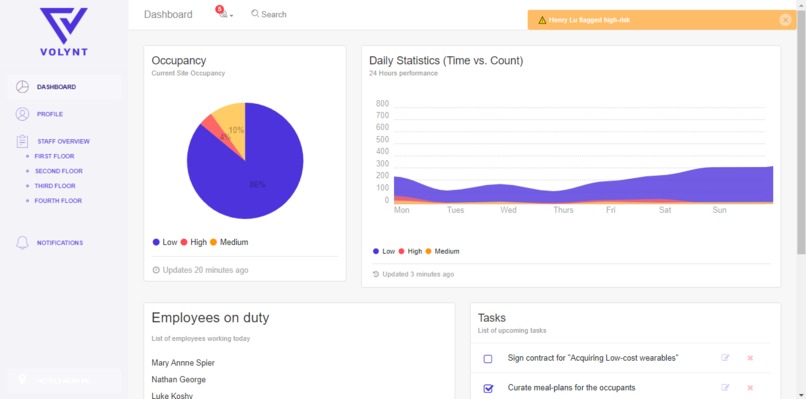
Dashboard
-
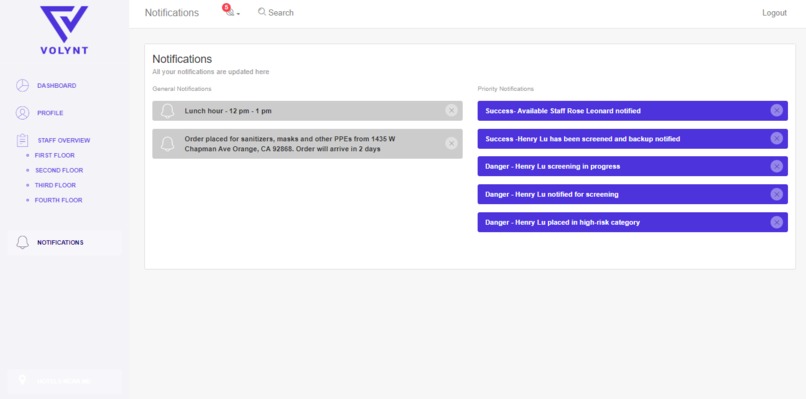
Notifications
-
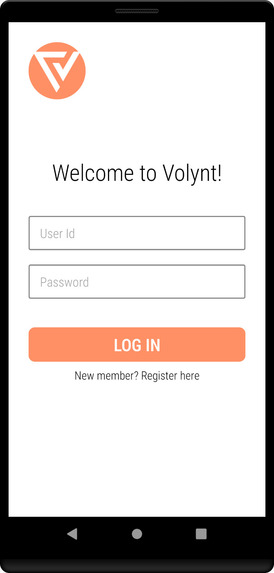
Staff login
-
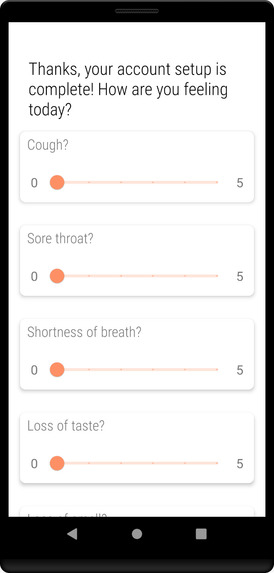
Daily checkup
-
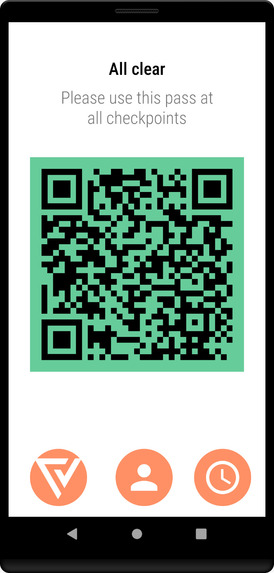
Thermal scanner link
-
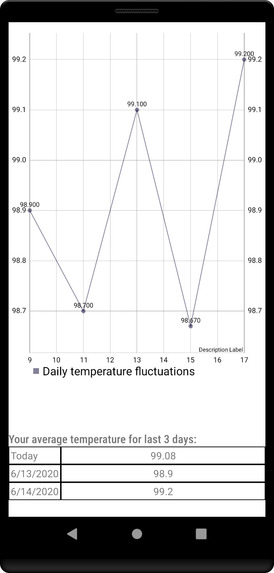
Statistics


Inspiration
Our team started Volynt because the new health authority and government guidelines requiring temperature screening puts travel companies between a rock and a hard place while they're desperately regain trust while the world reopens from quarantine. Companies are overwhelmed with extra logistics for temperature guns and staff doing the testing, which isn't accurate or cost-effective; guests aren't happy because screening it puts them in a tense interpersonal situation, and it's simply a job no one on staff really wants to do because it increases their risk of catching COVID.
All sides are struggling and no one is happy. We thought there had to be a better way to rebuild confidence in travel companies and assure both staff and travelers that companies were minimizing their health risk.
What it does
For travel companies who want to protect the health of staff and their guests and are desperately trying to find a way to provide peace of mind and stay compliant with new screening regulations, Volynt gives an automated way to screen large number of guests in real time, in addition to monitoring staff health in real time. As opposed to the error-ridden current processes requiring a human doing the testing (temp gun pointed at forehead) Volynt looks at it differently. We provide a staff-less, contact-less, and comfortable temperature screening and ongoing monitoring so companies easily stay compliant with screening procedures with the following components:
- Enterprise thermal kiosks. Collect health data from contact-less thermal camera selfie stations to automate visitor screening and reduce time needed for mandatory staff screening upon arrival at work.Temperature reads are linked via QR code recognition to reduce screening time by up to 50%.
- Continuously monitored accurate temperature. We're using clinically proven, EMA approved biosensors which are Fitbit like wearables that come in the from of a single Airpod-like lightweight earpiece, or a thin silver dollar shaped disc that can be worn on a chest strap or clipped into a bra. These wearables are synced to mobile devices.
- The Volynt mobile app makes if simple for healthcare staff to do their daily symptom check, and is configured to make vibration alerts if the wearable senses a high temperature.
- Alerts get pushed a a desktop application that allows managers to effectively track team health and proactively manage staff risk with an all-in one web dashboard.
The design of our system allows each of the components (selfie thermal, wearable, mobile app, or desktop app) to be either down-scaled or up-scaled according to a hospitality company's unique needs, allowing Volynt to rapidly scale in a variety of contexts.
How we built it
- We used HTML 5, CSS, Javascript and PHP to come up with a web app.
- We used Java to develop the Android App.
- Machine Learning algorithms were used to let the thermal kiosk measure by measuring an accurate body temperature i.e. focussing on the corner of the eye to get a more accurate body temperature.
- We used the knowledge of IoT to link data from thermal Kiosk, wearables, mobile and desktop app.
Challenges we ran into
- Knowing the exact pain points of the customers before framing the solution by conducting various customer interviews.
- Integrating all the hardware and software of the whole framework.
Accomplishments that we are proud of
The team pulled together and made a product out of scratch in less than a week!
What we learned
We were surprised to see the complete lack of solutions for travel organizations to protect staff worker health to reopen their businesses in the new normal. Part of this involved the challenge in architecting a solution that trekked across wearables, mobile phones, tablets, and desktop environments. Many out of the box platforms low code platforms did not have IOT integrations so we developed the mobile solution natively. We had to collaborate closely in order to ensure that the solution made sense.
What's next for Volynt
Launching. We're planning to complete 5 prototypes of our kiosks in the next three weeks and send them out on the field to test. Our software development for the contact-less, staff-less thermal kiosks will be completed by then. The beach head market for this is hospitality, and we see this extending across airlines, cruise lines, public transportation, and retail.
How you can help:
- Partnerships We're looking for travel companies who want to partner in pilots to refine the value and processes of our system. If you're a hotel, airline, or public transport system, we'd love to talk to you!
- Advisors If you're also involved with large travel companies you'd can offer advice with on improving our solution, our team would be excited to hear from you. Also, the supply chain and logistics in order to simplify temperature screenings everywhere is no small endeavor. If you have experience with internet of things (IOT) devices manufacturing/assembly, our team would benefit from you advice on scaling this operation.
- Funding We are raising $2M USD in order to complete the AI engineering and the purchase/shipping of the device and wearables. We see the demand for this product as applicable across virtually any industry with staff that are at moderate to high exposure to populations of people, and we want to empower companies to define their new normal in a way that protects their teams. Additional vertical where we see we can make a difference are essential workers, warehouses, construction, and schools.


Log in or sign up for Devpost to join the conversation.