-

UI Frontpage.
-
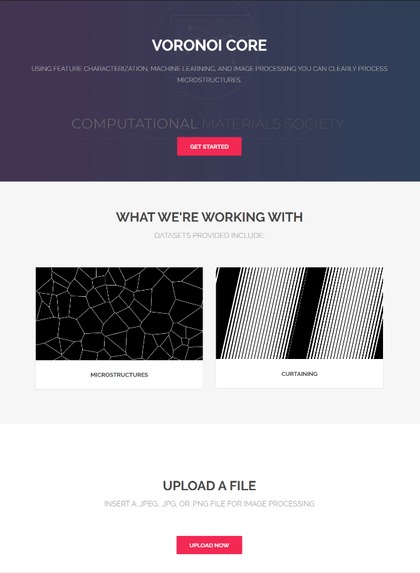
UI for loading images.
-
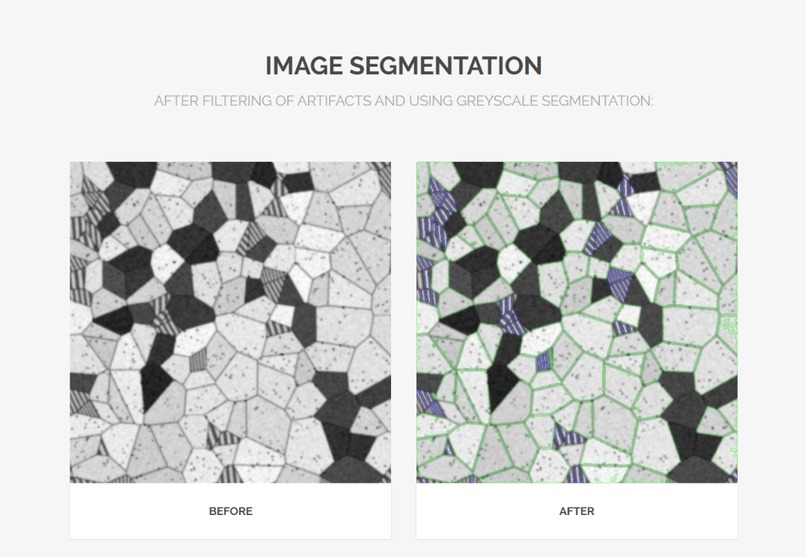
Before and after images of semantic segmentation of steel microstructures.
-

Meet the team!
-

Full single page webapp demo.


Inspiration
As a full stack team of materials science and engineering students, we have had much experience in using various image analysis software to tackle metallurgical characterization tasks in our research. A common general purpose scientific image analysis suite such as imageJ, or FIJI has much to be desired in the realm of accurate semantic segmentation of real life steel microstructures. In upcoming research into manufacturing, heat treating and galvanizing 3rd generation Ultra High Strength Steels, an accurate and bespoke metallurgical image analysis tool is essential to success.
What it does
The web application utilizes classical singularity detection techniques along with a uniquely trained deep learning network to identify and remove image artifacts from polishing particulates, etching deformation and curtaining from focussed ion beam microscopic milling.
How I built it
The backend is built in Python, using the image processing library OpenCV and the deep learning library and framework Tensorflow and Keras. The frontend is built in HTML with formatting and logic in CSS and Javascript.
Challenges I ran into
A great deal of time went into the accurate semantic segmentation of the pearlite structures within the steel microstructure. They proved difficult to segment due to their relative size to the surrounding light and dark phases of the steel. The team made a strong effort to prioritize not only identifying where the pearlites were in the image, but also their orientations. With materials science research in mind, it is important to be able to identify grain preferential orientations as it affects the material properties in the macroscale due to its anisotropy.
What I learned
The team was able to apply our knowledge of metallurgical sciences from the start of the challenge in deciding what milestones to set for the grain structure analysis. In doing so, we were able to produce a product that best met the end users metallurgical image analysis needs.
What's next for Voronoi Core
Voronoi Core is the executive team of a newly formed club within the McMaster Materials Science & Engineering (MSE) department called the Computational Materials Society (CMS). We are currently working with researchers and graduate students to improve our image analysis software, and eventually host it on the McMaster MSE linux development server for researchers across our cluster to freely use in their work.
Follow us to hear more about our future work: link

Log in or sign up for Devpost to join the conversation.