-
-
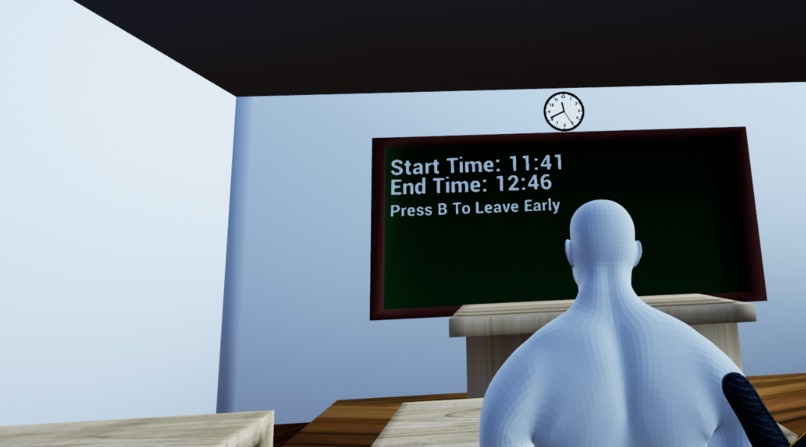
Front of the classroom. The chalkboard has start and end times listed.
-
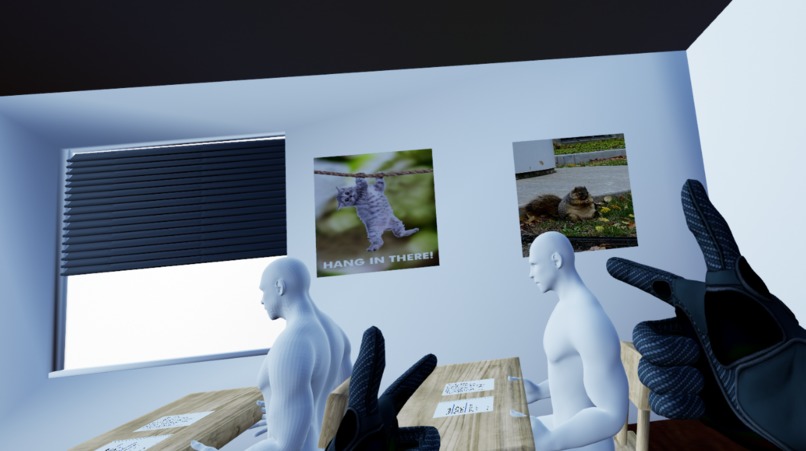
Player doing finger gun at other classmates
-
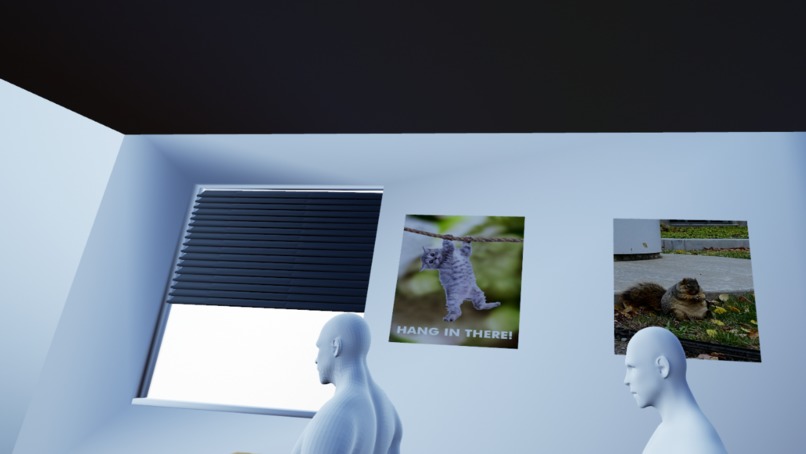
Posters are decorated around the classroom
-
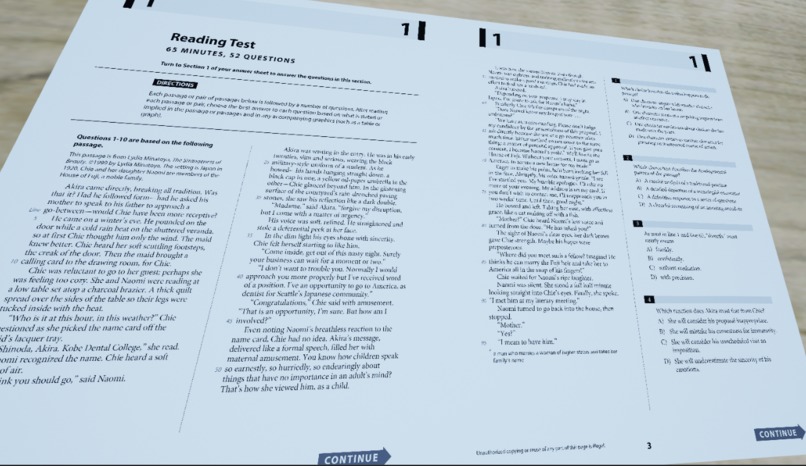
Player's perspective of SAT test packet
-
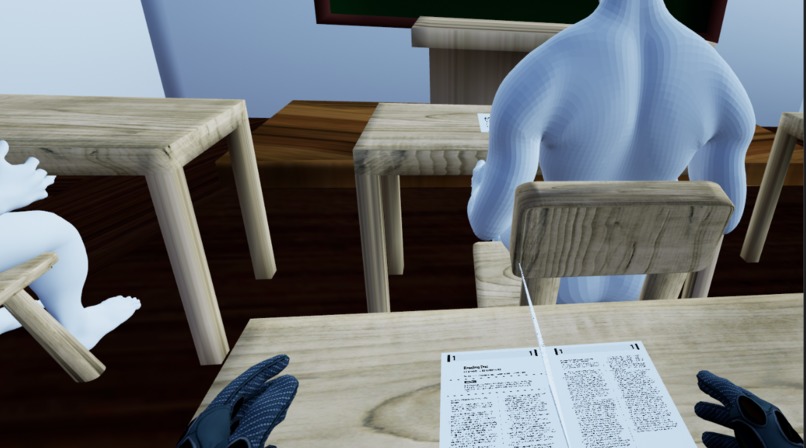
User can flip pages of the packet.
-
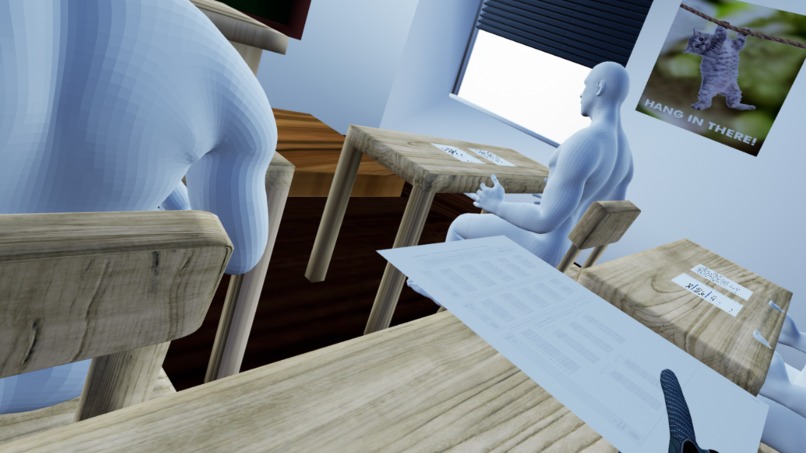
User interacting with the answer sheet.


Inspiration
Ever since the 1950's scientists have recognized the importance of environmental context when studying. There have been countless experiments conducted that show there exists performance improvements when the student has been practicing their test in an environment very similar to their testing room. According to a 1999 study conducted by Russo, Ward, Geurts, and Anouk Scheres, the study was able to recognize a statistically significant difference between a student's test performance when presented with unfamiliar and familiar stimuli. A student's memory recall was noticeably affected based on stimuli in the environment. More recently, another study conducted in November 2020 by Wuthisatian noticed a significant increase in student exam performance based on different proctoring techniques in the testing environment.
It's evident there are a host of different factors that may affect a student's performance within a test environment. To better prepare a student, we have developed a proof of concept VR application that can help them feel truly immersed into a realistic representation of their testing environment.
What it does
Upon starting the program, the user is presented with a menu that displays an image of the SAT along with two button options below asking the user to “Start” and “Quit”. Upon starting, the user is transported into a familiar and classical representation of a classroom for any player. The setting has been carefully created to represent a realistic environment consisting of several birch desks arranged in rows and columns. There are SAT question and answer packets on the user’s desk. In front of the user there lies a teaching desk, blackboard, and analog clock above that is a familiar and classical representation of a classroom for the player. Written on the chalkboard is the start and end time (that is synced with the user’s local time). Around the user are other simulated students who appear to also be taking the test. These people occasionally cough and scribble loudly to better represent a realistic testing environment.
How we built it
We used GitHub, Unreal Engine, and Blender. A GitHub repository was used as a form of version control for the .fbx files environment files used by Unreal Engine. The entire Unreal Engine project is currently stored in the GitHub repository link listed below. The repository also stores important assets such as Blender mesh files that were used when implementing VSAT as well as recorded audio and imagery for the classroom.
Challenges we ran into
Our team encountered some roadblocks throughout the process of constructing VSAT. Unfamiliarity with Blender and Unreal Engine led to a lot of research on online instructional content for guidance on the project. Thus, two separate machines were used, one team member constructed the classroom environment as well as the menu screen while the other constructed the physics to come with the question booklet as well as the ability to draw on the answer booklet.
The physics underlying the mechanics of our project center around the rotation and movement of vectors. Our team treated the various components involved in the Unreal Engine simulation as general, cohesive blocks, rather than subdividing VR actors. While this limited the control users had over the virtual environment, we found that the reduction in processing power and increase in simulation speed made this design choice an overall benefit to our project’s intent.
Accomplishments that we're proud of
This project involved a rapidly growing, relatively unexplored technology that is still filled to the brim with possibility. Most team members had minimal experience working in Unreal Engine, and simulation design as a whole. MHacks, so this event really pushed our team to explore the possibilities available with VR technology. Unfortunately, since VR technology has yet to go mainstream and with our limited resources in mind, there were some features that our team had to work on from scratch. Highlights include a drawing system, built from the ground-up using principles of Line Trace Extrapolation, the question booklet, representative of a real SAT test offered to students as practice, and the functional classroom environment which exposes users to stimuli they would face during their true exams.
What we learned
VSAT provided all team members the opportunity to explore and push the boundaries of our existing knowledge of Unreal Engine when working in a VR environment. For instance, our team learned how to create an analog clock in the virtual environment that would sync with the user's local time (by pulling from internal resources). Additionally, our team learned how to animate and move a human rig in Blender and imported those assets into Unreal Engine to make the testing experience as immersive and realistic as possible. We also explored mechanisms to overcome inherent challenges in our software and hardware systems, making great use of optimized logic circuits and streamlined rendering capabilities. Overall, our team gained invaluable skills in both technical and organizational fields, and we will be using concepts we learned over this past weekend for years to come.
What's next for VSAT
Although we have made immense progress given the limited timeframe of MHacks, there remain several tasks to complete in the future before VSAT can be considered for rigorous testing among a wide audience. Namely, an enhanced start splash screen, better audio settings/configurations, and a streamlined introduction sequence to incorporate all relevant aspects of a real testing environment.
In the near future, our team plans on creating an enhanced version of the splash screen (fit with more audio settings and other capabilities) and a skippable introduction scene where the user walks into the classroom, sits down to other people, hears the proctor give the SAT instructions, and writes out the start and end time on the chalkboard. All these features can drastically enhance the user experience and reflect a better representation of the testing environment, and it is clear that we can take VSAT far beyond the prototype that it is today.
As there are not any VR applications catered to simulating a realistic testing environment, this application could be offered to a wide-open audience eager for an opportunity to reduce stress and increase testing performance. Virtual Reality as a technology remains underexplored, a truly massive waste of potential given its ability to bring about true digital immersion. The VSAT team believes in the coming years that VR will be used to improve every facet of our lives, and we are honored to be a part of that wave of innovation. We hope to keep developing and improving tools like VSAT, so that together, we may all dream of wonders brought to life with VR.


Log in or sign up for Devpost to join the conversation.