-
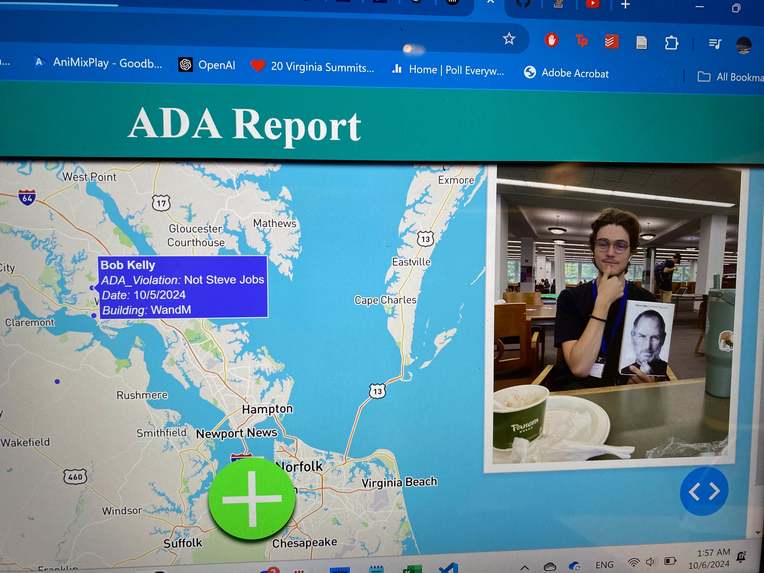
This is the first successful rendering of the map on our website! the green button allows you to add an ADA violation.
-
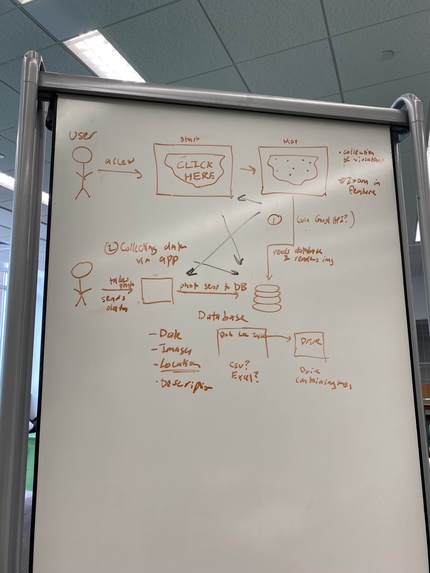
This was our early brainstorming of the workflow for this software.


The American Disabilities Act was a milestone achievement in America. It was the fruition of decades of activism done by people with a vision of America. One that was more accessible and equal, one where it doesn’t matter who you were born as you can participate in its economy and witness its beauty. Despite the ADA making massive strides in improving the ADA. America is still a country that is inaccessible to many. We are unaware of the full extent to which the ADA is currently unenforced in the country as the reporting process is long, arduous, and difficult to present. This easily leaves the disabled abandoned and the non-disabled oblivious.
Our application seeks to help fill that void by providing an easy-to-access website to see which buildings remain accessible to them and those that do not. The website showcases a detailed and live map of the United States, seen from the state borders down to the local streets of our homes. From there, we can view suspected ADA violations from a pop-up screen attached to a precise location explaining the violation with media. The people contributing to the website will be ordinary citizens using an app they can access on their phone or the website itself. The information is ultimately envisioned to be transmitted to a database, verified/vetted, and then rendered to the website's map in real-time.
This software was built in 3 parts - first using android studio and google API to develop a user friendly app, mainly featuring a camera, that would upload its media to a shared drive (prototype database) - second using Python, dash, and mapbox to create a server for hosting a highly detailed map of all the logged suspected ADA violations, updated in real time, reading media and image locations (these are stripped from .jpg images themselves) from the shared drive (would be the verified portion of database pushing updates to the web) - third using html and css, a website as an easier viewer for the map and an alternative form of data entry for the client.
We had a lot of accomplishments during the weekend as none of us had any experience with these tools and integrations before beginning this project but were still able to create a product! The most challenging aspects of this project were the Google API integrations require for hosting a pseudo database on a shared google drive. Everything for this integration for the mobile app uploads to the database storage was created but could not be debugged in time for successful deployment unfortunately (about 5 hours of trying). Nobody on our team had any prior experience using the Google API so this task was hard but we are very happy we at least tried and learned something new! Instead, a local server can be used to see the functionality of our idea.
We believe that our service has the potential to significantly improve the daily lives of those who face accessibility challenges. We are excited to see if this software can be continued after this hackathon, as W&M has many ADA disputes and a historically difficult campus landscape to navigate if you are disabled. If students can easily know in advance where they will not be accommodated, they can plan ahead or request help to prevent unnecessary hardships. It also serves as a rallying call for local communities to advocate for change, making our country a place where everyone can thrive!


Log in or sign up for Devpost to join the conversation.