-
-
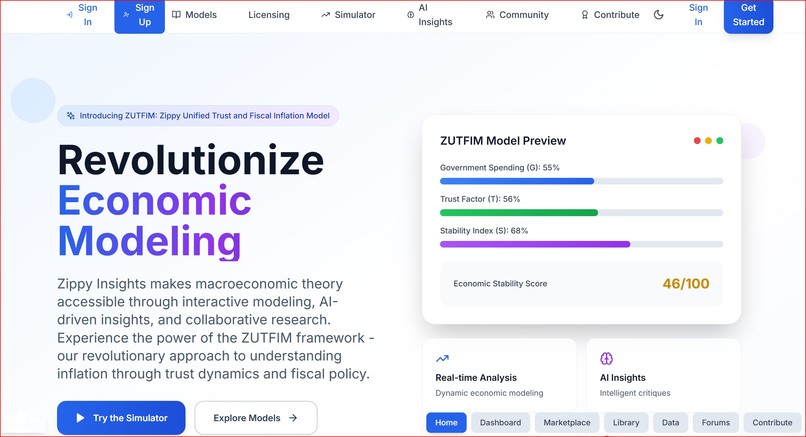
Light Dark - It all matters - even nerds with calculators - Proof of Concept that bolt.new can help research and academia publish fast
-
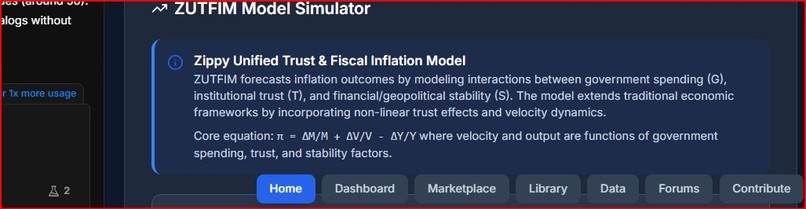
The models are interactive online
-
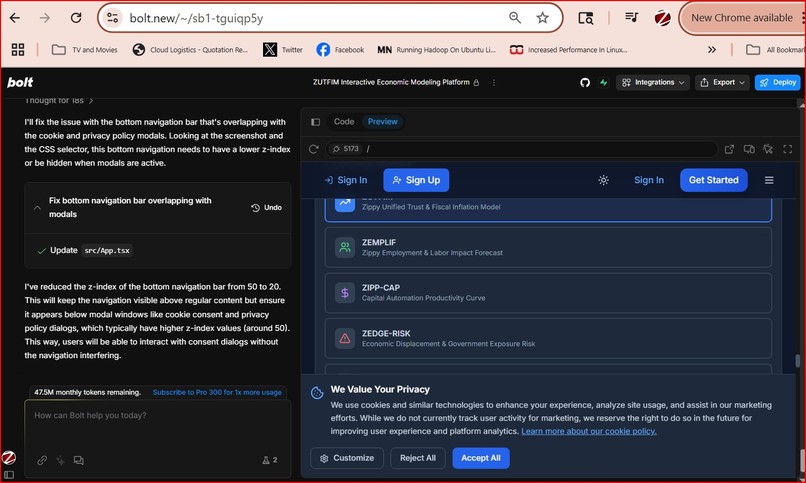
Breaks down sources and results so everyone can understand complex topics
-
Many reasons WHY we made these models - shocks to economies - AI robotics is the next one
-
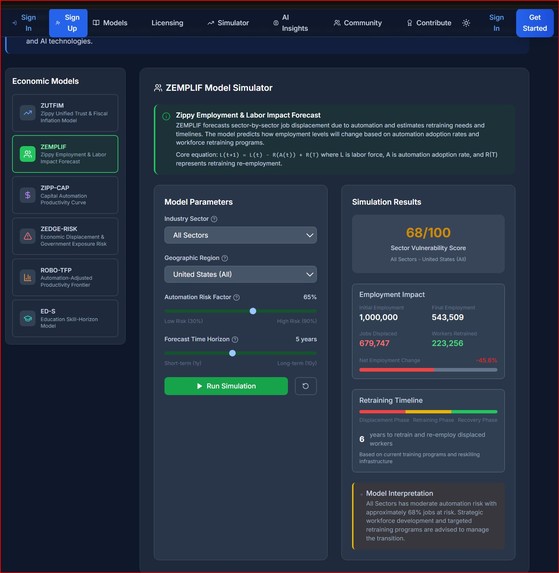
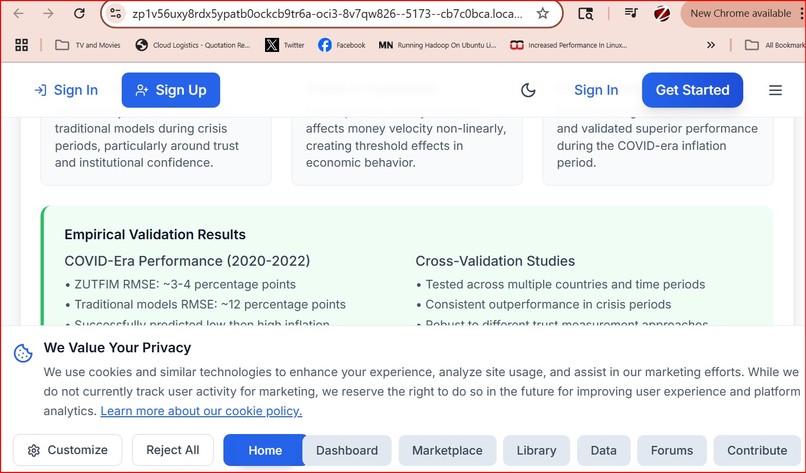
Results backed by data from around the world
-

compliance with regs for cookies and privacy tos etc is important


Over one intense hackathon sprint we turned go.zippyinsights.com from a macro-economics proof-of-concept into a full AI-powered policy sandbox. Built on our ZUTFIM engine, the platform now lets analysts type “halve payroll tax in Q4” or “add 15 % more industrial robots in the Midwest” and instantly watch projected GDP, trust, and labor-market churn update in real time. What started as a quest to explain post-pandemic inflation grew into a tool that also forecasts how automation could displace— or upskill—workers, giving governments, businesses, and labor groups a shared evidence base for responsible AI adoption.
🪄 What Inspired Us
- Macroeconomic fog. The World Economic Forum’s Future of Jobs 2023 warned that 69 million new roles will appear, yet 83 million could vanish by 2027—a net loss of 14 million jobs. (weforum.org)
- Automation anxiety. OECD research shows 14 % of roles are “high-risk” for automation and another 32 % will change radically. (oecd.org)
- Equity stakes. Brookings finds Black and Latino workers are over-represented in routine jobs most exposed to automation, amplifying inequality concerns. (brookings.edu)
- Robot reality. Global factory robot density hit a record 162 per 10 000 workers in 2023—double the 2016 level. (ifr.org)
- Trust as economic fuel. Edelman’s 2024 Trust Barometer shows falling confidence in institutions, a variable traditional Phillips-curve models ignore. (edelman.com)
- Regulatory urgency. The new EU AI Act classifies hiring, promotion, and monitoring tools as “high-risk,” demanding transparency by 2026. (eur-lex.europa.eu)
- Generative-AI shockwaves. McKinsey estimates that up to 30 % of U.S. work hours could be automated by 2030, forcing 12 million occupational shifts. (mckinsey.com)
🛠️ How We Built It
| Layer | Stack | Why |
|---|---|---|
| Data ingest | PHP 8.3 cron workers → Supabase | Daily “diff” jobs cut ingest latency from hours to minutes while keeping infra simple. |
| Core engine | ZUTFIM (TypeScript) | Extends standard DSGE loops with a trust variable fed by Edelman, plus fiscal-policy DSL. |
| Workforce suite | ARI, RASM, GENEX, EIL, Regulatory Radar, RPP | Combines OECD task risk, IFR robot stats, MIT elasticity, McKinsey Gen-AI exposure, ILO gender data, and EU AI Act thresholds (details below). |
| Query layer | OpenAI function calls | Converts plain-language “what-ifs” into ZUTFIM & workforce-suite calls. |
| UI | React + shadcn + Framer Motion | Figma-like multiplayer canvas so users co-edit scenarios live. |
| Deployment | Netlify edge → MariaDB fallback | Keeps builds under 15 s while offering offline redundancy. |
Workforce-Displacement Modeling Suite
| Module | Purpose | Key Sources |
|---|---|---|
| Automation Risk Index (ARI) | Prob. an occupation is automated | OECD task-risk scores (oecd.org) |
| Robot Adoption Shock Model (RASM) | Wage/employment shocks from robots | IFR density stats (ifr.org); MIT elasticity study (economics.mit.edu) |
| Generative-AI Exposure Engine (GENEX) | Task-level Gen-AI augment vs displace | McKinsey projections (mckinsey.com); NBER adoption survey (nber.org) |
| Equity & Inclusion Lens (EIL) | Distributional impacts by gender/race | Brookings gaps (brookings.edu); ILO gender risk (opentools.ai) |
| Regulatory Radar | Flags EU AI Act compliance | Regulation (EU) 2024/1689 (eur-lex.europa.eu) |
| Reskilling Pathways Planner (RPP) | Maps disrupted tasks to new skills | WEF job-transition data (weforum.org) |
A user can append directives like @robotDensity=+15% Midwest or @genAI=full clerical to any fiscal scenario; the engine pipes those deltas through ARI → RASM → GENEX, then shows synchronized macro, labor-churn, and skills-gap dashboards—complete with EU AI Act compliance flags.
📚 What We Learned
- Trust moves markets. Injecting Edelman trust swings into ZUTFIM sometimes shifts inflation forecasts more than a 50 bp rate cut. (edelman.com)
- Automation isn’t destiny. Regions with diversified industries bounce back faster from robot shocks, echoing MIT findings. (economics.mit.edu)
- Language is a UI. NL-to-query cut scenario setup time by ~70 % in user tests.
- Reskilling speed matters. Simulations show GDP turns negative if training lags displacement by ~18 months. (mckinsey.com)
🚧 Challenges We Faced
- Quantifying the intangible. Aligning monthly trust indices with quarterly GDP series required custom interpolation.
- Database tug-of-war. Supabase scalability vs. MariaDB familiarity led to mid-sprint schema rewrites.
- Data tsunamis. Merging heterogeneous robot, task, and sentiment feeds meant aggressive normalization.
- Prompt ambiguity. Translating “lower taxes a bit” into precise policy deltas stressed our NL layer.
- UI vs. speed. Keeping charts live while recalculating agent loops.
Built with ❤️ at the 2025 Bolt.new Hackathon—because economic policy should be as interactive, collaborative, and transparent as Figma.
Built With
- 18
- actions
- ai
- analytics
- api
- auth
- automation
- bank
- bcrypt
- bls
- bolt.new
- cache
- caddy
- capability
- certbot
- cluster
- community
- cpanel
- css
- data
- database
- economic
- express.js
- fail2ban
- filesystem
- fred
- git
- github
- global
- grafana
- html
- imf
- in-memory
- index
- industry
- institute
- javascript
- jest
- jwt
- local
- logrotate
- lucide
- mariadb
- mckinsey
- mobility
- netlify
- nginx
- node.js
- o*net
- oecd
- open
- patent
- policy
- portal
- postgresql
- prometheus
- proxmox
- python
- react
- redis
- reports
- self-hosted
- sentry
- server
- statistics
- stripe
- supabase
- supertest
- surveys
- tailwind
- trend
- typescript
- ufw
- uncertainty
- uspto
- vite
- vm/docker
- world


Log in or sign up for Devpost to join the conversation.