We received our protest T-shirts yesterday. They are a smokey purple and feature DreamHaven’s protester-in-chief in full angry Minnesotan mode. The text is “I’m still angry.” We have medium, large, XL, 2XL, and 3XL. All are $25.00, most of which will be donated to help immigrant services.
We also have stickers with the same image and text for $2.00.
Even if ICE leaves Minnesota today, the fight is not yet over.
Come to DreamHaven and join the rebel army today! Be angry.
It has been two weeks since your book orders started pouring in, and some of you must be wondering how much longer it will take for your books to arrive. Here is a general idea:
We have shipped approximately 550 orders, with another 200 or so waiting to be packed. Your books could already be in the mail!
We normally stock only two or three copies of most books. If we got multiple orders for a book, we’ve had to reorder them from our distributor. This takes about a week.
But there are some problems. We have several orders for titles which our distributor is also currently out of. We are trying to get copies directly from the publishers, which will take longer, possibly months. We will contact you when we find out when/if those books are available.
There are also several books which we seem to have had the only remaining copies anywhere. We have shipped them in the order in which we received them, and will not be able to get more. If you ordered a book which is now out of print, we will contact you as soon as we can.
Twice. And twice yesterday. And the day before . . .
DreamHaven usually takes maybe ten packages a day to the Post Office. Thanks to all your wonderful support, our orders have increased at least tenfold. But we are not Amazon. We actually only have space for one person to pack books.
We keep only one or two copies of most books on the shelves. We are now waiting for several hundred replacement titles to arrive from our distributer.
Right now, we have over 400 orders we have not yet filled. We will get to them, but expect that many will take at least a week to pack for shipping. In the meantime, we do not have the staff to track orders or take new ones.
Once we have caught up, we will reopen the ordering system. We hope to be taking orders again late next week.
Thank you again for your support, and your patience.
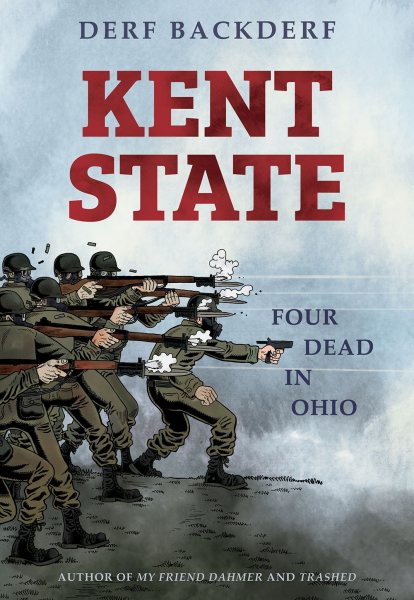
On May 4, 1970, a troop of National Guardsmen shot fifty-six M1-armor-piercing bullets directly into a crowd of student protesters, killing four of them and severely wounding nine others. The Guard had been sent to quell student demonstrations against the war in Vietnam, but the presence of armed men served only to increase the students’ anger. I was fourteen years old, and saw the resulting outrage and eruption of student protests that followed. I believed it was a turning point against the war in Vietnam. In fact, the war did not end until I was a sophomore in college, five years later.
Derf Backderf was ten years old at the time, and living in the next town over. He saw the truckloads of Guardsmen patrolling his own town. He became an award-winning journalist who produces, essentially, documentaries in graphic novel form. His graphic novel detailing the five days leading up to the Kent State incident is a “dramatic recreation” based on “eyewitness accounts, detailed research, and investigation.”
Kent State follows the mundane lives of several students, including the actions and opinions of the four students who were killed—or at least what could be pieced together later from interviews with their friends and family. It follows the testimony of a student who claimed at the time to be an FBI campus informant, but may not have been. It also documents the incident through the eyes of the only National Guardsman ever willing to speak about the tragedy.
Kent State assembles a picture of fearful confusion, hatred born of possibly-deliberate misinformation, and an absolute refusal of anyone in power to take responsibility or even give a clear command. The book is a stunning and wrenching account of the evolution and eventual cost of mutual paranoia and misunderstanding.
Disclaimer: I read Kent State and wrote this review in the days following the ICE murder of Alex Pretti in Minneapolis.
These days, we have a different set of lies, misdirections, and paranoid notions. The government has decided that protestors are terrorists rather than communists. We have scared, inappropriately-trained boys under the command of bitter, hardened men, but now they are signing up as ICE agents instead of escaping the draft by enlisting in the National Guard. Some of us dare to call the deaths “murders” instead of “killings,” though heavily-armed men still claim to be in fear for their lives at the hands of peaceful but angry protesters.
The murders at Kent State were never punished. There were a series of cover-ups—false claims of hordes of students charging the Guardsmen; mixed up or hidden ballistic evidence; judges acquitting Guardsmen for no reason; politicians telling outright lies. No Guardsmen ever admitted to any wrongdoing, though several student protesters were jailed. The general public blamed the students.
The book is essential reading for those who wish to continue an ongoing fight for justice. We now have video cameras on every phone instead of eyewitness reports, so perhaps we will be more successful. But it has never been without cost. Richard Nixon was later taped saying, “You know what stops them? Kill a few. Remember Kent State?” He was speaking about the civil rights protests in 1971. Nixon resigned, but not until 1974. His legacy of distrust and hatred obviously still lives on. It has been and still will be a long road.
We’re having to take a little bit of time to get caught up on web orders. Thank you all so much for your patience! The store is open regular hours and we are busy filling the existing orders.
In this retelling of Cinderella, “Ella” is murdered by her stepmother and becomes a ghost inhabiting the house that once belonged to her father. Unfortunately for Ella, even as a house she still can be persecuted by her stepmother and stepsisters, and forced to do all the housework. If you know the fairly tale of Cinderella, you know that eventually there will be a fairy godmother and a Royal Ball with a Prince on display. But, as it says on the cover copy, “You’re halfway right, and all the way wrong.”
This is one of the most inventive fairy tale retellings I’ve ever read. Like Cinderella, Ella spends very little time feeling sorry for herself. Unlike her fairy tale version, Ella is smart and intrepid and beginning to take charge of her own not-life well before the Royal Ball is rumored. The bargains she makes are her own, for her own reasons, which have nothing to do with being rescued by a Prince. But the truly wonderful thing about the book is that the other characters—including the woman-resembling-a-fairy-godmother, the step-trio, and the Prince—also have agency. This is a story that can only be told by a writer who is able to break away from the Prince/Princess narrative and forge a different sort of happy ending.
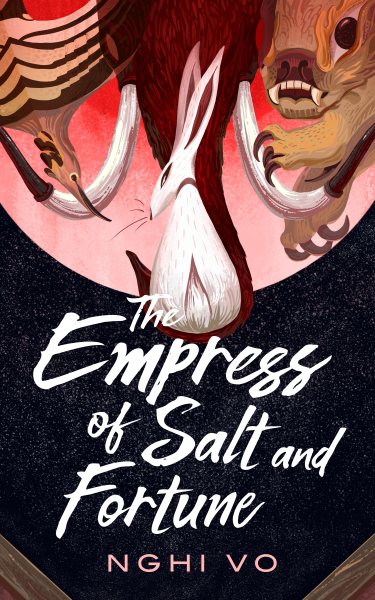
Chih is a Cleric of the Singing Hills, a fading order of non-gendered monks whose duty it is to record history. They travel with Almost Brilliant, a bird-like creature who remembers everything back to her ancestors’ memories of the Xun Dynasty. In The Empress of Salt and Fortune, they arrive at the now-deserted palace on Lake Scarlet, that once was the home in exile of the Empress In-yo. There, they catalog the items they find. They are aided by Rabbit, a handmaiden who may be a ghost.
As each precious artifact is revealed, Rabbit reveals a small gem of a story about the lives of the former inhabitants of the palace. The sum is a history of how the exiled Empress arrived at and left Lake Scarlet. Woven through the history is a wrenching but beautiful understanding of exactly what it might cost for the powerless to come into power. It is a history of sorrow and loss and triumph, told by the things left behind.
According to Cory Doctorow, we are living in the Enshittocene, wherein the once-friendly internet is being turned against us, not by evil attacking AI robots, but by giant tech corporations. I found the various usages of the word “enshittify” rather hilarious, until I realized that Doctorow is correct, and enshittification is actually not very funny. I caught on pretty quickly because bookstores were the first things to be attacked by the new tech giants (see the third chapter: Case Study: Amazon, page 20), and DreamHaven survived partly because we were on-line way before Amazon.
Enshittification is the transformation of the internet from a user-friendly way to connect with others, to an intrusive mess designed to funnel boatloads of money and private information into a few giant tech companies. Doctorow carefully traces how this was done, beginning with secret data collection and hidden tricks of internet pricing. They took advantage the current governmental reluctance to regulate anything, and crafted new laws to prevent competition. Eventually they were able to erode the basic honesty of tech workers, and the usefulness of their products declined. The details of these are very simply (and snarkily) explained in the book, despite many of them being pretty complicated.
The book is subtitled “Why Everything Suddenly Got Worse and What to Do About It.” I’m not sure the worsening is sudden, since problems seem to me to be rooted in Reagan-era deregulation and end-stage capitalism. Doctorow really only deals with the enshittification of the internet—now called the “enshitternet”—which arrived well after Reagan. But, honestly, shit on the internet may totally be able to enshittify the world.
Doctorow confirms what we booksellers always suspected—that Amazon was losing money on every book sale. What we didn’t know was that Amazon had enough money to do this indefinitely or, at least, until it had intentionally put a lot of us out of business. From there, it was able to acquire a currently-legal monopoly on books and then everything else. After all, Amazon is secure enough to sell this book. Though, if you buy an e-copy, you’re only renting access to it, which they can remove any time they want.
Happily, Doctorow spends no words predicting that things will get worse from here, though that may be just because of course it will. He also, in the last section of the book titled “The Cure,” has very few suggestions for individual action. But he does offer some bright spots—a few small-but-worldwide government shifts that he believes will eventually lead to positive changes. Overall Enshittification makes for an informative and surprisingly entertaining read.
This novel is already a New York Times bestseller, because Lev Grossman is also the author of the very popular series “The Magicians.” It has cover blurbs from George RR Martin, Rebecca Yarros, Oprah Daily, and the Wall Street Journal. It is also nominated for a World Fantasy Award. I expected to hate it. I didn’t think the world needed another King Arthur story. Now I think it should win the World Fantasy Award.
The plot does not follow King Arthur himself, not really; but the tragic shadow he casts is large enough to be visible on every page. The hero is Collum of the Out Isles, a seventeen-year-old of no particular parentage who happens to be the best fighter in a tiny village. (I think he is the only character in the novel that Grossman invented.) With no other options, he steals a horse and armor from his abusive guardian, and heads for Camelot, as heroes do. He is just in time to miss the final battle between King Arthur and his son Mordred. He finds himself set upon the final quest of the Round Table, with the few remaining knights of Camelot.
Like Collum, the remnants are a suspect bunch, none of whom really live up to their legendary counterparts. Sir Scipio is a Roman legionnaire lost in time, Sir Palomides the Saracen is a minor prince from Bagdad, Sir Dinidan is a trans man trained under a lake near a convent. They are knights in shining armor, in an age where magic is real and armor shouldn’t have been invented yet. They get drunk and sweaty and piss in unsavory places. Their moments of heroism are often misguided, and always bloody, but nonetheless guided by courage and attempted righteousness. They’re doing their best, like Arthur did.
The legend of King Arthur and his Knights of the Round Table, in all its many versions, is a centuries-long conversation about loyalty, power, and morality. Every generation adds its own message to the story. This retelling has all the tragic resonance of The Once and Future King, mixed with some of the absurdity of Monty Python and the Holy Grail. Grossman’s Arthur is caught between the old magic of Fairy and the new magic of the Christian God, and ultimately abandoned by both. The Bright Sword is a brilliant retelling of his story, made for these troubled times.
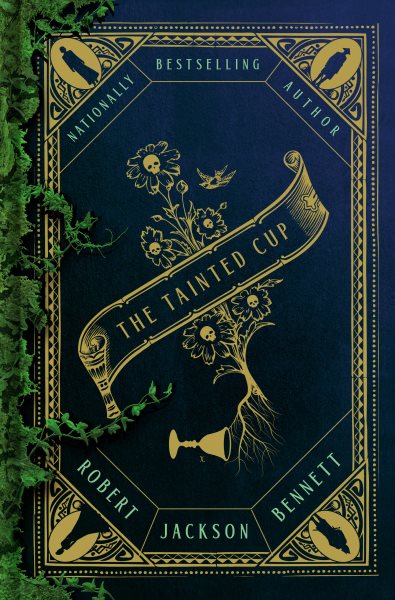
Despite being shortlisted for both the World Fantasy and the Hugo Awards, The Tainted Cup is not really either fantasy or science fiction. Yes, there is an Empire threatened by enormous, destructive horrors that come from the ocean depths every wet season. And there is a detailed, invented civilization which fights these leviathans using advanced biological techniques. But the book is a solid murder mystery. It features an absolutely delightful, neurodiverse detective, and her equally interesting new assistant.
Anagosa Dolabra is a high-ranking Iudex Investigator, sent to a backwater town not far from the sea wall that keeps the leviathans away. There, presumably, her idiosyncratic behaviors will be less intrusive. Her newly assigned assistant, Dinios Kol, doesn’t actually know very much about her. Din just knows that they have been assigned a gruesome murder case, and that, since Ana rarely leaves her sensory-protected rooms, he will be the one doing the actual legwork.
Almost everyone in this world has been augmented—physically or mentally or both—by carefully developed serums, grafts, spores and implants. Despite rigorous biological and bureaucratic oversight, these improvements can have permanent and debilitating side effects. Din doesn’t know how Ana has been augmented, or if all those augments are functioning properly. Din himself has been successfully augmented to become an “engraver,” able to remember absolutely everything he sees and hears.
Din really doesn’t want to remember the scene of his first murder case, clearly some sort of biological event gone monstrously wrong, but he faithfully collects and brings all the details back to Ana. Her brilliant deductions and his sometimes-unwilling attention to detail are the perfect combination for solving such crimes. They have a wonderfully sardonic relationship leading to a growing mutual respect. This serves them well as additional murders are uncovered and the case edges deeper into the politics of the Empire. They must move closer to danger, too. Some of the murders caused a breach in the sea wall, and it’s only a matter of time before a leviathan makes its way through it.
There are hints that there are more secrets waiting for Ana and Din to find them, but The Tainted Cup is a complete novel without cliffhangers. A sequel, A Drop of Corruption, is already available.
Malaysian-Chinese author Yangsze Choo is a New York Times bestselling author, and this book already has many prestigious reviews. It is also now a nominee for the World Fantasy Award and the Mythopoeic Award. Despite being based clearly on the Eastern mythology of hulijing (fox spirits who seek enlightenment in human form), it felt to me more like a mainstream novel. Choo has a simple, eloquent style, with lovely descriptions of the landscape as metaphor, reminiscent of Chinese poetry. The Fox Wife is a comfortable book, slow-moving and dreamy, full of the magic of the ordinary.
Most of the novel is narrated in first-person by Snow (Xue’er in Chinese, Yuki in Japanese), who takes every opportunity to remind the reader that she is a fox. She never takes the form of a fox, though presumably she can. She was present for events in the distant past, but seems to have no real understanding of history. Foxes are mischievous, she tells us, too curious, and impulsive. To me, she seemed childish despite her age.
Though it means stepping off her path to enlightenment, Snow is on a quest for revenge for the death of her child. She is following the trail of a mysterious photographer, made possible by the rarity of photography in 1908 China. She intends to kill him. She says very little about her child, except to reminisce about the horror of her loss. She never mentions the husband she must have had in order to be the fox’s wife.
Happily, there is also an interwoven story, of an old man, possibly dying, named Bao. His story is told in the more traditional third person, present tense. I found him much more interesting. As a child, he and a long lost childhood friend, had an encounter with foxes, a memory now hazy and relegated to imagination. But he can, very reliably, hear lies, which makes him a good detective. He is an otherwise unremarkable person, quiet and somewhat lonely, but more or less content with his life. He is on the trail of a series of disappearances and deaths, that eventually link to the same photographer.
The journeys of Snow and Bao are joined as much by attitude as by the crossing of their paths. Their search for the photographer is almost incidental. Their magic, real as it is, seems unimportant. It is the people they both meet along the way, and the small kindnesses they give and receive, that are important. Snow’s kindness comes from naivety and Bao’s from an unhurried wisdom, but they are both truly seeking connection, and ultimately find it.
Matt Dinniman burst upon the traditional publishing scene last year when Penguin Random House bought his “Dungeon Crawler Carl” series. Dinniman was already a successful author, having self-published the first books in the series, along with another dozen or so popular novels. Very popular, it seems. The most recent book hit number two on the New York Times bestseller list.
Carl is a twenty-seven-year-old, ex-US Coast Guard dude who has just broken up with his girlfriend. He tells his story in first person, and never gives his last name. He becomes “Dungeon Crawler Carl” on page sixteen. His ex-girlfriend’s prize-winning show cat, Princess Donut, has inexplicably jumped out a window into a tree at 2AM on a frigid Seattle night. So Carl is outside trying to rescue her when all the human-built structures in the world collapse, along with their contents, living or inert. This leaves Carl and Donut as the sole Seattle survivors of the end of the world. Since Carl is wearing only boxer shorts, too-small Crocs, and an old leather jacket, they head for the nearest light and warmth, which happens to be the entrance to a massive-multiplayer-RPG-style dungeon.
Unsurprisingly, aliens are involved in the conversion of all of Earth’s resources into a giant dungeon. It is an alien reality TV show projected to the entire universe, sort of like Hunger Games for adults, but without the need (mostly) for the participants to kill other players. This shouldn’t be funny, but it is. Dungeon Crawler Carl is probably the funniest end-of-the-world scenario since Douglas Adams’ Hitchhiker’s Guide to the Galaxy removed Earth to put in an inter-galactic highway. I predict that boxers with leather jackets and pink Crocs will join bathrobes and towels as the best easy cosplay for men.
Carl is a decent, practical guy who spends only a little time agonizing over the fate of the world. He survives by the seat of his non-existent pants, mostly by cleverly using explosives found in the dungeon. He tries to keep the other “crawlers” he encounters alive as well. This includes Donut the cat, who has hilarious abilities (and opinions) of her own, and a bunch of wheelchair-bound nursing home residents for whom “leveling up” doesn’t seem to be an option. It also includes non-player-characters (NPCs) who, turns out, have tragic backstories of their own.
If you want a good, long summer read, you won’t run out of books for a while. Dinniman began the series in 2019, and has already written eight of the anticipated ten books in the series. The first book finishes only Level 2 in a dungeon that, Carl is told, extends to Level 18, but no one has ever made it past Level 13. Dungeon crawl stories tend to get repetitive, so hopefully, other side-plots will develop. There are already hints of a universe-wide political system badly in need of an upgrade. But even without that, Dungeon Crawler Carl is a fun read, full of surprises, and oddly comfortable despite the enormously high body count.
This book is a great example of the new genre called “romantasy.” Books given this label often seem to be standard romance with a random bit of fantasy thoughtlessly thrown in. But The Gentleman and His Vowsmith has excellent world-building and an interesting magical system. The romantic relationship is fraught, and obstructed by both magic and society. This is romance and fantasy at its best. And, for added fun, both the gentleman and his vowsmith are men.
In the tradition of romance, Lord Nicholas Monterris is the somewhat useless and extremely unhappy heir to a dukedom. He has been in love since he was at school with Dashiell sa Vere, who is—also a genre tradition—not a suitable match because of his lack of noble birth. (Their sexuality is a bit less of a problem.) At school, they both received training in the magic art of vowsmithing, the crafting of the intricate and deathly binding contracts that both empower the nobility and keep them in their roles. Dashiell finished his training; Nicholas did not.
All the story needs now is a new obstruction, which comes in the form of an arranged marriage for Nicholas to Lady Leaf Serral. Even this could be weathered, since Lady Leaf is a delightfully practical woman who has no more desire for Nicholas than he does for her. But vowsmithing the magical marriage contract between them requires weeks of locked-room negotiations. These must be attended by both families and their vowsmiths, with dire consequences for withdrawal. And, of course, one of the vowsmiths responsible for crafting this contract is Dashiell sa Vere.
Things get complicated very quickly, when Nicholas and Dashiell find a dead body at the bottom of the stairs on the way back from an ill-advised tryst. An accident, perhaps. Then ghosts begin interrupting meals and the suspicion arises that Lord Monterris, Nicholas’ father, is keeping dire secrets. Dashiell makes his way to Nicholas’ bedroom and, though Lady Leaf cheerfully accepts their relationship, not everyone is happy about it. Tempers get short. Then the murders start.
What follows is a genre-crossing delight of fantasy, romance, and mystery. It’s all there. Was it murder or accident? Why did Nicholas and Dashiell break up? What happened to the Monterris family fortune? Does someone (besides Leaf and Nicholas and maybe Dashiell) want to stop the marriage? And, of course, what will it take for Dashiell and Nicholas to find happiness together?
This is an extremely interesting book, though I must say that I’m not sure I entirely understood it. At the very least, my old-fashioned brain kept mis-gendering the characters. Notes From A Regicide is the story of Etoine Keming, transcribed from his written prison journal by his adoptive son, Griffon. This is interwoven with the story of how Griffon came to be adopted by Etoine and his lover Zaffre. And why, after their deaths, Griffon decided to tell the story from Etoine’s journal.
Etoine was an artist in the now-lost city of Stephensport, and he was unwittingly involved in the revolution which destroyed it. He did, in fact, commit regicide, though that was not why he was imprisoned. His fellow artist and eventual lover, Zaffre, was probably much more actively involved, but her story is unreliable. She supposedly “burned down half of Stephensport,” but her memories are described from a fuzzy distance, as though this might have been more or less accidental.
Etoine and Zaffre are old when they find their son (or maybe Griffon finds them). They have finally arrived at themselves as both artists and revolutionaries. All three are living in a future New York City, where artists and refugees abound, and most of the streets are canals. Griffon is still finding himself, as a trans man whose biological parents were abusive and, ultimately, unworthy of him. Zaffre and Etoine are also trans, but secure enough in their bodies that the way they live can be a sort of guide. However they are both broken in other ways, and seem to still be in mourning for their lost city.
I thought at first that Isaac Fellman meant for revolution to be a metaphor for transitioning. Both involve uncertain change. The Stevensport revolution was passionate and messy, barging with minimal guidance toward an unknown future. But, though it was ultimately successful, it was not clear that everyone, including the revolutionaries, was satisfied with the outcome of the revolution.
The story is told in evocative, beautifully poetic prose, but it is filled with a sense of loss. The city burned, its magical foundation dismantled. The king is dead. Perhaps too many things of value were unintentionally destroyed in the process, or the new way of life is not as much of an improvement as hoped. Fellman does not really answer these questions, telling instead a story of wrenching love and loss and change.
The Tomb of Dragons is the third book in “The Cemeteries of Amalo Trilogy,” which takes place in a world populated by goblins and elves that was introduced in an earlier book called Goblin Emperor. All I remember about Goblin Emperor is that I quite liked it. It was one of the first books I read where kindness was more important than the power to wield either sword or magic.
I liked the Amalo Trilogy for much the same reason. There is a quiet heroism in doing the right thing, over and over, no matter how small or difficult or unpopular it is. I picked up The Tomb of Dragons as soon as I finished The Witness for the Dead and The Grief of Stones. It has been a long time since I’ve read the entirety of a trilogy.
Thara Celehar is a Witness for the Dead. This means that, not only can he hear the last thoughts of the dead by touching them, but also that he has the duty to investigate the death if someone asks him to. He takes all requests with the seriousness and carefulness of his calling as a prelate of his god, Ulis. He tells his story himself, with a lovely self-deprecating honesty, and kindness toward everyone except, possibly, himself.
The story is not exactly a murder mystery, though there are several mysterious murders. Celehar is a lonely man (elf, actually, though whether he is elf or goblin is of so little importance to him that it is barely mentioned) who carries the grief of the deaths he investigates along with his own past sorrows. He follows the threads needed to solve deaths with patience and persistence. He feeds the stray cats on his doorstep. He does not seem aware that he is gathering friends and allies along the way.
I did not have to reread Goblin Emperor in order to understand the trilogy. I did have a bit of a problem with the complexities of the government of Amalo, which is made up of assorted religious and secular bureaucracies, all with multi-syllabic, unfamiliar names. I looked for a map or list of characters, but didn’t find one. Despite this, I had no trouble figuring out who was who or understanding the political implications of events.
However, I intend to proceed immediately to rereading Goblin Emperor. I find that, in these times, I want to spend as much time as possible in this world where elf and goblin are learning to peacefully coexist. It is good to be reminded that small acts of decency, while not necessarily world-changing, still matter.
When Mary Darling’s three children disappear through an open window into the night, leaving no footprints behind in the snow, she has a pretty good idea what happened to them. She had her own childhood adventures, you see. And while she doesn’t know exactly where the imaginary place called Neverland is, nor exactly how to find the ageless boy who calls himself Peter Pan, she does know where she ended up, when she was a girl.
The problem is that she is now a more or less respectable British mother, and women of her status don’t travel half a world away unaccompanied, for any reason. But Mary is willing and eager to do anything for Wendy, Michael and John. When Mary’s Uncle, Dr. John Watson, and his colleague Sherlock Holmes prove to be of very little help, she disguises herself and escapes to a ship headed in the right direction. Watson and Holmes are not far behind. Holmes’ amazing deductive abilities are hilariously not terribly useful.
What follows is a wonderful musing on the toughness required for motherhood, and the lack of innocence inherent in childhood. There are some snide comments about British Imperialism and the rigidity of rational science. But there’s plenty of adventure too. All the Peter Pan things are there—a bunch of displaced Native Americans enacting Peter’s idea of Indians, some decidedly dangerous mermaids, pirates who may actually be normal seamen, a one-handed Captain, and flying with fairy dust.
And sword fights, of course. Who knew that Mary Darling, who spends most of JM Barrie’s Peter Pan presumably sitting tearfully in front of the window, is actually trained in martial arts? And that her granddaughter, Jane, who canonically also went off with Peter Pan, would one day write the true story of Mary Darling and the other children who once were lost.