
Integration
API interaction between systems
Integrate and execute your retail’s pricing process
Integration
Easily integrate e-commerce and ERP software
Periodical price updates with a streamlined, secure connection to your storefront
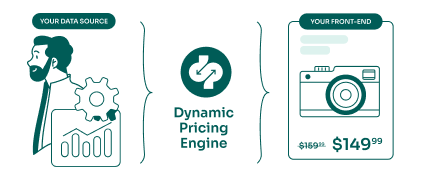
Scheduled price updates
- Set up pricing policies and periodically fetch up-to-date data
- Speed up the pricing process by integrating our APIs
- Use a single-purpose, highly scalable, and proven pricing
- Start building pricing strategies, analyzing results, and testing ideas
Calculations, tracking & data
- Calculate new prices up to 150 times per day
- A history track record of all your price calculations for troubleshooting
- Get competition data directly to your ERP platform
- Request similar products from our API


Integrations with e-commerce platforms like
- Shopify
- Magento
- PrestaShop
- Salesforce Commerce Cloud
- Custom built

Get in Touch with Us
Please fill out the form and we will contact you back with more details.
Integration FAQs
We offer ready-made integrations for major platforms including Shopify, Magento (Adobe Commerce), Salesforce Commerce Cloud, and PrestaShop. Additionally, we can connect with any custom backend system via our API.
For existing cloud providers like Shopify or Magento, the integration takes minutes to hours to set up. For custom backends via API, the process is streamlined and typically takes no more than one week of development for both parties to finalize.
Yes. If you are not using a standard e-commerce platform, we can integrate via API. We provide a standard integration schema, allowing your team to connect your custom backend or ERP system directly to our pricing engine.
Our standard integration schema includes 5 main data types: Clients' Product Data, Competition Data, Historical Sales Data - Transactional/Order Data, Inventory Data, and Click/Page Visit Data.
Data transfer is bi-directional and scheduled. Your system sends us the relevant data on a regular basis, and our system sends back the optimized pricing recommendations and updates based on the agreed-upon schedule.
While not strictly mandatory for all models, including Click and Page Visit data significantly improves the accuracy of demand-based models. It helps the AI understand customer intent and traffic patterns, even for products with lower transaction volumes.
Yes. If you are only consuming Competition Data, no integration is required. You can simply access the insights and reports directly through our web interface using your browser.
Yes. Partial integration is available for clients who want to control the timing of the process. In this setup, you perform regular file exports (CSV/Excel) to our system to apply pricing models and rules. You decide exactly when to trigger calculations, review recommendations, and export the results back to your system.
Yes. Even with a full integration, you can set the system to calculate recommendations without auto-publishing them. You can review the output and decide when to push the updates to your store.
Yes. Our primary infrastructure is hosted on AWS (Amazon Web Services), ensuring high availability, scalability, and security for all cloud-based integrations.
Yes. We support On-Premise deployments for enterprise clients who require their data and systems to remain within their own infrastructure.
The Hybrid approach offers a balance between security and cloud computing power. In this scenario, all your sensitive data remains located on-premise with you. Only the mathematical pricing calculations are performed on our cloud.
In the Hybrid model, the data sent to the cloud is anonymous. Our pricing models act as "pure calculators"—they are not interested in the origin, brand, or specific nature of the product. They simply receive numerical inputs, calculate the next best price based on the math, and return the answer, ensuring your proprietary product data remains secure.
No. Whether cloud or hybrid, our models function as mathematical engines. They analyze patterns in numbers (price, volume, stock, demand) rather than the "kind" of product. This means the system is agnostic to the source and focuses purely on statistical optimization.
