Customer Data Platform (CDP) – what is it and how to use it?

Customer Data Platform (CDP) is currently one of the key solutions for e-commerce companies that want to make real use of customer data in marketing, sales and customer service.
In a world where customer data comes from dozens of sources and users are difficult to understand without context, CDP platforms turn chaos into valuable data.
In this article, we will show you:
- what CDP is,
- how CDP works and what it is used for,
- how to leverage the potential of customer data in practice.
No marketing slogans, just a perspective based on real e-commerce needs.
What is a Customer Data Platform?
A Customer Data Platform is not just another database or a tool for analysts.
It is a platform that allows the entire company to work with the same, up-to-date customer data. In one place and in real time. This makes CDPs the foundation for effective marketing, automation and personalisation within omnichannel activities.

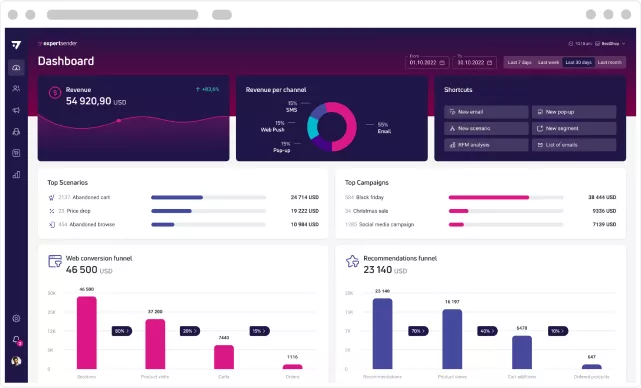
A Customer Data Platform is a central data platform that collects, unifies and activates customer data from various sources to better understand each customer.
In practice, this means that CDP combines customer data from e-commerce, applications, internal systems, social media and other tools - into a single, consistent database.
The Customer Data Platform (CDP) operates as SaaS software that enables company-wide customer data management. It not only collects transactional data, behavioral data, and demographic data, but also prepares them for use in marketing campaigns and customer service processes. This allows marketers, e-commerce teams and customer service departments to work from a single, comprehensive database of customer information.
Unlike a traditional database, a Customer Data Platform actively supports the activities of multiple departments – it enables real-time segmentation, personalisation and automation, while complying with applicable regulations and protecting customer data.
Why are CDP and e-commerce a perfect match?
CDP perfectly meets the needs of e-commerce because it allows you to understand customer behaviour throughout the entire purchasing cycle and respond to it in real time.
E-commerce generates huge amounts of customer data, from purchase history and behavioural data to interactions in mobile applications, SMS and email marketing.
CDP platforms enable the integration and unification of this data in one place, which translates into better audience segmentation, more relevant offers and more effective marketing campaigns. Thanks to CDP, e-commerce can conduct personalised marketing activities towards potential customers and regular users, increasing conversion, customer lifetime value, loyalty and cart value.
Without CDP, managing data and marketing activities becomes costly and inefficient.
See also: What is e-commerce? >>>
How CDP works: data from different sources to a unified customer profile
CDP acts as a central database. It allows you to organise and activate customer data from different sources. In practice, the Customer Data Platform collects data scattered across multiple systems, applications and channels, and then combines it into a single, consistent view of the customer.
Thanks to the integration and standardisation of data, the platform enables a complete understanding of customer behaviour. This is the foundation of effective marketing and sales activities.
Customer identification
Customer identification in CDP involves recognising and combining all interactions of the same user into a single, consistent customer profile.
The Customer Data Platform uses various identifiers to link customer data from multiple touchpoints. Examples of customer identifiers include:
- email address,
- telephone number,
- cookie ID,
- device ID,
- IP address,
- loyalty card number,
- login/profile.
In practice, CDP combines anonymous user data with known customer data, e.g. when logging in, subscribing to a newsletter or making a purchase.
Advanced CDP platforms such as ExpertSender also use matching rules and artificial intelligence mechanisms to improve customer identification quality and minimise errors resulting from duplicates or incomplete data.
As a result, each customer is represented by a single, up-to-date profile that can be immediately used for segmentation, personalisation, and automation of marketing activities.
Customer data integration and data standardisation
Customer data integration involves collecting data from various sources and combining it on a single platform without losing context. The Customer Data Platform integrates data from e-commerce, applications, internal systems, marketing tools, mobile applications and social media.
A key element is data standardisation, i.e. the standardisation of formats, identifiers and customer attributes. The platform normalises information, organises field names and removes inconsistencies, so that customer data can be used in analysis, segmentation and automation. Without this step, even the largest database has no real operational value.
Combining behavioural and transactional data
Consistent customer profiles are created when the CDP combines behavioural, demographic and transactional data into a single, dynamic view of each customer. The Customer Data Platform assigns all interactions, purchases and activities to a specific user, regardless of the contact channel.
Behavioural data shows how customers navigate the site, respond to marketing campaigns and use applications, while transactional data reveals the real value of the customer, their purchase history and purchasing preferences. Combining these two types of customer data enables the creation of consistent customer profiles.
As a result, CDP platforms enable marketing and e-commerce teams to better understand their audience's needs, precisely segment users, and conduct effective, personalised marketing activities. Each customer ceases to be an anonymous record in a database and becomes a complete, contextual profile ready for activation as part of an automation campaign.
How to use CDP platforms for marketing and automation?
CDP platforms enable the translation of customer data into specific, automated marketing activities in real time. By combining customer data from various sources, CDP not only allows you to analyse audience behaviour, but above all to actively respond to it in every channel of contact.
The Customer Data Platform is becoming a central tool for marketing, sales and customer service departments.
Real-time audience segmentation
Audience segmentation in CDP is dynamic, based on current customer data and their behaviour in real time. Customer Data Platform allows you to create audience segments based on behavioural, transactional, demographic and preference data.
This allows marketers to respond to specific user actions – such as visiting a website, abandoning a shopping cart, purchasing in a given category, frequency of purchases or returning after a long break – and immediately launch tailored marketing campaigns.
Personalisation of omnichannel communication: email, SMS, web push, on-site
CDP enables the personalisation of communication across every channel based on a single, consistent customer profile. CDP platforms power personalised emails, SMS, web push and on-site communication.
This ensures that recipients receive consistent content regardless of the channel, and that communication personalisation is based on actual behaviour, purchase history and preferences, rather than static contact lists.
Read also: Omnichannel – what is it and how does it work? >>>
Automating marketing activities and increasing sales
Automating marketing activities in CDP allows you to launch campaigns exactly when the customer is ready to interact. Customer Data Platform enables the creation of automation scenarios based on events, segments and changes in customer data.
Thanks to automation, marketers increase the effectiveness of marketing campaigns, shorten response times and scale activities without manual intervention. This directly translates into increased sales and better utilisation of customer data potential.
Product recommendations
CDP supports the display of product recommendations by utilising the full context of customer behavioural and transactional data. The platform analyses purchase history, viewed products and previous interactions to tailor offers to each customer's needs.
Thanks to integration with artificial intelligence mechanisms, recommendations can be dynamically updated and used in emails, on the shop website (on-site) and in remarketing campaigns, increasing conversion and cart value.
Summary
Today, the Customer Data Platform is the foundation of modern e-commerce, allowing customer data to be used effectively in marketing, sales and customer service. By integrating data from various sources, standardising it and building consistent customer profiles, CDP transforms scattered data into an organised, actionable knowledge base about recipients.
CDP platforms enable customer identification, real-time audience segmentation and personalisation of omnichannel communication – from email and SMS to on-site and web push communication. Combined with marketing automation and product recommendations, CDP allows you to scale your activities, increase sales and build long-term customer loyalty through loyalty programmes.
As a result, the Customer Data Platform ceases to be merely a technological tool and becomes a strategic solution supporting the development of the entire company. For e-commerce businesses that want to better understand their customers and act on data, CDP is not so much an option as a natural next step.
Frequently asked questions (FAQ)
What is a CDP platform?
A CDP platform is a system that centralises and organises customer data in one place. The Customer Data Platform collects data from various sources, standardises it and makes it available for use in personalised marketing campaigns, sales and real-time customer service.
What are the goals of implementing a CDP platform?
The main goal of implementing a CDP platform is to identify customers, better understand their needs, and make marketing and sales activities more effective.
CDP allows you to build consistent customer profiles, perform precise segmentation, personalise communication and automate marketing activities across the entire company.
How does CDP differ from CRM?
CDP differs from CRM in that it focuses on the full picture of customer behaviour, not just sales relationships.
A Customer Data Platform integrates behavioural and transactional data from multiple sources, while CRM (Customer Relationship Management) focuses primarily on contact details and sales processes.
What is the difference between ETL and CDP (Customer Data Platform)?
ETL is a technical data processing process, while CDP is a complete platform for managing and activating customer data.
ETL is used to transfer data between systems, while Customer Data Platform enables its unification, analysis and use in marketing activities and automation. CDP also acts as a centralised customer database and Marketing Automation tool.
Latest Resources
We share our knowledge











-
![Image]()
Dashboard
-
![Image]()
Customer Profile 360°
-
![Image]()
Preference Center
-
![Image]()
Website personalization
-
![Image]()
Consents Management
-
![Image]()
Automated emails
-
![Image]()
Email Raports
-
![Image]()
High Deliverability
-
![Image]()
User real-time tracking
-
![Image]()
Automated scenarios
-
![Image]()
RFM analysis
-
![Image]()
Drag & drop editor
-
![Image]()
Omnichannel marketing
-
![Image]()
Recommendation frames
-
![Image]()
Message checklist
-
![Image]()
Banners, pop-ups, forms