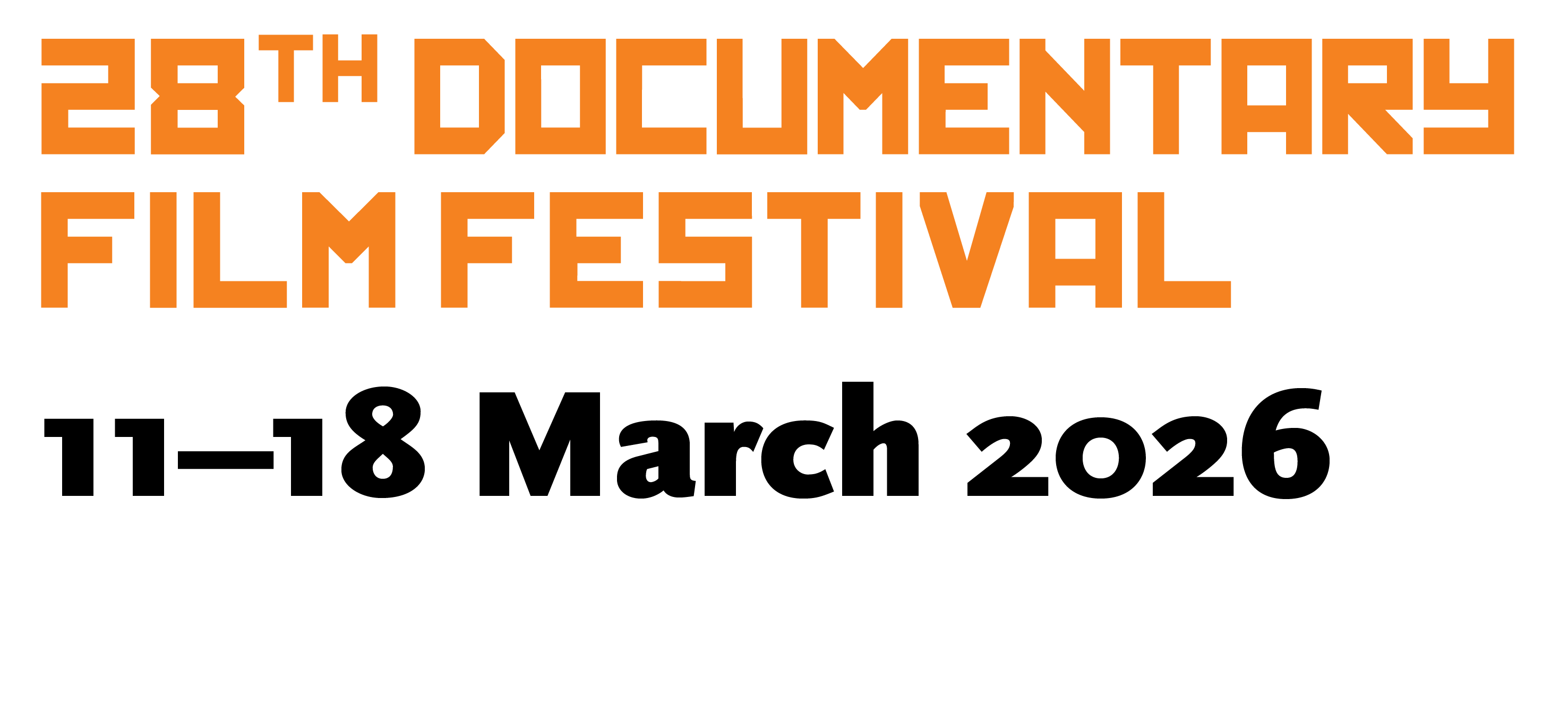
 1 (Medium).jpg)


-
![qxif-newspaper]() The programme has been announced – tickets are now on sale.
The programme has been announced – tickets are now on sale. From 11 to 18 March, Cankarjev dom, Kinodvor and the Slovenian Cinematheque will host a diverse selection of international documentary films, accompanied by talks with filmmakers and local experts. Across five festival sections, 29 documentaries from around the world will offer space for reflection on society, politics, ethics, history, and intimate personal stories.
The programme features a Human Rights Competition Section (with the award presented by Amnesty International Slovenija), topical, socially engaged films, intimate and global portrayals, and a retrospective titled Documentary on the March: The Turbulent 30s in New Deal America. This retrospective revisit the birth of social documentary while demonstrating that films made in the 1930s and 1940s – addressing the Great Depression, the rise of fascism, racism, restricted access to education and media manipulation – remain strikingly relevant today.Join us in exploring documentary cinema.

NOVICA - 21.10.2025

Vabljeni k branju uvodnika
The Thing to Be Done
The Thing to Be Done is the title of the opening film of this year's Documentary Film Festival, but looking at the 28th edition programme, it might just as well be a shopping list stuck to the fridge or a list of urgent to-do items, tasks for correcting and improving the modern world. So, what needs to be done to set right, at least moderately so, the world that is out of joint? We'll do this step by step.
We need to find Peacemakers, people who wholeheartedly and unselfishly advocate dialogue and the easing of (political and ideological) tensions, such as Josip Reihl-Kir, chief of the Osijek Police Department, one of the rare few who stood for the voice of reason amidst rampant nationalism.
We need to find people who can articulate and legislate the burning issue of euthanasia, the right to end The Dance of Life with dignity, without resorting to populism and scaremongering.
We need to find politicians and decision-makers who, within the context of repressive regimes and Cutting Through Rocks, are capable of addressing both reactionaries and reformists.
We need to find more people who would expose sexual violence not only within the Church, but in all entrenched and closed systems, because, believe me, what we are dealing with here is not just Nuns vs. the Vatican, but a much wider circle of systematically abused people of all genders and beliefs.
We need to find high-profile public figures, influencers, and people with economic power who do not use Instagram to promote themselves, but to quietly, yet decisively and selflessly endorse environmental initiatives and, in supporting Ellis Park, help save endangered species.
We need to find more people who, beyond The Librarians, would tirelessly and loudly draw attention to the rising censorship and dissemination of intolerance, while spreading knowledge and stewarding information.
We need to find the right leaders, statesmen, entrepreneurs, visionaries, a new Blum, who would not invest their profits and accumulated wealth solely in their own empty and conceited projects, but also, at least partially so, in the workers and the process that helped them in amassing their wealth.
I'm only halfway through this year's programme and my shopping cart is already full. I'll have to do some more shopping later, but in the meantime, the Documentary Film Festival offers hope-restoring content. Elvis’s Las Vegas residency; a 90-year-old fiercely independent horticulturist full of advice for living without digital imperatives (Agatha's Almanac); a tragicomic portrait of an urban and ethnically diverse megapolis (Below the Clouds); a tribute to our generation of film buffs raised on videotapes in the 1980s (Videoheaven); a joyous, and occasionally absurd, portrait of bucolic life in the Czech countryside (Better Go Mad in the Wild). And so on.
Nevertheless, I believe that the main event of this year's festival is the retrospective Documentary on the March: The Turbulent 30s and New Deal America. If we just take a quick look across the pond and assess the events in Minnesota and other regions governed by the 45th and 47th US president, as well as all the collateral damage he is causing around the world, it becomes clear that the 1930s and ‘40s documentaries on the economic depression, the rise of fascism, racism, the denial of education, and media manipulation of reality by American directors and international like-minded filmmakers are still incredibly relevant today. This combination of challenges is coming back to haunt us; we are faced with rising populism and social division, the economic and social impact of new technologies, political orthodoxy and nation state threats, impending ecological cataclysms, and more.
There are disturbing parallels between the 1930s and the 2020s, and the media aim to document this. It’s only the format and means of communication that have changed. Activists and rebels used to be armed with 16mm cameras, and the process of producing and distributing images was longer – even taking years – but today, images generated instantly and distributed over the internet and social media reach people in seconds.
The historical perspective is important. In the depths of Great Depression USA, a delicate coalition of radical filmmakers fought to birth a new genre of social documentary. They created a new cinema of reality, infusing facts with feelings, blurring art with propaganda, actuality with drama.
As Roosevelt committed to “social justice through social action” via the policies of his government’s New Deal, filmmakers did too. By the end of the decade, ‘documentary’ had become a widely used term, signalling a new development in the history of cinema.
The retrospective addresses America of the 1930s, and the decade’s attempt to address national and international political and socio-economic crises, against the spectres of fascism, populism and war.
In portraying a period in which it was hoped that cinema might be employed as a progressive agent of change, through an amalgam of cinematographic and social proposition, these films implicitly demand that we question the potential and limits of cinema’s sociopolitical capacity, the porous boundaries between non-fiction as an art form and as a form of propaganda.
This phenomenon will be addressed in further detail at the Slovenian Cinematheque by Andrej Šprah, author of the book Dokumentarni film in oblast (Documentary Film and Power) and Slovenia’s leading authority on documentary film. Join us.
Simon Popek
CD Film and Programme Director
.png)
.jpg)

V dvorane vstopamo vznemirjeni, v pričakovanju, ven pa hodimo včasih v tišini, včasih glasno, včasih olajšani, veseli, žalostni, razočarani, navdušeni, vsekakor pa drugačni kot smo vstopili. Vseh se nas film tako ali drugače dotakne in bolj kot se mu prepustimo, več svetov in življenj lahko doživimo.

Jure Novak
generalni direktor Cankarjevega doma




























28. Documentaty film
festival



@ 2026 FDD. All rights reserved.
