Image
  • Membership
  • Books
  • Projects
  • Learning
  • Newsletters
  • Member Login
  • Lack of data during the shutdown, globally

    October 21, 2025

    Topic

    Data Sharing  /  government, Reuters, shutdown, uncertainty

    While the government shutdown pauses data about the United States, other countries feel the effects. For Reuters, Leika Kihara and Howard Schneider report:

    “The month-to-month data flow in the U.S. gets talked about but never is a decisive factor,” for other central banks, said Adam Posen, president of the Peterson Institute for International Economics and a former Bank of England policymaker.

    But Posen said that the shutdown itself and the tumult around BLS “contributes to the general skepticism about the governance of the U.S. and the reliability of the U.S….And that is important. It eventually feeds into reserve management and currency decisions and feeds into volatility outlooks for the U.S. that were not there before.”

    The good news is that if all else fails, we’ll be able to function on AI and vibes.

  • Cartography of generative AI

    October 20, 2025

    Topic

    Infographics  /  generative, human, system
    Image

    It’s very easy to ignore what happens before and behind-the-scenes when you enter text into a chatbot and hit enter. A response spits up instantly. However, it takes a lot of bits, energy, and people to make that happen. A cartography of generative AI by Estampa shows the groundwork.

  • Libraries dealing with generated books

    October 20, 2025

    Topic

    Artificial Intelligence  /  Governing, library, slop

    For Governing, Jule Pattison-Gordon on how librarians are handling the slop trying to enter the public catalog.

    When you get a suspicious book, “you look it up to see what else the [author] has written. And you see there’s 30 things, and none of them have any reviews, and they were all written in the last two years,” DeMeester-Lane says. Typically, AI-generated books list an author with little to no digital footprint. And while a small or lacking online presence could indicate a new author just starting out, it takes humans time to write. One book every year or so is normal; dozens of titles per year start looking quite suspicious.

  • Signs of AI writing on Wikipedia

    October 20, 2025

    Topic

    Artificial Intelligence  /  fake, Wikipedia, writing

    From WikiProject AI Cleanup, a guide on spotting fake writing on Wikipedia.

    This list is not a ban on certain words, phrases, or punctuation. No one is taking your em-dashes away or claiming that only AI uses them. Not all text featuring the following indicators is AI-generated, as the large language models that power AI chatbots are trained on human writing, including the writing of Wikipedia editors. This is simply a catalog of very common patterns observed over many thousands of instances of AI-generated text, specific to Wikipedia. While some of its advice may be broadly applicable, some signs—particularly those involving punctuation and formatting—may not apply in a non-Wikipedia context.

    More on em-dashes:

    While human editors and writers often do use em dashes (—), LLM output tends to use them more often than nonprofessional human-written text of the same genre, and uses them in places where humans are more likely to use commas, parentheses, colons, or (misused) hyphens (-). LLMs especially tend to use em dashes in a formulaic, pat way, often mimicking “punched up” sales-like writing by over-emphasizing clauses or parallelisms. LLMs overuse em dashes because they were trained (sometimes illegally) on novels, and novelists have always used em dashes more often than is typical of a layperson.

    This sign is most useful when taken in combination with other indicators, not by itself.

    I think I’ve been subconsciously using more commas these days.

  • 50 Cent adjusted for inflation

    October 17, 2025

    Topic

    Statistical Visualization  /  50 Cent, Brian Moore, humor, inflation
    Image

    The rapper Curtis Jackson became 50 Cent a couple of decades ago, but the dollar is not what it used to be. Accounting for inflation, Brian Moore shows Jackson’s current value, which is 109 Cent, as of August 2025.

    One might argue the other direction where 50 Cent stayed static name-wise, in which case he is currently 50 Cent and rewinding back to 1994, he would be 23 Cent.

    These are the day’s tough decisions.

  • iRobot founder with a practical view of AI and robotics

    October 17, 2025

    Topic

    Artificial Intelligence  /  future, iRobot, Om Malik, robot, Rodney Brooks

    Om Malik interviewed Rodney Brooks, the founder of iRobot and former director of the MIT Computer Science and Artificial Intelligence Laboratory.

    You can do so much more computation, sensing, some actuation, but people underestimate the long tail of the natural environment. That’s what we see with autonomous vehicles. I first attended a talk on autonomous vehicles in 1979 in Tokyo. By 1990, Ernst Dickmanns in Germany had his truck driving on the Autobahn at 100 kilometers an hour. He took it to Paris, and an autonomous vehicle drove around Paris in 1990. Then in 2007, 2008, people saw the DARPA autonomous vehicle and said, “Oh, it’s going to be everywhere instantly.” But it’s taken almost 20 years, and it’s still only in little tiny geographical areas because of the long tail of all the things that can happen.

    There’s a tendency to go for the flashy demo, but the flashy demo doesn’t deal with the real environment. It’s going to have to operate in the messy reality. That’s why it takes so long for these technologies.

    Historical context and the reality of building things for a physical world is almost a shocking point of view these days. It usually feels like we’re either headed towards the end of the world or some kind of automated utopia. Brooks offers optimism, but a view in between doom and the box of dreams.

  • Data Underload  /  cost, spending

    Cost of Living, by State and Spending Category

    Image

    Housing in California costs about three times more than in Mississippi. Utilities in Hawaii cost nearly twice the national average. Clearly, the cost of living varies across the United States, depending on what you’re buying. See the differences in this chart.

    Read More
  • Members Only

    Sort the dots, like a table

    October 16, 2025

    Topic

    The Process  /  interaction, sorting
    Image

    This week we sort the dots and look closer at the things we can control.

  • Canceled $28B grants during government shutdown

    October 15, 2025

    Topic

    Maps  /  funding, government, New York Times, shutdown
    Image

    There’s been a lot going on and we almost forget that the federal government is approaching its third week of shutdown. The administration has used the time to cancel and pause billions in grants in the places you might guess. Tony Romm and Lazaro Gamio for the New York Times have the analysis.

    The Times conducted its analysis by examining federal funding records, which include details about the city and state where each grant recipient is based. The projects include new investments in clean energy, upgrades to the electric grid and fixes to the nation’s transportation infrastructure, primarily in Democratic strongholds, such as New York and California.

  • Fraudulent disability claims through Veterans Affairs

    October 15, 2025

    Topic

    Statistical Visualization  /  disability, fraud, Veterans Affairs, Washington Post
    Image

    For the Washington Post, Craig Whitlock, Lisa Rein, and Caitlin Gilbert examine court records and disability claims.

    “One inherent problem [VA] must contend with, is that it operates on an honor system with its veterans,” Justice Department prosecutors wrote in a 2021 court filing for a case involving an Army veteran who defrauded VA of more than $200,000. “… The result is that some veterans can, and unfortunately some veterans do take advantage.”

    While most claims are probably legit, there seems to be an alarming increase over the last few years for hay fever, irritable bowel syndrome, and penile deformity.

  • Using mega batteries to power the evening

    October 14, 2025

    Topic

    Statistical Visualization  /  batteries, energy, Financial Times, solar
    Image

    When there is an excess of solar energy during the day, it can be stored in batteries for use in the evening when the sun goes down. Financial Times, in a chart forward piece, describes how this applies at scale, using California as a prime example.

    Here in California it’s become more common to have home batteries than not in some places. During really hot days, you can send energy to the grid and receive reimbursements, which is nice. But the main selling point for me is when there is an outage. The battery kicks in and you don’t even notice.

    I’m a fan. Of the battery approach and the hatching in the FT charts.

  • Cost of driving an electric vehicle vs. gas car

    October 13, 2025

    Topic

    Statistical Visualization  /  cost, electric vehicle, Francesca Paris, Upshot
    Image

    The cost of driving an electric vehicle varies by where you charge and how much drive. It’s a lot cheaper to charge a car at home during off hours than it is to charge on the road during peak times. For NYT’s the Upshot, Francesca Paris made a straightforward calculator to estimate the true cost of going electric versus driving a gas car.

  • Circular deals among AI companies

    October 13, 2025

    Topic

    Network Visualization  /  Bloomberg, business, funding
    Image

    The big AI companies are making deals with each other, promising and distributing hundreds of billions of dollars over the next few years. It’s difficult to keep track, but Bloomberg has this network diagram that shows the moves.

    And from today, add Broadcom to the mix dealing with OpenAI, because sure why not.

  • Cash-poor millionaire households

    October 10, 2025

    Topic

    Statistical Visualization  /  Bloomberg, income, millionaire, spending
    Image

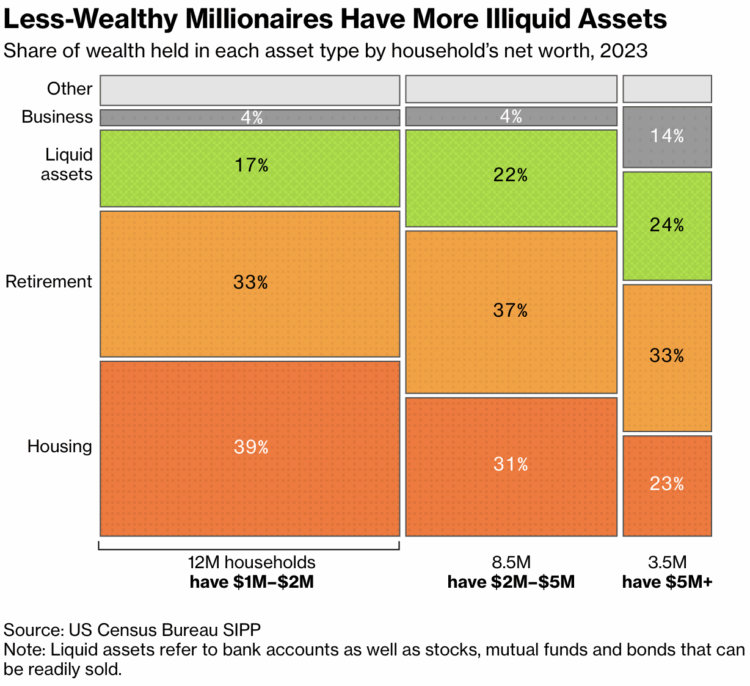
    Everyone loves reading about millionaires who don’t have enough liquidity to buy things, but the seven-figure status is not what it once was. For Bloomberg, Andre Tartar, Ben Steverman, and Stephanie Davidson show the increasing number of millionaire households who have most of their net worth tied up in housing and retirement accounts.

    The mosaic plot above breaks down assets by millionaire income groups. About half of households fall within the $1M to $2M range and only 17% of their net worth counts as liquid assets (in green). The liquid share increases with net worth.

    Cue the violins.

  • Odds against you in sports parlays, advantage house

    October 10, 2025

    Topic

    Statistical Visualization  /  betting, parlay, sports, uncertainty, Washington Post
    Image

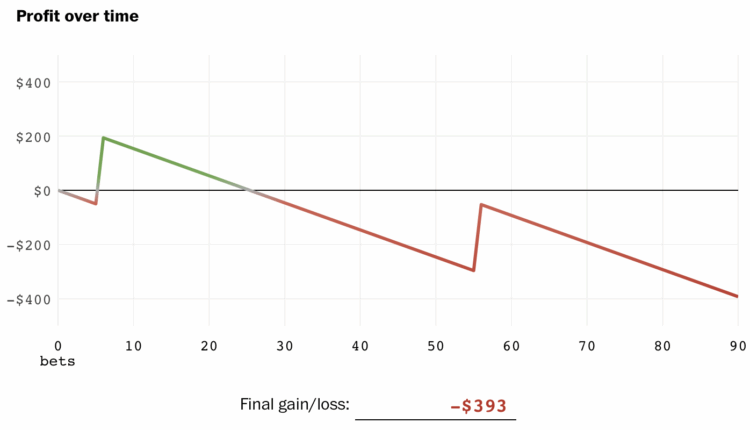
    Parlays in sports betting are booming and people are losing billions of dollars to online sportsbooks, like FanDuel and DraftKings. For the Washington Post, Emily Giambalvo, Kati Perry, and Aaron Steckelberg show how the bets work with playable simulations.

    Like most gambling games, the odds are completely against you in the long run and virtually guarantee that sportsbooks get all your money.

    So instead of tossing your money into the sports machine, you can just run simulations. It’s not nearly as fun, but at least you’ll be able to watch sports again for the spirit of competition and love of the game.

  • Unreliable library of human knowledge

    October 9, 2025

    Topic

    Artificial Intelligence  /  Internet, Kurzgesagt, misinformation
    Image

    Kurzgesagt, popular for illustrative explainer videos on YouTube, describes the current situation with generative AI slop. There is a flood of random, fake videos on the rise.

    It is all fun and games at first, but when there is no way to distinguish between fake and real online, this useful internet thing turns into something else.
    Read More

  • Members Only

    Overviewing and detailing

    October 9, 2025

    Topic

    The Process  /  Ben Shneiderman, details, patterns
    Image

    Visualization has been around for a few minutes, and while the tech, format, devices, and mediums change, we can still apply classic patterns in these new places.

  • Mortality in the news vs. what we usually die from

    October 8, 2025

    Topic

    Statistical Visualization  /  mortality, news, Our World in Data
    Image

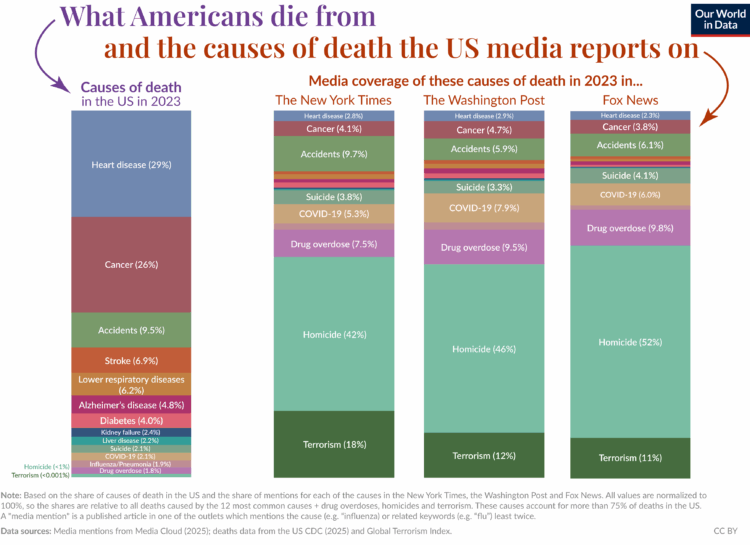
    Our World in Data compared causes of death in the United States against how much those causes are covered by the New York Times, Washington Post, and Fox News. The results are about what you would expect, based on coverage data from Media Cloud.

    Rarer events, like homicide and drug overdose, are reported more heavily, whereas everyday causes, like cancer and heart disease, are reported less.

    This, of course, is because the news covers things that are out of the ordinary, which is what readers and viewers are looking for on a by-the-minute timeline. Not many people care that mortality rates, which take more time to estimate than reporting on single events, are the same as yesterday.

    But, as residents of this planet, it is beneficial to know that life is not always getting worse. It’s good to get a reminder sometimes.

  • The Oatmeal reviews AI art

    October 7, 2025

    Topic

    Artificial Intelligence  /  art, Oatmeal
    Image

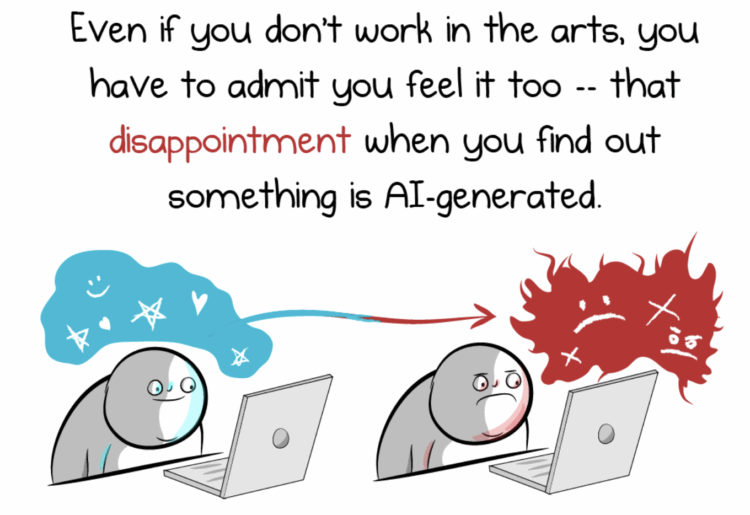
    Matthew Inman, the cartoonist who illustrates The Oatmeal, breaks down his feelings towards AI-generated art. When you remove the work, pain, mistakes, intention, and ultimately, the person from the art, the true value is lost.

  • Removing the process of creation

    October 7, 2025

    Topic

    Artificial Intelligence  /  Casey Neistat, creativity, OpenAI, slop, Sora

    OpenAI released Sora, which lets users easily generate videos with a prompt. The videos present in a TikTok-like feed and provides us with another source of endless scroll. Thank you, internet gods for your benevolence. Casey Neistat, known for his YouTube-ing, voices his concerns.
    Read More

  • Page 6 of 409
  • <
  • 1
  • ...
  • 3
  • 4
  • 5
  • 6
  • 7
  • 8
  • ...
  • 409
  • >

Get access to courses, tutorials, and more resources.

Become a member →

Recently for Members

January 15, 2026
Remake the chart, from reference to interesting bits

January 8, 2026
Visualization Tools and Resources, December 2025 Roundup

December 31, 2025
A year of FlowingData, in 2025

December 18, 2025
Ridgeline chart for fun and clarity

December 11, 2025
Looking for the right angles into the data

Second Edition

Image Visualize This: The FlowingData Guide to Design, Visualization, and Statistics (2nd Edition)
New tools, refined process.

Order: Amazon / Bookshop

Browse by Chart Type See All →

Line Chart Choropleth Map Density Plot Moving Bubbles Parallel Sets Bar Chart Race Radar Chart Mosaic Plot Dot Map Cartogram

Browse By Topic

  • Visualization

    Seeing data

  • Maps

    Seeing geographic data

  • Infographics

    Explaining data

  • Networks

    Connecting data

  • Statistics

    Analyzing data

  • Software

    Working with data

  • Sources

    Getting data

  • Design

    Making data readable

Made by FlowingData

  • The Process

  • Data Underload

  • Chart Everything

  • Guides

  • Books

  • Shop

  • About
  • Contact
  • LinkedIn
  • Instagram
  • Bluesky
  • RSS
Copyright © 2007-Present FlowingData. All rights reserved.
Image
Advertisement