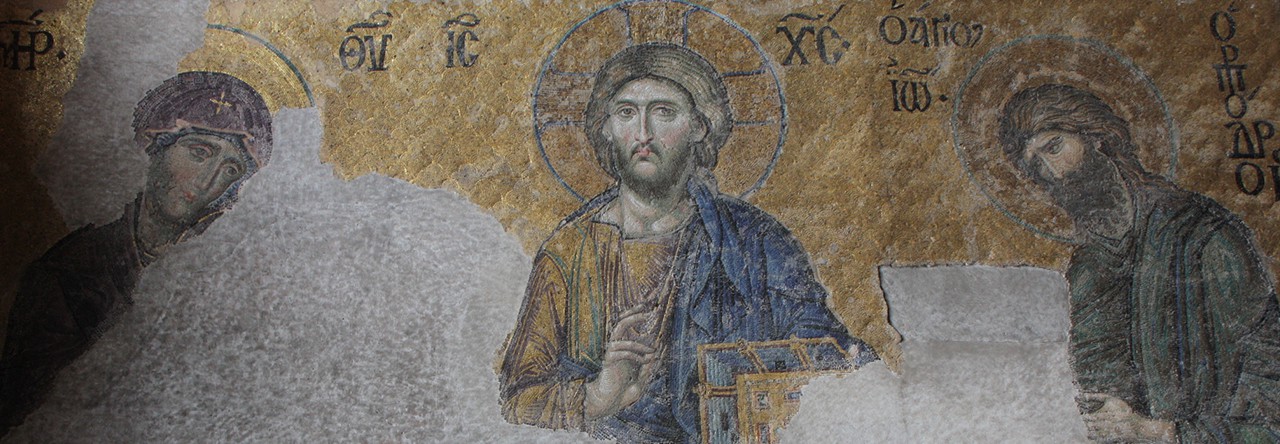
Christ Destroys Hell 

Image

This is the third post in a series of 4 looking at 5th Century Christian hymns as recorded in Stephen Shoemaker’s book, THE FIRST CHRISTIAN HYMNAL. The first post was Jesus in the Old Testament and the previous post was Salvation for All the World.

What is clear in the hymns is that Christ did not come into the world to send sinners to hell, instead He came to save all humankind from hell. And Christ does this for every human being who ever lived since the beginning of the world or who will exist in the years to come. He is Lord of all.

Image

… And to those who were in hell, you proclaimed the resurrection and life. (p 43)

Presumably Christ proclaims the resurrection and life to sinners, since the righteous wouldn’t be in hell. [However, the hymns may not be distinguishing between Hades (the place where the dead souls go) and hell (a place of punishment and torture).] In any case, Christ descends into hell to free all of its captives.

The power of the Lord annihilated hell and brought those who were in darkness to the light… (p 63)

Image

Christ has risen from the dead, He shattered the bonds of death, He put hell to shame and annihilated the power of the enemy, and announced to the us the good news of resurrection and life. (p 67)

And those who were sleeping in hell, the condemned, You brought them from darkness into light. (p 147)

Today the Lord shone forth from the tomb, and illuminated the entire world …  (p 259)

Image

Again, we see a heavy emphasis on Christ rescuing all the dead from hell (whether they deserved it or not! – which is the definition of grace), and saving the entire human race, not to mention the rest of creation. The Christians of the 5th Century were singing and celebrating God’s love and salvation for all of humanity, not limiting Christ’s efforts to believers, but rather proclaiming the Good News to the entire world. This is why they believed they had a message for all the world as Christ’s salvation affects everyone and everything.

Next: God So Loves the World

Salvation for All the World

The First Christian Hymnal: The Songs of the Ancient Jerusalem Church: Parallel Georgian-English Texts

This is the second post in a series of 4 looking at some 5th Christian hymns as recorded in Stephen Shoemaker’s book, THE FIRST CHRISTIAN HYMNAL. The first post was Jesus in the Old Testament.

The Prophet Joel proclaims: “And it shall be that whoever shall call upon the name of the Lord shall be saved…” (3:5) He is claiming God’s lordship over everyone in creation, not only the Jews. Christ comes to save all people – He is the Savior of the entire world. This theological truth is repeated frequently in this collection of early Christian hymns because it was a main focus of the Gospel proclamation. One hymn says Christ …

Image

… destroyed the sins of the world. Through his love of humankind, He saved us by the precious cross, He granted resurrection and life to all.  (p 45; Emphases in this and all quotes is added.)

This theme is repeated in many forms in these hymns:

You who were born from the Virgin, O Christ God, for the sake of the entire world. (p 47)

… you are God and saved us all.       …  By your resurrection, Savior, you saved the human race and delivered it from the corruption of hell with power. (p 53)

Image

… by His resurrection he delivered the world from darkness. (p 183)

… you granted resurrection to all by your cross. (p 201)

This truth that Christ saves everyone from sin, death, hell, was incorporated into the prayers of the early Church:

Image

But because of Your goodness You receive everyone who turns to You with a humble heart and a repentant spirit. (My Orthodox Prayer Book, Kindle Location 798-799)

Christ’s saves the entire cosmos from the grip of sin and death. Christ’s work and message is universal, applying to everyone and everything in the created cosmos.

Next: Christ Destroys Hell

Jesus in the Old Testament 

The First Christian Hymnal: The Songs of the Ancient Jerusalem Church: Parallel Georgian-English Texts

This is the first post in a series of four looking at the oldest known Christian hymnal from the 5th Century. In this first post, we are looking at 3 hymns which speak of Christ’s activities in the Old Testament as reported in Stephen Shoemaker’s book, THE FIRST CHRISTIAN HYMNAL.

Some Church Fathers were certain that the more anthropomorphic appearances of God in the Old Testament were actually theophanies of Christ. This is based on their reading of Jude, which some English versions of the New Testament translate as:

But I am determined to remind you—although you once knew all this—that Jesus, having saved a people from the land of Egypt, secondly destroyed those who were faithless … (Jude :5)

Image

Jude does credit Jesus Christ with guiding the Israelites out of Egypt into the Promised Land.  It was also Jesus who dealt with the rebellious Israelites in the wilderness. So, one of hymns sings:

Christ our God swallowed up Pharoah and his chariots in the sea, and He led forth his people. Joyfully they were crying out and saying: Let us sing to the Lord, for he is gloriously glorified. (p 11)

As we profess in the Nicene Creed it is Christ as Creator “by whom all things were made”, so too the hymn says:

Image

You are the Light, Christ, by your light you illuminated us. You who created light and darkness, You are mighty and merciful, O Lord. (p 273)

Another hymn also proclaims Christ to be the creator of the cosmos:

Christ the King, who clothed the heavens with stars, and made the earth fruitful for enjoyment of humankind, sing to him, all his works, and exalt him above all unto the ages. (p 129)

Image

Many early Christians were convinced that Christ is revealed in the Old Testament texts. Generally, in any text in the Jewish Scriptures in which God is personified, they believed it was actually an encounter with Christ rather than with God the Father. Christ as the Second Person of the Trinity was active in creation, in leading Israel, in the revelation of Divine Wisdom and in the salvation of God’s people.

Image

Next: Salvation for All the World

Persistently Seeking Enlightenment

Image

Then it happened, as He was coming near Jericho, that a certain blind man sat by the road begging. And hearing a multitude passing by, he asked what it meant. So they told him that Jesus of Nazareth was passing by. And he cried out, saying, “Jesus, Son of David, have mercy on me!” Then those who went before warned him that he should be quiet; but he cried out all the more, “Son of David, have mercy on me!” So Jesus stood still and commanded him to be brought to Him. And when he had come near, He asked him, saying, “What do you want Me to do for you?” He said, “Lord, that I may receive my sight.” Then Jesus said to him, “Receive your sight; your faith has made you well.” And immediately he received his sight, and followed Him, glorifying God. And all the people, when they saw it, gave praise to God. (Luke 18:35-43)

Image

St Ephrem the Syrian comments that it is the blindman’s persistence in praying for Christ’s mercy that ultimately results in the Lord granting him his prayer:

Blessed are you, too, courageous blind man whose great boldness enlightened you. For if you had been silent as you were admonished, silence would have kept you in darkness. Blessed is your boldness for in it you also offer a type, that the sinner, if he be bold, will obtain mercy. (HYMNS, p 331)

Image

Christ our Lord teaches us:

‘Ask, and it will be given you; seek, and you will find; knock, and it will be opened to you. For everyone who asks receives, and the one who seeks finds, and to the one who knocks it will be opened.’ (Luke 11:9-10)

A side comment about the Gospel lesson – Jericho (the city where the miracle in the above passage from St Luke takes place) is mentioned in several Gospel passages.

Image

1]  It is the city where one or more blindmen had their sight restored (Matthew 20:29-34 mentions 2 blind men; Mark 10:46-52 which names the one blind man – Bartimaeus; Luke 18:35-43 – above quote – mentions one nameless blind man). Why the differences in the various details of these Gospel lessons? Perhaps the evangelists remembered them differently, or Christ healed the blind on more than one occasion in Jericho and they are remembering different events or the details they focus on best fit their understanding of the importance of the miracles. Healing the blind also has a symbolic importance – enlightenment.

Image

2] Luke 19:1-10 places the narrative of Zacchaeus in Jericho.

3] Luke 10:25-37 mentions Jericho as the setting for Christ’s parable of the Good Samaritan.  Luke particularly connects Jericho with enlightenment – for the blind man and for Zacchaeus, but also the Good Samaritan parable is intended to enlighten the lawyer who questioned Jesus while endeavoring to show how holy he was for keeping the Law.

Image

Genes 

Image

Here are a collection of comments about genes from various scientists. Although the Bible doesn’t mention them, everyone has them – they are part of our God-given human body. While we can’t escape them, neither do they predetermine who we are or what we will do. 

“A newborn infant is not a blank page; however, his genes do not seal his fate. . . .  My genes have indeed determined what I am, but only in the sense that, given the succession of environments and experiences that were mine, a carrier of a different set of genes might have become unlike myself.” (Theodosius Dobzhansky , THE OXFORD BOOK OF MODERN SCIENCE WRITINGS, p 23) 

God commanded us humans to be fruitful and multiply, and God made genetics part of this reproductive process. The genes are one way for there to be orderly reproduction in which any species produces offspring similar to itself. 

Image

Life is a slippery thing to define, but it consists of two different skills: the ability to replicate and the ability to create order. Living things produce approximate copies of themselves . . .  In Erwin Schrodinger’s phrase, living creatures ‘drink orderliness’ from the environment.  

The key to both of these features of life is information. The ability to replicate is made possible by the existence of a recipe, the information that is needed to create a new body. (Matt Ridley, THE OXFORD BOOK OF MODERN SCIENCE WRITINGS, p 37) 

DNA is another form of Scripture that has recorded what God has been doing in humans (or any species for that matter) since creation came into existence. 

Image

In the beginning was the word. The word was not DNA. That came afterwards, when life was already established, and when it had divided the labor between the separate activities: chemical work and information storage, metabolism and replication. But DNA contains a record of the word faithfully transmitted through all subsequent aeons to the astonishing present. (Matt Ridley, THE OXFORD BOOK OF MODERN SCIENCE WRITINGS, p 40) 

To understand humans biologically, we have to understand genetics, for the genes record the information which is being passed down from one generation to the next. 

Image

… the novel feature of biological systems: that, in addition to flows of matter and energy, there is also the flow of information. Biological systems are information processing machines and this must be an essential part of any theory that we may construct. We therefore have to base everything on genes, because they carry the specification of the organism and because they are the entities that record evolutionary changes. (Sydney Brenner , THE OXFORD BOOK OF MODERN SCIENCE WRITINGS, p 44) 

Image

We can study ancient humans through anthropology and archaeology – excavating ancient cities, sifting through the remnants of cultures which disappeared long ago. Even if those cultures left no written history, we can still study them and learn a great deal about them. We also can study our current genes to see how humanity has changed through history. 

Image

Fossil bones and footsteps and ruined homes are the solid facts of history, but the surest hints, the most enduring signs, lie in these minuscule genes. For a moment, we protect them with our lives, then like any runners with a baton, we pass them on to be carried by our descendants. There is a poetry in genetics which is more difficult to discern in broken bones, and genes are the only unbroken living thread that weaves back and forth through all these bone yards. (Jonathan Kingdon, THE OXFORD BOOK OF MODERN SCIENCE WRITINGS, p 189)

Image

Psalm 85 

Image

LORD, you were favorable to your land; you restored the fortunes of Jacob. You forgave the iniquity of your people; you pardoned all their sin.

Image

You withdrew all your wrath; you turned from your hot anger. Restore us again, O God of our salvation, and put away your indignation toward us. Will you be angry with us forever? Will you prolong your anger to all generations? Will you not revive us again, so that your people may rejoice in you?

Image

Show us your steadfast love, O LORD, and grant us your salvation. Let me hear what God the LORD will speak, for he will speak peace to his people, to his faithful, to those who turn to him in their hearts.

Image

Surely his salvation is at hand for those who fear him, that his glory may dwell in our land. Steadfast love and faithfulness will meet; righteousness and peace will kiss each other. Faithfulness will spring up from the ground, and righteousness will look down from the sky. 

Image

The LORD will give what is good, and our land will yield its increase. Righteousness will go before him, and will make a path for his steps.

Image

[Too often people think the only way to consider God is as an angry judge always ready to condemn sinners. Yet, the Scriptures are full of references to God as patient, long-suffering, merciful, gracious, both slow to anger and not staying angry for ever. Psalm 85 is an appeal to the God of mercy and love to remember us, the people He created, and to forgive us so that we can continue to receive His love and mercy. Our constant prayer – Lord, have mercy – is offered up because we believe God to be good, easy to be entreated, merciful, forgiving and kind. Our prayer is a bold appeal to God’s nature, it is not a pathetic, groveling fear in the face of a tyrannical, unpredictable ogre. We are boldly telling God what we want Him to do – be true to Your merciful and loving nature. The prayer is not desperate and fearful, but an act of faith, hope and love on our part.]

Looking at Winter Weather 

Image

Bless the Lord, winter cold … (Daniel 3:67; Azariah :45)

Image

Winter’s cold is mentioned in the Bible, but rarely, as Middle Eastern climate tends to be moderate, so its weather didn’t make the news very often. Armies tended not to go to battle in the winter as summer was a more favorable season for ancient armies to march forth to war and to maintain supply lines – rainy seasons put a damper on ancient military efforts. Some of the texts imply that winter was not much liked by many ancients in the Holy Land.

Image

Those who were afraid of ice, much snow has fallen upon them. (Job 6:16)

Image

By the breath of God ice is given, and the broad waters are frozen fast. (Job 37:10)

Image

… the storm from the north and the whirlwind. He scatters the snow like birds flying down, and its descent is like locusts alighting. The eye is dazzled by the beauty of its whiteness, and the mind is amazed as it falls. 

Image

He pours frost over the earth like salt, and icicles form like pointed thorns. The cold north wind blows, and ice freezes on the water; it settles on every pool of water, and the water puts it on like a breastplate. and the water puts it on like a breastplate. (Sirach 43:17-20)

Image

Although I’m taking this next quote out of context, the sentiment expressed in it agrees with me.

Pray that it may not be in winter. (Mark 13:18)

Image

Then the LORD my God will come, and all the holy ones with him. On that day there shall not be either cold or frost. (Zechariah 14:5)

Image

Personally, I am grateful to learn from the Prophet Zechariah that when the Lord comes in His kingdom in the eschaton that cold and frost will be no more.

The Litany of Humility (II) 

Image

Image

This is the conclusion to yesterday’s post, The Litany of Humility (I), which we are praying from Prayer Book – In Accordance with the Tradition of the Eastern Orthodox Church, (Kindle Location 204-232). Putting others ahead of oneself is at the heart of humility. “Do nothing from selfishness or conceit, but in humility count others better than yourselves. Let each of you look not only to his own interests, but also to the interests of others.”  (Philippians 2:3-4)

That others may be loved more than I O Jesus, grant me the grace to desire it.   

That others may be esteemed more than I O Jesus, grant me the grace to desire it.  

That others may increase and I may decrease O Jesus, grant me the grace to desire it.   

Image

That others may be chosen and I set aside O Jesus, grant me the grace to desire it.   

That others may be praised and I unnoticed O Jesus, grant me the grace to desire it.   

That others may be preferred to me in everything O Jesus, grant me the grace to desire it.   

That others may become holier than I O Jesus, grant me the grace to desire it. 

That I may become as holy as I should O Jesus, grant me the grace to desire it. 

The Litany of Humility (I)

Image

In today and tomorrow’s posts, we will offer up the prayer, ‘The Litany of Humility’ from Prayer Book – In Accordance with the Tradition of the Eastern Orthodox Church (Kindle Location 204-232). It is a prayer whose words are often counterintuitive just as humility is often misunderstood because people prefer power, praise and popularity.

Image

O Jesus! meek and humble of heart, hear me. From the desire of being esteemed Deliver me, O Jesus.

From the desire of being loved Deliver me, O Jesus.

From the desire of being extolled Deliver me, O Jesus.

From the desire of being honored Deliver me, O Jesus.

From the desire of being praised Deliver me, O Jesus.

Image

From the desire of being preferred to others Deliver me, O Jesus.

From the desire of being consulted Deliver me, O Jesus.

From the desire of being approved Deliver me, O Jesus.

From the fear of being humiliated Deliver me, O Jesus.

From the fear of being despised Deliver me, O Jesus.

Image

From the fear of suffering rebukes Deliver me, O Jesus.

From the fear of being calumniated Deliver me, O Jesus.

From the fear of being forgotten Deliver me, O Jesus.

From the fear of being ridiculed Deliver me, O Jesus.

From the fear of being wronged Deliver me, O Jesus.

From the fear of being suspected Deliver me, O Jesus.

Next: The Litany of Humility (II)

The Church as a Kingdom of God’s Priests 

Image

At that time Jesus went through the grainfields on the sabbath; his disciples were hungry, and they began to pluck heads of grain and to eat. But when the Pharisees saw it, they said to him, “Look, your disciples are doing what is not lawful to do on the sabbath.” He said to them, “Have you not read what David did, when he was hungry, and those who were with him: how he entered the house of God and ate the bread of the Presence, which it was not lawful for him to eat nor for those who were with him, but only for the priests? Or have you not read in the law how on the sabbath the priests in the temple profane the sabbath, and are guiltless? I tell you, something greater than the temple is here. And if you had known what this means, ‘I desire mercy, and not sacrifice,’ you would not have condemned the guiltless. For the Son of man is lord of the sabbath.” (Matthew 12:1-8)

Image

One possible lesson we can glean from the above Gospel passage in which the Pharisees criticize Christ’s disciples for eating on the Sabbath is that Jesus in his response is telling the Pharisees that God always intended for all His people to be priests. In ushering in the Kingdom of Heaven, Christ makes all of us into God’s priests. This fulfills what God envisioned and promised in the book of Exodus:

Now therefore, if you will obey my voice and keep my covenant, you shall be my own possession among all peoples; for all the earth is mine, and you shall be to me a kingdom of priests and a holy nation. (Exodus 19:5-6)

Image

Jesus answers the Pharisees’ complaint by citing a story from the Old Testament of David and his companions who behaved as priests both in entering the temple and in eating the bread of the Presence. He also points out that the temple priests technically violate the Law in the temple by working and eating on the Sabbath and yet are guiltless. If all of God’s people are priests, as God intended, no violation of the law is occurring by gathering food on the Sabbath because everyone is behaving according to God’s will for priests.

The Book of Revelation says that Christ made all of us into God’s priests:

Image

... Jesus Christ the faithful witness, the first-born of the dead, and the ruler of kings on earth. To him who loves us and has freed us from our sins by his blood and made us a kingdom, priests to his God and Father, to him be glory and dominion for ever and ever. Amen. (Revelation 1:5-6)

“Worthy art thou [Christ the Lamb of God] to take the scroll and to open its seals, for thou wast slain and by thy blood didst ransom men for God from every tribe and tongue and people and nation, and hast made them a kingdom and priests to our God, and they shall reign on earth.” (Revelation 5:9-10)

Image

Every Christian is to be a priest of God Most High. This is a truth that the Pharisees and priests of Judaism could not accept. In Church history, Christian clergy also had difficulty with this concept. The Orthodox Church makes it very clear that there is a difference between clergy and laity. The development of the iconostasis further solidified the distinction between the clergy and the laity – excluding the laity from the altar area, though originally in the early church all laity (male and female) approached the altar to receive Holy Communion. Orthodoxy makes a distinction between the priesthood of all believers and the liturgical priesthood, but it needs to think more about how to treat all of Christ’s followers as priests as is described in Revelation in fulfillment of God’s wish in Exodus 19. Christ says His disciples are faultless for harvesting grain and eating it on the Sabbath because they are all priests of the Heavenly Father.