garote: (flounder garden)

We found Mira in 2005.

Image

If I hadn't been in the back yard at the right time, I wouldn't have heard her blind cries from the other side of the fence, as she dragged herself out from under the neighbor's house with failing strength.

Image
Image

La and I were pretty sure that without the immediate rescue, Mira wouldn't have survived the night. If a hungry animal hadn't taken her, the cold would have. She would have had one miserable day outdoors for her tiny life, and that would be it.

Image
Image

Instead she got formula, several flea baths, a hot pad to sleep on, and more formula. La was determined to show the world the proper way to treat this little creature, and we and the housemates threw ourselves into it. In a matter of weeks Mira's kitten ears unfurled and she doubled in size. We gave her run of the house, her own litter box, then pride of place on the bed between sleepy humans.

Image

We also gave her an absolute flood of affection and joy every day, which she reciprocated. In a few months she had doubled in size again, and we had a strong, graceful, lightning-fast, endlessly curious, and surprisingly well-adjusted little force of nature inhabiting the house.

Image
Image
Image

For a while one of her brothers would hang out in the back yard, and they would play. She briefly met her mother but didn't seem to recognize her. Other cats that weren't family made her nervous, and she would try and fight them. Sometimes I would have to charge outside to break up some ruckus, and she'd run past me in the other direction, into the house. Other times she would just trot up to me, like, "Where have you been? We're supposed to be patrolling this perimeter together, human."

Image

I discovered that she liked to follow me around. In the evening, I led her out onto the sidewalk, then to the corner. She sniffed everything, and hid under the parked cars when the moving ones rumbled by, and she always looked for me and caught up when I moved along. Pretty soon me and La and the other housemates were taking her on walks all around the neighborhood. Whenever we crossed a street we stood patiently on the other sidewalk until she worked up the nerve to canter across and join us. A little bit at a time, she developed her habits for avoiding cars and other dangers, and for three years, taking Mira out for the pre-bedtime walk was a household tradition.

We got a place in San Jose, so I wouldn't have to risk my life driving over Highway 17 to get to work. It was Mira's first big move, and we engineered it carefully, sticking close as she emerged from the box and cautiously learned the extent of her new empire.

Image

The house was two stories with a basement apartment. One day I was sitting at my desk on the top floor, and saw Mira's face outside the window. The window was set into the roof, and Mira had learned how to jump from the back railing to the eaves on the porch to the top of the house, and was standing on the little one-foot-wide strip of rooftop that sloped away from the window. Beyond was a 30-foot drop to the sidewalk. I wanted her inside the house pronto, so I opened the window.

The lesson she learned - of course - is that if she wanted into the house, sitting outside the door was the slow way: She got better results climbing up onto the roof and yelling at us from that precarious cliff outside the window. If we ignored her pleas and left the window shut, she would just yammer on, with us being quietly nervous inside. I think the longest we held out was half an hour. We knew it was a bad habit but didn't know how to un-train her, and we lived in fear of finding her smashed body on the sidewalk in front of the house one morning. But she never fell off. One time she got into a fight with another cat while on the roof which was very alarming, but she didn't fall off even then.

We definitely did almost lose her in San Jose, and I will never forget how close it came. One night La and I took Mira out for our usual walk, and we went up a block, then another. The city was especially quiet, and the conversation was good, and we kept going. Block after block we waited at the corner, and Mira trotted happily across the street, then along behind us, sniffing and darting.

Something like ten blocks north of the house, we finally turned around. We made sure Mira saw us, and was following us as usual. Then we kept talking. 20 minutes later we arrived at the house and went inside, and settled in.

20 minutes after that I was walking upstairs and suddenly stopped cold. "Where's the cat?" I said, out loud.

Heart in my mouth, I ran around the house, then ran around outside. We both called for her. Nothing. Feeling like time was essential, I hauled my bike outside and began pedaling north, retracing our route, calling her name every block. Mira had a chip in her ear but no collar. If she wandered away from our path, I would never, ever find her.

Eight blocks up, I suddenly heard a frantic meowing, and turned to look behind me. Mira had come running out from underneath a parked car and was jogging behind the bike, calling to me over and over. I nearly burst into tears, then nearly fell off the bike, then slowed down and turned a half-circle. She jogged behind me, eight blocks back the way we had come. When I got near the house, she ran past me, up to the front steps, then sat down to wait for me to open the door like it was the end of any other walk.

We fed her a small mountain of cat treats that night.

She loved being an indoor-outdoor cat. We knew it was dangerous but she lived so much more exciting of a life, and seemed all the more happy to be inside with us each night. Her favorite spot in the San Jose house was the top of an enormous armoire which had a commanding view of the living room and front door, but she spent plenty of time on my desk, or in La's study, lounging in a cat bed while we tinkered nearby. She oversaw many dinner parties, and collected endless praise for her self-possessed but friendly nature.

"Self-possessed" really is her main attribute. She's determined to do exactly what she wants, and it's hard to stop her. The best part is, most of the time, exactly what she wants to do is love you. And that's poetry. She'll sit on your chest, bump her nose onto yours, lean into both your hands on either side, and stare into your eyes with her own deep emerald ones and purr.

Image

Are you sitting in a chair? Mira will jump up onto the arm and perch on it. If you lean your head against her, she'll lean back.

Image

Are you in a bed? Mira will nose her way under the covers and curl up in a ball against your chest. Purr, purr.

Image
Image

Bend down and show her your back when she's on a table, and she'll step onto you and take a ride around the house.

Image

Present her with your forehead, and she'll try and lick it clean with her little sandpaper tongue. Humans are so bad at cleaning; we clearly need help.

Image

When she was a bit smaller she would climb onto my shoulders and drape herself around my neck like a scarf. If you put on a sweater, she will turn it into a platform and take a nap.

Image
Image

In 2010 I moved to Oakland. This was the first place I'd rented where I had permission to make changes, and the first thing I did was install a cat door, so I didn't have to be Mira's butler all day long. The door had a cover you could use to lock it at night, which was important because Oakland had plenty of critters wandering around. She spent a lot of time roaming the back yard, or piloting a cat bed in a sunbeam next to my desk. That was a tough couple of years for me, and the continuity of her presence, and her cat-like priorities in life, set a good example.

Image
Image

After that was a place in Berkeley, with beautiful hardwood floors but no cat door. She and I would sit together on the front step in the evenings. Around this time my sleep apnea started to give me terrifying nightmares, and since I was living alone I relied on Mira to shine a beacon with her animal nature whenever I woke up confused and afraid in the dark. Her self-possession, her being totally immune to any and all metaphysical worries, the fact of her warm nose, instantly banished the horror. She and it just could not exist at the same time.

I owe her a lot, you know.

A year after that, she found her best home on Linden Street. The cozy downstairs apartment was half her empire, and the garage was the other half. I installed cat doors in both, and she started lounging and patrolling between them, with the back garden as her hunting ground. She would catch and eat spiders, which always shocked me. Did she know whether they were poisonous? Could she determine that by smell, or was she just winging it?

Image

I filled the place with potted plants, inside and outside. Surprisingly, Mira never developed a habit of chewing on them, though she would nibble on the crabgrass whenever it invaded the back yard, and inevitably hork it back up about an hour later. All my life I've read conflicting information about why cats do this and whether it should be encouraged. It was a moot question really, because I hated crabgrass in the back yard and would dig it out as soon as I saw the first blade, so Mira didn't get much chance to "have the salad" as I called it.

Image
Image

Shortly after me and Mira moved in, I met Kerry. Kerry adored Mira. Everyone adored Mira of course, but Kerry also backed it up with work. She helped me find better flea medication, better food bowls, better kibble. We got regular vet checkups going. Kerry had her own cat too and we split our time between her place and mine. Mira and Princess never met, but they were a kind of extended clan. They ended up sharing a lot of the same accessories.

Image
Image
Image

In 2017, Kerry noticed a lump on Mira's rear leg, and a quick vet visit later I learned it was an aggressive tumor, and made the agonizing decision to surgically remove the leg.

Image

Mira spent a week or so high as a kite and resting next to me and Kerry in turns, while we made sure she didn't tear her stitches. As soon as we let her get up, she fell over. Then she got up again, and fell over. Again, and again, for almost half an hour, while Kerry and I looked on tearfully. And then at long last, she formed a tripod, and stood there. Two days later she was hopping around sniffing at things like usual. A few days after that she was chasing cat toys again.

In retrospect, we understood that the dismay had been all ours. Mira didn't spend a single second feeling sorry for herself. She just kept falling down and getting back up until something worked. We loved her for that. We tried to take her lesson.

Image

We didn't know if the cancer was gone. We didn't know if she had ten days, or a month. We hoped for one more year.

We got nine!

Image
Image
Image
Image

Now it's 2026, and Mira has spent most of the 2020's being a grand old lady, hopping between kitchen, garage, and a series of sunlit tuffets in the back yard. When I've been here in the evening, I've taken her on walks, out past the driveway and around the block while she hops curiously from one plant and post to another. Over the years at Linden St a long procession of housemates, upstairs and downstairs, have adored her.

ImageImage
Image


In time she lost the ability to jump down from the cat door in the kitchen window, so I removed it. For the last five years everyone has taken care to haul her inside before nightfall, every single day, because one more encounter with a raccoon would surely be her last.

This year, and last year, her little routine with me has been to barge in through the cat door, yell at me, cram herself under the covers and purr me back to sleep, then yell me awake again about an hour later. With part one accomplished, she then sits down and waits patiently until I have enough clothing on, and when I open the door she hops around the side of the house to the hose in the back yard, which I turn into a little waterfall just for Her Majesty, and she has a long drink. Sometimes I stand there and pet her, sometimes I head back around put the bags on my bike. Either way I shut the hose off a few minutes later, and she settles down on whichever of the pads in the back yard is currently lit by a sunbeam. Then I'm off to work.

Image

I have spent time living in other places, but Mira stays put. I made that decision nine years ago. The gate and the fence now form a fine boundary to her indoor-outdoor life, and she's very familiar with the layout. As a very old cat, probably with memory issues, I want her to remain in familiar surroundings, even if it means we're apart. I absolutely owe it to her. She's been with me for almost half my life, and all that time she's reminded me to enjoy sunbeams, breathe deeply in the present, and put metaphysical fears in their place. Even when I've been away for months, the knowledge that she's been here asserting her view of the world through those emerald cat eyes has reassured me that life makes sense.

Image

Nine years on three legs is definitely - pun intended - a good run. And this whole time, her retinue of human servants has kept her safe in spite of herself, since if she had access to the outdoors at night she would definitely go there, raccoons be damned. But the threat that came calling wasn't a raccoon, or a dog, or a hawk, or a rat trap, or a car. At long last, it was the cancer.

At first I thought she had an infection, because the left side of her face seemed swollen. I took her to the vet and they discovered a growth on her upper palate, starting to push her teeth out of the way. It wasn't painful, as far as we could tell, but it was already growing into both her mouth and her sinuses, and it was growing fast, and there was absolutely nothing anyone could do about it. Surgery was impossible. Another separate tumor was growing near her nose, and where there's two, there's possibly a dozen.

Gradually, agonizingly, over a period of weeks, Mira has been losing her ability to eat, and breathe. Both are already difficult for her. Soon one or the other will be impossible. There are mobile vets who will make house calls and provide two injections - one the equivalent of morphine, the other a drug to stop the heart - and now I have another choice to make, and there is only one option: All I can decide is when. In the morning she still yells me awake, though her voice is weakening. In the evening she still sits happily on my chest, though I can tell purring is harder. I don't want her to starve or choke to death. I owe it to her to do something.

Twenty years is astonishing for a cat that's lived such an adventurous indoor-outdoor life as little Mira. For almost half that time, ever since the leg came off, I've been fighting within myself over the desire to truly feel that little surge of joy I get when she trills "hello" to me from a sunbeam in the back yard, and the need to build a wall of emotional detachment so I can make a hard decision if - when - the cancer returns. I had no idea I would get nine more years. Mira has kept on being her self-possessed cat self straight through it, and it's a lesson for us all. I'm still doing my best to learn it. I have maybe a week left with her, maybe only a few more days. We will sit together in a sunbeam.

Image
garote: (maze)
In about five years, our culture will discover a new social problem, where groups of (mostly terminally-online) people socially engage with each other and the outside world the same way they engage with the AI bots they use for their hobbies and careers.

Think of it less like a communication style and more like a mental disorder. It will go beyond simple speech patterns and tactics; these people will start to see other people as chatbots, and treat them in the same disposable, exploitable way.

This will be the thing that the current crop of new parents will panic about in their children.

I'm willing to bet it will mostly be a "young man" problem, because that group is historically a combination of:

1. Cynical about social interaction.
2. Not wise.
3. Hyperfocused on their work (because they need to survive and don't know how yet.)

Treating other people like chatbots will also have an ugly resemblance to a role young men are already vulnerable to, that women are all-too-familiar with: Being a pick-up artist. Say the right things to "game the system", and the reward is yours. Then hit "delete" and move on. Or, if it's not working, retreat back into your reassuringly pliant community of robots. Real people are "hard mode." Who wants that?
garote: (programming)
Imagine a person who was born without the ability to hear. Ask yourself “what does their interior monologue sound like?”

You can tax your imagination trying to answer this, but you can also do another thought exercise that might explain why the question is a trap:

Imagine a new species of animals that communicate with each other through wireless signals, broadcast directly from one mind to the next, without anything visible or audible occurring. To be clear, this is not like using a telephone. They're not sending the sound of spoken words on some other frequency. The information that passes between them has no real equivalent in audible sound at all. You could try recording it and then playing it back as audio but it would sound like garbled hash to your ears.

Imagine that the animals call this activity “wiring”, and they can understand each other quite well using it.

Now imagine that, like you, these animals have an inner monologue -- the equivalent of what happens in your mind when you think a bunch of words, to figure something out, without actually speaking. But it's not exactly the same thing, because their primary method of communication is "wiring". So appropriately enough, when they think about sending signals without actually doing it, they call it “inner wiring”.

Now ask them what their “inner wiring” would “wire” like if they couldn’t “wire”.

The question is crazy because you don't know what the noun is, what the adjective means, or what the verb is doing. So you have to throw all that away. What you're really asking is, "how do you communicate with yourself, if you can't use the units of expression and reasoning that you need to communicate with others?"

It's obvious that you can think without "inner wiring". You yourself are proof of this. Want to know what it would be like? You have an answer: It would be like you. And yet, you can still think quite complicated things without engaging a wireless transmitter ... or opening your mouth.

You're using something adjacent to - underneath - those sensory means of communicating. It would be there, even if those means were stripped away. But here's a fun riddle for you: What would thinking be like, if all those sensory tools were stripped away? I don't mean, "what if you were suddenly struck deaf," I mean, "what if you somehow learned to think without having any senses at all?"

Give us even the faintest, most tenuous sense - anything at all - and with time and willpower we can conjure the most amazing thoughts. But what if there was nothing? I rather suspect there would be no thought either.

And so we arrive at ... "Sum, ergo cogitare possum". René Descartes would be proud?? Hmm.
garote: (ultima 6 workshop)
In the years leading up to my father's demise, he began giving away almost all of his possessions, and over time I realized that you could separate the stuff he was getting rid of into categories, grouped by the questions you would need to ask yourself about each group. Some examples make the point:

"This ping-pong table: I have trouble just walking and holding a glass, so I am definitely done playing sports. This table needs to be with someone else."

"These books: They look nice on a shelf, but my vision's not good enough to read such small print. The most rewarding thing I can do with them now is enjoy the act of giving them away, to people who would be grateful."

"These nice clothes: They look good on me, but if I'm honest, I can't be arsed to go to fancy events that would mandate them. Besides, shoelaces, and buttons, and neckties, are a nuisance now. I'll make them into gifts."

"This truck: My wife doesn't like it, and recently the DMV said I was no longer qualified to safely drive. I'll never need it again. Time to get rid of it."

"All these tools in the garage: I use them to repair stuff. Do I want to spend my limited time repairing stuff? Especially now that my concentration and coordination are this shaky? Not ever again. Time to give them away."

The end-goal, which he never quite reached, was to have empty bookshelves, an empty garage, an empty driveway, and empty closets. It was a smart thing to do, and in his case it was complementary to what was happening in his mind, which was also being slowly emptied by dementia. One of the best things you can do to fight dementia is to engage socially, and asking the people you know if they might like some free stuff is a great excuse for it. Just about everyone likes free stuff. So come on over and let's chat for a bit while you muscle this ping-pong table into your car.

ImagePopular culture has recently extruded a quirky little growth of books and videos about "Swedish Death Cleaning," based on the common problem that Americans have with spending too much time seeking and maintaining piles of stuff, and the quaint feeling that anything Swedish must be a clever, less-stressful alternative to anything American. We love having space and we love accumulating piles of material goods onto that space, and in multiple ways that makes America the envy of most of the world, where space or material goods - or both - are very expensive. But our typical approach to everything good, is to do it until it's so incredibly over-done it flips around and becomes evil. So what do we do when we're drowning in piles of stuff, for example, too many books? We buy a book explaining how to solve the problem. Which is why I think the opening sentence of every book and video about "Swedish Death Cleaning" should be: "First thing, return this item, and get your dang money back."
But I think of those books, when I think of what my Dad was doing. Around here, it's apparently so hard to counteract the desire for material goods that we can only succeed by invoking the finality of death itself. When you're gone, all this crap will still be here, but - and I guess this is really hard for people to internalize - you won't actually get any joy or utility from it, because your body is kind of an essential component. Physical objects are beholden to physical bodies, and no amount of mental attachment in the form of sentimentality or stubbornness can overcome that. If you apply this lesson about death to the lifetime that precedes it, you get the idea that you're are always paying a physical price, or taking on a physical debt, for every object you keep. The satisfaction you feel as you arrange and curate it, and marinate in the knowledge that it's there when you need it, gets smaller with time, but the object continues to require exactly as much space, and shelter, as always. Or if you neglect it, you eventually have to clean it up. At the same time, your own body gets harder to maintain, making the management of your stuff even more annoying. I think that's a big reason why this lesson is naturally easier for older people.

On the other hand, if you're the rebellious type, you might refuse to embrace it, and refuse harder every year, until your house and property are a grimy mausoleum of books and furniture and old letters and jars of urine...

Anyway, the point I'm trying to arrive at, is that personal experience and popular culture have both conditioned me to be very skeptical about accumulating stuff. I've found that it's very hard to get rid of, or just to let go of, and it's also hard to stop it from accumulating in the first place. There have been times in my life when I moved into a new living space and actively tried to fill it, just because I suddenly had empty rooms, or open shelves in the garage. It's fun! And plenty of times in the last decade or so, cruising around Oakland, when I've found free items and felt the urge to haul them home just because, hey, free stuff! I could re-stain this coffee table and it would look pretty good, and I could always use more plates and cups (except that honestly I couldn't.)

I'd like to sound wise and cool by saying that what I've truly embraced is experiences, rather than possessions. How mature! But no, the real motivation here is, dealing with stuff is just an absolute pain in the ass. It's the physical debt. It's inescapable. You can defer it for a very long time by, for example, buying a larger piece of property than you really need, and maintaining couple of extra rooms to heap the stuff into. Workshops and sewing rooms and libraries and personal "maker spaces" and so forth can be very pleasurable and useful as well, and if you're living with someone else, an extra private room for one or both of you can be essential. Having a hobby is one of the keys to a long life, and enjoying your older years, and I personally have two huge cabinets in the garage filled with bike parts and little electronic bits. But it is really easy to give time to the maintenance and curation, especially when it only feels like fun, and it's really hard to reclaim that time later on, when one bicycle and one shelf of parts has expanded to three - no, five - no, let's be honest, seven - bicycles and most of an entire garage of tools, spare parts, and working space. Good ol' Stephen King opined many years ago in a book about writing that art needs to be a support system for life, and if you have it the other way around, you're going to have problems. I feel like I'm constantly in danger of the same thing, except it's not art, it's just the material goods I might use to make art. Piles of it, growing organically like some malevolent compost heap.

Ironically, I never used to worry about this until I became a "property owner" (by which I mean, I took on a massive loan) and was suddenly completely responsible for maintaining an entire house. You'd think that since I could do anything I wanted with the space, I would feel free to cram it full of stuff. Well, perhaps if I didn't have that massive loan. To deal with the loan I've been renting almost all the space out to other people, and I'm being paid to maintain space for them instead of me. That means a garage full of tools, arranged into labeled boxes. And currently, it means all the rest of my materials for living part-time in Oakland are crammed into the garage as well, so I can maximize the rentable space. I guess it's not your typical "home owner" experience. I guess I've never actually had that experience. Property has meant much more responsibility than freedom, for me. But maybe that's had a positive effect overall because I've been forced to to learn the lesson about the physical debt of stuff.

This creates a cognitive dissonance sometimes. I feel like I'm expected by society around me to have a particular living space, because of my age. If you're 50 years old, shouldn't you have a house with a bunch of rooms, all your own, all deliberately furnished, with lamps and framed art, and a big dining room with seats for a whole party, and maybe a rug that really ties the place together? A den, a man-cave, a craft room? Plus a back yard, with a barbecue or a pool or both? If you have a living arrangement that's smaller, or you technically have the space but you're putting it to some other use (like renting it out), does that mean that you messed up somewhere along the way? College people and early adults can be expected to make do in apartments, living on top of each other, but by the time you're pushing out to the edge of middle-age, shouldn't you have "arrived" in a big, permanent, curated, possibly suburban, residence?

Here's the strange thing about that: I've had those things already. For like, years and years. I used to do Friday dinners with at least six people around the table like clockwork. I had a series of amazing kitchens, a series of dens, a series of man-caves, in different places. They were wonderful. I have great memories and a giant pile of photos. That all started in my late 20's and ran pretty consistently, until I began aggressively paring my stuff down. I gave away the dining room table in 2012, and downsized to one that seats four. Almost all the time, what I enjoy now is a meal with one other carefully chosen person. Almost all the time, my hobbies happen with equipment that occupies a space ranging from a table-top to about eight feet of shelving. Some external force keeps whispering to me that, if I really want to fit in with society, I need to expand that out again, and damn the expense. Kick all the tenants out and claim the den, dining room, and driveway, stock a pantry with bulk items, fill up all the walls with art, play my stereo much louder because no one is sharing any walls, and organize another series of dinner parties. Forget about being portable, and minimal. And when I hear that whisper, that expectation and the pressure behind it, something in me hisses back, "No! Shut up and go away! This is better!"

Which is odd, right? Because I really did like doing all that. When I first moved to Oakland I rented a five room flat, and my housemate and I filled all of it immediately. We both got craft rooms, and we muscled the giant table with room for eight into the dining room. Turns out the flat upstairs was a classic "punk house" though, where every single weekend was a giant party, so we didn't even need the table; we'd just walk upstairs. Either way, the space and the furniture felt essential, like we needed it to properly experience life. I hauled that table to two other houses, then at some point I can't remember, I must have decided it wasn't worth the work, and I needed to figure out what came next.

This is a kind of transition I run into, over and over: Society and culture implanted me with a bunch of long-term goals, and I spent many years chasing them down, building them up, and then having them accomplished - taking the metaphorical victory lap - and then I went skating ahead, into a place society and culture made absolutely no mention of, beyond the goal they are still, even now, stridently endorsing, and the message is so loud and constant that it makes me think the right thing to do is turn around and go back to where I was - the victory lap - and stay there, even though I don't actually want to. Just so I can stop feeling the cognitive dissonance of this loud message. When everyone around you seems to be clamoring for something you don't want, how can you help but ask, "What's wrong with me?"

I think in my case, it's the awareness of death that caused me to "go wrong", combined with an ever-increasing awareness of the much longer arc of history that created the world I grew up in. Like, when you grow up in a house with separate bedrooms and a giant dining room table, that feels like your goal; and then you learn that your longer family history involves growing up with 13 siblings jostling around in a two-room cabin on a farm, or ditching all their possessions except a couple of suitcases to board a ship for another continent. And then you start looking at that giant dining room table with a more critical eye. Is it there because you need it, to have a real life? Or because your grandparents dreamed of having one, and now you get to make your own decision? Awareness of death has taught me that the most important factor, in whatever you decide, is whether it will get you more time with the people you love, or second to that, more time doing what you love.

It bites you in the end: It's possible to spend a whole lot of your time and money managing the stuff you think you need for a hobby, or just a level of material abundance that will make you feel successful, and in the meantime the chances you get to do stuff with the people you like - the people who really know you, and get what you're about - get smaller, and shorter, and then bodies fail or accidents happen and the chance is completely gone. You'll still have that organized workshop, that amazing classic car you rebuilt by hand, that house full of extremely well-matched furniture, but you'll eventually only have enough time to start figuring out who's left that you can pass it to, aside from indifferent strangers.

Dealing with this is a challenge! Because like I said, hobbies are vital. And it's a good challenge, honestly, because it's something you get to worry about only after you've avoided starving to death, succumbing to disease, or getting run over by an oxcart. It's led me lately to ask the question, am I going to go for a big career change, like I've been contemplating the last five years or so? Maybe it's time...
garote: (bards tale garth pc)
A Few Good Men (2009). After a string of gory murders, the owners of Studio 54 are placed on trial for operating a secret sex dungeon in the basement of the nightclub, behind the regular sex dungeon in the basement of the nightclub. Meanwhile, a detective (Guy Pearce) finds evidence that the killer will strike again, and hires a former dominatrix (Helen Mirren) to get him 'in the right headspace' to solve the case. (R, 96 minutes, also NC-17 version at 110 minutes. Four out of five stars.)

The Hunger Games (2009). Young prison camp inmates compete to see who can make the most appealing food items out of dirt. They are discovered by the warden (Bruce Dern), who arranges a multi-prison musical bake-off, during which they plot a daring escape. (93 minutes, PG-13. Two out of five stars.)

8 Mile Island (2011). A rabbit farmer named Rabbit, living in an illegal bunker deep in the exclusion zone around Pripyat, opens a petting zoo. KGB agents arrive to shut it down, and discover that the rabbits can freestyle rap. The farmer avoids prison by training the animals to produce propaganda. 'Rabbit's Rabid Rapping Radioactive Red Rabbit Revue' becomes famous throughout the USSR, and when the Soviet Union collapses, they begin a von-Trapp-family-style secret exodus from Ukraine into Belarus to avoid slaughter, hopping through forests and hiding in basements. (PG-13, some scenes of animals in peril, 105 minutes. Three out of five stars.)

Smile (2003). While brushing his teeth one night, a young boy comes up with an idea for a new toothpaste flavor. He and his friends sell jars of toothpaste out of the family garage, prompting lawsuits from big corporations. The "Toothpaste Kid" is elected major, then runs for president. As the election results are being announced, it is revealed that the boy is actually in a coma triggered by hitting his head on the sink in the opening scene of the film, and everything else was a hallucination. (79 minutes, PG-13, zero stars.)

Twilight (1988). A high school student (Martha Plimpton) is cursed by a homeless man (Pete Murphy) after hitting him with her truck, and begins to transform into either a werewolf or a vampire any time she hears the phrase 'like, oh my god'. Most of the student body is drained or eviscerated before her father (Christopher Walken) performs a ceremony to lift the curse. (85 minutes, R. Three out of five stars.)

Note: Spawned a whole series of Twilight sequels, where the curse moved to a procession of wacky victims: The high school principal, a sex therapist, a pilot on a mission to Mars, and finally, a squirrel. Decades later, fans continue to debate over whether it was more fun to watch the staff of an auto shop be terrorized by a werewolf vampire squirrel, or watch a werewolf vampire sex therapist try to do her job.

(The last episode.)
garote: (zelda library)
I poked into this book about ten years ago, and posted a sort-of review on Amazon. Then much later Amazon notified me that an automated system had detected a violation of its content policy, and in response it was taking down every review I'd posted on the site, over approximately 15 years.

It never told me what it had found, and the process is left very deliberately opaque as a cover-their-ass legal policy. I had zero interest in making some kind of appeal. That was the last in a series of signals to me that contributing any meaningful content into Amazon's universe of data was utterly foolish, and frankly I should have known that from the start.

Anyhoo, the review I wrote is below, preserved for the heck of it:


ImageIf this book had any more strawmen in it, it would have to come wrapped in bailing wire.
But that's rather beside the point, isn't it, because you and I both know that the people who sit down to read this book will fall squarely into only one of two categories, and that will determine how much they enjoy the experience:

The categories are:

1. People who pride themselves on having an "open mind" about creationism, and are looking for some kind of balanced presentation.
2. People who feel personally invested in the idea of divine creation and are looking for reassurance (or ammunition).

To save time, I'm going to assume that anyone reading this review is in one of those two categories. Anyone who falls into any other category would steer away from this book just after reading the title. Now I'll explain why the category you're in is important.

If you're in category 1, you're going to choke right when you get to the end of the introduction, where the author states quite boldly that Darwin's theory describes evolution as "a purely undirected process". If you have sharp eyes you can stop right there. The author hopes you won't notice this little falsehood, because the entire book that follows depends on it completely.

He will spend 20 looong chapters building a castle in the sky, made of many bricks, each an example of how incredibly unlikely it is that any of the components of modern life would spontaneously form in various "undirected" ways. But you don't need any of that, because you have recognized the switcheroo, and you know that the cornerstone of Darwin's theory is that evolution is a very directed process indeed. It is directed by a process that had been thoroughly described in all its myriad forms since his time. That process is given the name "natural selection" and it is both ruthless and incredibly creative. And, unlike what this book claims a few chapters in, it applies just as well to the precursor molecules that formed the first living cells, as it does to the living cells that followed. That selection process changes the numbers drastically.

But even so, the numbers don't actually need to be changed that much. To you folks with open minds in category one, here's something that may interest you:

Did you know that the eukaryotic cell - the kind of cell that makes up all plants and animals, every creature you can see with the naked eye - was quite likely created "by accident", by a very specific collision of two types of bacterial cell - archaebacteria and eubacteria, a billion years ago? It was a very unlikely smashing-together that resulted in a viable, new creature. In fact, in all of the Earth's history, it happened only ONCE. (How do we know it happened just once? Because when we examine the genetic code of various cell components in plants and animals, we can trace their lineage back, and we find that all the lines everywhere converge to one single parent.)

(Don't just take my word for it, take the word of a textbook, for example: The Cell, 2nd edition, by Geoffrey M Cooper of Boston University. Very much worth reading.)

Before that one eukaryotic cell appeared, archaebacteria and eubacteria ruled the Earth, for three billion years. It took three billion years, of an entire planet sloshing around, for that "accident" to happen JUST ONCE.

Consider this entire planet. Not just your house, or the city you live in, but the whole planet. Now consider your lifespan, of about a hundred years. Consider that lifespan passing repeatedly, 30 times in a row. That's much farther back than you can trace your ancestry. Now consider a thousand intervals of that. You can't, really. Our brains just can't manage it. They go up to about a hundred years or so and just break. Think of it as a design constraint. A thousand of anything is too much. But now, in a purely numerical sense, think of a thousand of those intervals of a thousand intervals of 30 lifetimes. That's how long three billion years is. All your instinctive notions of what's "likely" to happen in the environment around you are completely destroyed by an interval that long.

You could take a few shots at calculating the odds of two fairly incompatible types of organism smashing together and surviving as a hybrid, applied to that interval, but all the numbers would be speculative, because we still don't know enough about early biochemistry to narrow them down. Nevertheless, once on a whole planet over three billion years is enough room for some very long odds. If the chances of a coin toss coming up heads is 50 percent, and you flip a coin twice, you would not be surprised at all if it came up heads at least once. If the chances of something happening in a year anywhere on the planet are one in a billion, and you wait three billion years, you shouldn't be surprised or even impressed if that thing happens.

And so, here we are to talk about it. Every other place in the universe where it could have happened, but didn't -- well, intelligent life isn't there, so it's not around to talk about how it didn't happen. That means the fact of our existence is not even evidence that anything truly mathematically unlikely has occurred. We can't really be surprised by our own existence.

All you folks in category one: Sorry, you'll be disappointed. You just bought 20 chapters full of strawmen, and the state of the art of biological sciences left all of them well behind at least 20 years ago when DNA sequencing got cheap enough to do on a large scale.

To you folks in category two: What can I say? You'll get exactly what you want, here. You won't encounter anything that will make you more informed of the science, except in broad strokes, but that doesn't matter to you, does it? Enjoy your guided tour through this castle in the sky. But, to steal a phrase from a classic game, "Sorry Mario, the truth is in another castle."
garote: (gemfire erik)

One of my absolute favorite comedy shows is The Young Ones. It first appeared in 1982 and made its way to my living room in 1985. Surreal, manic, highly destructive, puerile, kind of loathing youth culture... Basically my personality at the time.

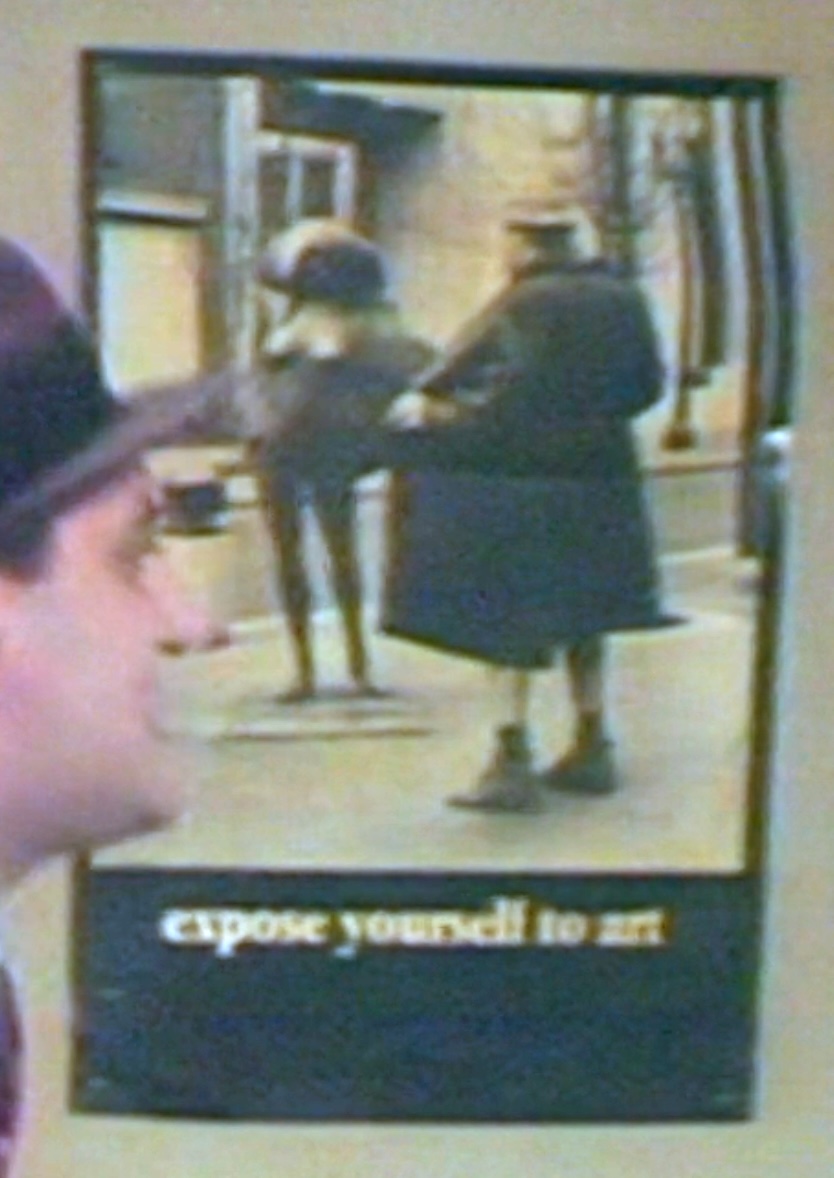
A while back it finally, FINALLY got a Blu-ray release. In the first episode you can see a poster on the wall for a few seconds, and now it's visible enough to make out details:

Image

The photo on the poster was taken in 1978, by a fellow named Mike Ryerson, in the Goose Hollow neighborhood of Portland, Oregon. He originally intended to make it a poster for the Venereal Disease Action Council, until a reader of The Northwest Neighbor newspaper wrote in and submitted the caption "expose yourself to art".

How in the bloody hell did a photo taken in Portland end up on the set of the first episode of The Young Ones four years later?

garote: (ghostly gallery)
Weapons (2025)

If there was an ad campaign for this, it never reached me, but when I heard it was created by the director of 'Barbarian' I got interested.

ImageI read a single review, which described it as a slow-burn exploration of how a small community deals with the sudden disappearance of a bunch of children. So I expected lots of intimate character work and conversations about grief and paranoia, with some spooky happenings and perhaps a central mystery to solve, shot with the same high-quality camerawork and pacing from Barbarian.
Turns out, the mystery was more prominent than I expected. The screenplay was carefully built to walk back-and-forth over the timeline of the disappearance and let you solve it in layers. That was cool, but with so much attention given to plot, the characters don't get as much depth as I was hoping for. No matter; the journey has lots of weirdness and humor, and the ending is so delightful and cathartic that you can't help leaving the theater satisfied.

Death Of A Unicorn (2025)

Oh my god, we get it already, rich people are assholes. Didn't need two hours to learn that.

The CGI is trying very hard to match the puppetry but feels uncanny in the action shots. Will Poulter is amusing, Paul Rudd throws his role way over into cringe -- trying to be funny I guess? Ends up just cringe. Jenna Ortega's role is absolutely thankless. I feel bad for the actress, playing a role that is basically a surly adolescent version of Cassandra from Greek myth. I get the impression that a lot of the dialogue was improvised in repeated takes.

4.5 out of 10 purple dranks up.

Nosferatu (2024)

It's refreshing for a modern director to put a vampire on screen that's much more revolting than seductive. It's got to be a harder sell for a movie studio, but I assume it was due, since Stephenie Meyer and Anne Rice have collectively dominated vampire fiction for almost fifty dang years. Lestat and Edward have cast a long shadow (har har). Meanwhile, What We Do In The Shadows has only engaged with gross vampires for comedic purposes. To see a truly disgusting bloodsucker is novel again.

Be warned, I'm going to walk into spoiler territory in the next paragraph. If you want to stop here, the take-away is this: It's like watching two teenagers with old-school braces trying to make out. It's tragic, sexually frustrated, kinda gross, and goes on too long. But on the other hand, the visual effects are brilliant. I'd give it six diseased rats out of ten.

Perhaps if I sat down and watched it a second time, I would feel properly drawn into the atmosphere. Or perhaps if I'd seen it in a theater with a horde of impressionable young viewers around me, laughing nervously at the gore while speed-munching popcorn. I tried to get ideal conditions at home: A dark room, a nice chair, good headphones, a rainstorm happening outside. But the most I could feel was a sense of respectful appreciation, for the craft in the set designs, the wonderful lighting, and gross practical gore effects.

The director Robert Eggers has thoroughly rewired the story to make it as much about Mina Harker (Ellen in this case, for whatever reasons) and her weird connection to the monster. It's all set up in a creepy prologue that, unfortunately, also sets the tone for the visual standard we're operating in: We've got great practical effects when the bodies of actors are involved, but outside that in the wider shots and the landscape, the universe is a lantern show of computer-hallucinated forests and moldering estates, populated by animals that don't quite move the way you expect. It manages to look really cool and expensive without actually looking real.

But how much should that matter, when we've got a good concept to sink our fangs into? Mina Harker's connection (yeah I'm just gonna go ahead and call her Mina, I find it less confusing) to the vampire is a much more articulated combination of non-consensual and consensual feelings here, and she struggles with it right to the end. When she's around Jonathan, the feelings are at bay and she seems genuinely happy, but as soon as he leaves her side a powerful, terrifying combination of attraction and revulsion for something alien surges up to take his place. Sometimes it's treated like manic depression, sometimes it's used to explore how Mina's social position as a woman confines and infantilizes her: When she's not denied agency outright, she is chided for pressuring the men around her to act on her behalf, as they drag everyone into disaster and then flail ineffectively trying to escape.

And we get another angle as well, one that's more subtext than the others: Mina's helpless attraction to what is socially unthinkable, discovered by herself at an early age and then subsumed out of fear and confusion, then making her miserable as it bleeds through into her adult romance... It's all distressingly familiar. Mina is in the closet. Shut hard, and dying from the inside out. This version of Mina does so much more interesting work than Meyer or Rice or Francis Ford Coppola gave her.

So, this movie doesn't work for me as atmosphere, and the action scenes are frankly bad, and the flailing and hand-wringing in the third act goes on too long, but the concept lingered for a while afterwards even as the bloody visuals drained away. And that Counts for a lot.

Smile 2 (2024)

I had such optimism for this movie. The first go-round was an exercise in style over substance, providing a series of escalating scares and twisted scenes that I enjoyed, even though it didn't have a coherent plot, or hold together as a story in the end. The reviews for the sequel claimed that it was a better film all around, but putting it bluntly: It was a retread, without a coherent plot, that didn't even hold together as a story in the end.

Just like the first film, what you get instead of a story is a series of rug-pulls and fake-outs that get worse and worse until they end, and you are left with no clue what to believe, since apparently all of the secondary characters that the protagonist interacts with for more than a few lines throughout the film - yes, ALL of them - turn out to be hallucinations or false memories or some other nonsense. And by the end it's just as brazen as the first film: The entire third act turns out to be a bullshit rug-pull. Which I would have been more upset about, except that the sequel had already wasted so much of my time with absurdly telegraphed twists and padded buildup that I was bored and starting to impulsively check my email instead of paying attention.

It's that cardinal sin, folks. It's why writing is hard. You can't waste your audience's time, even for a couple seconds.

I assume the writer/director was given the green light to make this based on the box office success of the first. And so he decided - why not - let's just do exactly the same thing, beat for beat, except with more money and longer takes. Well, good for him. Money in the bank. But shame on me, for letting this hack fool me twice.

Arcadian (2024)

This one flew under my radar for most of the year until I read about it in a review for another horror movie. It was a favorable comparison, saying that Arcadian had much more interesting creature design, and a script that did a better job building empathy for its characters.

That review built up my expectations a little too high. I'm a very jaded horror fan, so you can (and should) interpret this as praise, but ... I would place this movie just over the line into "worth watching" territory. The creature designs are indeed interesting and the characters are empathetic, but the movie is also frustrating in several ways. The big problem is, there are too many questions raised and then left unanswered. Like, in a post-apocalyptic world full of weird critters, what caused the apocalypse? In the story, it's been almost two decades since the decisive event - whatever it was - and yet no one knows what it was?

That could be plausible with specific constraints. Like, all communications suddenly stop working, and we're following the story of a community that was already isolated, and the creatures are suitably ambiguous that they could be monsters from space or some kind of plague-addled mutation or dwellers from the sea come ashore, or whatever. But the world of Arcadian is not that constrained, and the clues in the story don't fit together. So you have questions, and none of the characters are asking them. Which is natural for people jaded by twenty years of trying to survive, but unfortunately, not very interesting.

With one exception: One young man, central to the plot, who tries to trap one of the creatures in order to study it. What does he learn? It's unclear; possibly nothing. But that may be deliberate, because it turns out that instead of navigating an apocalypse, or even solving the mystery of one, this movie is mostly about something else:

The absurd angst of teenage masculinity. The way it can make young men behave like morons, and can also make them incredibly vulnerable to exploitation, to the point where it seems completely impossible that any young man would become a responsible father like we see in some of the other characters. It's actually refreshing to see a story about this unfold without pulling any punches.

If you decide to watch this, you will get a decent horror setting, but you will primarily get a platform for some interesting discussions about young men. Might even be useful in a classroom setting.

Six Sesame-Street-inspired weird critter limbs up.

Big Trouble In Little China (1986)

I pulled this one out of the vaults because it had been a very long time and I remembered it being very silly. It turned out, I only remembered a quarter of the silliness. You could say there was 300% more silliness than I was expecting.

I was a kid in 1986, so I didn't notice that this movie was released in a year where it went toe-to-toe with Aliens, Top Gun, Star Trek 6, and Ferris Bueller’s Day Off. It held its own, and has since risen in esteem.

The director, John Carpenter, said this in an interview shortly after the film was made:

"I'm almost 40 years-old now. And since I'm getting older in my career, I thought I'd better do something nuts while I still could do it. But I think the primary reason for making Big Trouble In Little China is to see the world through the eyes of my son, who's now two years old. I can see a really ridiculous, fun world, an enormous, wondrous world."

"Rambo 2 was out, which was the template for action films. They were all patriotic," Carpenter says. "They wanted an action hero. I don't think they realized that I would make the white guy look like a blowhard John Wayne idiot who couldn't do anything."

Kurt Russel chimes in: "John and I wanted to have a guy who wasn't as sharp as he thought he was. Jack's a blustery sort of blowhard who has a lot of self-assurance. And it really is not too handy. That made playing him a lot of fun because Jack gets out of trouble in ways you wouldn't expect him to."

The immediate result was that the Fox studio execs tried to make Jack look more heroic, by forcing Carpenter to add a scene to the beginning of the film, wherein Egg Shen praises Jack's "great courage" to an attorney.

From the liner notes to the official soundtrack: "While Big Trouble In Little China referenced no end of Hong Kong and American action films on its journey, John Carpenter's most referential ode was saved for the rocking end credit song by the Coupe de Villes - a group comprised of the director and his pals Nick Castle and Tommy Lee Wallace. Carpenter had first played with Wallace in their high school band Kaleidoscope, and then jammed with Castle while both studied film at USC."

"The way I look at it, no one's ever too old for rock n' roll," Carpenter says. "I thought this was a perfect chance to do a main title. It was also something else making that music video. We shot it through the course of one night on a little sound stage. The whole idea was to get to sing and strut our stuff. No one else was going to pay us to do this. In fact, we didn't get paid to do it! The experience was ridiculous, and also a lot of fun."

Watch this weird toybox of a movie, preferably with some kids sitting around to laugh at it. A nice use of a few hours.

Non-Horror:

Thunderbolts*:

7 out of 10. Surprising thematic choices for a Marvel film. Dramatic scenes handled much more gracefully than anything James Gunn cranks out, but it's still a "ragtag group of crappy people saves the day" thing, which means it may as well be by James Gunn.

Latest Mission Impossible film

6.5 out of 10. Really cool dialogue-less underwater action sequence. Neat plane stunts. Drags at the beginning. Script is ponderous and overcooked.

Fantastic Four:

6 out of 10. A wisely skipped origin story, some glorious retro-futuristic set design, a really stirring action sequence built around a medical emergency. Good stuff. But the script really, seriously struggles with making us know these comic characters as real people. It's the Marvel formula showing its age, really: You need some greater theme or more interesting premise to explore. "What if there were people with cool fantasy-story abilities we don't see in the real world, marching around using them in the real world" as a concept has been so completely beaten into the ground at this point that you'd need mining equipment and paleontologists to recover it. But what else is Marvel going to do?
garote: (programming)

I rarely write about my work here. But today I think I will!

ImageI've worked on many codebases, with very large numbers of contributors in some cases, and only a few in others. Generally when you make a contribution to a large codebase you need to learn the etiquette and the standards established by the people who came before you, and stick to those.
Not making waves - at least at first - is important, because along with whatever code improvements you may contribute when you join a project, you also bring a certain amount of friction along with you that the other developers must spend energy countering. Even if your code is great you may drag the project down overall by frustrating your fellow contributors. So act like a tourist at first:

  • Be very polite, and keen to learn.
  • Don't get too attached to the specific shape of your contribution because it may get refactored, deferred, or even debated out of existence.
  • It won't always be like this, but no matter what kind of big-shot you are on other projects, it may be like this at first for this new one.

Let me put it generally: Among supposedly anti-social computer geeks, personality matters. There's a reason many folks in my industry are fascinated by epic fantasy world always on the brink of war: They are actually very sensitive to matters of honor and respect.

Anyway, this is a post about code commentary.

In one codebase I contributed to, I encountered this philosophy about code comments from the lead developers: "A comment is an apology."

The idea behind it is, comments are only needed when the code you write isn't self-explanatory, so whenever you feel the need to write a comment, you should refactor your code instead.

I believe this makes two wrong assumptions:

  • The only purpose of a comment is to compensate for some negative aspect of the code.
  • Code that's easy for you to read is easy for everyone to read.

The first assumption contradicts reality and history. Code comments are obviously used for all kinds of things, and have been since the beginning of compiled languages. You live in a world teeming with other developers using them for these purposes. By ruling some of them out you are expressing a preference, not some grand truth.

Comments are used to:

  • Briefly summarize the operation of the current code, or the reasoning used to arrive at it.
  • Point out important deviations from a standard structure or practice.
  • Explain why an alternate, simpler-seeming implementation does not work, and link to the external factor preventing it.
  • Provide input for auto-generated documentation.
  • Leave contact information or a link to an external discussion of the code.
  • Make amusing puns just to brighten another coder's day.

All of these - and more - are valid and when you receive code contributed by other people you should take a light approach in policing which categories are allowed.

The second assumption is generally based in ego.

I've been writing software for over 40 years, and I haven't abandoned code comments or even reduced the volume of the ones I generate, but what I have definitely done is evolve the content of them significantly.

I've developed an instinct over time for what the next person - not me - may have slightly more trouble unraveling. That includes non-standard library choices, complex logic operations that need to be closely read to be fully understood, architectural notes to help a developer learn what influences what in the codebase, and brief summaries at the tops of classes and functions to explain intent, for a developer to keep in mind when they read the code beneath. Because hey, maybe my intent doesn't match my code and there's a bug in there, hmmm?

The reason I do this is humility. I understand that even after 40 years, I am not a master of all domains. The code I write and the choices I made may be crystal clear to me, but not others. Especially new contributors: People coming into my codebase from outside. Especially people with less experience in the realm I'm currently working in. For the survival of a project, it's better to know when newcomers need an assist and provide it, than to high-handedly assume that if they don't understand the code instinctively, then they must be unworthy developers who should be discouraged from contributing, like by explaining what's going on you are "dumbing down" your code.

Along the same lines, it's silly to believe that your own time is so very valuable that writing comments in code is an overall reduction in your productivity.

You may object, "but what if the comments fall out of sync with the code itself, and other developers are actually led astray?"

I have two responses to this, and you may not like either one: First, if your comments are out of sync with the implementation it's either because your comments are attempting to explain how it works and the implementation has drifted, or your comments are explaining the intent behind the code, and the behavior no longer matches the intent. In the first case, the comment may potentially cause a developer to introduce a bug if they're not actually understanding the code. But if they're reading the code and they can't understand it because it's complex, then the commentary was justified, and it should be repaired rather than removed. (Or, you should refactor the code so you don't need to explain "how" so much.) In the second case, someone has already introduced a bug, and the comment is a means to identify the fix.

And second, if it feels like a lot of trouble to maintain your comments, then perhaps you write great code but you're not very good at explaining it in clear language to other humans. You should work on that.

If it's your project, you can make the rules, and if it's your code, then obviously it's clear to you. But if you want to work on a team, and have that team survive - and especially if you want to form a team around your own project - then you need a broader philosophy.

By the way, I should note that there are less severe incarnations of "a comment is an apology" out there. For example, "a comment is an invitation for refactoring". That's a handy idea to consider, though it still runs afoul of the reductionist attitude about the purpose of comments.

You should indeed always consider why you think a comment is necessary because it might lead to an alternate course of action. Even if that action has no effect in the codebase itself, like filing a ticket calling for a future refactor once an important feature gets shipped, it may be a better move. But this is an exercise in flexibility, and considering what you might have missed, rather than a mandate that code be self-explanatory enough to be comment-free (and an assumption that you personally are the best judge of that.)

Here's my own guidelines for writing comments. They're a bit loose, and they stick to the basics.

  • Comments explain why, not how.
  • Unless the how is particularly complicated. Then they explain how, but not what.
  • Unless the what is obscure relative to the standard practice, in which case a comment explaining what might be useful.
  • You learn these priorities as you go, and as you learn about a given realm of software development.

Always be thinking about the next person coming in after you, looking around and trying to understand what you've done. And, try to embrace the notes they're compelled to contribute as well.

THE NET

Jul. 7th, 2025 06:14 pm
garote: (io error)
ImageMatt: We should do a watch party some night. How about ... THE NET?
Me: Gruh, that was 1995?

(Rummaging around in digital archives.)

Me: Stop your grinnin' and drop your linen. The movie starts at 10pm. Let's go.

(0:00 in.)

Matt: Here comes the MIDI brass!
Me: Ooo! Intriguing music for such an awful movie.

(0:05 in.)

Me: Faaake! MacOS did not use "/" as a folder separator! My disbelief is throughly de-suspended.
Matt: Oh believe me, that won't be the least accurate thing in this movie.
Me: Oh yeaaah the online pizza order...
Matt: Fun fact, Sandra Bullock really was one of the earliest proponents of Internet food ordering.
Me: That was like, already a combination of really cool and really wanky, even then. Also: No one eats like that, and looks like her.

(0:15 in.)

Matt: Oh look, a small aircraft at a critical plot point, I wonder what will happen.
Me: Yeah there's no reason we'd be seeing this unless...

(KABOOOOM)

Me: Yeah there it is.
Matt: That wasn't the tower he was supposed to contact. And also that's not what we meant by contact.

(0:20 in. Sandra is on the beach, with a laptop. An older guy is nearby, also on a laptop.)

Me: This guy is a villain, right?
Matt: WHAT GAVE IT AWAY
Me: The hair.

(0:25 in.)

Me: Okay, so, uh, DOES THIS MOVIE ACTUALLY HAVE A PLOT? We're almost 25 minutes in, and so far it does not.
Matt: Maybe it's one of the special features on the DVD.

(0:29 in.)

Me: At what point does she use her super hax0r skills to not get murdered at sea?
Matt: Well... I think she plays snake on her phone with a hacked skill level to avoid getting bored out of her mind.
Me: Wait; he unloaded the gun and put it away below decks after killing that guy, but now he's going down to get it, even though the plan was to kill her the whole time?
Matt: Don't overthink it. He clearly didn't.

(0:31 in. Sandra and the creepy guy are making out.)

Me: Okay, NOW THEY'RE PLAYING "SNAKE". AM I RIGHT PEOPLE?
Matt: Looks more like Tetris to me.

(0:35 in. The camera is focusing on the villain's lips. They fill the screen as he talks.)

Me: Mr. Winkler made a dumb decision with those close-ups. That was like, "student project" directing.
Matt: Yeah, I think that editing was considered edgy for the '90s. But what it really looks like to me is somebody who mostly shot for TV.
Me: I'm enjoying the fact that I can google stuff about this movie while watching it. Me from 1995 would find that hilarious.

(0:49 in. Sandra is running from the law, and meets up with Dennis Miller.)

Matt: And there he is!
Me: You know, I kinda forgot, 1995 Sandra is not actually a very good actor. She has two modes: Slightly checked-out, or panicked motormouth.
Matt: Dialogue can be written for her, and she looks good on camera, but yeah, it's not the same thing.
Me: Dennis Miller isn't great either, but for a totally different reason. I mean, he's very natural, but that's because he's not acting. He's just being Dennis Miller.

(0:53 in.)

Me: Tell me Dennis ad-libbed that toilet line.
Matt: I feel like he either did it as a formal rewrite or ad-libbed it, yeah. Because that clearly didn't come out of the rest of these writers.
Me: AGREED. So, is he gonna get killed in like 35 seconds?

(1:00 in.)

Me: Awwww, they had to actually spell out IRL!
Matt: "You know what would help, Sandra, is if you just like read the screen out loud, because most people who go to see hacker movies can't actually read. Our focus group thinks this is what it will take."
Me: "Also, while you read it, we're going to film your lips moving. Right up close. Try not to think about it."

(1:02 in. Dennis has just been poisoned.)

Me: Okay it took longer than 35 seconds, but he is going to die, right?
Matt: I honestly can't remember.

(Sandra is using stolen hacking software to look something up in a hospital's medical records.)

Me: Hold on. You looked at a record on the internet, and used that as confirmation that the last record you saw on the internet was fake? Now that's just dumb.
Matt: IT WAS A SIMPLER TIME.

(1:07. Dennis is being poisoned again, but worse.)

Me: Awww Dennis. I knew you were gonna die as soon as you walked on-screen.

(1:15 in. Sandra has just yanked an old computer monitor off a desk. It shatters on the floor.)

Matt: Now I don't know about you, but I've dropped a few CRTs from a second floor, and those things don't shatter that easy.

(1:20 in. Sandra is being chased by cops for driving a stolen car.)

Me: Okay, so Sandra has like, 20 minutes to turn this all around. And so far she's done nothing but ask a couple of guys for help, and run from people. Now both the guys are dead and she's in jail. When are we going to see some h4x0r skills?

(1:25 in. Sandra has just crashed another car and is running from a fake FBI agent.)

Me: ... Okay now Sandra has less than 15 minutes to turn this all around.

(1:33 in. Sandra has finally decided to infiltrate the headquarters of the company pursuing her.)

Me: Cathedral, Inc! We do software security like gangbusters, but we don't lock our doors, and we don't have a front desk! No one has a badge, no one asks who you are, there are no security cameras, and we never log out of our machines when we leave!

(1:36 in. Columns of numbers are zipping around on the screen.)

Matt: Nice. A subnet octet greater than 255. I wonder if somebody was thinking that was like the "555-1212" of the internet.
Me: Yeah that was .... a whole lot of confusing.

(1:42 in.)

Matt: Oh here it is, here it is! The theme scene for the whole film! Wait fooor iiiiit...

(Sandra attempts to put a 3.5" disk into a drive but shoves it in upside down. It jams. She pulls it back out and turns it over.)

Matt: Ta daaa! Did you catch that?
Me: "That's the take we'll use!"

(1:46 in. Sandra has just restored her entire digital life by pressing one key.)

Matt: And there you go.
Me: It just ends?
Matt: What did you think?
Me: Well, to start, I'm glad I didn't watch that movie 30 years ago. Because honestly it's better as a horrendous time capsule, and by "better", what I mean is, less than completely intolerable.

(The credits are finally rolling.)

Me: "Adam Winkler" as "COMPUTER NERD". Hey, there are like 4 Winklers in this cast.
Matt: Yeah they got Winklered to hell.
Me: Very Winklery.
garote: (zelda custom flame war)

I just received an unsolicited email from the Social Security Administration.

Image

The Social Security Administration (SSA) is celebrating the passage of the One Big, Beautiful Bill, a landmark piece of legislation that delivers long-awaited tax relief to millions of older Americans.

The bill ensures that nearly 90% of Social Security beneficiaries will no longer pay federal income taxes on their benefits, providing meaningful and immediate relief to seniors who have spent a lifetime contributing to our nation's economy.

“This is a historic step forward for America’s seniors,” said Social Security Commissioner Frank Bisignano. ...

So naturally I did what any sensible citizen would, and went to https://secure.ssa.gov/oig/fraud/ and reported The Social Security Administration to The Social Security Administration for committing waste and abuse.

I'm reporting waste and abuse. The waste and abuse was perpetrated by you.

The email you just sent out to millions of people titled "Social Security Applauds Passage of Legislation Providing Historic Tax Relief for Seniors" was inappropriately partisan while also being a distortion of the truth about the legislation's content. It does not actually grant the tax exemption you claim it does!!

Political statements have ZERO PLACE in this office's communications. Don’t corrupt this department with empty platitudes praising ANY administration. The president is not your department's master, it's the constitution, and the American people behind that document. Your communications should NOT BE POLITICAL. I mean, dang, any eighth grader who's taken a civics class would know that. Now return the money of mine that you just wasted through your fraud and abuse of this system.

Now with any luck they'll get off my lawn.

garote: (ultima 4 combat)

In March of 2022 I made the following guess about the eventual outcome of Russia's Ukraine invasion:

Image
Russia will blast Ukraine into powder, extract some concession like "we won't join NATO and those new republics are not part of Ukraine", then pull back into the republics, leaving them bristling with hardware for years. The Russian economy will burn low for a long while during which they will be at the mercy of the Chinese and whatever belt-and-road-style economic devil's bargain they care to name. Animosity between Europe and Russia, the US and Russia, will remain high for a decade, accomplishing nothing.
Ukraine will remain a depopulated ruin for at least that long. The EU will turn up its nose, sensing another debtor country like Greece. Putin will die or ""step down"" in something like five years, probably less, and his replacement will try and turn the page with the West, but without internal reforms the hands that are extended will all be those of the same old oligarchs and the Russian people will continue to be screwed for another generation, continue to be susceptible to jingoism and propaganda, and will lean even harder into the Chinese philosophy of governance: Not a government of, by, and for the people, but a people of, by, and for the government (by swordpoint if necessary).

This guess was mostly about stagnation. I figured the situation would not change for years, even as more people died and more hardware was thrown at both sides. This has come true, though there are some external consequences: NATO is re-arming and growing more independent, and Russia's ostensible allies are taking advantage of their economy being leveraged out over a financial abyss.

I set a limit of five years, which was a bit arbitrary, but I'm rolling with it. I think we're still headed for this state of affairs two years from now and there's only one thing that could realistically alter the course: Russia's economy going into a complete tailspin, before Putin's death.

If that happens, the Russian people might, maybe, get so sick of total war and sending their sons into a meat grinder that they strike Moscow hard enough to put a crack in the state oligarchy. But if I'm honest, this is unlikely. Never underestimate the capacity of Russian people to suffer.

garote: (ultima 6 bedroom 2)
(Paraphrased from Of Boys and Men: Why the Modern Male Is Struggling, Why It Matters, and What to Do About It.)

Six out of ten births to women without a high-school diploma occur out of wedlock. For women with a four-year college degree, that ratio is only one out of ten. And even if college educated women are not married by the time they have their first child, they are quite likely to be married by the time they have a second, usually to the man who is the father of both children.

Thus, marriage remains a central part of life to college-educated women, which seems like a contradiction: The women who are least likely to need a partner for economic support are the most likely to get married, and stay married.

To resolve this contradiction we acknowledge a shift in the purpose of marriage: Partners now see it as a joint venture for the purpose of parenting. A shared commitment to invest in kids, more than a commitment to financially support a spouse. "'Till death do us part" has transformed into something more like "'til the kids get into college."

Image

Middle-class men, in white collar jobs, have seen their wages stay high, or even grow, in the last 40 years. Their access to more resources has also given them the security to evolve beyond the traditional male role, which makes them attractive prospects for affluent women.

Those women still weigh a man by his economic success, but also seek one who is "modern": Willing to share the practical duties of child-raising, more emotionally sophisticated, more respectful of women's choices.

Meanwhile, working-class men have seen their wages collectively drop. This has hollowed out their value and usefulness in the traditional male role: They struggle to be providers. To working-class women, these men are risky marriage prospects. Many women in fact choose to avoid the risk of marrying a "deadbeat", and elect to remain single parents. Not because they can thrive as single parents, but because they don't want things to get worse.

So, high earners are pooling resources in a marriage to raise kids; low earners are shying away from marriage because it threatens what little they have. And since affluent parents invest much more heavily in their kids, those kids tend to go on and become high earners, cycling this class division forward into the next generation.

So what do you do, as a working-class guy, when you barely make enough money to support yourself, and the women who will date you don't see you as marrying material? Your work life is unstable, your social life is unstable, your religious practice has atrophied, and you still somehow need to finance the core of a new nuclear family, with spouse and home and car and kids, and keep it stable. But how? Everything is telling you to be something you can't reach. Your idea of what it means to be a man, of what your own personal destiny is, starts to drift.

Viriiiiiii

Jun. 24th, 2025 03:28 pm
garote: (weird science)

Viruses are very very small, and so numerous that their quantity is beyond all hope of human understanding.

Image

Consider the ocean:

There are 10 nonillion viruses in the ocean. That's a 10 with 30 zeroes after it.

That's 10,000,000,000,000,000,000,000,000,000,000 viruses sloshing about.

Let's play around with that number a bit just to understand how we, as mere humans, cannot actually ever understand it:

  • There are 100 billion times more viruses in the oceans than there are grains of sand on all the world's beaches.
  • If you put the viruses of the oceans together on a scale, they would equal the weight of 75 million blue whales. (There are currently less than 10,000 blue whales on the entire planet.)
  • If you placed all the viruses in the ocean next to each other in a straight line, that line would stretch for 42 million light years.

The good news for humans is, only a minute fraction of the viruses in the ocean can infect us. Some infect fish and other marine animals, but their most common target is bacteria and other single-celled microbes.

Marine viruses are incredibly good at infecting their chosen targets. In the ocean, with every second that passes, one hundred billion trillion microbes are newly invaded by a virus. Every 24 hours, viruses kill between 15 and 40 percent of all the bacteria in the world's oceans. Those that survive, reproduce... And the next day another 15 to 40 percent are murdered by viruses. Over and over again, every day, this war rages as the ocean churns.

Paraphrased from A Planet Of Viruses, 3rd Edition

garote: (weird science)
Humans are too brief and fragile to travel the depths of space in person. We can send machines, but it's still agonizingly slow at sub-light speeds.

ImageWe can try to reach intelligent aliens with radio waves or lasers or similar, but the dialogue would still be too slow.
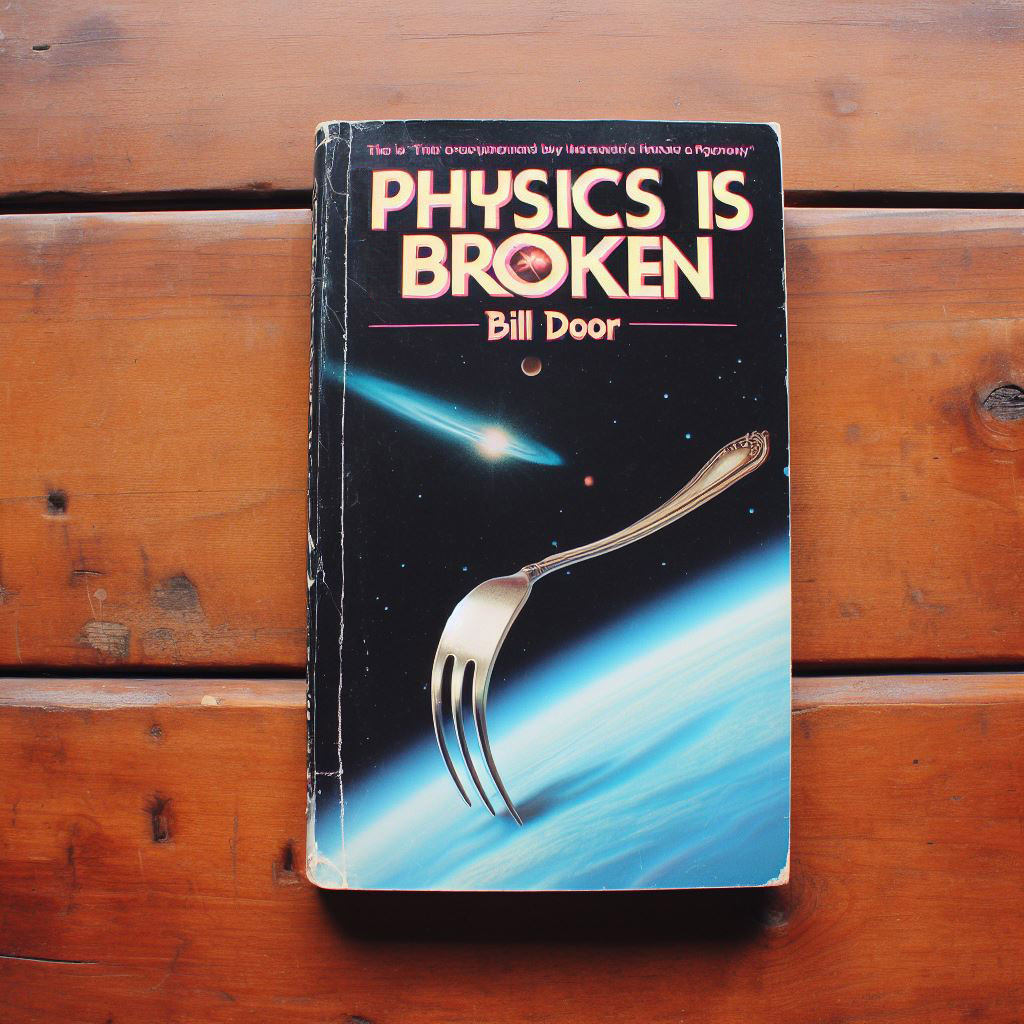
There must be a better way to exchange information. We can assume it's already been invented by other intelligence that evolved before us, so when we do discover this communication channel, we can assume it's stuffed with information. Perhaps so much that it looks like noise to us.

Whatever it is, it must somehow be able to transcend light speed if it's going to happen in a timely way. I mean, we could just assume humans are permanently too brief and give up, and accept that the dialogue of the universe is too slow for us to hear, but that would suck.

So we start looking at the chaos in random movements of particles at the extremely microscopic level. It's so full of noise... Perhaps that noise is communication that can be decrypted?

That doesn’t work. So instead, we make an assumption about the fundamental nature of aliens. We hypothesize that the creatures we might communicate with live on some different plane of existence. For example, in fifth or sixth dimensional space. All their dialogue is happening on some kind of side channel that isn't subject to the vast separations of distance in the universe we observe.

Perhaps these aliens observe our four-dimensional environment as we might observe the workings of an ant colony with a window installed in it: We can watch all the ants at once, and exert our influence by moving material or even ants from one area to another, or tinkering with the glass to install shortcuts or bridges.

In film, this was most recently explored in the movie Interstellar. Humanity is apparently shown how to manipulate space by being given information due to the interference of beings with power outside the constraints of our four dimensional world. They poked holes in space and sent signals from the future to the past, allowing us to collect vital information to build universe-altering technology.

A less ambitious movie from a few years previous, called “Knowing”, used a variation on this theme where aliens provided humans with a mysterious message that turned out to contain predictions about the future, which the aliens could only obtain by having some kind of extra dimensional existence, and used it to compel the humans to act in a way where samples of them (along with samples of other living creatures) could be collected and taken off the planet - rescuing them - before a massive solar flare burned it clean.

They messed with history just enough to preserve bits of us at the end, perhaps out of some kind of curiosity.

But what if the aliens communicated through some means that was simultaneously more indirect, but also more powerful? And what if the aliens were not communicating with us at all, but rather communicating with each other, and we just happened to learn how to eavesdrop on their conversation?

Let's get bigger: What if our planet, or our galaxy, or our entire universe, was actually being used by an extra dimensional intelligence to store a message, while it was being delivered somewhere else?

Like a splash of watercolor on a paper eventually drying into a shape that we can interpret, what if our entire universe is merely a drop of explosive matter, very carefully deployed so that it eventually dries into the permanent form of a message, after all this crazy gravitational business settles down at the heat death of the universe billions of years from now?

What if the whole point of everything we see around us, is to eventually arrive at this dead image, and after the message is interpreted by the recipient, this entire document - our entire universe - will be crumpled up and recycled?

We wouldn't stand the tiniest chance of understanding what the message is about. We wouldn't even stand a chance of seeing all but a tiny fraction of the message as it's being written, since light only travels so fast.

ImageBut in the meantime, if humans escaped the confines of the solar system and began to terraform and rearrange the stars in the galaxy ... followed by other galaxies ... would the aliens observe this, and interpret us as some kind of defect in the medium? Mold on the paper? A rare but annoying quality control problem?

At best we would be examined by alien engineers in order to better understand why their messaging system is corrupting data.

Assuming they care enough to even try communicating with creatures so inconsequential, wouldn’t they actually find it easier to rearrange entire chunks of our history, rather than bother engaging with any of us in actual language? Of course, even that would be too subtle for them to bother. Our own human history? Our own documents? Why would they care?

Whatever they do to us, it probably couldn't even be seen as language. You may as well try to communicate with a single molecule of ink using your pen. What could you even do but write? What could a molecule of ink do, that comes close to "understanding"?

This leads to some interesting plot twists:

1. Intelligent life used to be rampant in the universe, but the aliens applied a bunch of error correction. We're only here because of all the weird exceptions: Goldilocks zone, moon, gas giants, stable galaxy, etc. If we don't stay quiet we might get error-corrected out.

(A variation on this with in-universe aliens was recently explored in The Three Body Problem.)

2. With the right technology we can leap out of our own universe and into another, because the documents are stacked on a metaphorical desk.

3. Careful examination from nearby worlds reveals horrible astrophysical inconsistencies. This document has been used at least once already, and not completely "erased".

4. We start exploring, and find that the laws of physics bend completely out of shape just beyond our local galaxies. The light that's reaching us, showing other galaxies, is a remnant from when the document was whole. It's since been ... torn up. We're in the midst of being recycled.

5. Lots of fancypants computing and off-the-wall thinking allows us to interpret some of the message as it will eventually read when the ink is "dry" (when the universe is dead). We project it into 2d space and it turns out to be a picture of Douglas Adams.
garote: (weird science)
So this morning, I had a dream where I was watching a made-for-TV movie that was being broadcast even though it had run out of budget about 2/3 of the way through filming.

ImageIt concerned a middle-school girls' basketball team, who had won some kind of vacation in a contest and was going around a tropical island solving a mystery. But in every scene, the entire team took part. Usually the dialogue started with whichever girl arrived in the room first, and continued as other girls streamed into the room until it was almost full. Whoever they were interrogating would always refer to them collectively, as “you girls”, and when they discussed the case amongst themselves they would never use each other’s names, and just pick another girl indiscriminately to have dialogue with.
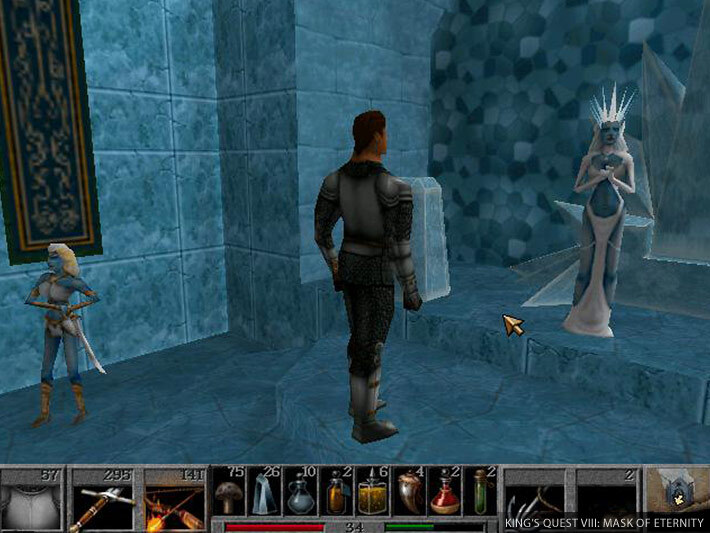
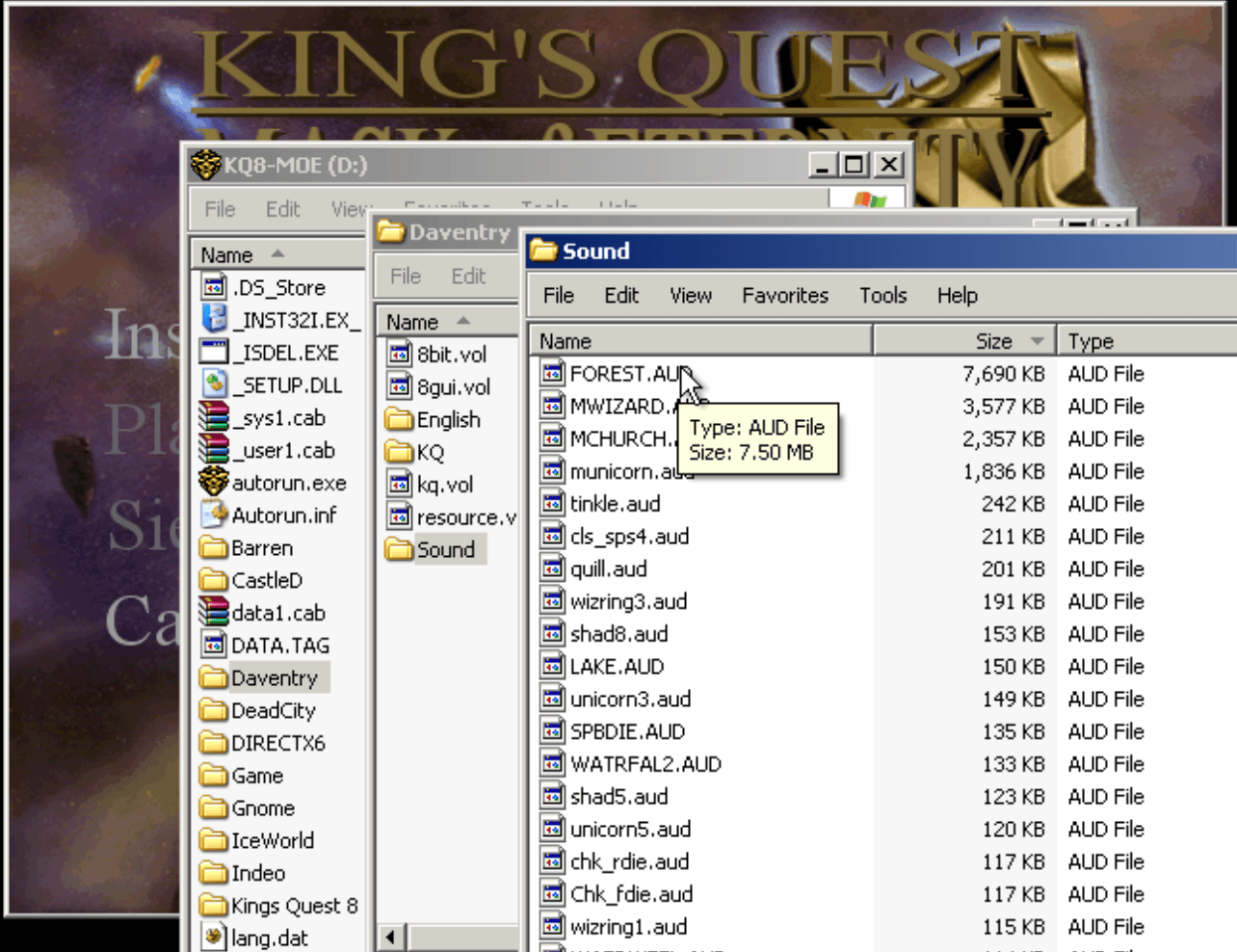
And the entire time, some of the girls would be waving their hands up and down at waist level, sometimes constantly, sometimes for just a few seconds. The director had told them to do this because they were going to add in CGI basketballs later, to make it look like they were constantly dribbling and passing basketballs. But the money had run out.

I dreamed a scene where they talked to a shopkeeper, and the shop was packed with girls in uniforms jostling around by the time the scene ended, with more team members still crowding in.

Analysis anyone?
garote: (castlevania 3 sunset)

One of the earliest and most memorable computer games I played as a kid was "King's Quest II", for the Apple IIe. It was pretty hard, and I only managed to get about 1/3 through it, because there was a bridge in the game that would collapse, sending my character plummeting into a canyon. I never figured out that the bridge could only be crossed a set number of times before it would always collapse, and the saved game I was playing only had one crossing left.

So I remained stumped, until I got a "hint book" as a Christmas present. The book was full of questions with empty boxes beneath them, and you could run a special pen over the boxes, causing the answers to slowly fade into view before your eyes. I revealed the answer to "Why does the bridge keep collapsing?" and slapped my forehead, then started the game from the beginning, carefully counting the times I crossed.

Later that day I finished the game. All the rest of the puzzles were easy, and I barely needed the hint book, but I used the marker to reveal all the answers anyway. From those I realized there were multiple way to solve some of the puzzles, which added a few more hours to the fun.

Over dinner that night I said "Let's get King's Quest III!"

My father smiled and said "Well, the last one cost 40 dollars, but eight months of entertainment for 40 dollars is a pretty good deal, so we'll see."

I played and enjoyed King's Quest III, and then King's Quest IV, but that was the last sequel that would run on Apple computers. Then I left for college, and everyone was playing console games and getting well into 3D graphics. King's Quest V, VI, and VII came and went, but I was distracted by multiplayer games and girls.

When King's Quest VIII appeared, I only got vague news of it from gaming magazines and the early internet. I read that it was a massive departure in tone and technology from the earlier games, and that disoriented all the people playing and reviewing it. I assumed it wasn't very good, and wouldn't sell.

Fast forward 25 years...

Apparently the game found an audience, and once a patch was released to fix the glitches in it, reviews and ratings went up. It's true that it was weird, and very unlike the rest of the series, and suffered greatly by being too ambitious for the scrappy state of 3D graphics technology at the time. To be honest, in terms of both visuals and motion, it looks ugly now, even while 2D games from years earlier still look completely acceptable to the modern gaming eye.

Image

For a fun comparison, check out this bundle on the "Good Old Games" retro gaming site. They're selling Kings Quest VII and King's Quest VIII in one package, and they show screenshots from each side-by-side. Flip though and you'll see nice-ugly-nice-ugly-nice-ugly-nice-ugly...

Still, I got curious, and discovered a few video walkthroughs of the game. While watching those I noticed that the background music was eerily compelling, and had a sudden need to hear it in more detail. There were mp3 versions of some of the musical cues sitting around online, but I wanted higher quality. So I went to the source: The Internet Archive copy of the original King's Quest VIII CD-ROM.

I downloaded that, mounted the disc in an emulated copy of Windows XP, and went trolling around. Turns out there are hundreds of files just sitting there on the CD:

Image

But what is this ".AUD" format? Well, long story short, I tried a bunch of different utilities in both Windows and Mac, and eventually did this:

  1. Copy all the .AUD files into a folder on the Mac
  2. Install ffmpeg via homebrew
  3. Go to the folder via Terminal, and run for i in *.AUD; do ffmpeg -i "$i" "${i%.*}.WAV"; done

That gave me a long list of uncompressed audio files to work with, and I went poking through them, and gathered the longest ones into an hour-long collection, converted to Apple Lossless format with proper tags.

Here, have an hour-long compilation of music from King's Quest: Mask of Eternity.

And then I discovered something else. There are some voicover outtakes scattered into the rest of the audio.

"There is a curious slot in this pedestal. Something must fit here. Let me try... this. Zip... Ugh... Ow... No, doesn't work."

And so on. In all their horrible glory, here they are. Another amusing detail is that in addition to the usual walkthroughs, you can find complete transcripts of the game made by automated software trawling through the data files, and the outtakes are right there in the transcripts. Surely someone else has noticed these in nearly 30 years? Good grief, I hope so.

Anway, I recommend the music. To me it sounds like a companion ambient album to the soundtrack of the film Labyrinth. (Another favorite of mine.)

garote: (zelda minish tree)
My brain really messes with me sometimes. I had a long complicated dream this morning, all of which was weird, but the end of which was especially screwy:

ImageI was a kid, about 16 years old. I emerged from some kind of teleportation device in the living room of the family home. Previously I had just been outside another house, several miles away, and seen a huge redwood tree fall over. It might have hit a building nearby but I wasn’t sure.
I walked from the living room to the kitchen. My sister was there, and she followed me. Outside we found my brother. He was standing in the grass between the road and the house, looking into the distance. I followed his gaze and saw a big column of smoke a few miles away. Looks like the tree had hit something after all, and started a fire.

Between us and the smoke was thick forest, of mixed trees. Redwoods and pines and oak trees all growing among each other. Unlike my sister and brother, I could fly. I took off at a run and launched myself into the air. I could only go about eight feet above the ground, but it was enough to speed me towards the smoke. I followed the road at first, but it turned away so I went into the forest, and then passed over a shallow lake. At the far side of the lake was a thick group of oak trees, all covered with moths, to the point where I saw more moth wings than leaves. All the moths had their wings folded like they were Monarch butterflies resting mid-migration.

I took this in, then saw smoke drifting around the trees. Looking down I saw tiny points of firelight on the ground, as though the fire was spreading like some kind of underground organism, sending little shoots upward to emerge from the leaf litter like mushrooms. Each little fragment of fire glowed and moved like a flower, and just grew bigger without actually spreading to the leaves around it. Well weird.

Turning around in mid-air I looked back across the lake, and saw little points of fire emerging from the shore, moving around the edge of the lake and towards the road, and my house beyond. I could hear my brother and sister in the distance, yelling and running around. They were stomping on the tiny fires, trying to drive them back from the house. I couldn’t save these moth-covered trees but perhaps I could help save the house. I flew back over the lake.

When I got to the house, it was getting dark. Little bits of fire were smoldering all over the ground, which was wet as though it has just rained. I couldn’t find my brother or sister, but I could hear them both shouting nearby in the forest. I half-ran, half-glided in their direction. The forest canopy closed overhead. The ground was very uneven. Huge decayed stumps poked out of the ground, some with holes in them, filled with leaf litter or open like animal dens, leading down. I passed clusters of massive fiddlehead ferns. There were still points of firelight on the ground, but fewer now. I could hear my bother and sister shouting ahead of me. Then I paused, and listened closer, and realized their voices weren’t coming from ahead... They were coming from below.

And they were oddly distorted and wordless, as though it wasn’t them, but some kind of creature making sounds to mimic them. All of a sudden I realized something in the forest, or perhaps the forest itself, was trying to kill me. It wanted me to crawl into one of these holes and get trapped.

"Where are you?" I shouted, hoping that my actual brother or sister would respond. I turned back in the direction I thought I’d come, towards the house, but there seemed to be more low branches. I couldn’t fly so I slogged across the ground, through increasingly thick leaf litter. The ground was very uneven and messed with my sense of direction. "Where are you?" I shouted again.

That’s when I heard them both again. Their voices were strangely echoing, and they spoke in unison:

"We’re behind you."

I knew it was a trick. The forest was trying to make me spin around and lose my sense of direction. I struggled through the branches, but there were even more branches beyond them. I was getting more tangled. At the corners of my eyes I could see an indistinct light, growing. It didn’t illuminate anything around me. I just seemed to be interfering with my own ability to see the branches I was trying to move. Some kind of faerie-light? A will-o-the-wisp coming towards me? I had no idea. I heard my not-brother and not-sister again: "We're behind you..."

I stopped struggling. I was done for. Whatever was after me had won. The light at the edges of my vision grew and grew, and the forest receded into darkness.

Abruptly I realized I was awake, and looking at the darkness of the inside of my face mask. The mask had been displaced, and what I’d thought was faerie-light in the dream was actually daylight leaking in around the edges.

Now, there are a lot of questions I could ask about that, but the biggest one I have is: Why, brain? Why take an already weird dream and turn it into a freaking horror movie?
garote: (programming)
It doesn’t really feel like seven years have passed since I wrote my little essay about un-structured time. Just after I wrote it, I told myself I would check in after a while and see how my attempts at structuring my time were playing out.

ImageSeven years is probably too long to wait for the exercise to really be useful, but I’m doing it anyway since I have a few thoughts.

For seven years now, I have had two reoccurring calendar events that show up on my phone every two weeks. All they do is raise a message which I can easily dismiss. The idea with the events is that I could choose to make my time structured each time in the moment.

The first event is simply titled “call your parents”. My rough calculation is that I have ignored it four out of five times. The fifth time, I’ve taken it as inspiration, and called up a parent on the phone to chat sometime later in the day. So the question of whether it actually added structure is not easily answered.

The other event is titled “home improvement power hour“ and the idea is that whenever I see the alert, I can pick one of the dozens of home improvement projects in my perpetually long list, and spend an hour doing it. I completely ignore that notification 19 out of 20 times, so I would say the mission was not accomplished.

But on the other hand, I have been seeing those calenda events pop up in my face every couple of weeks for seven whole years, and though I have thought a few times about deleting them permanently, I never did, because I have discovered that I like the reminder, even if I don’t actually heed the message.

And perhaps that’s the best I can ask for, really. My brain is extremely clever at knowing when something truly needs to be fixed in my schedule, and when I can let it slide. For example, any kind of deadline on my work calendar is taken with total seriousness. I hit those right on the minute, and on rare occasions when I can’t, I do things to mitigate in advance. It’s very American of me: Convinced that there is no social safety net of any value, I treat work as the existential obligation that it is. My brain understands that, and so I find it much easier to structure my time around work. I can tell that there is a part of me constantly pushing to skip a deadline or disregard an appointment and stay in its freely distractible state, or stay wedged in a mode of extreme focus - a mode that is totally different from a distractible state but just as hostile to the dictates of a schedule - and work raises a barrier high enough that even this usually irresistible de-structuring urge can’t push it over.

All the other activities in my life that are resistant to this urge are existential in some degree: it’s hard to get appointments scheduled to see a doctor or a dentist, so I never missed those. It’s also hard to get on the schedule of a plumber or an electrician or a roofer or a repair man for the utility company, but even those fall on a scale. If there’s a hole in the roof and it’s raining, you can bet I will be all over that problem. If rats have found their way into the walls and are chewing on the wiring, I will be on that problem as well, though slightly less so because of an instinctive understanding that even determined rats do take at least a little while to chew through walls and wiring. Water can ruin things instantly, but with rats the difference between 1 day or 2 days is much less drastic.

I hate that I have to push back very hard against my own instincts to deal with these problems immediately, even during times when I obviously have plenty of additional hours in the day that won’t be affected. That greedy little bastard inside me keeps me sane, but I still deeply dislike him.

But none of this is new. I knew this seven years ago, which is why I was determined to keep fighting. And to stay on track with the idea of an update, rather than simply a rehashing, I can at least say this:

For many years I've had a tiny, but industrious filing clerk living inside me. One activity it deeply enjoys is constructing a schedule with each hour of the day allocated for tasks that I arguably should be handling as soon as possible. The act of assembling the schedule and setting reminders for it most definitely does not result in me following it…

But it does provide me with something to contrast my actual day against. Knowing that I could do all these things, but instead am enjoying whatever random thing is inspiring me in the moment, has two good consequences: It helps me to savor just how indulgent I’m being, and it keeps those things popping up enough in the foreground of my mind that I occasionally think of them at other times when I’m actually in the mood to do them.

The trick, I’ve learned, is to not feel guilty each time I dismiss the reminder, but instead to tell myself that since I was the one who put it there, I am exercising a perverse sort of self-control by deferring it: I'm not just spacing out and forgetting, I am consciously deciding to do something else. It’s very difficult to honestly ask yourself the question “are you sure you still want to do something else?” without letting guilt dictate the answer. But if you can, you make room for a different reaction: A banal but ultimately satisfying feeling of practicality, that compels you to do a thing not for the sake of eliminating guilt, but for the sake of gaining that slight boost in your well-being when one less obligation is looming over you.

And I suppose, as long as I can keep the lights on and food on the shelves, and keep preventable health problems at bay, that is the very best I can ask for. I need to accept that I am simply never going to run my life in a fully structured way - or even a mostly structured way - and I am probably never going to feel as though I actually have enough unstructured time.

Hell, for almost all of last year I was unemployed, and there were still long runs of days where I felt as though I just did not have enough time away from structure. Even things that I knew I would enjoy and would be very healthy for me, gave me mild distress when they were scheduled for an exact day and time, even if that day was weeks in the future. Call it burnout, call it depression, call it being stupidly unrealistic and unsustainable and ridiculous... Call it being a bad adult... I can’t argue back because I can’t really explain it.

But I’m doing OK, which is actually saying a lot given that I’m at a stage in life where one can seriously make up one’s own rules for happiness ... and there are many ways to screw that up.

The phone reminders are staying put.
garote: (zelda library)
This is only track 1 of the storybook album Аржаана (Arzhaana), released in 2005.

I can't find a translation of this anywhere else, so I made an attempt. It's rough, I'm sure. Suggestions welcome. Sometimes it's hard for me to parse what Sainkho is saying because of the music, sometimes there are just silent letters missing that I don't know about because I'm not familiar enough with Russian.

Edit: WIth some help in the comments, this translation is now much improved!

Давно это было,
Очень давно,
Long ago it was,
Very long ago,

В далекой прекрасной стране...
Где могучий Енисей раскинул атласный рукав.
In a distant beautiful country...
Where the mighty Yenisei (river in Eastern Russia that runs North from the border of Mongolia) spread its satin sleeve,

Где над бескрайними просторами степей и тайги
В бездонной сверкающей вышине
Летают гордые орлы,
И поют звонкие жаворонки
Where over the endless expanses of the steppes and taiga,
In the bottomless sparkling heights
Proud eagles fly,
And the ringing larks sing,

Жилы-были старик и старуха
Once upon a time there lived an old man and an old woman.

Жили они небогато.
Старик ходил на охоту и рыбачил,
А старуха смотрелась за скотом да работала по хозяйству.
Их ветхая закопчённая юрта стояла на берегу озера,
Которые люди называли Чашхой: Детская Слеза.

They lived modestly.
The old man went hunting and fishing,
and the old woman looked after cattle and worked around the house.
Their dilapidated, smoke-blackened yurt stood on the shore of a lake
Which people called Chashkha: Child's Tear.

Летом оно почти пересыхало,
А весной выходило из берегов.
Вода в нем была чистой и светлой,
Как детская слеза.

In the summer it almost dried up,
And in the spring it overflowed its banks.
The water in it was clean and bright,
Like a child's tear.

Вся жизнь старики прожили у этого озера.
Да так и не нажили богатство.
Лишь одно у них сокровище было.
Их внучка - Аржаана.

The old people lived their whole lives by this lake,
But they never acquired wealth.
They had only one treasure:
Their granddaughter Arzhana.
Page generated Feb. 25th, 2026 03:09 pm