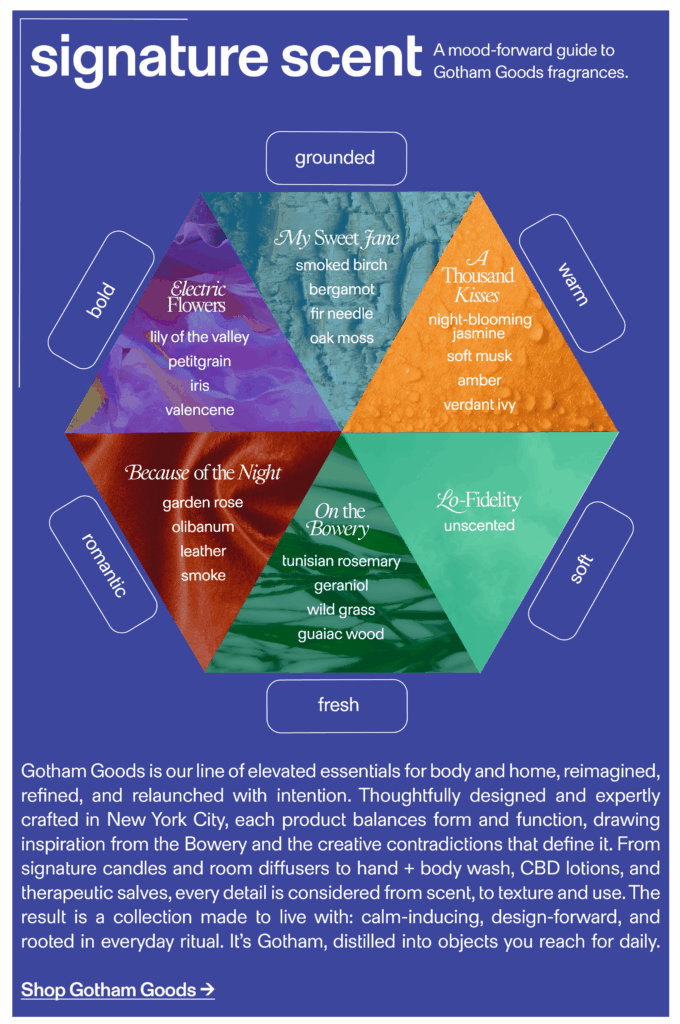
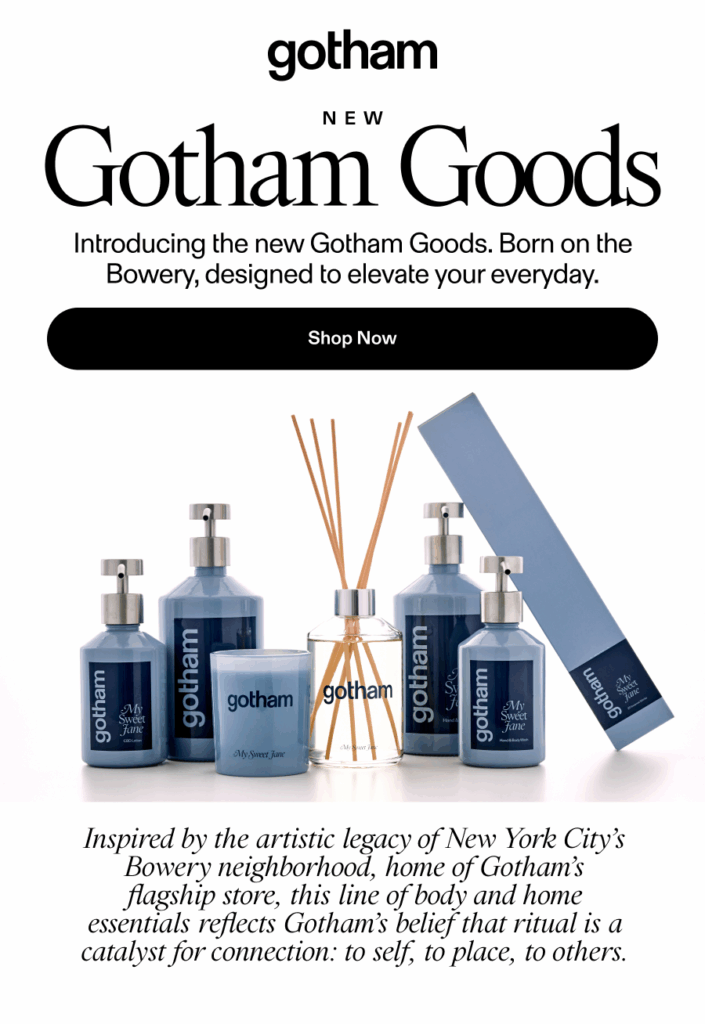
When I began Gotham, the concept was to develop products we could sell outside our four walls. Private label is a key component for multiple reasons. I saw a void in the market for a color- and elevated-CBD lotion that is incredible for your skin. We have had ample missteps and many lessons learned, but it appears we have finally nailed it.
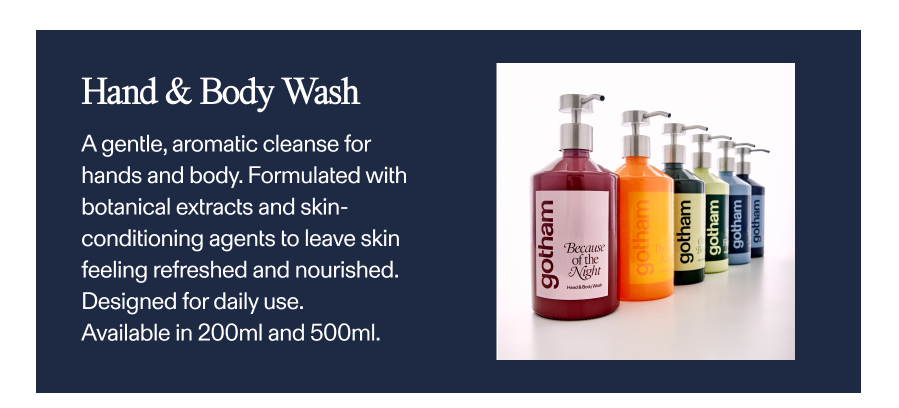
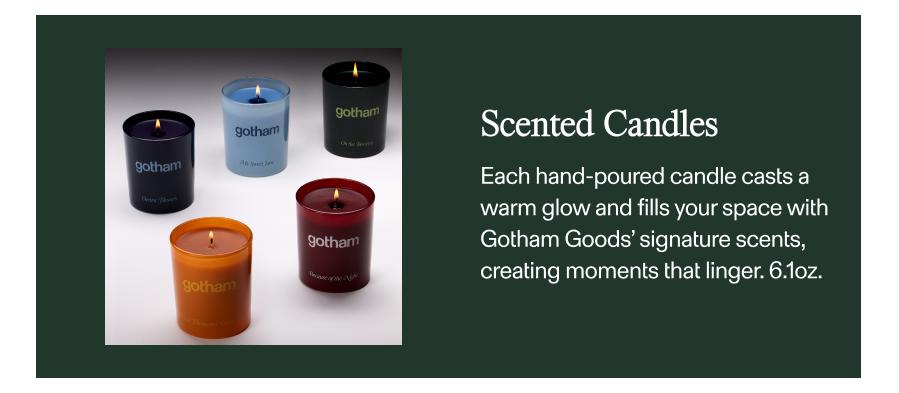
The scents are incredible, the packaging (aka glass vs plastic) is good for the environment, and the colors pop. We all need a bit of color in our lives these days. Gotham is highlighting the new rollout of these products in our stores and also online.
There is the CBD lotion
Body wash.
The salve (one of our best-selling products in our stores).
Our daughter, Emily, who has returned to NYC, is a win for all of us. She began the Angel in LA (aka the name), writing profiles and other long-form content about the food and restaurant industries. She filled a void in the media business, and of course, the readership grew. Her partner, David, provided the photography, and the rest is history. She posted twice a week: the first was her piece on Tuesday, and the other on Saturday, where chosen people get to answer five questions she calls the Plugs. She will continue building in LA, but living in NYC, we NYers will get the same love that LA has captured. I was honored to be the first plug…and of course I must share. See below.
Plugs is The Angel’s recs column. Every week, you’ll get six picks—a restaurant, a bar, a shop, an ingredient, a person, and a treat—from someone in New York who knows what they’re talking about, plus a selection of Angel-curated links.
#96 (in all-time Plugs history, but #1 in NY Plugs history) is Joanne Wilson, also known as the Gotham Gal. Joanne is the founder and CEO of Gotham, the cannabis concept store with locations on the Bowery, at the Domino Sugar Factory, in Chelsea, and in Hudson, New York. Before getting into the weed biz, she was an angel investor focused on women-founded startups like Parachute, Clue, Sweet Loren’s, and Food52. She’s also my very own mother—and the person most responsible for my lifelong obsession with food. She taught me how to roast a chicken, and that chocolate chip cookies should be baked regularly and kept in a big glass jar on the kitchen counter. She gave me a proper education in dining, too: taking me to places like Tabla, wd~50, Momofuku Ssäm Bar, and Fatty Crab at the height of their popularity, and shepherding me to classics like Fred’s at Barney’s and Florent. She likes to call herself a woman about town, and I’d agree. Who better to kick off Plugs in New York City? Here’s Joanne.
For the first two weeks of January, The Angel is free. After that, all editions of Plugs and most of our reporting will be behind a paywall.
I have lived in NYC long enough that when asked to plug a restaurant, it all depends on the angle. Favorite (tough one), cuisine (multiple), old school (plenty), and the list goes on. We all have our go-tos. My husband and I eat out six days a week. I insist we stay home on Sunday night. I decided the plug must be a spot we frequent at least once a week, and sometimes more, because you can also go there for lunch: Anton’s. The vibe is great, the story behind it is great, and in full transparency, we ended up becoming investors when the former owners (The Franks of Frankies) left the space behind and handed the golden keys to Natalie and Nick, who made it their own. It has been an absolute success, and the food is delicious. Ask anyone who has been there. Anton’s is also our neighborhood spot, located on Hudson and 11th, an epic corner.
I love a good bar, particularly one you can eat at, and that is around the corner. We have been going to Barbuto from the start, when it was on the corner of 12th and Washington, where the bar had maybe seven seats. It was a miracle if you could score one. Barbuto closed when the landlord sold the building to someone who planned to convert it into a one-family, then four-family (and now currently stalled) project, which is not ok for the neighborhood, but the good news is that Barbuto found a spot a block away. The new bar is huge, and we can usually score a seat and have a drink. The bartenders all know us, they know our drinks, and they know to bring us an order of breadsticks.
I wanted to share my favorite food shop, but there aren’t many that I frequent. Besides Eataly, which works if you live in the area, and the H Marts springing up everywhere, there is a real void in the grocery store sector, particularly in the West Village. I pine for the old Dean & Deluca and Balducci’s. Citarella has gone downhill. So I am going to plug my favorite store in NYC (besides, of course, all the Gotham stores): Dover Street Market. Cutting-edge, cool building, constantly changing inventory, young designers, and of course lunch, a treat, or just a coffee at Rose Bakery, where they carry a great curated selection of food products. It’s the perfect way to spend a few hours once in a while.
A Rose Bakery scone. Photo by Joanne Wilson.
Ingredient — Lemon
I love when lemons get charred at a high temperature, making them soft, juicy, and ideal for squeezing hot juice over fish. I love a moist lemon cake with ample zest. I love a tart, oozing lemon pudding. Lemon rind in my vodka martini, always. Even when I was a kid, and we would go to Baskin-Robbins for a treat, I’d always order a scoop of lemon ice cream on a cake cone.
I usually would say my husband, as we are great together, and he is my favorite person, but I am going to choose Liz Neumark here. I was introduced to Liz by someone I had invested in. He thought we would make a good connection, so we all got together for drinks. After meeting her, I wrote about her for Women Entrepreneur of the Week, a column I used to write for my blog. Liz and I got together at Chelsea Market, and I interviewed her. She was a photographer who began to cater art openings on the side, turning her side hustle into Great Performances, one of the biggest hospitality companies in the country. We became fast friends. She loves food, and so do I, so I suggested we spend an afternoon at the Golden Mall Food Court in Queens. Since then, we have visited countless cities together to eat, learn, go to farmers’ markets, and have fun. Liz is a true New Yorker, and I am lucky to have her in my life.
My favorite treat isn’t especially gourmet, but it always hits the spot. Hershey’s Kisses make me happy, although sometimes I have to hold myself back from eating too many. They’ve been around since 1907, a classic. I peel off the silver foil, pop the kiss in my mouth, and let it melt on my tongue. For Valentine’s Day many many years ago, I got each of our kids a framed photo of a Hershey’s Kiss. It’s kind of the perfect treat.
The Angel is a reader-supported publication. The best intel is for paid subscribers. Subscribe here
As an employer, we have an obligation to our employees (particularly full-time employees) to pay them appropriately for their work and loyalty to the business, including healthcare, opportunities for growth, education, and a healthy environment to come to every day.
There are a few organizations, run and owned by extremely wealthy individuals who have built incredible businesses but have treated their employees like shit. I don’t get it, and I am sure I never will because I don’t operate that way. I have always believed that if you do the right thing, there is no need for a union. Unions are meant to represent employees who have been treated poorly and need an organization to advocate for them and their peers. That makes sense.
Starbucks has treated its employees like shit and is now attempting to fight off the unions? Same at Amazon. How about Telluride, where the owner of the ski resort doesn’t want to pay the workers a fair minimum wage, so he closed down the resort. I honestly don’t know how these founders and CEOs sleep at night.
We can look at history, because this happened in the 70’s too—large corporations that took advantage of working people. It is in the air, and perhaps I can hang some type of optimism on Mamdani who appears to care about the people.
As for the unions, there is a place for them, not in every organization, but in those that do not take care of their workers. I am pro-labor, but I am not always pro-union. These are very different things, as for Starbucks, Amazon, and Telluride, they are obviously not pro-labor, and shame, shame on them.
I should go back through my blog posts over the years and see when I first began to think the department store era was near its end. There are so many things to say about Saks’ going bankrupt. Saks also owns Neiman Marcus, and purchased Barneys for a ridiculous amount of money to make Barneys label products, which haven’t seemed to pan out except for private equity holders in Japan.
So, why did they never innovate? Where did all the good merchants go? Why did they take on this massive amount of debt? Why did someone even give them this cash? Was it just a write-off against gains? Will all the vendors just get screwed? Will the banks swarm in and sell all the real estate? What will all those empty buildings become? How will they affect Main Street and communities? Does it even matter?
Two stories come to mind. One thing Fred learned in business school. A company began importing champagne from France and decided to crush the market by selling its bottles for $19.99. What happened is the opposite. Nobody bought the bottles; they just sat there because customers perceived this champagne as bad. After all, champagne is known as a “luxury” product. The company regrouped, pulled the bottles, and repriced them at $99, and the product flew off the shelf.
What that says is know your customer, because consumer behavior is challenging to change. Just as Macy’s decided in the late 80’s to shift to higher-end products, but the majority of people walking into their stores were not, just as Target leaned into anti-DEI. They lost their base.
The other tale was at Gilt Group, which shockingly still exists today. Gilt Group started as a place to buy top brands at discounted prices from vendors with surplus inventory. The catch was that when those products dropped at noon, you had to be at your computer to jump in and buy them before they sold out.
There are so many things I never understood about this model, as someone who started their career in retail and then moved to wholesale. Eventually, the vendors improved their inventory management, so instead they began making best-selling products with lower-quality fabrics to match last year’s numbers. Customers are not that dumb.
Remember, tech entrepreneurs started the Gilt Group, as during that time, everyone was attempting to disrupt everything. Fast forward, and the powers that be noticed that many customers were lurkers. Customers would log in to the sale at noon but never purchase. Perhaps, management thought, they wanted those items but couldn’t afford them, so we should build a secondary site for them at lower price points.
If they surveyed their customers or reached out to merchants who have been in business for years, they would have better understood the business. What they did do was build an entirely new website with this concept, throwing a lot of capital at it. Think about how Donna Karan built DKNY, the less expensive line, but that worked. After months and months, the new, less expensive site finally launched, and instead of an onslaught of business, all they got was crickets. Why? Those lurkers wanted the high-end products and were willing to swoop in only occasionally, not every day. No shit.
There are more stories to tell when it comes to companies being purchased by private equity companies, which are financially focused, not product-focused, where they have killed great companies or just sold them off at a massively discounted price to another private equity group.
Back to the demise of Saks. There is so much we do not know, but I gather that those losses work out financially for everyone involved, except, of course, for all the employees in the stores. Retail is a tricky business, and for some reason, merchants in Europe and Asia have figured it out. Nordstrums has figured it out. It isn’t e-commerce that killed them all. Those stores are listening to their customers, innovating when needed, and surviving in a new environment, because in retail, you must innovate all the time or you end up like Saks. That doesn’t mean the same four-way with constant discounts. Let’s at least hope that all the buildings left empty are sold to each state government to become public housing. That is definitely something we need, because it appears that customers no longer want that many uninteresting department stores.
Gotham had quite the year, though, like all cannabis businesses in NYS, we are still struggling to see a healthy future. It is frustrating, exhilarating, educational, thought-provoking, and annoying all at once.
Gotham now has four stores: Chelsea (10th and 19th), Bowery (3 E 3rd), Hudson (Warren Street), and Williamsburg (Domino Sugar Factory). We have tweaked our model, adding kiosks (the new beautiful ones will be installed in January), and that includes a tighter team. We can’t thrive unless we think about how we survive.
Our biggest win has been creating a place where our customers have become part of our community, and keep coming back time and time again. That feels insanely good because it means Gotham is providing a store experience with the right products, a warm environment, top-notch customer service, and cannaseurs (our wonderful sales experts) who have become part of people’s lives. We have had customers come in with cookies, cards, and, of course, their dogs to say Happy New Year and thank us for the year. That is epic.
On a marketing note, we blended art, fashion, and culture under one roof. Models hit the runways smoking joints from Gotham; we had a float at NYC’s Gay Pride Parade; we hosted a fun and fashionable 4/20 disco party; we had a group show featuring over 40 artists who made one-of-a-kind ashtrays; and we put on countless events, such as Slam Poetry night. The list goes on and on, and they were all highlighted in Gotham’s windows and collectible gummy tins showing it all on the streets of NYC.
In a short time, the Office of Cannabis Management, which oversees all things cannabis in the state of NY, has had three leaders. That says it all. Although there has been some progress in addressing illegal products sold in NYS in unlicensed stores and by illegal delivery businesses, NYS has not achieved the impact needed to build a robust legal market. Industry frustration is high, and this should be a priority for the state.
The OCM moves too slowly, and they need to focus on measures in 2026 that will help the industry grow. Dispensaries should be able to pull a license (with ease) as caterers do for events. That means we can do more weddings and private events, and sell at concerts and farmers’ markets, just like liquor companies do. There needs to be other avenues for dispensaries to build their businesses beyond four walls. That is a win for everyone, including the farmers.
Research, although slow, is uncovering the plant’s positive aspects every day. Cannabis compounds have proven to halt cancer growth, blocking blood vessels and tumors. From a pain perspective, cannabis can block pain, help with inflammation, and improve sleep. It is not a simple solution, and more research needs to be done, but if cannabis can be an opioid substitute, that is huge. Opioid addiction usually starts with an accident, and why should people find themselves falling into the abyss of abuse over pain?
I am optimistic as always, but being at the forefront of this industry has made me more cynical and realistic. I am looking forward to our first salon at The Highrise to discuss the importance of research and why no one is putting capital into our businesses. I know the answer as an investor, but many do not.
The Federal Government is a shambles, so it is unclear to me that legalizing the plant at that level will happen anytime soon, which would be a huge mistake. Yet mistakes across the board seem to be the government’s motto. But if we look at history, it will happen. The question is always the same: when?
I spent the last part of the year sleeping. It was as if my body needed to reboot. 2025 was a good year. Wonderful family affairs, and the entire family is back and living in NYC, which makes our hearts sing.
Gotham has been a wild roller coaster, as all start-ups are, particularly in an industry that continues to operate like the Wild West, changing and evolving. Everyone in the industry is thrilled to see movement in the right direction, rescheduling cannabis. I hope federal legalization is not far behind. It is such an absolute shit show that change is needed. Gotham has added The Highrise, a salon, where we hope to spark interesting conversations in the cannabis industry. Apply today!
This year, the Community Fund raised nearly $12 million to advance resident leadership, workforce development, digital equity, community health, and neighborhood revitalization across NYCHA communities. These investments translated into paid jobs, scholarships, and direct financial support for residents, while also delivering visible and lasting improvements to public spaces, community centers, and quality of life for tens of thousands of New Yorkers.
I got to spend time in a variety of different places with good friends and family. The white noise of what is happening in our country has cast a pall over my path, making me more cynical than ever. Although, as the saying goes, only the paranoid survive.
On a positive note, I am optimistic about seeing young people run for office and win. We need change. I talk to young people in the art world who are thinking differently about the industry’s realities. Phones are being banned in schools, and kids are filling their time with clubs and games. People want to meet in person. Media is shifting to new platforms, and individuals can find an audience and a voice because old-school media needs to regain some trust. The Knicks are doing well.
Women are making a greater impact, although we still have far to go. It’s obvious the men right now aren’t doing a very good job and seem to have no empathy. Currently, power seems like a very ugly game.
I can’t think of a genre that isn’t shifting onto a new path. It may be the post-COVID world, where being disconnected was not a good thing, where big business has become like the Wizard of Oz, and where it is hard to trust anything. People seem to be leaning into a more socially conscious society. I hope so.
In 2026, I will be 65, and after sleeping for six days, I am going to take it down a notch, and that might mean blogging less, or not. Only time will tell. I am excited about the year ahead, and as always, it is a good time to take a look at the landscape before surging ahead into 2026.
At the end of December 2025, that is soon upon us, Paramount Skydance is shutting down all MTV musical channels. No music videos, no unplugged, no more premieres. This is the end of an era.
MTV launched in 1981 with “Video Killed the Radio Star” by the Buggles. Instead of DJs, there were VJs, and Martha Quinn was my fave. MTV changed the way people found music, marking the evolution of music discovery away from radio. Oddly, radio is still here, though waning, as our own music from our phones can be plugged in and played almost anywhere.
The Real World was MTV’s first reality show, and one of the first across all platforms, launching a new era of bad TV. Rock the Vote was a response to the censorship of young rap artists and energized youth to register and get involved, reeling in celebrities to highlight the importance of government engagement.
At the end of the day, it was all about the music. Before MTV, music from abroad made the hit list a year after playing nonstop overseas. Now, hits were streaming simultaneously. When I lived in London in the fall of 1981, Soft Cell’s Tainted Love hit the charts, and when I returned to the States, this song began to get traction. I listened to that song endlessly for an entire year, and what spoke to me is that the world was beginning to connect simultaneously.
Both my siblings were in the music video business, producing videos from Push the Little Daisies with Ween to All I Wanna Do with Sheryl Crow. I got an insider’s view of a new industry producing short-form storytelling content and music videos to promote songs vs. albums.
MTV’s impact took time because conservative operators were wary until, of course, the ratings came in. The cost of these videos is not low, and, like everything, it has gone up over the years. I remember when Bad by Michael Jackson launched on MTV, and although groundbreaking, it was costly to make, almost the cost of putting on a concert, but at a concert, the ROI might be higher.
How do you keep a channel running for less? You create shows like Snooki that rate high, and then we saw more stations jump on this bandwagon. Video obviously did not kill the radio star, but Snooki might have.
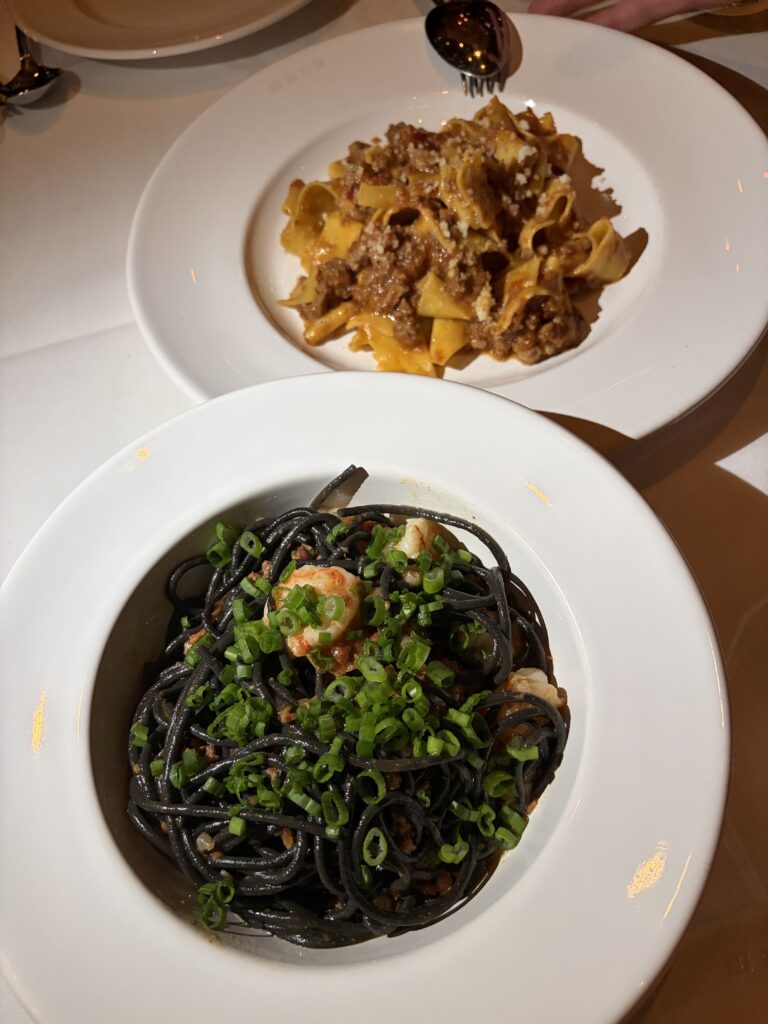
This past week, we went to two spots that have brought in older chefs with experience to take over the kitchen. The first is Babbo, where Mark Ladner, who was brilliant at Del Posto, worked for Mario Batali and Joe Bastianich—the days when restaurateurs and chefs were catapulted to fame. The other spot was Lex Yards, at the newly renovated Waldorf Astoria, where Michael Anthony, the original chef at Gramercy Tavern, spent twenty years.
Mario had a fall from grace, but he still lives on at Babbo. The rooms have not changed, and neither has the menu. Certainly, Ladner is the perfect choice to head the kitchen because he was around back in the day, but the food lacked that moment when flavors explode in your mouth, and your eyes pop out of your head because the dish is so spectacular.
What is wild is nothing has changed, even the cluster fuck when you check in remains the same. I can’t count the times we had dinner at Babbo, so returning was a strange, nostalgic feeling. I kept imagining David Lynch, the sommelier at Babbo, coming over to our table. Michael Glickman was always at the front checking in the patrons.
I do wonder about the deal that was made with Stephen Starr, who is now the proud owner of Babbo and an excellent restaurateur. Batali and Bastianich owned the building and sold it to Starr. Did they also make a deal to keep it the same, give them the recipes, and share the playlists? Will we ever know? I am not sure we are running back, but I would sit in those rooms or at the bar at any time of the day. It is a beautiful spot where, if you close your eyes, you can see the orange clogs peeking out of the kitchen.
As for the Waldorf Astoria, they brought in Michael Anthony. Granted, it is a hotel restaurant, and in Europe, hotel restaurants tend to have more cred than ones in NYC, but I was inspired to have a holiday dinner there after going for a drink this fall to see the hotel after reopening from a five year renovation this past summer.
The Lex Yard room is not that inspiring, considering it is the holiday season. I expected a lot more glitter. Who else still spends money on that? The entire experience from start to finish was insanely disappointing, and the food was a giant meh. The concept is to serve a fixed menu upstairs at Lex Yard, and if you want, you can also order from the bar menu downstairs. The bar menu is superior, though we finally got a few things off it, and they weren’t outstanding either. All in all, a huge disappointment.
As we see the rise of new spots with young, creative chefs, including the surge in cocktails, these old spots might be better off thinking outside the box rather than sticking to an old-school approach. Or perhaps, I am not the audience they are hoping to feed
In 1960, the FDA approved the pill. We can point to bigotry, racism, white supremacy, misogyny, and patriarchy as the leading causes of the hatred we are seeing in society today. Still, when women were finally able to take control of their own bodies, everything changed. Keep in mind, it wasn’t until 1973 that women were finally able to get a loan or a credit card. Perhaps the biggest fear is the changing of the guards.
Not only do women want their own careers, but households with two working parents are also becoming the norm. Women are delaying or choosing not to have children. The timing has changed, too, whereas thirty years ago, women were having children in their early 20s; now, the majority are waiting until their 30s. More women are going to college, having successful careers, and making decisions about how they want to live their lives today.
In the past sixty-plus years, cultural shifts have been evident. Women go under the heading ‘two steps forward, one step backward’. Outlawing abortion, demeaning women in a public arena (aka our misogynist President), and even women’s peers who want to return to a time when men rule the roost. The backlash right now is insane, particularly since the “Me Too” movement (thank god) changed more than we realize. Take a look at some old 80s films to see how women were filmed and how language was used.
Fewer women are having children. We can point to Korea, Japan, and even Greece, where birth rates have plummeted. Why? Perhaps because having is rewarding but hard work, expensive, stressful, and the responsibility generally falls on one person’s shoulders, and in a male-female marriage, it is typically the woman. We might all be able to live a hundred years but those early years of ones career are essential, and nobody should discount the importance of ones own self worth.
Giving women a financial bonus to have a child is not the answer; instead, it requires a complete restructuring of how businesses and governments help women (and families) flourish. Childcare, housing, a 4-day work week, and diversity in the workforce create environments where women want to have children, as these are basic needs that help reduce stress when juggling a family and a career.
Perhaps Hillary Clinton had it right, it does take a family, and right now women are not getting the support and recognition that they deserve from their male counterparts or their government.
We all love finding a good bargain, but we have taught consumers to expect a deal because somehow they will become loyal. Customers who are bargain hunters have zero loyalty unless everything is always on sale. I saw that firsthand at Macy’s during the one-day sales, where a different group of consumers came into the store. Look at Groupon, a business model built on customer loyalty for merchants who use its site. The model doesn’t work.
It kills me to see the cannabis vendors using discounts to undercut their competitors. There is a time and place to mark down products, as in right before they expire. How can we build a successful foundation when we know we must follow suit to do what everyone else in the market is doing?
I want to believe that consumers are smart. Loyalty is built in other ways, from loyalty points to experiences, to assortment, to discovery, and fun. The cannabis environment is forcing the discounts, and it is definitely not the way to build any of our businesses. Real margins help build real companies. Discounts are not a strategy.