Angelicum in the News!
The Liberal Arts Go Online: The Angelicum Academy brings the study of the Great Books into the 21st century.

Some of the comments from the Article:
Kelsey B: I graduated from the Great Books program two and a half years ago, and now study at a liberal arts university. Although the Great Books program is often extolled (and rightly so) for its ability to prepare students for university studies, its true virtue rests in the fact that it prepares students for more than a few years of academic work. It prepares students for life. The Great Books program finds and develops the love of wisdom in each of us, helping us to love goodness for its own sake and not an arbitrary letter on a transcript. The program ends after four years (much to our chagrin), but students emerge from it as fledgling philosophers, prepared to expand and enlarge this love of wisdom for the rest of our lives.
Scott Lorbeer, Ed.D.: We found Angelicum Academy right before our daughter’s 8th grade year. The Great Books high school program looked amazing, and we enrolled her in the 8th grade Socratic Discussion group to see how it all worked. It exceeded all of our expectations, and 4 years later she will enter her senior year with Great Books this fall. My daughter’s writing is at least as good as my college students’ A papers, and better than their B papers (and she’s only 17). Her ability to think deeply about topics and grasp their historical roots is extraordinary and a joy; it is due mainly to the fruits of this wonderful program.
Kathi B.: We have had one or more of our children enrolled in the Great Books program for the past 6 years. If you were to ask any of our high schoolers what is one of their favorite things about homeschooling, they would tell you the Great Books program. In addition to learning about the good/true/beautiful, there is also a practical aspect. Learning to think deeply and then speak these thoughts articulately & in an engaging manner so others will listen; how to look at something, so to speak, in 3-dimensions, how to truly “read a book”, & how to spot fallacy. Not to be overlooked are also the friendships formed – our eldest, now a few years out, has several good friends that she met through this program.
This program is a gem and I consider it an essential component of our children’s high school education.
A. Davis: As a recent graduate of this admirable institution, I would like express my thanks and admiration for Angelicum Academy. The “Great Books program” is quite simply the ultimate educational experience. Enthusiastic, curious students will excel in this program if offered this once-in-a-lifetime opportunity. Students gain confidence in communication as they are led by world-class instructors through incredibly memorable discussions over works by Homer, Kant, Shakespeare and more. Throughout middle school/high school it slowly became my favorite class and is by far the one I look back on most fondly as I enter college. I feel so blessed to have been able to participate in the program.
Maggie D.: I have been enrolled in the Great Books program for two years (and am about to begin my third and last year, as I joined late and did not participate in the Greek Year) and I have reaped so many benefits from it. I believe that I am more articulate, a better writer, a better thinker, and, of course, more well-read than I was before the Program. I recommend this program to anyone interested in obtaining a liberal arts education for their high schooler. In addition, I have heard from others that it is also an excellent preparation for going to a traditional liberal arts college.
Christina D.: I was a student in the Great Books academy all throughout high school. I can honestly say not only was it my favorite course throughout all four years, it was the course that cultivated excellence in my liberal education. Thanks to the discussions, texts, and fellow students and professors in this forum, I have been inspired to pursue what is true, good, and beautiful from the classroom to the real world.
Hunter: By reading the Great Books in high school, I was given the invaluable opportunity to whole-heartedly envelope myself in ideas and develop a love of intellectual discovery. The Great Books really allowed me to foster a different kind of knowledge, one that points to wisdom, instead of practical information. Perhaps most valuable are the active reading and analytical skills I have developed. These have enriched every aspect of my life and will continue to do so as I continue through my Senior year and on into college.


 5. IT IS AFFORDABLE FOR FAMILIES: The Angelicum Payment Plan will reserve a seat in the class of your choosing for only 10% down. The other 90% is payable in 9 monthly installments of 10% each, beginning September 1, 2012. For the high school credit track that is only $99 down, and $99 each month, beginning September 1, through May. For the college track, that is only $295 down, and $295 per month, September through May. The Angelicum Academy offers a generous 50% tuition reduction for all other siblings (may not be combined with other discounts).



 Hi Steve!
 Niccolo Machiavelli and Thomas Aquinas both presented their views of man as being either animal or a mix of animal and angel respectively. Machiavelli sees man as an animal. He sees no need to treat man with respect. He believes it is perfectly acceptable to use others for your own needs and profits. On the other hand, Thomas Aquinas sees man as a cross between animal and angel. He believes that the angel part of us is what gives us compassion towards one another and draws one closer to God for it is in His likeness that we desire to do good. It can be shown that although Machiavelli understood the animal part of human nature, Thomas had a more complete understanding of our true complete nature.
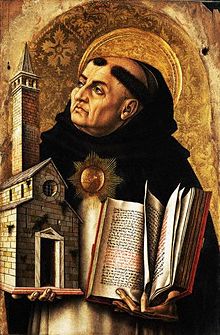 Thomas Aquinas discerns that man not only has an animal part, but also an angelic spirit which is essentially our soul, our likeness to God. It is the part that allows us to give love and compassion. Thomas asserts that man is half “corporeal organ”, animal, and half angelic intellect, a soul (Aquinas, Pt.1, Q. 85, Art. 1). He declares that we have corporeal body that is the form of our angelic soul creating a half corporeal and half angelic form. He goes on to further explain this by stating that our “phantasm”, spiritual soul/form, exists in “corporeal organs”. He deems that we do have an angelic part that supplies us with an intellect that allows us to reason and thinks about consequences which ultimately will bring us closer to God (Pt. 1 Q. 85, Art. 2). He believes that we are complete when we use not only the animal part, but also the angelic part. It is only when we use both that we can feel complete joy and bring happiness to others. Thomas speaks about the importance of doing good deeds for others. It is in this manner that we find joy in the contentment of others (Pt. I-II, Q. 4, Art. 8). Thomas concludes that loving God is enough to bring happiness to the soul, but if there was a neighbor there, love of him would result in perfect love of God thus bringing true happiness (Pt. I-II, Q. 4, Art. 8). Thomas speaks of our likeness to God. He explains that we are not identical, but are made in His image in as much as we come from Him (Pt.1, Q. 4, Art. 3). Thomas speaks of humans trying to imitate God, but because God is perfect they fall short. It is in that desire to be like God in his goodness that brings us pure joy when we achieve it.
 Although Machiavelli skillfully demonstrates how one has the characteristics of both a fox and a lion, Thomas reminds us of our likeness to God. Machiavelli advises people how they should use one another, lie to one another, and trick one another for ones own personal gain. Even thou this may bring success in one’s status and personal gain is there true joy? Thomas answers that question quite simply by reminding us of our likeness to God, and that our desire to do good is innate; we can not separate from it. When we do good deeds we are at our happiest. Our true nature is not only our human qualities, but also an angelic qualities, our likeness to God.


 Angelicum Academy News
