I have seen the future, and it is revolving sushi

This week I ate at Kura Revolving Sushi Bar for the first time. It was a trip!

What I knew going in was that there is a conveyor belt that winds throughout all the tables with dishes, and you can just take whatever looks good. (like dim sum) This was neat enough to make me excited about going.

But there’s more! Each seat has a tablet next to it (with a helpful video for how things work) where you can order specific dishes, and even some bigger things like ramen. When your dish is ready it comes out on a _second_ conveyor belt (above the first one, sort of an “express” belt), stops at your spot, and a doorbell rings to tell you to get your dish, which is an elegant solution to the fact that they can’t send out another dish until you take yours off the belt.

All this is tracked by putting your finished dishes into a slot under the main conveyor belt, and your tablet shows your total number of dishes. (I think all the dishes that go by on the main conveyor belt are the same price, around $3-4) Every five dishes you put in, your tablet plays a victory sound for you. If you (somehow!) eat fifteen dishes, then you get a special Hello Kitty prize from a dispenser above your tablet.

To cap off the futuristic vibe, sometimes when you order drinks they are brought by a robot, something like a tall Roomba, although my tea was brought the old-fashioned way, by a person.

Anyway, the place is wild, and we may not have jetpacks but this is not a bad substitute!

My thoughts on the ethics of LLMs

(When I write, I’m usually not speaking for my employer, but I’m super-duper not speaking for my employer here!)

There are a lot of opinions about the ethics of using LLMs. I’ve been considering the arguments I see for a while, and writing down something is a great way to clarify one’s thinking. So, here I go!

  1. Environmental concerns
  2. Training data concerns
  3. Uses of LLMs
    1. Writing code
    2. Writing text
    3. Summarizing text
    4. Image generation

Environmental concerns

I think this has been pretty overblown, both in terms of the amount of electricity usage and water usage. (for cooling data centers) Here’s a good article showing that even the author’s heavy use of Claude Code for a day approximately equals the energy it takes to run a dishwasher once.

This doesn’t take into account the amount it takes to train models, which I haven’t seen a good estimate of. Honestly, solar panels are cheap enough that we should be building them as fast as we can anyway!

Training data concerns

Undoubtedly the biggest models have been trained on copyrighted data without authors’ consent. (You can see if your name shows up in the LibGen dataset here, and if so register to get a settlement from Anthropic) This is bad, and I do think companies should have to pay for using people’s words. I should probably feel more strongly about this, and I’m sure I would if I made a living writing stuff.

Uses of LLMs

The two big main ways I evaluate here are:

  1. Is it OK that LLMs can give wrong answers?
  2. Are you wasting people’s time?

Writing code

I would argue that using LLMs to write code (via an agent like Claude Code or just by asking an LLM individual questions) is probably their least problematic use. It is OK that an LLM will produce wrong code; that’s why you should have a good test suite! (although you better know what you’re doing security-wise…) And provided that you review the LLM-generated code before you send it out for review (like what the LLVM project is requiring), this seems pretty fine to me. (as a bonus, I would imagine much of the code the LLM was trained on was open-source to begin with)

Writing text

Hmm…it depends? I don’t think there’s really anything wrong with asking an LLM for suggestions to improve or reword your writing. (although I don’t do this!) But the more the LLM writes, the more the humanity is taken out, like that terrible Google “Dear Sydney” ad that ran during the last Olympics. And don’t get me started on writing a few sentences and asking the LLM to make it longer; that is the epitome of wasting the readers’ time! If you’re tempted to do this, just send the few sentences you have instead!

Summarizing text

The amount of fine this is is inversely proportional to how important the text is. LLMs make mistakes, and if it’s summarizing a promotional email it’s probably fine, but summarizing an important presentation or letter from a crush is pretty dangerous!

Image generation

Ehh, this seems not great to me because most of the time making an image involves a lot of human expression. I guess if you’re just making it for yourself, whatever, but otherwise it feels gross to me. (we had someone make an LLM image of Jesus to show at our church’s children’s service and I felt pretty revolted!)


Feel free to tell me why I’m wrong!

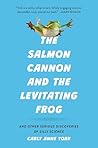
The Salmon Cannon and the Levitating Frog: And Other Serious Discoveries of Silly Science review

The Salmon Cannon and the Levitating Frog: And Other Serious Discoveries of Silly ScienceThe Salmon Cannon and the Levitating Frog: And Other Serious Discoveries of Silly Science by Carly Anne York

My rating: 3 of 5 stars


This book is a love letter to basic (i.e. not applied) science – York’s enthusiasm clearly shines though in her writing, and I am here for it! The whole book is more or less a series of stories about how a seemingly silly investigation led to very useful results, although I couldn’t help notice that in a few of the cases the useful results aren’t quite here yet.

York also talks about “wastebook”s that have been published by various senators that purport to name and shame wasteful government spending, which includes dumb-sounding scientific grants. It turns out, which will not come as a great shock, most of these grants are for studies that might actually turn out to be useful.

Other interesting parts:
– It’s estimated that 30% of the US’s gross national product is based on stuff that depends on quantum mechanics! (pg 6)
– Massaging premature babies makes them grow faster, leave the hospital sooner, and saves an average of $10,000 in health care costs per baby! (pg 28)
– GLP-1 medicines (like Ozempic, Wegovy, etc.) were developed partially based on research done on Gila monster venom! (pg 40)
– The first bone graft was done in 1668 on a soldier’s deformed skull. The doctor used a dog’s skull to do it, and after the procedure the patient’s church decided he was partially dog and could no longer be part of the church! (pg 96)
– A nit to pick – York says “You might have felt what happens when an airplane stalls”, and I’m not an expert here but hopefully most people have not felt this! (it doesn’t mean you’re necessarily going to crash but it does mean that something has gone pretty wrong!) (pg 112)
– Adding bumps on the blades of a wind turbine (inspired by bumps on humpback whales’ flippers) can improve its efficiency by 20%! (pg 114)


View all my reviews

The Appeal review – solve a mystery by reading lots of emails!

The Appeal (The Appeal, #1)The Appeal by Janice Hallett

My rating: 4 of 5 stars


I wasn’t sure I was going to like this book but I really got sucked into it. The premise is that you’re following two people trying to figure out what happened solely by reading a bunch of emails, etc. It had a lot of similar vibes to the book S. by J.J. Abrams.

There are a lot of people to keep track of but probably because I read the book so fast I didn’t have too much trouble. My one complaint is that the solution was a bit convoluted, but maybe the book earned it after 400 pages. Would recommend!


View all my reviews