The Fourier transform

The Unreasonable Effectiveness Of The Fourier Transform

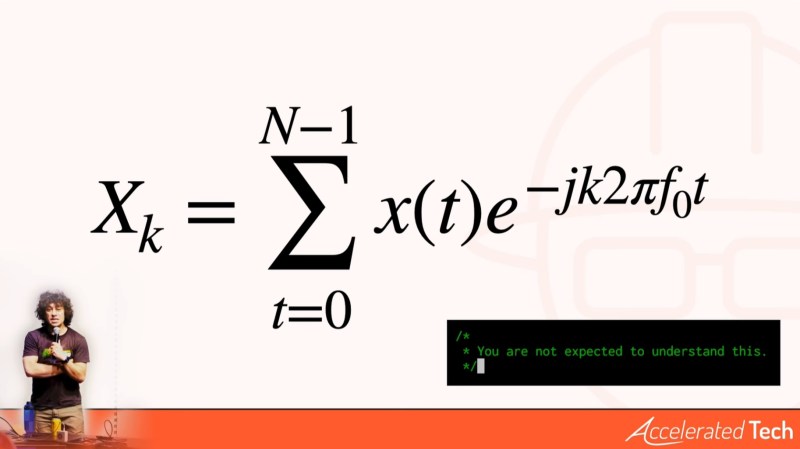
A talk, The Unreasonable Effectiveness of the Fourier Transform, was presented by [Joshua Wise] at Teardown 2025 in June last year. Click-through for the notes or check out the video below the break for the one hour talk itself.

The talk is about Orthogonal Frequency Division Multiplexing (OFDM) which is the backbone for radio telecommunications these days. [Joshua] tries to take an intuitive view (rather than a mathematical view) of working in the frequency domain, and trying to figure out how to “get” what OFDM is (and why it’s so important). [Joshua] sent his talk in to us in the hope that it would be useful for all skill levels, both folks who are new to radio and signal processing, and folks who are well experienced in working in the frequency domain.

If you think you’ve seen “The Unreasonable Effectiveness of $TOPIC” before, that’s because hacker’s can’t help but riff on the original The Unreasonable Effectiveness of Mathematics in the Natural Sciences, wherein a scientist wonders why it is that mathematical methods work at all. They seem to, but how? Or why? Will they always continue to work? It’s a mystery.

Hidden away in the notes and at the end of his presentation, [Joshua] notes that every year he watches The Fast Fourier Transform (FFT): Most Ingenious Algorithm Ever? and every year he understands a little more.

If you’re interested in OFDM be sure to check out AI Listens To Radio.

Continue reading “The Unreasonable Effectiveness Of The Fourier Transform”
Image

39C3: Liberating ESP32 Bluetooth

Bluetooth is everywhere, but it’s hard to inspect. Most of the magic is done inside a Bluetooth controller chip, accessed only through a controller-specific Host-Controller Interface (HCI) protocol, and almost everything your code does with Bluetooth passes through a binary library that speaks the right HCI dialect. Reverse engineering these libraries can get us a lot more control of and information about what’s going on over the radio link.

That’s [Anton]’s motivation and goal in this reversing and documentation project, which he describes for us in this great talk at this year’s Chaos Communication Congress. In the end, [Anton] gets enough transparency about the internal workings of the Bluetooth binaries to transmit and receive data. He stops short of writing his own BT stack, but suggests that it would be possible, but maybe more work than one person should undertake.

So what does this get us? Low-level control of the BT controller in a popular platform like the ESP32 that can do both classic and low-energy Bluetooth should help a lot with security research into Bluetooth in general. He figured out how to send arbitrary packets, for instance, which should allow someone to write a BT fuzzing tool. Unfortunately, there is a sequence ID that prevents his work from turning the controller into a fully promiscuous BT monitor, but still there’s a lot of new ground exposed here.

If any of this sounds interesting to you, you’ll find his write-up, register descriptions, and more in the GitHub repository. This isn’t a plug-and-play Bluetooth tool yet, but this is the kind of groundwork on a popular chip that we expect will enable future hacking, and we salute [Anton] for shining some light into one of the most ubiquitous and yet intransparent corners of everyday tech.

Image

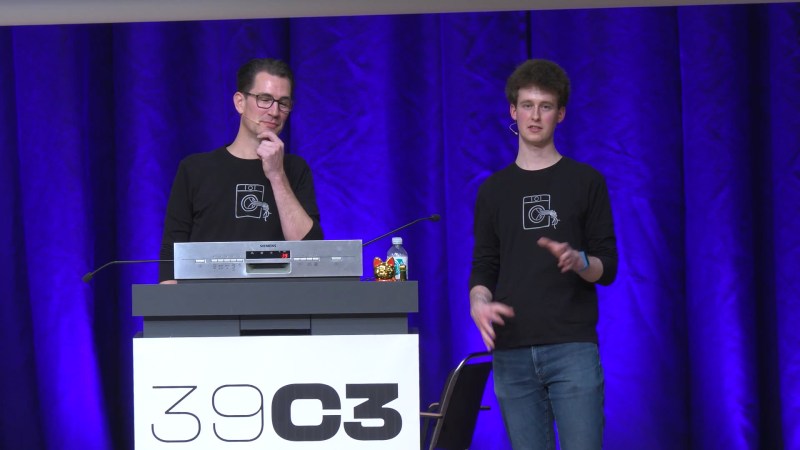
39C3: Hacking Washing Machines

Many of us have them, few of us really hack on them: well, here we’re talking about large home appliances. [Severin von Wnuck-Lipinski] and [Hajo Noerenberg] were both working on washing machines, found each other, and formed a glorious cooperation that ended in the unholy union of German super-brands Miele and B/S/H — a Miele washer remote controlled by Siemens’ web app.

This talk, given at the 39th Chaos Communication Congress (39C3), is about much more than the stunt hack, however. In fact, we covered [Severin]’s work on the very clever, but proprietary, Miele Diagnostic Interface a little while ago. But now, he’s got it fully integrated into his home automation system. It’s a great hack, and you can implement it without even opening the box.

About halfway through the talk, [Hajo] takes over, dissecting the internal D-Bus communication protocol. Here, you have to open up the box, but then you get easy access to everything about the internal state of the machine. And D-Bus seems to be used in a wide range of B/S/H/ home appliances, so this overview should give you footing for your own experimentation on coffee machines or dishwashers as well. Of course, he wires up an ESP32 to the bus, and connects everything, at the lowest level, to his home automation system, but he also went the extra mile and wrote up a software stack to support it.

It’s a great talk, with equal parts humor and heroic hacking. If you’re thinking about expanding out your own home automation setup, or are even just curious about what goes on inside those machines these days, you should absolutely give it a watch.

Editor Note: The “S” is Siemens, which is Hackaday’s parent company’s parent company. Needless to say, they had nothing to do with this work or our reporting on it.

Image

39C3: Hardware, And The Hard Bit

The 39th annual Chaos Communication Congress (39C3) is underway, and it kicked off with a talk that will resonate deeply with folks in the Hackaday universe. [Kliment] gave an impassioned invitation for everyone to start making hardware based on his experience both in the industry and in giving an intro-to-surface-mount workshop to maybe thousands of hackers over the years.

His main points are that the old “hardware is hard” cliche is overdone. Of course, working on a complicated high-reliability medical device isn’t child’s play, but that’s not where you start off. And getting started in hardware design and hobby-scale manufacture has never been easier or cheaper, and the open-source tooling gives you a foot in the door.

He tells the story of an attendee at a workshop who said “I kept waiting for the hard part to come, but then I was finished.”  Starting off with the right small-scale projects, learning a few techniques, and ramping up skills built on skills is the way to go. ([Kliment] is a big proponent of hand-placed hot-plate reflow soldering, and we concur.)

This is the talk that you want to show to your software friends who are hardware-curious. It’s also a plea for more experimentation, more prototyping, more hacking, and simply more people in the hardware / DIY electronics scene. Here at Hackaday, it’s maybe preaching to the choir, but sometimes it’s just nice to hear saying it all out loud.

PN26 badge

Shelf Life Extended: Hacking E-Waste Tags Into Conference Badges

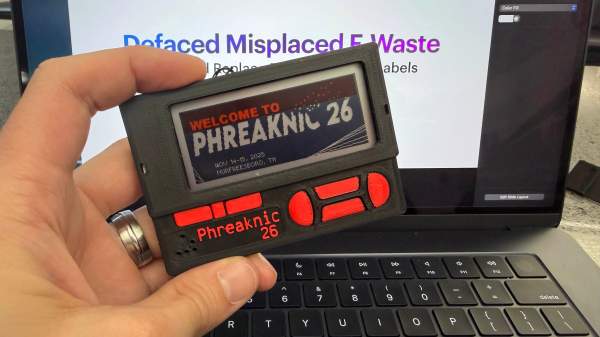
Ever wonder what happens to those digital price tags you see in stores once they run out of juice? In what is a prime example of e-waste, many of those digital price tags are made with non-replaceable batteries, so once their life is over they are discarded. Seeing an opportunity to breathe new life into these displays, [Tylercrumpton] went about converting them to be the official badge of the Phreaknic 26 conference.

Looking for a solution for a cheap display for the upcoming conference badge, [Tylercrumpton] recalled seeing the work [Aaron Christophel] did with reusing electronic shelf labels. Looking on eBay, he picked up a lot of 100 ZBD 55c-RB labels for just $0.70 a piece. When they arrived, he got to work liberating the displays from their plastic cases. The long-dead batteries in the devices ended up being easily removed, leaving behind just the display and the PCB that drives it.

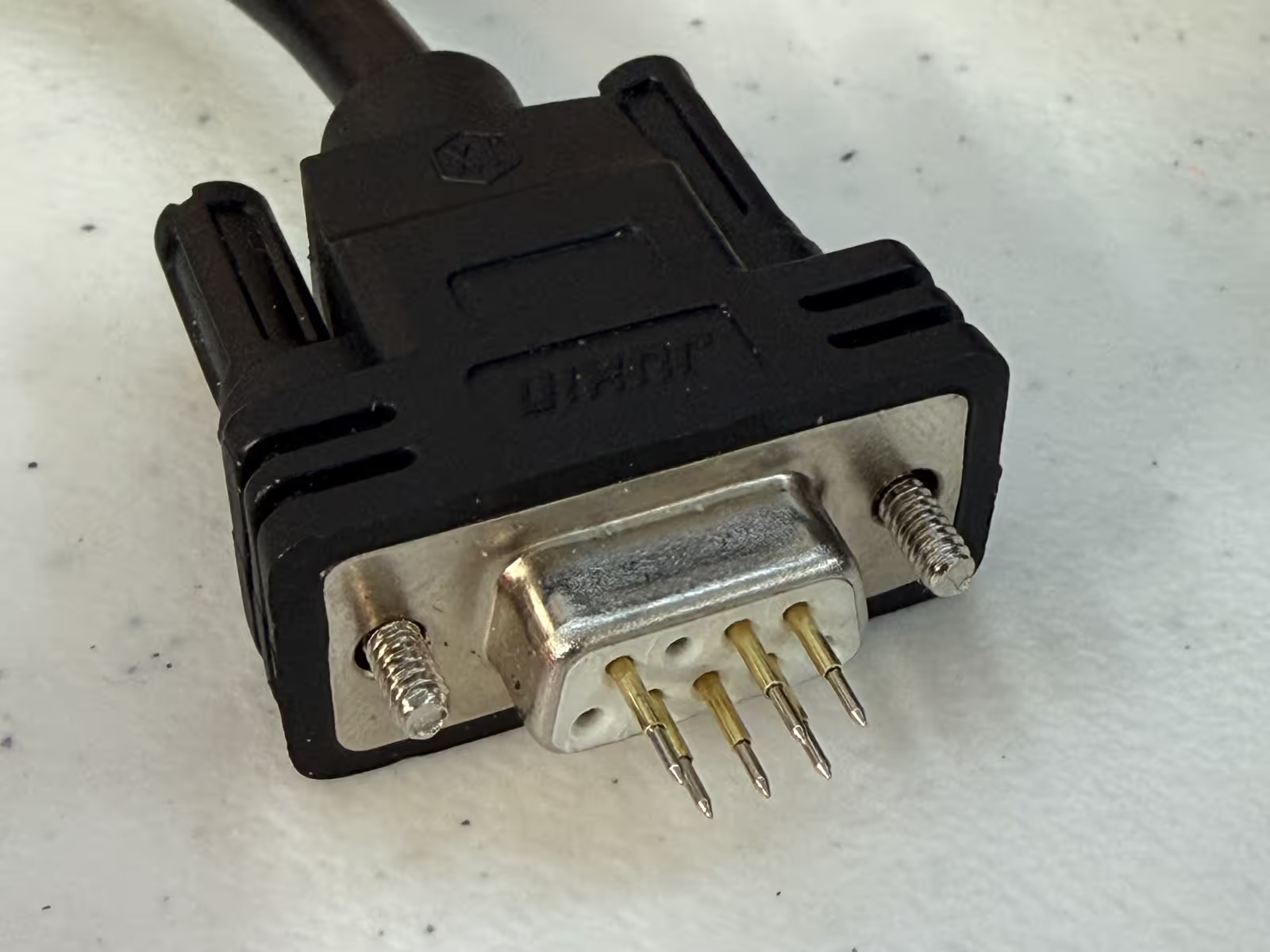
db9 programmerAnother hacker assisting with the badge project, [Mog], noticed that the spacing of the programming pads on the PCB was very close to the spacing of a DB9/DE9 cable. This gave way to a very clever hack for programming the badges: putting pogo pins into a female connector. The other end of the cable was connected to a TI CC Debugger which was used to program the firmware on the displays. But along the way, even this part of the project got an upgrade with moving to an ESP32 for flashing firmware, allowing for firmware updates without a host computer.

The next challenge was how to handle customizing 200 unique badges for the conference. For this, each badge had a unique QR code embedded in the back of the 3D printed case that pointed to an online customization tool. The tool allowed the user to change which of the images was used for the background, as well as input the name they wanted to be displayed on the badge. Once finished, the server would provide a patched firmware image suitable for flashing the badge. The original intent was to have stations where attendees could plug in their badge and it would update itself; however, due to some 11th hour hiccups, that didn’t pan out for this conference. Instead, [Tylercrumpton] ran the update script on his machine, and it gave him a great opportunity to interact with conference attendees as they stopped by to update their badges.

For the Phreaknic 27 badge, the plan is to once again use electronic shelf labels, but this time to utilize some of the advanced features of the tags such as the EEPROM and wireless communications. We’re eager to see what the team comes up with.

Continue reading “Shelf Life Extended: Hacking E-Waste Tags Into Conference Badges”

Image

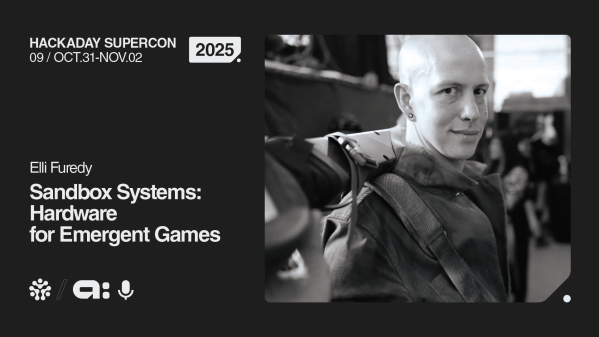
Elli Furedy Brings Cyberpunk Games To Life

When you’re designing a bounty hunter game for a five-day cyberpunk live-action-role-play out in the middle of the Mojave desert, you’ve got to bring something extra cool. But [Elli]’s Hackaday Supercon talk isn’t just about the hardware; it’s as much about the design philosophy behind the game – how you bring something immersive and exciting to hundreds of players.

Sandbox Systems

The game itself is fairly simple: bounty hunters try to find the bounty, and when they do, they have a quick-draw to see who wins. Everyone is issued a color-coded Portable Data Node device, and when a hunter jacks into a bounty’s Node, a countdown begins, and the first to press the button after the display say “Go” wins.

But the simplicity of the game is by design, and [Elli] talks about the philosophy that she and her team followed to make it a success. If you’re designing a conference badge or an immersive game for a large group of people, take note.

The first principle is to focus on the people first before the tech. Here, that essentially means making the experience as simple as possible in order to leave room for the players to put their own spin on it – it’s a role-play event after all.

Next is providing opportunities over demands. In this game, for instance, if you’re playing the bounty hunter role, you have to deliver a “Declaration of Intent to Seize” when you encounter a bounty player, but what deciding on your personal catchphrase for this is left up to you. Continue reading “Elli Furedy Brings Cyberpunk Games To Life”

Image

Lithium-Ion Batteries: WHY They Demand Respect

This summer, we saw the WHY (What Hackers Yearn) event happen in Netherlands, of course, with a badge to match. Many badges these days embrace the QWERTY computer aesthetic, which I’m personally genuinely happy about. This one used 18650 batteries for power, in a dual parallel cell configuration… Oh snap, that’s my favourite LiIon cell in my favourite configuration, too! Surely, nothing bad could happen?

Whoops. That one almost caught me by surprise, I have to shamefully admit. I just genuinely love 18650 cells, in all glory they bring to hardware hacking, and my excitement must’ve blindsided me. They’re the closest possible entity to a “LiIon battery module”, surprisingly easy to find in most corners of this planet, cheap to acquire in large quantities, easy to interface to your projects, and packing a huge amount of power. It’s a perfect cell for many applications I and many other hackers hold dear.

Sadly, the 18650 cells were a bad choice for the WHY badge, for multiple reasons at once. If you’re considering building a 18650-based project, or even a product, let me show you what exactly made these cells a bad fit, and how you might be able to work around those limitations on your own journey. There’s plenty of technical factors, but I will tell you about the social factors, because these create the real dealbreaker here. Continue reading “Lithium-Ion Batteries: WHY They Demand Respect”