Image

A Guide To Using Triacs For Switching AC

For switching high-powered loads from a microcontroller, or for switching AC loads in general, most of us will reach into the parts bin and pull out a generic relay of some sort. Relays are fundamental, proven technologies to safely switch all kinds of loads. They do have their downsides, though, so if you need silent operation, precise timing, or the ability to operate orders of magnitude more times you might want to look at a triac instead. These solid state devices can switch AC loads unlike other transistor-based devices and [Ray] at OpenSprinkler is here to give us an overview on how to use them.

The key to switching an AC load is bi-directional conductivity. A normal transistor or diode can only conduct in one direction, so if you try to switch an AC load with one of these you’ll end up with what essentially amounts to a bad rectifier. Triacs do have a “gate” analogous to the base of a bipolar junction transistor, but the gate will trigger the triac when current flows in either direction as well. The amount of current needed to trigger the triac does depend on the state of the switched waveform, so it can be more complex to configure than a relay or transistor in some situations.

After going through some of the theory around these devices, [Ray] demonstrates how to use them with an irrigation system, which are almost always operating on a 24VAC system thanks to various historical quirks. This involves providing the triacs with a low voltage source to provide gate current as well as a few other steps. But with that out of the way, switching AC loads with triacs can become second nature. If you prefer a DC setup for your sprinklers, though, [vinthewrench] has demonstrated how to convert these sprinkler systems instead.

[Dr Ali Shirsavar] drawing schematics and equations on the whiteboard

Calculating The Capacitance And ESR Specifications For The Output Capacitor In Your Switching-Mode Power Supply

[Dr Ali Shirsavar] from Biricha Digital runs us through How to Select the Perfect Output Capacitor for Your Power Supply. Your switching-mode power supply (SMPS) will require an output capacitor both to iron out voltage swings due to loading and to attenuate ripple caused by switching. In this video we learn how to calculate the required capacitance, and when necessary the ESR, for your output capacitor.

To begin [Dr Ali] shows us that in order to calculate the minimum capacitance to mitigate voltage swings we need values for Δi, Δv, and Ts. Using these we can calculate the minimum output capacitance. We then need to calculate another minimum capacitance for our circuit given that we need to attenuate ripple. To calculate this second minimum we need to change our approach depending on the type of capacitor we are using, such as ceramic, or electrolytic, or something else.

When our circuit calls for an electrolytic capacitor the equivalent series resistance (ESR) becomes relevant and we need to take it into account. The ESR is so predominant that in our calculations for the minimum capacitance to mitigate ripple we can ignore the capacitance and use the ESR only as it is the feature which dominates. [Dr Ali] goes into detail for both examples using ceramic capacitors and electrolytic capacitors. Armed with the minimum capacitance (in Farads) and maximum ESR (in Ohms) you can then go shopping to find a capacitor which meets the requirements.

If you’re interested in capacitors and capacitance you might enjoy reading about Measuring Capacitance Against Voltage and Getting A Handle On ESR With A Couple Of DIY Meters.

Image

How Accurate Is A 125 Year Old Resistance Standard?

Internals of the 1900 Evershed & Vignoles Ltd 1 ohm resistance standard. (Credit: Three-phase, YouTube)

Resistance standards are incredibly useful, but like so many precision references they require regular calibration, maintenance and certification to ensure that they stay within their datasheet tolerances. This raises the question of how well a resistance standard from the year 1900 performs after 125 years, without the benefits of modern modern engineering and standards. Cue the [Three-phase] YouTube channel testing a genuine Evershed & Vignoles Ltd one ohm resistance standard from 1900.

With mahogany construction and brass contacts it sure looks stylish, though the unit was missing the shorting pin that goes in between the two sides. This was a common feature of e.g. resistance decade boxes of the era, where you inserted pins to connect resistors until you hit the desired total. Inside the one ohm standard is a platinoid resistor, which is an alloy of copper, nickel, tungsten, and zinc. Based on the broad arrow mark on the bottom this unit was apparently owned by the UK’s Ordnance Board, which was part of what was then called the War Office.

After a quick gander at the internals, the standard was hooked up to a Keithley DMM7510 digital bench meter. The resistance standard’s ‘datasheet’ is listed on top of the unit on the brass plaques, including the effect of temperature on its accuracy. Adjusting for this, the measured ~1.016 Ω was within 1.6% tolerance, with as sidenote that this was with the unit not having been cleaned or otherwise having had maintenance performed on it since it was last used in service. Definitely not a bad feat.

Continue reading “How Accurate Is A 125 Year Old Resistance Standard?”

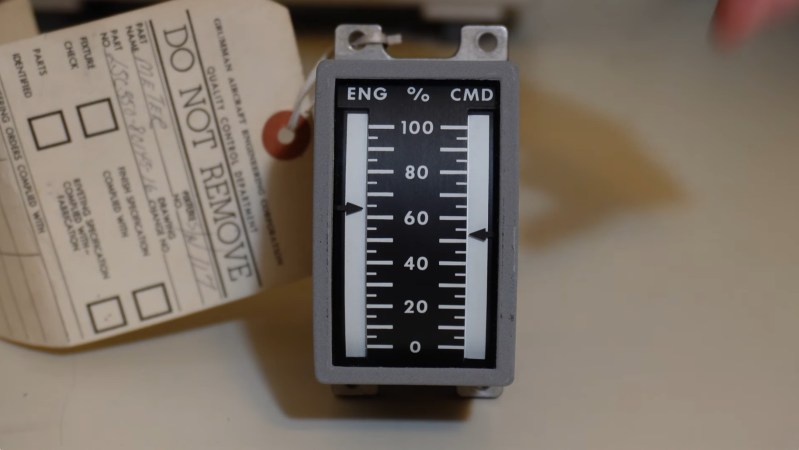
A photo of the thrust meter from the Apollo lunar module

Apollo Lunar Module Thrust Meter Lives Again

[Mike Stewart] powers up a thrust meter from an Apollo lunar module. This bit of kit passed inspection on September 25, 1969. Fortunately [Mike] was able to dig up some old documentation which included the pin numbers. Score! It’s fun to see the various revisions this humble meter went through. Some of the latest revisions are there to address an issue where there was no indication upon failure, so they wired in a relay which could flip a lamp indicator if the device lost power.

This particular examination of this lunar thrust module is a good example of how a system’s complexity can quickly get out of hand. Rather than one pin there are two pins to indicate auto or manual thrust, each working with different voltage levels; the manual thrust is as given but the auto thrust is only the part of the thrust that gets added to a baseline thrust, so they need to be handled differently, requiring extra logic and wiring for biasing the thrust meter when appropriate. The video goes into further detail. Toward the end of the video [Mike] shows us what the meter’s backlights look like when powered.

If you’re interested in Apollo mission technology be sure to check out Don Eyles Walks Us Through The Lunar Module Source Code.

Continue reading “Apollo Lunar Module Thrust Meter Lives Again”

Scientific staff members working on the computing machine Setun

The Setun Was A Ternary Computer From The USSR In 1958

[Codeolences] tells us about the FORBIDDEN Soviet Computer That Defied Binary Logic. The Setun, the world’s first ternary computer, was developed at Moscow State University in 1958. Its troubled and short-lived history is covered in the video. The machine itself uses “trits” (ternary digits) instead of “bits” (binary digits).

When your digits have three discrete values there are a multiplicity of ways of assigning meaning to each state, and the Setun uses a system known as balanced ternary where each digit can be either -1, 0, or 1 and otherwise uses a place-value system in the normal way.

An interesting factoid that comes up in the video is that base-3 (also known as radix-3) is the maximally efficient way to represent numbers because three is the closest integer to the natural growth constant, the base of the natural logarithm, e, which is approximately 2.718 ≈ 3.

If you’re interested to know more about ternary computing check out There Are 10 Kinds Of Computers In The World and Building The First Ternary Microprocessor.

Continue reading “The Setun Was A Ternary Computer From The USSR In 1958”

Interconnected circuits for controlling the clock

Tick, Tock, Train Station Clock

We’ve seen a few H-bridge circuits around these parts before, and here’s another application. This time we have an Old Train Station Clock which has been refurbished after being picked up for cheap at the flea market. These are big analog clocks which used to be common at railway stations around the world.

This build uses an ESP32 C3-mini microcontroller (PDF) in combination with an A4988 Microstepping Motor Driver (PDF). The logic is handled with MicroPython code. The A4988 provides two H-bridge circuits, one for each of two stepper motors, only one of which is used in this build.

The controller for this clock needs to send an alternating positive then negative DC pulse every minute to register that a minute has passed so the clock can update its hour hand and minute hand as appropriate. The ESP32 and the A4988 H-bridge cooperate to make that happen. The wifi on the ESP32 C3-mini is put to good use by facilitating the fetching of the current time from the internet. On an hourly basis the clock gets the current time with a HTTP call to a time server API, for whatever is suitable for your time zone.

Thanks to [PiotrTopa] for writing in to let us know about his project. If you’re interested in learning more about H-bridge applications be sure to check out Introduction To The H-bridge Motor Controller and A H-Bridge Motor Controller Tutorial Makes It Simple To Understand.

Image

39C3: Hardware, And The Hard Bit

The 39th annual Chaos Communication Congress (39C3) is underway, and it kicked off with a talk that will resonate deeply with folks in the Hackaday universe. [Kliment] gave an impassioned invitation for everyone to start making hardware based on his experience both in the industry and in giving an intro-to-surface-mount workshop to maybe thousands of hackers over the years.

His main points are that the old “hardware is hard” cliche is overdone. Of course, working on a complicated high-reliability medical device isn’t child’s play, but that’s not where you start off. And getting started in hardware design and hobby-scale manufacture has never been easier or cheaper, and the open-source tooling gives you a foot in the door.

He tells the story of an attendee at a workshop who said “I kept waiting for the hard part to come, but then I was finished.”  Starting off with the right small-scale projects, learning a few techniques, and ramping up skills built on skills is the way to go. ([Kliment] is a big proponent of hand-placed hot-plate reflow soldering, and we concur.)

This is the talk that you want to show to your software friends who are hardware-curious. It’s also a plea for more experimentation, more prototyping, more hacking, and simply more people in the hardware / DIY electronics scene. Here at Hackaday, it’s maybe preaching to the choir, but sometimes it’s just nice to hear saying it all out loud.