Image

Genetic Therapy Aims To Bring Hearing To Those Born Deaf

For those born with certain types of congenital deafness, the cochlear implant has been a positive and enabling technology. It uses electronics to step in as a replacement for the biological ear that doesn’t quite function properly, and provides a useful, if imperfect, sense of hearing to its users.

New research has promised another potential solution for some sufferers of congenital deafness. Instead of a supportive device, a gene therapy is used to enable the biological ear to function more as it should. The result is that patients get their sense of hearing, not from a prosthetic, but from their own ears themselves.

Continue reading “Genetic Therapy Aims To Bring Hearing To Those Born Deaf”

Image

Clone Wars: IBM Edition

If you search the Internet for “Clone Wars,” you’ll get a lot of Star Wars-related pages. But the original Clone Wars took place a long time ago in a galaxy much nearer to ours, and it has a lot to do with the computer you are probably using right now to read this. (Well, unless it is a Mac, something ARM-based, or an old retro-rig. I did say probably!)

IBM is a name that, for many years, was synonymous with computers, especially big mainframe computers. However, it didn’t start out that way. IBM originally made mechanical calculators and tabulating machines. That changed in 1952 with the IBM 701, IBM’s first computer that you’d recognize as a computer.

If you weren’t there, it is hard to understand how IBM dominated the computer market in the 1960s and 1970s. Sure, there were others like Univac, Honeywell, and Burroughs. But especially in the United States, IBM was the biggest fish in the pond. At one point, the computer market’s estimated worth was a bit more than $11 billion, and IBM’s five biggest competitors accounted for about $2 billion, with almost all of the rest going to IBM.

So it was somewhat surprising that IBM didn’t roll out the personal computer first, or at least very early. Even companies that made “small” computers for the day, like Digital Equipment Corporation or Data General, weren’t really expecting the truly personal computer. That push came from companies no one had heard of at the time, like MITS, SWTP, IMSAI, and Commodore. Continue reading “Clone Wars: IBM Edition”

Image

Ask Hackaday: Do You Curb Shop Components?

I’m not proud. When many of us were kids, we were unabashedly excited when trash day came around because sometimes you’d find an old radio or — jackpot — an old TV out by the curb. Then, depending on its size, you rescued it, or you had your friends help, or, in extreme cases, you had to ask your dad. In those days, people were frugal, so the chances of what you found being fixable were slim to none. If it was worth fixing, the people would have probably fixed it.

While TVs and radios were the favorites, you might have found other old stuff, but in those days, no one was throwing out a computer (at least not in a neighborhood), and white goods like refrigerators and washing machines had very little electronics. Maybe a mechanical timer or a relay, but that’s about it.

Continue reading “Ask Hackaday: Do You Curb Shop Components?”

Illustrated Kristina with an IBM Model M keyboard floating between her hands.

Keebin’ With Kristina: The One With The Cheap-O Keyboard

All right, I’ll cut to the chase: Cheap03xD is mainly so cheap because the PCB falls within a 10 x 10 cm footprint. The point was to make a very affordable keyboard — all the parts come to ~40 Euro (~$47). So it would seem that [Lander03xD_] succeeded.

A 36-key, no-frills split keyboard whose PCBs fit in a 10 x 10 cm footprint.
Image by [Lander03xD_] via reddit
Cheap03xD is all the things — 36-key, split, column-staggered, wireless, hot-swappable, and uses ZMK. The batteries are easily replaceable, and no they don’t get in the way.

Those are MMD Princess silent switches, which I wouldn’t choose, but [Lander03xD_] is taking this board to the office, so I get it. They sure are a nice shade of pink, anyway, and they go really well with the pastels of the DSA keycaps and the bezel.

One cool thing to note is that the PCBs are reversible, like the ErgoDox. This isn’t [Lander03xD_]’s first board, and it won’t be the last.

Now, let’s talk batteries. [Saixos] pointed out that the design doesn’t appear to include a protection circuit. In case you can’t tell from where you’re sitting, those are nice!nano clones that [Lander03xD_] is using, and they expect a protection circuit.

[Lander03xD_] is going to look through the docs and see what’s what. The goal is not to have any daughter boards, so this may take some rethinking.

Via reddit

Continue reading “Keebin’ With Kristina: The One With The Cheap-O Keyboard”

Image

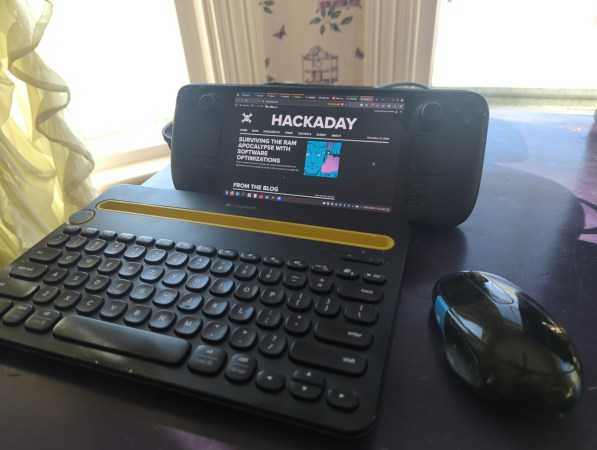
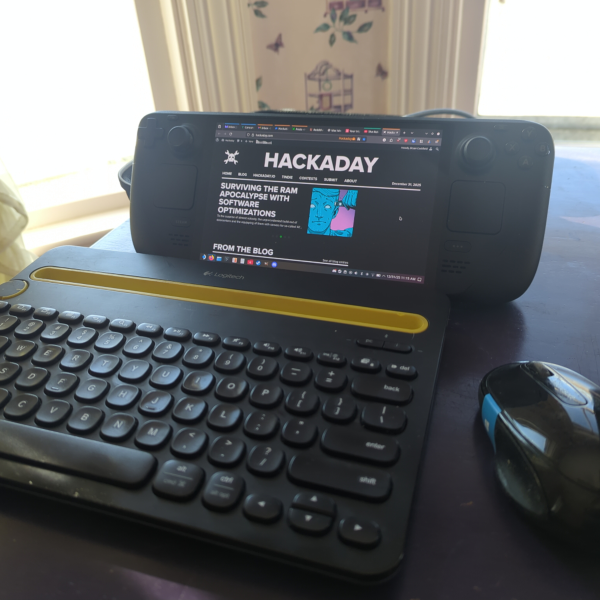
A Linux Power User Puts SteamOS To Work

The line between a Linux user and a Linux power user is a bit gray, and a bit wide. Most people who install Linux already have more computer literacy than average, and the platform has long encouraged experimentation and construction in a way macOS and Windows generally aren’t designed for. Traditional Linux distributions often ask more of their users as well, requiring at least a passing familiarity with the terminal and the operating system’s internals especially once something inevitably breaks.

In recent years, however, a different design philosophy has been gaining ground. Immutable Linux distributions like Fedora Silverblue, openSUSE MicroOS, and NixOS dramatically reduce the chances an installation behaves erratically by making direct changes to the underlying system either impossible or irrelevant.

SteamOS fits squarely into this category as well. While it’s best known for its console-like gaming mode it also includes a fully featured Linux desktop, which is a major part of its appeal and the reason I bought a Steam Deck in the first place. For someone coming from Windows or macOS, this desktop provides a familiar, fully functional environment: web browsing, media playback, and other basic tools all work out of the box.

As a Linux power user encountering an immutable desktop for the first time, though, that desktop mode wasn’t quite what I expected. It handles these everyday tasks exceptionally well, but performing the home sysadmin chores that are second nature to me on a Debian system takes a very different mindset and a bit of effort. Continue reading “A Linux Power User Puts SteamOS To Work”

Image

For The Fun Of It

I was off at the Chaos Communication Congress last weekend, and one of the big attractions for one who is nerdily inclined is seeing all of the personal projects that everyone brings along with them. Inevitably, someone would ask me what my favorite is. Maybe it’s my decision paralysis, maybe it’s being forced to pick a favorite child on the spot, or maybe it’s just that I’m not walking around ranking them, but that question always left me drawing a blank.

But after a week of thinking about it, I’m pretty sure I know why: I don’t actually care what I think of other peoples’ projects! I’m simply stoked to talk to everyone who brought anything, and bathe in the success and failure, hearing about the challenges that they saw coming, and then the new challenges they met along the way. I want to know what the hacker thinks of their project, what their intention was, and how their story went. I’m just a spectator, so I collected stories.

The overwhelming, entirely non-surprising result of listening to a couple hundred hackers talk about their projects? They’re all doing it for the fun of it. Simply for the grins. And that held equally well for the supremely planned-out and technical projects as well as their simpler I-bought-these-surplus-on-eBay-one-night relatives. “We were sitting around and thought, wouldn’t it be fun…” was the start of nearly every story.

That’s what I absolutely love about our community: that people are hacking because it makes them happy, and that the amazing variety of projects suggests an endless possibility for hacker happiness. It’s hard to come away from an event like that without being energized. Some of that comes from the sharing of ideas and brainstorming and hanging out with like-minded folks, but what I find most important is simply the celebration of the joy of the project for its own sake.

Happy hacking!

Image

Fighting Food Poisoning With A Patch

Food poisoning is never a fun experience. Sometimes, if you’re lucky, you’ll bite into something bad and realize soon enough to spit it out. Other times, you’ll only realize your mistake much later. Once the tainted food gets far enough into the digestive system, it’s too late. Your only option is to strap in for the ride as the body voids the toxins or pathogens by every means available, perhaps for several consecutive days.

Proper food storage and preparation are the key ways we avoid food poisoning today. However, a new development could give us a further tool in the fight—with scientists finding a way to actively hunt down and destroy angry little pathogens before they can spoil a good meal.

Continue reading “Fighting Food Poisoning With A Patch”