Hackaday Links Column Banner

Hackaday Links: January 18, 2026

Looking for a unique vacation spot? Have at least $10 million USD burning a hole in your pocket? If so, then you’re just the sort of customer the rather suspiciously named “GRU Space” is looking for. They’re currently taking non-refundable $1,000 deposits from individuals looking to stay at their currently non-existent hotel on the lunar surface. They don’t expect you’ll be able to check in until at least the early 2030s, and the $1K doesn’t actually guarantee you’ll be selected as one of the guests who will be required to cough up the final eight-figure ticket price before liftoff, but at least admission into the history books is free with your stay.

Mars One living units under regolith
This never happened.

The whole idea reminds us of Mars One, which promised to send the first group of colonists to the Red Planet by 2024. They went bankrupt in 2019 after collecting ~$100 deposits from more than 4,000 applicants, and we probably don’t have to tell you that they never actually shot anyone into space. Admittedly, the Moon is a far more attainable goal, and the commercial space industry has made enormous strides in the decade since Mars One started taking applications. But we’re still not holding our breath that GRU Space will be leaving any mints on pillows at one-sixth gravity.

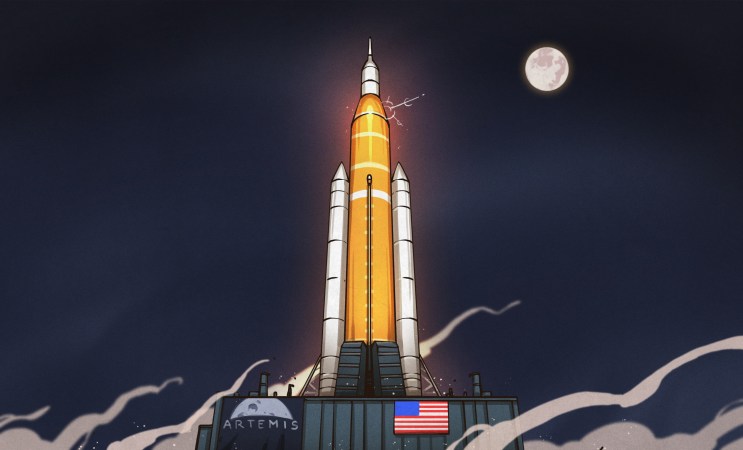
Speaking of something which actually does have a chance of reaching the Moon on time — on Saturday, NASA rolled out the massive Space Launch System (SLS) rocket that will carry a crew of four towards our nearest celestial neighbor during the Artemis II mission. There’s still plenty of prep work to do, including a dress rehearsal that’s set to take place in the next couple of weeks, but we’re getting very close. Artemis II won’t actually land on the Moon, instead performing a lunar flyby, but it will still be the first time we’ve sent humans beyond Low Earth Orbit (LEO) since Apollo 17 in 1972. We can’t wait for some 4K Earthrise video.

Continue reading “Hackaday Links: January 18, 2026”

Hackaday Links Column Banner

Hackaday Links: December 14, 2025

Fix stuff, earn big awards? Maybe, if this idea for repair bounties takes off. The group is dubbed the FULU Foundation, for “Freedom from Unethical Limitations on Users,” and was co-founded by right-to-repair activist Kevin O’Reilly and perennial Big Tech thorn-in-the-side Louis Rossman. The operating model works a bit like the bug bounty system, but in reverse: FULU posts cash bounties on consumer-hostile products, like refrigerators that DRM their water filters or bricked thermostats. The bounty starts at $10,000, but can increase based on donations from the public. FULU will match those donations up to $10,000, potentially making a very rich pot for the person or team that fixes the problem.

Continue reading “Hackaday Links: December 14, 2025”

Image

Could Moon Mining Spoil Its Untouched Grandeur And Science Value?

It’s 2024. NASA’s Artemis program is in full swing, and we’re hoping to get back to the surface of the Moon real soon. Astronauts haven’t walked on the beloved sky rock since 1972! A human landing was scheduled for 2025, which has now been pushed back to 2026, and we’re all getting a bit antsy about it. Last time we wanted to go, it only took 8 years!

Now, somehow, it’s harder, but NASA also has its sights set higher. It no longer wants to just toddle about the Moon for a bit to wave at the TV cameras. This time, there’s talk of establishing permanent bases on the Moon, and actually doing useful work, like mining. It’s a tantalizing thought, but what does this mean for the sanctity of one of the last pieces of real estate yet to be spoilt by humans? Researchers are already arguing that we need to move to protect this precious, unique environment.

Continue reading “Could Moon Mining Spoil Its Untouched Grandeur And Science Value?”

Image

Crippled Peregrine Lander To Make Fiery Return Home

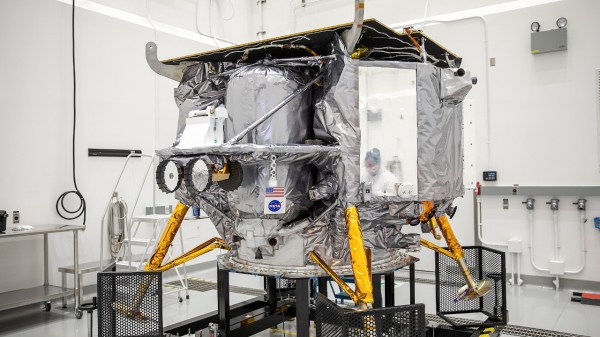
Within a few hours of this post going live, Astrobotic’s Peregrine spacecraft is expected to burn up in the Earth’s atmosphere — a disappointing end to a mission that was supposed to put the first US lander on the Moon since the Apollo program ended in 1972.

In their twentieth mission update since Peregrine was carried into space on the inaugural flight of the United Launch Alliance Vulcan Centaur rocket, Astrobotic explains that the craft has been put on a trajectory designed to ensure it breaks up over a remote area of the South Pacific.

Image
Predicted re-renty point for the Peregrine lander.

It was previously hoped the lander, which suffered a severe system malfunction just hours after liftoff, could have at least made a close pass of the Moon in lieu of touching down. But mission controllers felt the more responsible approach was to have Peregrine make a controlled re-entry while they still had the ability to maneuver it. The alternative, allowing the craft to remain in an uncontrolled orbit between the Earth and Moon, could potentially have caused problems for future Artemis missions.

Over the last ten days, ground controllers at Astrobotic have been working to piece together what happened to the doomed lander, while at the same time demonstrating a remarkable level of transparency by keeping the public informed along the way. It’s now believed that the stream of gas being expelled from a rupture in one of the craft’s propellant tanks was acting as a sort of impromptu thruster. This not only made the craft difficult to keep oriented, but also wasted the propellants that were necessary to perform a soft landing on the lunar surface.

Although the craft was eventually brought under control, the damage to the mission had already been done. While this obviously isn’t the ending that Astrobotic was hoping for, we have no doubt that the company collected valuable data during the craft’s flight through space, which took it approximately 390,000 kilometers (242,000 miles) from Earth.

As for us space nerds, we won’t have to wait long before another lunar lander makes its attempt. Japan’s Smart Lander for Investigating Moon (SLIM) should be touching down at around 10 AM Eastern on Friday (YouTube Live Stream), and the Nova-C lander from Intuitive Machines is scheduled to be launched aboard a Falcon 9 rocket sometime next month.

Image

NASA Adjusts Course On Journey To The Moon

It’s already been more than fifty years since a human last stepped foot on another celestial body, and now that NASA has officially pushed back key elements of their Artemis program, we’re going to be waiting a bit longer before it happens again. What’s a few years compared to half a century?

ImageThe January 9th press conference was billed as a way for NASA Administrator Bill Nelson and other high-ranking officials within the space agency to give the public an update on Artemis. But those who’ve been following the program had already guessed it would end up being the official concession that NASA simply wasn’t ready to send astronauts out for a lunar flyby this year as initially planned. Pushing back this second phase of the Artemis program naturally means delaying the subsequent missions as well, though during the conference it was noted that the Artemis III mission was  already dealing with its own technical challenges.

More than just an acknowledgement of the Artemis delays, the press conference did include details on the specific issues that were holding up the program. In addition several team members were able to share information about the systems and components they’re responsible for, including insight into the hardware that’s already complete and what still needs more development time. Finally, the public was given an update on what NASA’s plans look like after landing on the Moon during the Artemis III mission, including their plans for constructing and utilizing the Lunar Gateway station.

With the understanding that even these latest plans are subject to potential changes or delays over the coming years, let’s take a look at the revised Artemis timeline.

Continue reading “NASA Adjusts Course On Journey To The Moon”

Image

Vulcan Nails First Flight, But Peregrine Falls Short

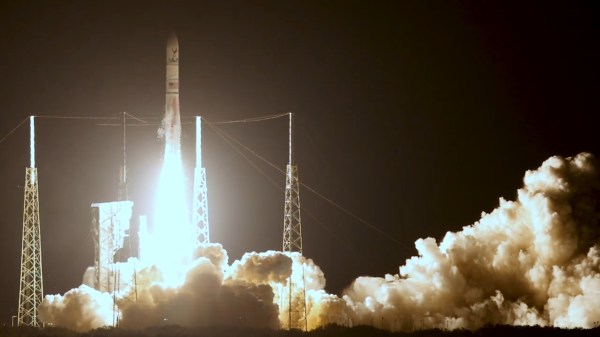
For those with an interest in the history of spaceflight, January 8th promised to be a pretty exciting day. Those who tuned into the early morning live stream were looking forward to seeing the first flight of the Vulcan Centaur, a completely new heavy-lift booster developed by United Launch Alliance. But as noteworthy as the inaugural mission of a rocket might be under normal circumstances, this one was particularly special as it was carrying Peregrine — set to be the first American spacecraft to set down on the lunar surface since the end of the Apollo program in 1972.

Experience has taught us that spaceflight is hard, and first attempts at it doubly so. The likelihood of both vehicles performing as expected and accomplishing all of their mission goals was fairly remote to begin with, but you’ve got to start somewhere. Even in the event of a complete failure, valuable data is collected and real-world experience is gained.

Now, more than 24 hours later, we’re starting to get that data back and finding out what did and didn’t work. There’s been some disappointment for sure, but when everything is said and done, the needle definitely moved in the right direction.

Continue reading “Vulcan Nails First Flight, But Peregrine Falls Short”