Image

A Guide To Using Triacs For Switching AC

For switching high-powered loads from a microcontroller, or for switching AC loads in general, most of us will reach into the parts bin and pull out a generic relay of some sort. Relays are fundamental, proven technologies to safely switch all kinds of loads. They do have their downsides, though, so if you need silent operation, precise timing, or the ability to operate orders of magnitude more times you might want to look at a triac instead. These solid state devices can switch AC loads unlike other transistor-based devices and [Ray] at OpenSprinkler is here to give us an overview on how to use them.

The key to switching an AC load is bi-directional conductivity. A normal transistor or diode can only conduct in one direction, so if you try to switch an AC load with one of these you’ll end up with what essentially amounts to a bad rectifier. Triacs do have a “gate” analogous to the base of a bipolar junction transistor, but the gate will trigger the triac when current flows in either direction as well. The amount of current needed to trigger the triac does depend on the state of the switched waveform, so it can be more complex to configure than a relay or transistor in some situations.

After going through some of the theory around these devices, [Ray] demonstrates how to use them with an irrigation system, which are almost always operating on a 24VAC system thanks to various historical quirks. This involves providing the triacs with a low voltage source to provide gate current as well as a few other steps. But with that out of the way, switching AC loads with triacs can become second nature. If you prefer a DC setup for your sprinklers, though, [vinthewrench] has demonstrated how to convert these sprinkler systems instead.

Image

DIY, Full-Stack Farm Automation

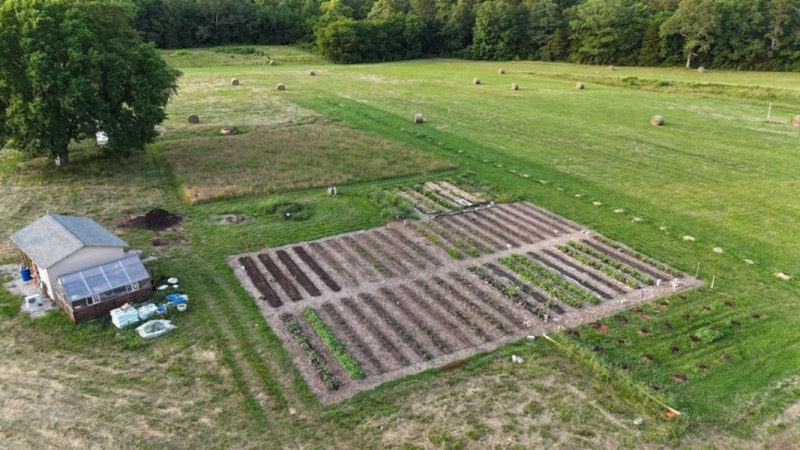
Recently, [Vinnie] aka [vinthewrench] moved from Oregon to Arkansas to start a farmstead. This is a style of farming that focuses not just on a profitable farm where produce is sold at market, but also on a homestead where much of one’s own food is grown on the farm as well. Like any farm, though, it’s extremely hard work that takes a tremendous amount of time. Automation and other technology can make a huge impact in these situations, and [Vinnie] is rolling out his own software stack to help with this on his farm.

He calls his project the Pi Internet of Things, or PioT, and as its name suggests is based around the Raspberry Pi. Since this will all be outdoors and exposed to the extremes of Arkansas weather, everything built under the auspices of this project prioritizes ruggedness, stability, and long-term support, all while avoiding any cloud service. The system also focuses on being able to ride through power outages. The server side, called piotserver, uses a REST API to give the user access to the automation systems through a web interface

[Vinnie] also goes into detail about why existing systems like Home Assistant and Open Sprinkler wouldn’t work in his situation, and why a ground-up solution like this is more appropriate for his farm. This post is largely an overview of his system, but some of his other posts go into more detail about things like integrating temperature sensors, rainfall monitoring, controlling irrigation systems, and plenty of other farm automation tasks that are useful for any farmer or gardener.

We’ve also seen some other projects of his here like this project which converts a common AC sprinkler system to an easier-to-use DC system, and a DIY weather station that operates in the 915 MHz band. He’s been a great resource for anyone looking to have technology help them out with their farm or garden, but if you’re just getting started on your green thumb be sure to take a look at this starter guide as well.

Image

Field Guide To North American Crop Irrigation

Human existence boils down to one brutal fact: however much food you have, it’s enough to last for the rest of your life. Finding your next meal has always been the central organizing fact of life, and whether that meal came from an unfortunate gazelle or the local supermarket is irrelevant. The clock starts ticking once you finish a meal, and if you can’t find the next one in time, you’ve got trouble.

Working around this problem is basically why humans invented agriculture. As tasty as they may be, gazelles don’t scale well to large populations, but it’s relatively easy to grow a lot of plants that are just as tasty and don’t try to run away when you go to cut them down. The problem is that growing a lot of plants requires a lot of water, often more than Mother Nature provides in the form of rain. And that’s where artificial irrigation comes into the picture.

We’ve been watering our crops with water diverted from rivers, lakes, and wells for almost as long as we’ve been doing agriculture, but it’s only within the last 100 years or so that we’ve reached a scale where massive pieces of infrastructure are needed to get the job done. Above-ground irrigation is a big business, both in terms of the investment farmers have to make in the equipment and the scale of the fields it turns from dry, dusty patches of dirt into verdant crops that feed the world. Here’s a look at the engineering behind some of the more prevalent methods of above-ground irrigation here in North America.

Continue reading “Field Guide To North American Crop Irrigation”

Image

Automated Drip Watering Device Keeps Plants Happy

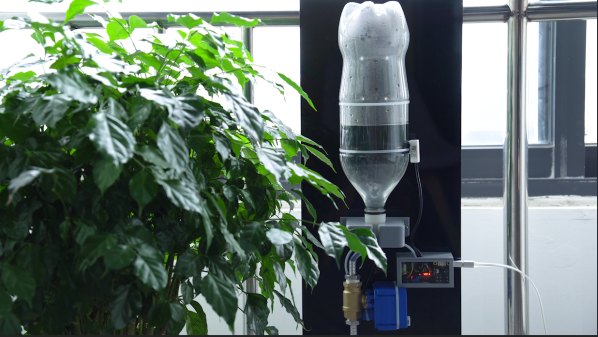
Plants tend to need a regular supply of water to stay happy. If you’re a green thumb, it’s one of the primary things you should take care of before you go on holiday. This DIY plant watering system from [Jaychouu] offers to handle just that.

The system consists of a soda bottle acting as a water container, and an electronically-controlled valve to control the flow of water to plants. Irrigation of the plants is via dripper nozzles to provide a small but consistent feed to the plants. The use of drippers tends to disturb the soil less than pressurized jets of water. A soil humidity sensor is used to detect moisture levels and avoid over-watering. There’s also a capacitive water level sensor that fires off a warning when the reservoir’s water level is low. An ESP32 serves as the brains of the operation, allowing remote control via Blynk.

If you’re looking for a simple way to drip water your plants while you’re away, it’s hard to go wrong with this concept. If you feel like a more passive solution though, we’ve seen other viable methods too.

Continue reading “Automated Drip Watering Device Keeps Plants Happy”

Image

Irrigation Controller Uses Google Calendar To Make Things Easy

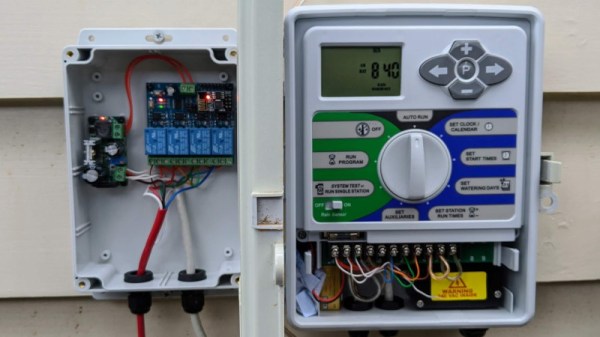
Irrigation controllers have been around for a long time, often using similar hardware inside that would be familiar to the average maker. However, many of the products on the shelf at your local hardware store can be quite expensive for what amounts to a microcontroller, display, and relay board. [oscillatory] had such a rig, but wanted to bring it into the 21st century, IOT style.

The existing Holman irrigation system consisted of a control box, hooked up to four solenoid valves controlled by relays. [oscillatory] decided that replacing this with something fancier would thus be straightforward. A relay board packing an ESP8266 was sourced, and flashed with the Tasmota firmware. This was then hooked up to run off the Holman’s 24 VAC supply via a CCTV power supply, allowing the new controller to be run in parallel with the existing hardware, just in case. Scheduling is then controlled by Google Calendar, in concert with Home Assistant.

[oscillatory] now has a watering system that can be controlled over the web, and without the need to install any custom apps. Simply creating a calendar entry is enough for the system to spring into action. We’ve seen others use a similar approach, too.  It’s a great example of using off-the-shelf parts to whip up a useful custom home automation setup!

Image

Vinduino Water-Smart Farming – Now With LoRa!

Our five rounds of Hackaday Prize 2018 challenges have just wrapped up, and we’re looking forward to see where the chips fall in the final ranking. While we’re waiting for the winners to be announced at Hackaday Superconference, it’s fun to take a look back at one of our past winners. Watch [Reinier van der Lee] give the latest updates on his Vinduino project (video also embedded after the break) to a Hackaday Los Angeles meetup earlier this year.

Vinduino started with [Reinier]’s desire to better understand what happens to irrigation water under the surface, measuring soil moisture at different depths. This knowledge informs more efficient use of irrigation water, as we’ve previously covered in more detail. What [Reinier] has been focused on is improving usability of the system by networking the sensors wirelessly versus having to walk up and physically attach a reader unit.

His thought started the same as ours – put them on WiFi! But adding WiFi coverage across his entire vineyard was not going to be cost-effective. After experimenting with various communication schemes, he has settled on LoRa. Designed to trade raw bandwidth for long range with low power requirements, it is a perfect match for a network of soil moisture sensors.

In the video [Reinier] gives an overview of LoRa for those who might be unfamiliar. Followed by results of his experiments integrating LoRa functionality into Vinduino, and ending with a call to action for hackers to help grow the LoRa network. It sounds like he’s become quite the champion for the cause! He’s even giving a hands-on workshop at Supercon where you can build your own LoRa connected sensor. (Get tickets here.)

We’re always happy to see open-source hardware projects like Vinduino succeed, transitioning to a product that solve real world problems. We know there are even more promising ideas out there, which is why Hackaday’s sister company Tindie is funding a Project to Product program to help this year’s winners follow in Vinduino’s footsteps. We look forward to sharing more success stories yet to come.

Continue reading “Vinduino Water-Smart Farming – Now With LoRa!”

Image

Battery-Powered Watering Timer Converted To Solar On The Cheap

Watering the garden or the lawn is one of those springtime chores that is way more appealing early in the season than later. As the growing season grinds along, a chore that seemed life-giving and satisfying becomes, well, just another chore, and plants often suffer for it.

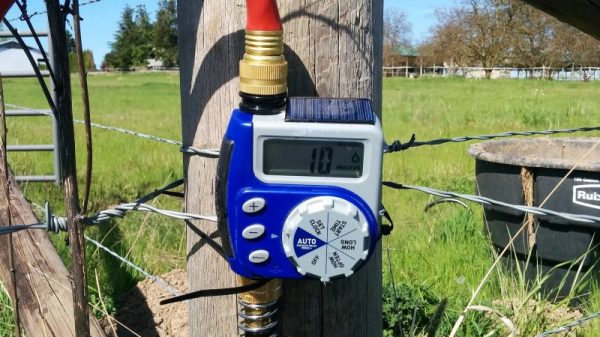
Automating the watering task can be as simple as buying a little electronic timer valve that turns on the flow at the appointed times. [A1ronzo] converted his water hose timer to solar power. Most such timers are very similar, with a solenoid-operated pilot valve in line with the water supply and an electronic timer of some sort. The whole thing is quite capable of running on a pair of AA batteries, but rather than wasting money on new batteries several times a season, he slipped a LiPo pack and a charge controller into the battery case slot and connected a small solar panel to the top of the controller.

The LiPo is a nominal 3.7-volt pack, so he did a little testing to make sure the timer would be OK with the higher voltage. The solar panel sits on top of the case, and the whole thing should last for years. And bonus points for never having to replace a timer that you put away at the end of the season with batteries still in it, only to have them leak. Ask us how we know.

Like the best of hacks, this one is quick, easy and cheap — $15 in parts, aside from the timer. There are more complicated irrigation solutions, of course, one of which even won the Hackaday Prize once upon a time. But this one has us ordering parts to build our own right now.