Image

WCH CH32M030: Another Microcontroller To Watch Out For

One of the joys of writing for Hackaday comes in following the world of new semiconductor devices, spotting interesting ones while they are still just entries on manufacturer websites, and then waiting for commonly-available dev boards. With Chinese parts there’s always a period in which Chinese manufacturers and nobody else has them, and then they quietly appear on AliExpress.

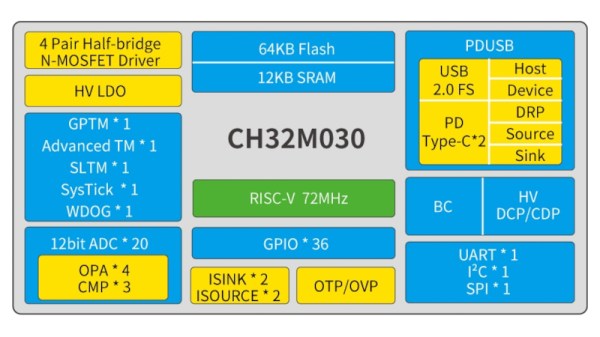
All of which brings us to the WCH CH32M030, a chip that’s been on the radar for a while and has finally broken cover. It’s the CH32 RISC-V microcontroller you may be familiar with, but with a set of four half-bridge drivers on board for running motors. A handy, cheap, and very smart motor controller, if you will.

There’s been at  least one Chinese CH32M030 dev board (Chinese language) online for a while now, but the one listed on AliExpress appears to be a different design. At the time of writing the most popular one is still showing fewer than 20 sales, so we’re getting in at the ground floor here.

We think this chip is of interest because it has the potential to be used in low price robotic projects, replacing as it does a couple of parts or modules in one go. If you use it, we’d like to hear from you!
Image

Motors Make The Best Knobs With SimpleFOC

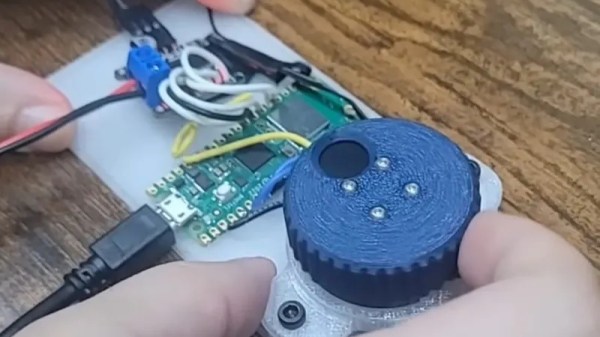
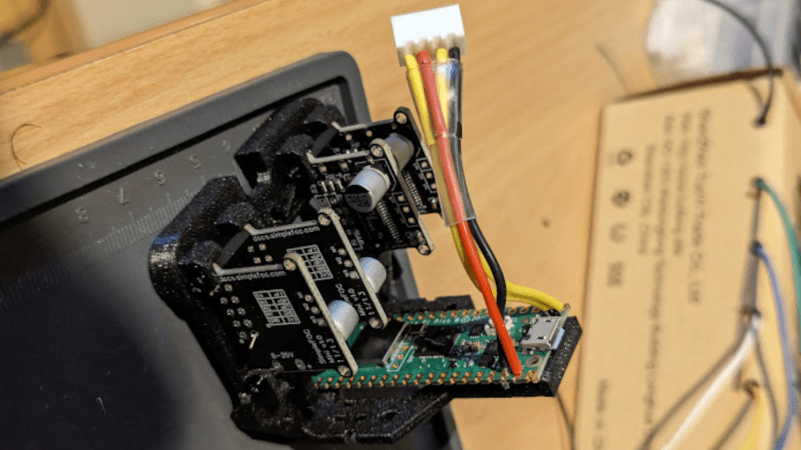
The worst thing about a volume knob is that, having connected it to a computer, it might be wrong: if you’ve manually altered the volume settings somewhere else, the knob’s reading won’t be correct. [I Got Distracted] has a quick tutorial on YouTube showing how to use a BLDC, a hall effect sensor, Pi Pico and the SimpleFOC library to make a knob with active haptic feedback and positioning.

We covered the SimpleFOC library a few years ago, but in case you missed it, it’s, well, a simple library for FOC on all of our favorite microcontrollers, from Arduino to ESP to Pico. FOC stands for field-oriented control, which is a particular way of providing smooth, precise control to BLDCs. (That’s a BrushLess DC motor, if the slightly-odd acronym is new to you.) [I Got Distracted] explains exactly how that works, and shows us just how simple the SimpleFOC project is to use in this video.  Why, they even produce their own motor controllers, for a fully-integrated experience. (You aren’t restricted to that hardware, but it certainly does make things easy.)

The haptic feedback and self-dialing knob make for an easy introductory project, but seeing how quick it hacks together, you can doubtless think of other possibilities. The SimpleFOC controller used in this video is limited to relatively small motors, but if you want to drive hundreds of kilowatts through open source hardware, we’ve covered that, too.  

Arguably, using a motor as a knob isn’t within the design spec, and so could almost qualify for our ongoing Component Abuse Challenge, had [I Got Distracted] thought to enter.

Continue reading “Motors Make The Best Knobs With SimpleFOC”

Image

Running Four Brushless Motors With A Single Pi Pico

Sometimes, you have to drive four motors, and you need to do so with a certain level of control. You could throw a lot of parts at the problem, but you don’t necessarily have to. As [Shaun Crampton] demonstrates, you can run four brushless DC motors with a single Pi Pico.

[Shaun] set about developing a brushless motor controller from scratch with the Pico, relying on its PIO hardware and the TI DRV8313 — a handy three phase motor driver. Before he knew it, he was implementing field oriented control (FOC) in MicroPython, only to find that it was a little too slow for proper motor control work. He soon switched to C for the lower overheads, and was readily driving a brushless motor with his own code. Before long, he’d implemented torque limiting and PID speed control. He was even able to optimize things to the point where he had four motors hanging off a single Pi Pico, complete with Hall sensors for feedback.

The full story is well worth reading, as it goes from “Hello, World” all the way to the end of the project. If you’ve never experienced the joy of your own code getting a motor to spin, you might enjoy following in [Shaun’s] footsteps. Files are on GitHub for the curious.

We’ve seen a lot of motor controllers around here, many of which draw heavily from other projects online. It’s a great way to learn the basics of what is a very well established field. Meanwhile, if you’re cooking up your own project in this space, do drop us a line!

Image

Kid’s Ride Gets Boosted Battery, ESP32 Control

That irresistible urge to rescue an interesting piece of hardware from the trash is something that pretty much every Hackaday reader will have felt at one time or another. Sometimes it’s something that you could put to work immediately, like an old computer or some scrap piece of material that’s just the right size. But other times, you find something on the side of the road that ends up being the impetus for a whole new project.

For [David Bertet], finding a beat up kid’s Jeep Wrangler on the curb was the first step towards a journey that ends with PowerJeep: an open source project that we wager could end up saving similar vehicles from the landfill. The basic idea is simple enough — strip out the vehicle’s original 12 volt power supply and replace it with 18 V provided by easily swappable tool batteries. But as is often the case, it’s the details and the documentation that sets this project apart.

Continue reading “Kid’s Ride Gets Boosted Battery, ESP32 Control”

Image

300 Amps Through An Open Source Speed Controller

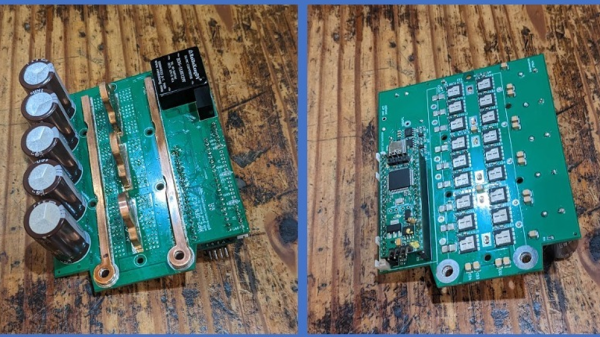
Sometimes, a little puny matchbox-sized electronic speed controller (ESC) won’t do the job. If you find yourself looking for something heftier, say, in the range of hundreds of amps, you might look towards a design like the MP2 ESC. [owhite] has built an example of the design that can deliver some serious power.

[owhite’s] build has some serious specs: it’s rated to offer up to 300 amps at up to 150 volts, though thus far, it’s only been tested at up to 100 V. Like the original MP2, which hails from the Endless Sphere forums, it’s designed to be compatible with VESC code using the STM32F405 microcontroller. It’s intended for driving high-powered traction motors in applications like e-bikes and electric scooters, as you might have guessed by its potential output power being well into the tens of kilowatts range.

If you’re eager to build your own, you can do so, with the design files on GitHub. Just note that you’ll need some hefty parts to handle the juice, including beefy MOSFETS and juicy capacitors rated at 160 V.

Open source motor controllers abound of late, and we’ve featured a few in recent times. Just remember that astute design and using parts within their means is the key to avoiding letting the smoke out! Continue reading “300 Amps Through An Open Source Speed Controller”

Image

Hackaday Prize 2023: Tiny RC Aircraft Built Using Foam And ESP12

Once upon a time, a radio controlled plane was a hefty and complex thing. They required small nitro engines, support equipment, and relatively heavy RC electronics. Times have changed since then, as this lightweight RC build from [Ravi Butani] demonstrates.

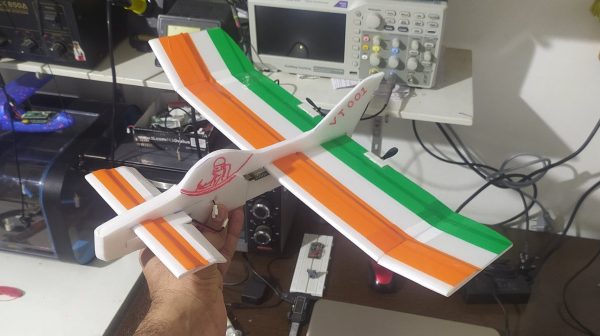
ImageThe body of the plane is lightweight foam, and can be assembled in two ways. There’s a relatively conventional layout, using a main wing, tailplane, and rudder, or a pusher model with the main wing at the rear and a canard up front. The open hardware electronics package, which [Ravi] calls VIMANA, consists of an ESP12 module with a pair of MOSFETs to act as two independent motor drivers — allowing the plane to be flown and steered with differential thrust.

For more advanced flight control, it can also command a pair of servos to control ailerons, a rudder, canards, or elevons, depending on configuration. There’s also potential to install an IMU to set the plane up with flight stabilization routines.

Thanks to the low-cost of the VIMANA board, [Ravi] hopes it can be used in STEM education programs. He notes that it’s not limited just to aircraft, and could be used for other motorized projects such as boats and cars. We’ve featured an early version of his work before, but the project has come a long way since then.

Continue reading “Hackaday Prize 2023: Tiny RC Aircraft Built Using Foam And ESP12”

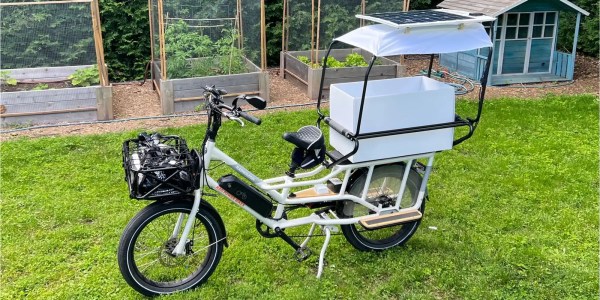
A white longtail cargo bike sits on grass with fenced-in planters behind it. The bike has a basket made of black metal tubes on the front and a passenger compartment behind the rider seat for children made of similar black metal tubes. A white canopy is above the passenger compartment and a solar panel sits atop the canopy.

Solar Powered E-bike Replaces Car Trips

E-bikes can replace car trips for some people, and adding a solar panel can make the fun last longer. [Luke] did some heavy modifications to his RadWagon to make it better, stronger, and faster than it was before.

The first step was replacing the stock 750 W controller with a 1500 W model to give the motor twice the power. [Luke] plans to replace the motor if it gets fried pushing too much juice, but is planning on just being careful for now. To stop this super-powered ride, he swapped the stock mechanical discs out for a hydraulic set which should be more reliable, especially when loading down this cargo bike.

On top of these performance enhancements, he also added a 50 W solar panel and maximum power point tracking (MPPT) charge controller to give the bike a potential 50% charge every day. Along with the OEM kid carrier and roof, this bike can haul kids and groceries while laughing at any hills that might come its way.

Checkout this other solar e-bike or this one making a trip around the world for more fun in the sun.