Hackaday Links Column Banner

Hackaday Links: January 18, 2026

Looking for a unique vacation spot? Have at least $10 million USD burning a hole in your pocket? If so, then you’re just the sort of customer the rather suspiciously named “GRU Space” is looking for. They’re currently taking non-refundable $1,000 deposits from individuals looking to stay at their currently non-existent hotel on the lunar surface. They don’t expect you’ll be able to check in until at least the early 2030s, and the $1K doesn’t actually guarantee you’ll be selected as one of the guests who will be required to cough up the final eight-figure ticket price before liftoff, but at least admission into the history books is free with your stay.

Mars One living units under regolith
This never happened.

The whole idea reminds us of Mars One, which promised to send the first group of colonists to the Red Planet by 2024. They went bankrupt in 2019 after collecting ~$100 deposits from more than 4,000 applicants, and we probably don’t have to tell you that they never actually shot anyone into space. Admittedly, the Moon is a far more attainable goal, and the commercial space industry has made enormous strides in the decade since Mars One started taking applications. But we’re still not holding our breath that GRU Space will be leaving any mints on pillows at one-sixth gravity.

Speaking of something which actually does have a chance of reaching the Moon on time — on Saturday, NASA rolled out the massive Space Launch System (SLS) rocket that will carry a crew of four towards our nearest celestial neighbor during the Artemis II mission. There’s still plenty of prep work to do, including a dress rehearsal that’s set to take place in the next couple of weeks, but we’re getting very close. Artemis II won’t actually land on the Moon, instead performing a lunar flyby, but it will still be the first time we’ve sent humans beyond Low Earth Orbit (LEO) since Apollo 17 in 1972. We can’t wait for some 4K Earthrise video.


Continue reading “Hackaday Links: January 18, 2026”

Image

ISS Medical Emergency: An Orbital Ambulance Ride

Over the course of its nearly 30 years in orbit, the International Space Station has played host to more “firsts” than can possibly be counted. When you’re zipping around Earth at five miles per second, even the most mundane of events takes on a novel element. Arguably, that’s the point of a crewed orbital research complex in the first place — to study how humans can live and work in an environment that’s so unimaginably hostile that something as simple as eating lunch requires special equipment and training.

Today marks another unique milestone for the ISS program, albeit a bittersweet one. Just a few hours ago, NASA successfully completed the first medical evacuation from the Station, cutting the Crew-11 mission short by at least a month. By the time this article is released, the patient will be back on terra firma and having their condition assessed in California.  This leaves just three crew members on the ISS until NASA’s Crew-12 mission can launch in early February, though it’s possible that mission’s timeline will be moved up.

Continue reading “ISS Medical Emergency: An Orbital Ambulance Ride”

Hackaday Links Column Banner

Hackaday Links: November 16, 2025

We make no claims to be an expert on anything, but we do know that rule number one of working with big, expensive, mission-critical equipment is: Don’t break the big, expensive, mission-critical equipment. Unfortunately, though, that’s just what happened to the Deep Space Network’s 70-meter dish antenna at Goldstone, California. NASA announced the outage this week, but the accident that damaged the dish occurred much earlier, in mid-September. DSS-14, as the antenna is known, is a vital part of the Deep Space Network, which uses huge antennas at three sites (Goldstone, Madrid, and Canberra) to stay in touch with satellites and probes from the Moon to the edge of the solar system. The three sites are located roughly 120 degrees apart on the globe, which gives the network full coverage of the sky regardless of the local time.

Continue reading “Hackaday Links: November 16, 2025”

Hackaday Links Column Banner

Hackaday Links: October 12, 2025

We’ve probably all seen some old newsreel or documentary from The Before Times where the narrator, using his best Mid-Atlantic accent, described those newfangled computers as “thinking machines,” or better yet, “electronic brains.” It was an apt description, at least considering that the intended audience had no other frame of reference at a time when the most complex machine they were familiar with was a telephone. But what if the whole “brain” thing could be taken more literally? We’ll have to figure that out soon if these computers powered by miniature human brains end up getting any traction.

Continue reading “Hackaday Links: October 12, 2025”

Image

A New Generation Of Spacecraft Head To The ISS

While many in the industry were at first skeptical of NASA’s goal to put resupply flights to the International Space Station in the hands of commercial operators, the results speak for themselves. Since 2012, the SpaceX Dragon family of spacecraft has been transporting crew and cargo from American soil to the orbiting laboratory, a capability that the space agency had lost with the retirement of the Space Shuttle. Putting these relatively routine missions in the hands of a commercial provider like SpaceX takes some of the logistical and financial burden off of NASA, allowing them to focus on more forward-looking projects.

Image
SpaceX Dragon arriving at the ISS for the first time in 2012.

But as the saying goes, you should never put all of your eggs in one basket. As successful as SpaceX has been, there’s always a chance that some issue could temporarily ground either the Falcon 9 or the Dragon.

While Russia’s Progress and Soyuz vehicles would still be available in an emergency situation, it’s in everyone’s best interest that there be multiple backup vehicles that can bring critical supplies to the Station.

Which is precisely why several new or upgraded spacecraft, designed specifically for performing resupply missions to the ISS and any potential commercial successor, are coming online over the next few years.

In fact, one of them is already flying its first mission, and will likely have arrived at the International Space Station by the time you read this article.

Continue reading “A New Generation Of Spacecraft Head To The ISS”

Hackaday Links Column Banner

Hackaday Links: September 14, 2025

Is it finally time to cue up the Bowie? Or was the NASA presser on Wednesday announcing new findings of potential Martian biosignatures from Perseverance just another in a long line of “We are not alone” teases that turn out to be false alarms? Time will tell, but from the peer-reviewed paper released simultaneously with the news conference, it appears that biological activity is now the simplest explanation for the geochemistry observed in some rock samples analyzed by the rover last year. There’s a lot in the paper to unpack, most of which is naturally directed at planetary scientists and therefore somewhat dense reading. But the gist is that Perseverance sampled some sedimentary rocks in Jezero crater back in July of 2024 with the SHERLOC and PIXL instruments, extensive analysis of which suggests the presence of “reaction fronts” within the rock that produced iron phosphate and iron sulfide minerals in characteristic shapes, such as the ring-like formations they dubbed “leopard spots,” and the pinpoint “poppy seed” formations.

Continue reading “Hackaday Links: September 14, 2025”

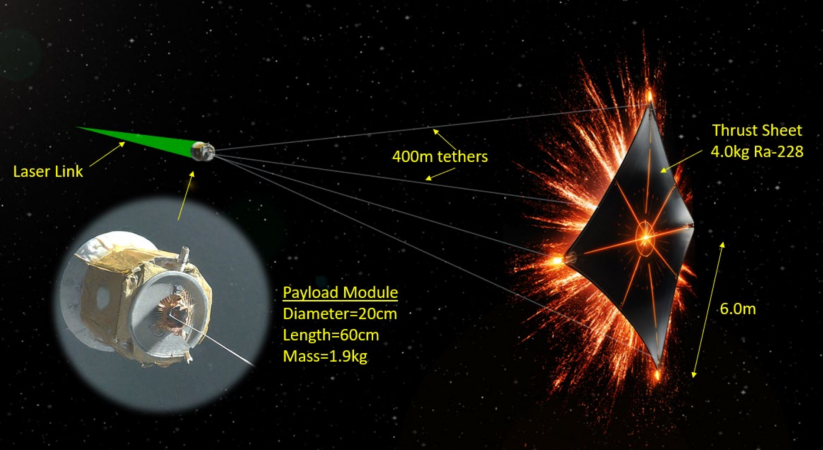
Figure 7-8, caption: Example thrust sheet rotation using tether control. Credit: NASA/James Bickford.

TFINER Is An Atompunk Solar Sail Lookalike

It’s not every day we hear of a new space propulsion method. Even rarer to hear of one that actually seems halfway practical. Yet that’s what we have in the case of TFINER, a proposal by [James A. Bickford] we found summarized on Centauri Dreams by [Paul Gilster] .

TFINER stands for Thin-Film Nuclear Engine Rocket Engine, and it’s a hoot.  The word “rocket” is in the name, so you know there’s got to be some reaction mass, but this thing looks more like a solar sail. The secret is that the “sail” is the rocket: as the name implies, it hosts a thin film of nuclear materialwhose decay products provide the reaction mass. (In the Phase I study for NASA’s Innovative Advanced Concepts office (NIAC), it’s alpha particles from Thorium-228 or Radium-228.) Alpha particles go pretty quick (about 5% c for these isotopes), so the ISP on this thing is amazing. (1.81 million seconds!) Continue reading “TFINER Is An Atompunk Solar Sail Lookalike”