Image

A Guide To Using Triacs For Switching AC

For switching high-powered loads from a microcontroller, or for switching AC loads in general, most of us will reach into the parts bin and pull out a generic relay of some sort. Relays are fundamental, proven technologies to safely switch all kinds of loads. They do have their downsides, though, so if you need silent operation, precise timing, or the ability to operate orders of magnitude more times you might want to look at a triac instead. These solid state devices can switch AC loads unlike other transistor-based devices and [Ray] at OpenSprinkler is here to give us an overview on how to use them.

The key to switching an AC load is bi-directional conductivity. A normal transistor or diode can only conduct in one direction, so if you try to switch an AC load with one of these you’ll end up with what essentially amounts to a bad rectifier. Triacs do have a “gate” analogous to the base of a bipolar junction transistor, but the gate will trigger the triac when current flows in either direction as well. The amount of current needed to trigger the triac does depend on the state of the switched waveform, so it can be more complex to configure than a relay or transistor in some situations.

After going through some of the theory around these devices, [Ray] demonstrates how to use them with an irrigation system, which are almost always operating on a 24VAC system thanks to various historical quirks. This involves providing the triacs with a low voltage source to provide gate current as well as a few other steps. But with that out of the way, switching AC loads with triacs can become second nature. If you prefer a DC setup for your sprinklers, though, [vinthewrench] has demonstrated how to convert these sprinkler systems instead.

Image

Harvard Claims Breakthrough In Anode Behavior Of Solid State Lithium Batteries

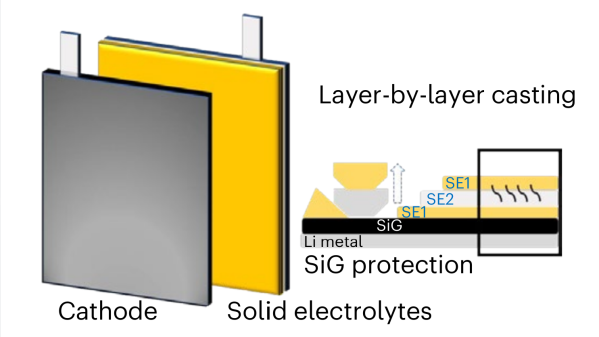
One of the biggest issues facing the solid-state lithium-based batteries we all depend upon is of the performance of the anode; the transport of lithium ions and minimization of dendrite formation are critical problems and are responsible for charge/discharge rates and cell longevity. A team of researchers at Harvard have demonstrated a method for using a so-called constriction-susceptible structure on a silicon anode material in order to promote direct metal lithium deposition, as opposed to the predominant alloying reaction. After the initial silicon-lithium alloy layer is formed, subsequent layers are pure lithium. Micrometre-scale silicon particles at the anode constrain the lithiation process (i.e. during charging) where free lithium ions are pushed by the charge current towards the anode area. Because the silicon particles are so small, there is limited surface area for alloying to occur, so direct metal plating of lithium is preferred, but crucially it happens in a very uniform manner and thus does not tend to promote the formation of damaging metal dendrites.

Continue reading “Harvard Claims Breakthrough In Anode Behavior Of Solid State Lithium Batteries”

Two researchers, a white woman and dark-skinned man look at a large monitor with a crystal structure displayed in red and white blocks.

AI On The Hunt For Better Batteries

While certain dystopian visions of the future have humans power the grid for AIs, Microsoft and Pacific Northwest National Laboratory (PNNL) set a machine learning system on the path of better solid state batteries instead.

Solid state batteries are the current darlings of battery research, promising a step-change in packaging size and safety among other advantages. While they have been working in the lab for some time now, we’re still yet to see any large-scale commercialization that could shake up the consumer electronics and electric vehicle spaces.

With a starting set of 32 million potential inorganic materials, the machine learning algorithm was able to select the 150 most promising candidates for further development in the lab. This smaller subset was then fed through a high-performance computing (HPC) algorithm to winnow the list down to 23. Eliminating previously explored compounds, the scientists were able to develop a promising Li/Na-ion solid state battery electrolyte that could reduce the needed Li in a battery by up to 70%.

For those of us who remember when energy materials research often consisted of digging through dusty old journal papers to find inorganic compounds of interest, this is a particularly exciting advancement. A couple more places technology can help in the sciences are robots doing the work in the lab or on the surgery table.

Continue reading “AI On The Hunt For Better Batteries”

Image

Magic Eye Tubes Go Solid State With This Plug-In Replacement

Perhaps nothing added quite so much to the charm of vacuum tube circuits from back in the heyday of the vacuum tube as did the “Magic Eye” indicating tube. With the ghostly green glow of its circular face, magic eyes stood in for more expensive moving-coil meters for things like tuning indicators and VU meters. And while they may be getting hard to come by today, fear not — this solid-state replacement for the magic eye tube is ready to stand in for your restoration projects.

To pull off this clever build, [Gord Rabjohn] started with original 6E5 and 6U5 magic eye tubes, presumably ones that either no longer worked or had become too weak to see. The glass envelopes of the cathode-ray tubes were carefully cut from the sockets, and the guts of the tubes were discarded to make room for the replacement circuit, which lives on two PCBs. A rectangular control board holds an LM3915 bar graph LED driver chip, while a round display PCB holds 120 surface-mount green LEDs. The circular display board is mounted at the top of the control board and perpendicular to it, with a diffuser mounted above the LEDs. Everything is stuffed back into the original glass envelope and socket, making this a plug-in replacement for the tube.

The effect is quite convincing, as shown in the video below. True, you can see some evidence of the individual LEDs even with the diffuser, but honestly this just makes the display look more like the iris of an eye. We really like the look of this and we appreciate the work [Gord] put into it, especially the documentation. For a little more on how the tubes worked, check out [Al Williams]’ article.

Continue reading “Magic Eye Tubes Go Solid State With This Plug-In Replacement”

Image

The State Of Play In Solid State Batteries

Electric vehicles are slowly but surely snatching market share from their combustion-engined forbearers. However, range and charging speed remain major sticking points for customers, and are a prime selling point for any modern EV. Battery technology is front and center when it comes to improving these numbers.

Solid-state batteries could mark a step-change in performance in these areas, and the race to get them to market is starting to heat up. Let’s take a look at the current state of play.

Continue reading “The State Of Play In Solid State Batteries”

Image

Recover Data From Damaged Chips

Not every computer is a performance gaming rig. Some of us need cheap laptops and tablets for simple Internet browsing or word processing, and we don’t need to shell out thousands of dollars just for that. With a cheaper price tag comes cheaper hardware, though, such as the eMMC standard which allows flash memory to be used in a more cost-advantageous way than SSDs. For a look at some the finer points of eMMC chips, we’ll turn to [Jason]’s latest project.

[Jason] had a few damaged eMMC storage chips and wanted to try to repair them. The most common failure mode for his chips is “cratering” which is a type of damage to the solder that holds them to their PCBs. With so many pins in such a small area, and with small pins themselves, often traditional soldering methods won’t work. The method that [Jason] found which works the best is using 0.15 mm thick glass strips to aid in the reflow process and get the solder to stick back to the chip again.

Doing work like this can get frustrating due to the small sizes involved and the amount of heat needed to get the solder to behave properly. For example, upgrading the memory chip in an iPhone took an expert solderer numerous tries with practice hardware to finally get enough courage to attempt this soldering on his own phone. With enough practice, the right tools, and a steady hand, though, these types of projects are definitely within reach.

Image

Robert Hall And The Solid-State Laser

The debt we all owe must be paid someday, and for inventor Robert N. Hall, that debt came due in 2016 at the ripe age of 96. Robert Hall’s passing went all but unnoticed by everyone but his family and a few close colleagues at General Electric’s Schenectady, New York research lab, where Hall spent his remarkable career.

That someone who lives for 96% of a century would outlive most of the people he had ever known is not surprising, but what’s more surprising is that more notice of his life and legacy wasn’t taken. Without his efforts, so many of the tools of modern life that we take for granted would not have come to pass, or would have been delayed. His main contribution started with a simple but seemingly outrageous idea — making a solid-state laser. But he ended up making so many more contributions that it’s worth a look at what he accomplished over his long career.

Continue reading “Robert Hall And The Solid-State Laser”