A best yet marston mat helicopter landing pad from the stranded bunnies section of Apocalypse Now Redux (2001 edition). Not in any of the other editions, for reasons you can guess if you’ve seen it, but this is the classic example:
****
For the Redux premiere in London, I got the last returned comp ticket and was sat next to Tim Page, one of the models for Dennis Hopper’s unhinged photojournalist.* On the next seat over a woman attending to page woke the sleeping celebrity just for the Hopper sequence. He had slept soundly through the rest of the film (*Hopper says he was also channelling Sean Flynn, son of Errol, lost in Cambodia).
And of course, there is a corpse in the room in the sequence with camouflage–make–up–enthusiast and surfer–boy Lance, as he and the strung out playmate get down to it. Mr Clean comes to the window to perfectly fit Coppola’s stereotype – that director got issues.
Follow the Marston Mats – they will lead, well, everywhere:
On January 3 2026, after the strike on Venezuela, Trump called up what I assume is now his second most favourite programme Fox and Freindsto say: “I watched it literally like I was watching a television show”.
Well well. Did you also watch the Cubans being killed? Snuff film fan you. Not that there are no precedents for this sort of thing, to be fair. But at Jeffrey’s old club? sheesh. Are we gonna see a photo of you watching this tv? Anyways, here is a little of the history of US snuff film fandom below:
First of all, buy the signed picture (search it, who knows if its legit – they did release it as a publicity shot). Apparently all proceeds of the site I found this on go to veterans (which ones?)… Later on Prez Obama wrote that the strike was “the first and only time as president that I’d watch a military operation unfold”, and he called the day of the strike “the most important single day of my presidency.”
%%%
And here is a narration of all that snuff, for, erm, context – its an excerpt from Global South Asia on Screen, Bloomsbury 2019:
If you have any interest in electronic music, classical, experimental, or just music, or humanity, in general, today is the day to listen again to the works of the great Edgard Varèse. Theremin fans will know his work, but there is more intensity and to him than that. A number of excellent collections of his works exist, and exhibition books of aphorisms, performance notes, and biography all worth the time — I dunno with what end, I mean, beyond expansion of your world, the possibilities of sound, the knowledge that such experiments exist, that there were dedicated and relentless explorers of the outer reaches of creativity, as if interplanetary, sonicity, plurality — listening again as I type this and it is so clear how so many of the conventions of composition in rock, pop, jazz, incidental music, drums, sirens, space opera, piccolo elfenreich, even advertising jingles, are in absolute debt to his innovations. Edgard V folks, the real deal, with diacritical notes that will bug some people, but without which, not much else would have advanced (incidentally, Frank Zappa’s favourite composer, if that works as a recommendation for you, all is not lost). Happy 142nd birth anniversary, a sonic colossus. This is volume one of the complete works:
Of course not without criticism, from 2006: “Edgard Varese describes an alleged difference between Western and Eastern music – citing one of his Indian students who thought Western music jerky and edgy he writes ‘To them, apparently, our Western music seems to sound much as it sounds to us when a record is played backwards’ and Varèse then conducts his own quaintly charming experiment: ‘playing a Hindu record of a melodic vocalization backward, I found that I had the same smooth flow as when played normally, scarcely altered at all’ (Varèse 1936 P 20 of “Audio Culture”)”
In a perhaps misguided effort to preserve love of writing, enthuse about independent critical mental facility, to “exercise the metaphoric muscle”, as Mick Taussig would say, and just out of sheer Sarah Connerism—this year I set my anthropology classes tasks to include in their final reports that would make their essays also be poetic, creative, and not mere information. Holding Celeste Olalquiaga’s beautiful book “The Artificial Kingdom” aloft, I waxed enthusiastic about describing things in the wondrous power of your own word hoard (and horde). Unleash the thesaurus of expressive thunderous swift and deadly wit, do not be afraid of turns of fun, or pruning praised sentences of their cliche seriousness by detourning routines of chaotic inspiration and, yes, the desire to persuade with arabesques invented by poets… maybe too far,, for one of the clever youths saw through my intimidating dare for them to write with questions and made a fair and legitimate query: since you ask us to read monographs by anthropologists carefully, does the object have to be one that their anthropologist had also mentioned/
I cannot lie, I had suggested that objects too could be matters of interpretation. Consider, for example, a commodity… [no, wait, wrong talk…]
Here is my actual answer, itself flighted with fantasy:
You can choose any object. I think I also said in one class that it could be an imaginary object – the point is that it should help you tell the story/make the argument you are making, and perhaps indeed help you explain something core to your chosen anthropologist(s) from the course. [I had something in mind when I said imaginary objects as I had once wanted to point out to my anthropology class – circa 1998, that worship of Malinoswki as some sort of infallible culture hero was cult of personality stuff, so I brought in a piece of canvas cloth that I had cut from an old shirt, framed it in a little red frame, and handed it around the class for them to admire as a piece of one of Malinowki’s three actual tents used in the Trobriands fieldwork. Of course it was not, which I revealed at the end of the class by taking it up and wiping my nose (I am now embarrassed to say). The point though is that we cannot make Malinoski into a god, he was just a man, who nicked the idea of fieldwork from Gillen an Spencer and made it sound like science. The power of interpretation is all.
So, while I am not saying you should make anything up, if you have a point to make that is worthwhile (I mean about anthropology) then that object could be almost anything. {I will post a picture of the old cloth later]
I should add that some time afterwards I read that Michael Young, the famed and admirable Malinowski expert from Australian National University, had set up an auction of one of Malinowski’s tents to raise money for that department, faced with cuts of some kind or another. I never heard it was untrue, but I suspect its “one of those stories”.
Abstract: This paper considers a course on critical thinking in Vietnam with a case study focus on historical prisons as they are represented in museums. Reflections on prison narratives in history and literature, texts, film excerpts and museum visits were used in classes for students of anthropology and sociology. In Ho Chi Minh City (hereafter HCMC), a series of museums tell versions of the wider colonial and military story, and in part turn that story into one of pedagogical resistance that students today study as history. That is, the colonial prison is remembered and presented—to Vietnamese and international visitors, with quite different levels of preparedness—as a space where anti-colonial struggle was organised, and a determined revolutionary Party ethos built up a ‘revolutionary school’ (rường học cách mạng) within the prisons. Our class made use of concepts from Discipline and Punish—the panopticon, the tableau, the diagram and the calligraphic—to evaluate and critique a global cinematic version of the story of war, contrasting representations of prison in the museums of HCMC to expand accepted understandings and challenge the curriculum and history of national liberation.
……………
****
Sidenote/afterthought: And while I’ve much to lament about publishers (and how some of the biggest profiteers are raking it in through fees for articles which is obscene when reviewers get owt, editors next to owt, and copyeditors scrimp on below – below whatever. Below is shit, and below what anyway, since even the average is the pits now, skewed as it is by a bloated managerialism… STILl, I say), as far as I understand it – its a good move that Wiley has this ‘share your content’ thing. Of course that always existed for those who asked, and thank you, but now its tracked.. . And yet, good I guess. If it works – now I’ve posted it I am not sure it does:
I interviewed the much missed Keith Hart about a half dozen times across the last 30 or so years, each time planning to do something with it but never able to really tie down the project – one on Don Quixote in the mid 1990s; an interview in Manchester, so 1997 perhaps, about his time as advisor for the ill-fated Bouganvile–Riotinto—PNG love triangle; another time in London on Kant/Marx; and then via email some years later on Fieldwork stories. Here is the bit on fieldwork circa 2016:
Keith Hart: “I have already started on the book after the one I just published. It is an intellectual and political biography of Marcel Mauss. After organizing the revival of Annee Sociologique, including the gift essay, his socialist government failed and his lover died, so he dedicated the rest of his life to teaching the first two generations of French ethnographers in the Institut d’ Ethnologie. He did two weeks of fieldwork in Morocco himself. He was fed up with top down politics and education and his experience in writing the Gift persuaded him that the writing and reading of ethnography was the answer to his political questions. No-one would fight for beliefs passed on by the politburo and professors. He wanted an economic revolution from below against capitalism: unions, coops, mutual insurance a la Keir Hardie and the Webbs. But he knew, as Gandhi did, that people needed their own versions of why to fight for radical change. Ethnography is the opposite of instructions for above, of ‘theory’. I tried to teach world history for decades and failed. I blamed the students. But if given an ethnography to read, they found their own meaningful version of it, every time. I don’t care about fieldwork. Life is fieldwork or auto-ethnography. I read a lot and I draw on my personal experience, as I have in this book. It ends with this: “Magritte soaks up what the place has to tell him, imagines a Paris he can’t see and takes in a universe of stars, altogether. I spent two years in a West African slum. I thought I became a better fieldworker with time. But when I wrote it up, I only used my notes from the first year. These read like a detective story – I was asking big questions then, but later I drowned in the trivia of parish pump politics.”
Once for his birthday less than a decade ago I gave him a bottle of Blue Label Johnny Walker, that I would have liked to share with him, but I did not drink by that time. Sadly, I’ve no idea how far along the Mauss book was, but I’d guess a significant chunk of it exists and I hope its the first of many posthumous tracts.
Learning peace and acceptance in the toleration-negotiation-circulation saga. I bought a book online from an organisation in the Czech Republic and it arrived at my house a week later – free of postage. Emboldened by this, I ordered a book on the 17th Century travels of William Dampier from a bookstore in Adelaide and they sent it via Australia Post, for an extortionate 600k postage for a 200k book. So the book ordered early September arrived in Vietnam Sept 23. No tracking support from Australia Post, they said after I queried this that I had to contact VietPost. The link AustPost offered was dead but VietPost said they would explore and email me. No email arrived and after three weeks I consigned the matter to the ether, albeit after making myself a bit annoying at work. Then, pretty much out of the blue in late October I was informed by the helpful Mai of VietPost that I had to go to Q10 to receive the book. I have been there before and while it was a long visit, after some pikachu-coffee stuff, turned out ok. This time my visit to Q10 was much less smooth and they say because of changed rules I now need to go to the Ministry of Culture in Q1. Mini Cult says fill this form and come back in 2 weeks. I come back in two weeks, pay 20k and are told to come back again in the afternoon. Then get a ‘license’. This is taken then to the Q10 post office and they now helpfully say they will find the package (its a big warehouse-like place that would put the Circumlocution Office in Little Dorrit to shame) and courier it to my house in two weeks. Result. This is the new process to buy books from abroad. I include this narrative in case there researchers are seeking key texts from foreign.
(also because I have a talk deadline soon, so am clearly procrastinating)
This is from the summer of 2025—attendance at two conferences, one Inter Asia Cultural Studies at Walailak/Nakhon Si Thammarat, the other on Islands at Jeju National University/Jeju City. A squib of commentary, but well organised events, notable for much more than I could scribble down at the time.
Continental thinking of Inter-Asia Cultural Studies conference was followed by the archipelagic and oceanic thinking of Critical Island Studies. Was there a contrast between a thinking of shared work between nations, cities or regions and thinking that foregrounds peripheries and isolation, even persecution of minorities? Stress on a shared relation to hegemonic China contrasts with shared minority thinking; questions of method were comparable to some extent, though not all obviously indebted to Kuan Hsing Chen in IACS, whereas methodological hesitation, doubt, refusal and reversal (rhythm, dialectic, disconnection) were favoured at CIS where Gayatri Chakravorty Spivak was an ever–present reminder. Cinema auteurs were a feature of IACS: Ghatak – and the historical materialism team day—while features of CIS were the range of papers on Jeju Island (the venue) and on songs and poetry that were notable and unique. Bordering found commentators at both conferences, perhaps more urgently at CIS, but solidarity with Gaza was more forcefully articulated at IACS, for whatever that is practically worth (thanks Ash Sharma). Food, organisation, venue and keynotes were excellent at both, though Spivak as star turn was the highlight of summer in Asia. The rejection of the term the Global South in favour of Banding was a somewhat discordant feature of IACS while indigeneity and subalternity were distorted at CIS.
Is it plausible that a journal, association, or its manifestation in a conference, have a cohered agenda around some elaborated keywords and conceptual challenge—an understanding of the need to think archipelagic post continental Bandung, non aligned, inter and cross or post–geographical formation? Not every participant at a conference will get it, but more may have a more engaged, complicated, enthused response—and responsibility—from these two conferences. [Even if someone missed the meaning of the tile Global South Asia, taking the term Global South more prominently than the South Asia of its content]. Perhaps a Chinese prejudice?
Thought of the month: Do not imagine that structuralism and post structuralism are exempt from, however complex, a relation to the restructuring of global power after WWII. Just as today digital systems and Al are complicated by the struggle over knowledge in Asia
We are delighted to announce the publication of Writing against Occupation: Palestine and Beyond.
This volume compiles a range of writings digitally published on Conflict, Justice, and Decolonization (CJD) between 2019 and 2025. It brings together the voices of those who refuse silence in the face of erasure and injustice—voices that continue to believe in the enduring power of words and intellectual work as acts of resistance.
Within these pages, readers will find analyses, testimonies, and theoretical reflections on the decades-long Israeli-Palestinian war, the ongoing genocide in Gaza, the enduring colonial structures in Palestine, and the broader histories of social and political struggle across the Arab world.
We extend our deepest gratitude to all contributors—especially those writing from Gaza, Jerusalem, and Sana’a—who, even amid the devastations of war, have continued to think, write, and speak, offering insights that sustain the ethical and political urgency of this collective project. Our heartfelt thanks also go to Professor Joyce C.H. Liu for her passionate and insightful guidance throughout the making of this issue.
Edited with dedication and conviction by the CJD editorial team, this booklet is both a record of thought and an invitation: may it serve as a resource, an inspiration, and a spark to kindle further acts of engagement, reflection, and solidarity.
Keith Hart 6th November & Paolo Virno on 7th November. Death is sad, but I imagine them plotting strategies on storming heaven and would love to read their text on that. Instead I will read books from them on my shelves, and honour their sustained engagement. Not a proper tribute, but "Red Salute".
Ghassan Kanafani, The Revolution of 1936–1939 in Palestine, Background, Details, Analysis,translated by Hazem Jamjoum, with an introduction by Layan Sima Fuleihan and an afterword by Maher Charif (1804 Books, New York, 2023)
Ghassan Kanafani, On Zionist Literature, translated by Mahmoud Najib (Liberated Texts/Ebb Books, Oxford, 2022)
There seems too little focus of how the loss of writing skills though the convenience of AI as writing flounders under the ever urgent need for results, the ability to learn from close slow reading versus demand to deliver any response at all, the wherewithal of critical acumen, destroyed by and at scale, all leading to vast limitations in what Bernard Stiegler called the battle for knowledge…
This film, as directed by Đặng Thái Huyền. a hard watch, educational rather than informational (that is a good thing) and powerful. Aggravated eye infection by some degree. Seemed to me to be more about the horror of war and the tragedy of the the love, people, comrades, and lives it smashes to bits, more than I had been led to believe by the reviews. Heavily discussed, with some not getting the allegory, but there is much in this film that deserves watching – not least for its subtle tributes, eg., to Saving Private Ryan (nuanced), the Longest Day (less so), 1917 (severally) – and because it is up there with The Dirty Dozen, All Quiet on the Western Front, anything by Frank Capra, and of course Paths of Glory by Stanley Kubrick – it adds some new things too. Only maybe the map shaped scarf after the epic battle o two guys that otherwise could be…
To get that ‘oh, there they are’ moment of recognition in the cinema by me at least (and no-one else) there are several Marston Mats in the bunker scenes, and then also the nice detail at the end with the reflection of the mats appearing/echoed in the choice of music stand for the orchestra bit in Paris. Nice touch:
An important adornoversary coming up in two day’s time. So get your selfie selbst selfed.
.
I cannot tell from the desk calendar, but it looks like 10 Sept to me, and its in 1963, so maybe its a the-day-before-the-birthday selfie. Stefan Moses probably brought in the mirror and/or camera with remote. Office seems very tidy – I was invited into this office by the then head of sociology once, and there was only a set of TWA collected works on the one shelf in the room, nothing else. I did not expect Adorno’s office would be so tidy—see Bloch’s office for contrast (and indeed the glimpse through the door here suggests books are not for display).
.
Moses was preparing a series called “Selbst im Spiegel” which also included Ernst Bloch (whose birthday was 08/07/1885, so nearly 20 years older than Teddy – born 11/09/1903). Check out Thor’s hammer on the bookshelf in Bloch’s “selfie” below.
.
The photo of Adorno from behind is not clear enough, but this last one, of two old geezers (Bloch and Hans Meyer) taking a break, is worth noting as the venue is clearly a functioning home office, a piano in the foreground, the rug, the curtains, which are the same curtains as in the Bloch selfie above—and check out Bloch’s loafers! Of course there must be another person here taking the photo, since Mayer is operating the camera that is in shot—so this one is attributed to Moses, taken at Haus Bloch in Tübingen.
.
Another Moses shot from the series is of Ellen Auerbach, photographer, early zionist, emigrated to the US in 1938, later worked for Life magazine and is famous for photography in Mexico… more to find, but this snip from Metromod suggests the framing of Moses project perhaps owes something to Ellen (though its probably no big deal to associate camera and mirror):
‘All her self-portraits were taken in front of a mirror or shop window, in which the reflection of herself was photographed. In the 1950s and 1960s, Ellen Auerbach took a series of self-portraits in her different New York apartments. One photograph from 1950 shows the photographer sitting on a bed in front of a large mirror. The cropped edges of the mirror simultaneously form a kind of frame for the self-portrait. Both hands deftly hold the 35mm camera” (https://archive.metromod.net/viewer.p/69/2948/object/5138-10770030).
[Its not like we aren’t familiar with this sort of shot, just now often in upmarket washrooms because of the lighting]
Lets not forget the redundancies built into the news cycle.
#1
What was the Trump—Musk alliance if not the merger of two distorted character masks representing shills for respective opportunist modes of oligarchic capital. Trump on the one hand the car-salesman front lot (no good) deal-maker offering loud spot–ads with last chance snake-oil charm and Musk as the fickle investor flitting with failed rocket velocity from foreclosure to foreclosure with the morals of Gordan Gecko in the guise of Gotham City’s Penguin. Both thrive on the advent of 4chan’s replicant DNA seeping into mainstream media, the political farty–parties made more irrelevant than ever, audiences morphed into identity blocks—media segment filaments, turned on and off by scandal–attention, inconsistent coherence, and a frisson of hate around whichever product–entity achieves 15–seconds–of–fame visibility in the current media cycle:—swifties, Al super bowl, fans, nations, earthquakes, Gaza, super-Friday sales, TV serials, heath fads, drone attacks, Wednesday, storms, hospital demolitions, racial profiles, immigration raids, left collapse, celebrity marriage/trials/arrests…—all follow the logic of the media sensitivity cycle of breaking–mainstream–quaking-in-fear that repurposes and up-scales old news in ever shorter bursts. What passes though the cycle is quickly forgotten, flushed or buried.
At least Nero had a fiddle. Both had intent.
Are Musk, Zuck and Beso not the three–headed technocratic version of one capitalist kills many, against which are arranged an increasingly dispossessed but similarly, potentially unified, mass of screen–platform eyeball labourers who have no other skills or possession than their screen attention—their only means of production—which cannot as securely or certainly be expropriated. The screen burn of contemporary capital has platform proletarianised all and a consequence of the networked P2P distributed mode of operation peculiar to screens is that ownership of the means of production is now a hollow sphere where we own only the device that tethers us to the system of extraction—here platforms became interchangeable and cannot necessarily be monopoly, but there is no option of renouncing platforms altogether.
In a new squib on SubstackTM this morning* Slavoj Žižek has a well rehearsed routine about dildos that segways into a critique of academic publishing which will be readily recognised – and very like the now very old (pre S/Z even) joke way back in the days of cassettes where lecturers were leaving tape recorders in lecture halls to give lectures to students leaving tape recorders to record them (while everyone was at the pub).
Today, under a screenshot of slimy Neo, waking up in the Matrix (yes, also that old schtick again) SZ’s version reads: “with academic publishing … An author uses ChatGPT to write an academic essay and submits it to a journal, which uses ChatGPT to review the essay. When the essay appears in a “free access” academic journal, a reader again uses ChatGPT to read the essay and provide a brief summary for them—while all this happens in the digital space, we (writers, readers, reviewers) can do something more pleasurable—listen to music, meditate, and so on” (https://slavoj.substack.com/p/why-we-remain-alive-also-in-a-dead).
What is astonishing here is that S/Z does NOT foreground this with a point about how these technical distractions are first and foremost about the massive profit drive. Direct financial extortion in the paper mills. I will also repeat, as an addendum: because academic publishing is now in the hands of private publishers, and universities are in thrall to the beauty contest ranking game, and Governments set targets for postgrads and all staff to publish all the time in high ranking journals that get them rankage points, the journals in turn are are overwhelmed with the sheer number of articles sent in vying for QI and Q2 high rank spots. Such journals unable to get enough (unpaid – because ethics) reviewers to comment, so must therefore get low-paid and part time, if not volunteer work experience assistants (also called adjuncts by some, what terms!, they are the actual editors aka apprentice-like lackeys that are doing the first cull for free) because just to keep up the journals must process more desk rejections and more strsss passdd ba k down the line to those needing to appease the rankster-gangsters… This, even as the companies owning the journal expanded capacity a bit – because, again, they want to make money from this twisted shell game, and indeed they make very good money in an environment where, in contrast, the Humanities and Social Sciences are being gutted in Universities all over the place. That is surely the lead: 6 figure salaries for the execs of the private publishersand for the mugwump malignant parasite cost cutters, while actual work is done by underpaid, part-time, autobot-regulated and outsourced workers or those soon to be, erm, retrenched, retired or redundant. Trumps’s cuts to the Endowment for the Arts and hi-viz attacks upon elite research in the US is of a piece with earlier and ongoing cutbacks in hundreds of universities in the UK and Europe, the sabotage of programmes at Oregon and Chicago is only the latest… and the relative silence of those who have some responsibility to teach the critique of these extractive profit driven military-sales linked war economy routinisation of atrocity… the mess of the new dispensation within which privatised journals thrive is part of a wider disaster.
* now, this morning I admit I did not immediately read all of SZ’s article because I was due at work and the techno-paywall required jacking into my handy device to read it on an app that has the strapline “the home for great culture”… Now I have, there was not much more to say, it gets into the extortion farms on the Myanmar border and some disturbing stuff on chip-brain implants in China – as is dystopia is mainly happening in Asia not arms-race crazy Euro-America. Then the anticipated return to “the Matrix” which SZ keeps calling ‘The’ Matrix, seemingly unwilling to consider the now almost 30 year old property has long been, with his help, a corporate franchise marketed and selling retreads and rebootery like the time to cash-in on any and all stocks on fire-sale earth is already at the last chance final aisle closing now basement bargain now (at 6 million a year in bonuses and incentive). Despite appearances, the script-writers here went full retro because, maybe they have been watching to much Alien and the green-screen Lacanian monitors blinking in the gloaming short circuited their sense of scale…
I like this sentence, but think it has to be cut because it really has no actual content in the context—though I am a bit grumpy to have to lose it. Would you keep this? Its the sort of overwriting I complain o in others, so its gotta go:
These may be the quibbles of a cantankerous scholarship that needs to get out more, or it may be a critical overkill that too easily comes as political rabble–rousing from getting out too much—but the wash of history will be the making or breaking of the ethical.
Yup, in the circumstances, it is a quite empty sentence—like almost everything said at present while the genocide loving weapons markets continue to dominate. Rereading the word-master extraordinaire Ranajit Guha’s “Domination Without hegemony and its Historiography” again as solace/inspiration (Subaltern Studies VI, 1989—a 100 page article).
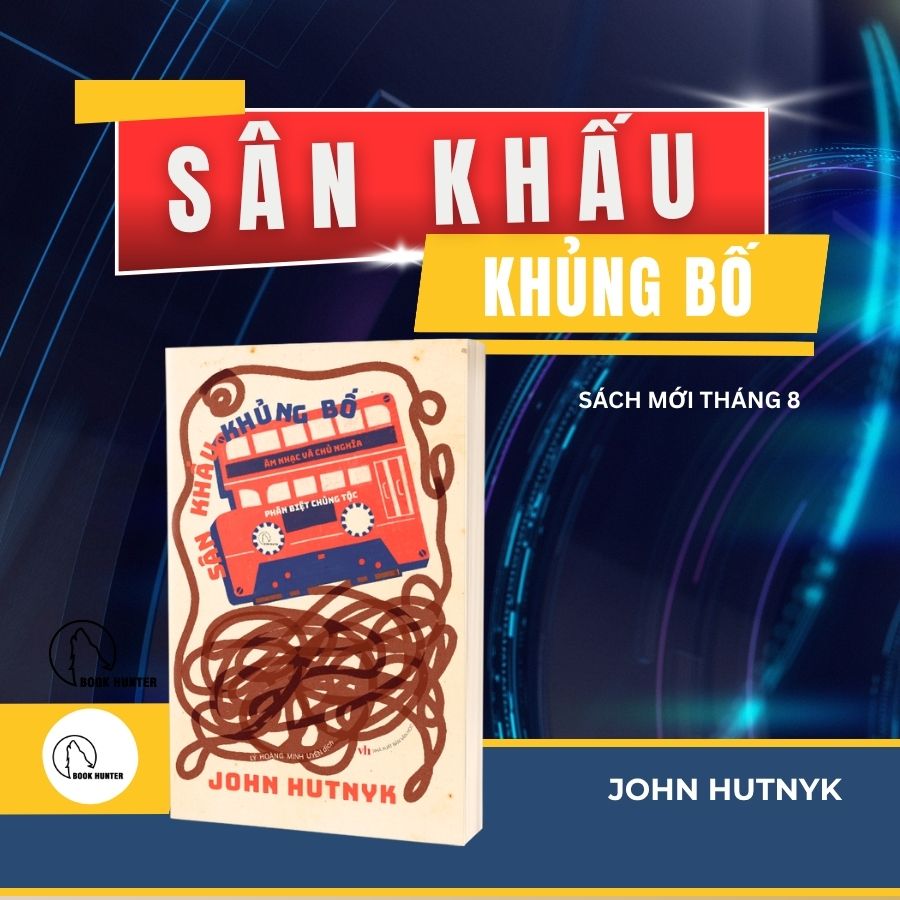
Xuất bản: “Sân khấu khủng bố – Âm nhạc và chủ nghĩa phân biệt chủng tộc” của John Hutnyk
Chúng ta đã quen với việc chứng kiến bạo lực dưới dạng hình ảnh. Nó đến từ màn hình, qua tai nghe, trong lời bài hát, những đoạn clip ngắn, những dòng tít gây sốc — và rồi tan biến nhanh chóng như thể chưa từng hiện diện. Nhưng điều gì xảy ra khi chính những hình ảnh ấy không chỉ phản ánh thực tại, mà tham gia vào việc nhào nặn nên nó? Khi âm nhạc, truyền thông và các biểu tượng văn hóa bị huy động để định hình kẻ thù, khuôn đúc nỗi sợ, và duy trì một trật tự chính trị vô hình?
John Hutnyk, trong Sân khấu khủng bố, không đi tìm thủ phạm cho các vụ tấn công, không tái dựng hiện trường khủng bố, cũng không viết lại những hồ sơ chính trị quốc tế. Ông làm một việc khác: ông lật lại hậu cảnh của những hình ảnh mà ta tưởng đã “xem hiểu”, những âm thanh mà ta tưởng là “vô hại”, những bản tin mà ta tưởng chỉ là “truyền đạt sự thật”. Bằng giọng văn sắc lạnh nhưng không lên gân, bằng chất liệu là văn hóa đại chúng, Hutnyk phơi bày một thế giới nơi chính trị không còn cần phải tuyên bố, vì nó đã được phối âm, dựng hình, và phát sóng hàng giờ mỗi ngày.
Cuốn sách bắt đầu từ một hình ảnh ám ảnh: chiếc xe buýt hai tầng bị phá hủy trong vụ đánh bom London năm 2005, bên hông vẫn còn nguyên dòng quảng cáo cho một bộ phim kinh dị sắp chiếu: “Hoàn toàn khủng bố, táo bạo và rực rỡ.” Hình ảnh ấy – một sự trùng hợp rợn người – trở thành khởi điểm cho một hành trình phân tích không khoan nhượng về cách mà khủng bố, âm nhạc, và chủ nghĩa phân biệt chủng tộc bị sân khấu hóa trong thời đại truyền thông toàn trị. Hutnyk không chỉ dừng lại ở hiện tượng; ông lật tẩy cả cấu trúc của những hình ảnh ấy: Ai là đạo diễn? Ai viết kịch bản? Và tại sao những “người khác” – người Hồi giáo, người da màu, người di dân – luôn bị đẩy vào vai diễn “kẻ đe dọa”?
Điều đáng sợ không phải là hình ảnh bạo lực, mà là sự lặp lại của những hình ảnh ấy đến mức trở thành nền — thành nhạc nền, thành meme, thành điều mà ta lướt qua khi chờ xe buýt hay mở một playlist trên Spotify. Âm nhạc, tưởng như là nơi trú ẩn cuối cùng của tự do biểu đạt, trong phân tích của Hutnyk, lại trở thành một công cụ hai mặt: vừa là phương tiện phản kháng, vừa bị đồng hóa vào guồng máy kiểm soát. Một đoạn rap có thể bị gọi là “ca từ cảm tử”. Một MV có thể bị gỡ bỏ vì “kích động”. Một nghệ sĩ có thể bị biến thành biểu tượng – rồi bị đạp đổ bởi chính hệ thống đã tôn vinh họ.
Nhưng Sân khấu khủng bố không chỉ là một bản cáo trạng. Đó là một lời mời bước vào vùng nhiễu — nơi mọi thứ đều có thể là biểu tượng, nơi mọi lời giải thích đều khả nghi, và nơi mà điều quan trọng không phải là “Bằng chứng đâu?” mà là “Vì sao ta lại tin vào điều này?”. Hutnyk lật lại cả cách các nhà lý luận lừng danh như Žižek, Spivak, Derrida tiếp cận chiến tranh và khủng bố, chỉ ra sự im lặng lạ lùng trong những khái niệm tưởng chừng sắc bén. Ông không bài bác, mà đặt họ trở lại chính giữa cuộc sân khấu hóa mà họ cũng không thể thoát ra hoàn toàn.
Điểm đặc biệt của cuốn sách là cách nó kết nối lý thuyết với văn hóa đại chúng mà không hạ thấp cả hai. Những gì tưởng như là chi tiết “trôi” – như nhạc nền trong các buổi thẩm vấn ở Guantánamo, hay mặt nạ trong một đoạn quảng cáo pop – đều được Hutnyk đưa trở lại bối cảnh, khiến người đọc không thể tiếp tục xem đó là những ngẫu nhiên. Tất cả đều là dấu vết – của một cuộc chiến không cần tuyên bố, chỉ cần thao túng ký ức tập thể.
Cuốn sách này không dễ đọc nếu bạn tìm kiếm những kết luận đơn giản. Nó không cung cấp hệ quy chiếu ổn định, mà mời bạn đặt lại cả những công cụ nhận thức mình đang dùng. Nó đẩy bạn vào vùng nhiễu – rồi yêu cầu bạn học cách lắng nghe. Không chỉ lắng nghe lời nói, mà cả những khoảng lặng. Không chỉ nghe âm nhạc, mà cả những thứ đang bị gắn nhãn “ồn”. Sân khấu khủng bố là văn bản cho thời đại mà việc giữ im lặng cũng đã trở thành hành động có tính chính trị. Đọc nó, không phải để “biết thêm về chiến tranh” — mà để nhận ra ta đã vô thức đứng trên sân khấu ấy từ lâu, dưới ánh đèn không phải của sân khấu nghệ thuật, mà của các thiết bị ghi hình an ninh, của truyền thông toàn trị, và của một thứ quyền lực mềm đã thôi dùng súng, vì biết rằng hình ảnh và âm thanh đủ sức khiến ta ngoan ngoãn.
THÔNG SỐ SÁCH:
Tên đầy đủ: SÂN KHẤU KHỦNG BỐ – Âm nhạc và chủ nghĩa phân biệt chủng tộc
Tác giả: John Hutnyk
Dịch giả: Lý Hoàng Minh Uyên
Lĩnh vực: Phê phán văn hóa đại chúng
Tủ sách: Hiểu Thực Tại
Số trang: 232
Cỡ sách: 16x24cm
Tình trạng bìa: Bìa mềm
Lượt in: Lần đầu
Cấp phép: NXB Văn Học
Ngày phát hành: 19/8/2025
GIÁ BÌA: 190.000 VNĐ
Cuốn sách này ghi lại những cách mà câu chuyện về chiến tranh đương đại được thể hiện ngay tại trung tâm các thủ đô, song song với những vấn đề trên, từ truyền hình âm nhạc, video trên internet, tin tức phát trực tuyến cho đến các quảng cáo nhạc pop. Những hoạt động này đóng vai trò như một bình luận về cách quyền lực mềm và truyền thông hỗ trợ sức mạnh quân sự, thông qua sự kết hợp chặt chẽ của NATO, báo chí, thông báo an ninh, iPod, kiểm tra an ninh và quảng cáo.Trang 8
Việc sử dụng rap để lên án các hoạt động đế quốc của Mỹ, Liên Hợp Quốc, NATO và quân đội Anh không chỉ là một hình thức phản kháng, mà còn cho thấy mối quan hệ phức tạp giữa chính trị và nội dung nghệ thuật – điều mà những nhà nghiên cứu hip-hop theo trường phái tuyến tính dễ bỏ qua. Điều này không đơn thuần là lời bình luận về chiến lược quảng bá trong ngành công nghiệp âm nhạc, mà còn chỉ ra cách mà các chiến lược thương mại đã góp phần tạo nên sự im lặng nguy hiểm xoay quanh các vấn đề chính trị, đặc biệt là trong “cuộc chiến chống khủng bố”. Nó cũng phơi bày sự yếu kém của các phong trào chống phân biệt chủng tộc, đấu tranh cho tự do, và những lý tưởng lãng mạn từng được ca ngợi. Fun-da-Mental không chỉ là một nhóm nhạc đa văn hóa, mà còn là một lời cảnh báo mạnh mẽ chống lại các chính sách khủng bố trá hình, sự đồng lõa và phục tùng, sự thao túng từ thị trường, luật pháp, và việc phá hủy văn hóa vì lợi ích dầu mỏ.Trang 59-60
Một dạng khủng bố mang tính sân khấu đã và đang được dựng lên – nơi những hình ảnh rùng rợn, tin đồn thất thiệt và sự bóp méo thông tin được dàn dựng như những vở kịch, nhằm che đậy cho các hệ thống phân biệt chủng tộc, chủ nghĩa thượng đẳng da trắng và những đặc quyền vốn ăn sâu trong cấu trúc xã hội. Kiểu khủng bố này không tách rời mà gắn bó mật thiết với liên minh quân sự – giải trí, và thực chất là một căn bệnh trầm kha, đã thấm sâu vào cấu trúc quyền lực được gọi dưới cái gọi là đồng thuận dân sự. Một khía cạnh hiếm khi được nhắc đến trong chiến lược chiến tranh của phương Tây. Dù “chúng ta” là ai, thì những tác động của cuộc chiến đó vẫn len lỏi và hiện diện trong cuộc sống hàng ngày của mỗi người. Ngay cả câu hỏi về danh tính – ta là ai – cũng không thể thoát khỏi sự chi phối của những tọa độ quyền lực ấy. Trò đùa, dầu mỏ, cái chết hay vinh quang –phải có ai đó sẽ đứng ra kể lại câu chuyện đó.Trang 141
1. Giới thiệu – Chiếc xe buýt London – Kịch câm – Nhật ký chiến tranh – Sự trung gian – Áo tù nhân màu cam – Cảnh báo
2. DIY Cookbook – Đến thăm nhà Kumar – Rapper cảm tử – 1001 đêm – Video Kịch Câm – RampArts interclude (những ghi chép từ một buổi chiếu phim) – Tất cả đều là chiến tranh – Quay trở lại với Kumar
3. Nhạc Dub trong Điện Ảnh – Đại diện cho La Haine – Žižek-degree-zero – Derrida viết về một cách thức – Tháp Eiffel – Lũ du côn, Đám nổi loạn, Kẻ lưu manh và Sự tái diễn – Nhạc Interlude – Riff-raff – Coda: Trận chiến Algiers
4. Scheherazade và chị em của cô ấy, M.I.A – Các Dự Án Văn Hóa – Những đêm của người kể chuyện – M.I.A. – Born Free – Bán đứng (Sell out) hay Tiocfaidh ár lá (Ngày của chúng ta sẽ đến) – Những câu nói châm biếm và Wagner – Văn hóa chuyên chế – Scheherazade ở Guantánamo


 . And yet, good I guess. If it works – now I’ve posted it I am not sure it does: