
BOSTON, July 14, 2025 — A team of scientists from QuEra Computing, Harvard University and the Massachusetts Institute of Technology has reported the experimental demonstration of magic state distillation carried out on logical qubits. The study, “Experimental Demonstration of Logical Magic State Distillation,” is now available as Accelerated Article Preview on the Nature website. Quantum computers use qubits and quantum […]
Quantum: QuEra, Harvard and MIT Researchers Demonstrate Logical-Level Magic State Distillation
July 14, 2025 by
Quantum: Harvard, QuEra, MIT and NIST/University of Maryland Announce Error-Corrected Algorithms on 48 Qubits
December 6, 2023 by

BOSTON, December 6, 2023 – Neutral-atom quantum company QuEra Computing today announced what the company said is a quantum computing breakthrough, published in the scientific journal Nature. In experiments led by Harvard University in collaboration with QuEra Computing, MIT, and NIST/UMD, researchers executed large-scale algorithms on an error-corrected quantum computer with 48 logical qubits and […]
Harvard Uses Google Cloud to Clone Supercomputer for Medical Research Runs
August 21, 2023 by

A Harvard scientist used Google Cloud Platform compute resources to construct an HPC clone to conduct heart disease study, according to a Reuters story, “a novel move that other researchers could follow to get around a shortage of powerful computing resources….”
MIT: New Method Uses ML to Accelerate Data Retrieval in Large Databases
March 14, 2023 by

Researchers from MIT and other institutions report that a “hash function” — a core database search operation — can be significantly accelerated through the use of machine learning. The hope is that the new technique could accelerate computational systems that scientists use to store and analyze DNA, amino acid sequences, or other biological information.
Research Highlights: ExBERT
July 11, 2020 by
In the insideAI News Research Highlights column we take a look at new and upcoming results from the research community for data science, machine learning, AI and deep learning. Our readers need to get a glimpse for technology coming down the pipeline that will make their efforts more strategic and competitive. In this installment we review a new paper: EXBERT: A Visual Analysis Tool to Explore Learned Representations in Transformers Models by researchers from the MIT-IBM Watson AI Lab and Harvard.
Visualizing an Entire Brain at Nanoscale Resolution
February 14, 2020 by
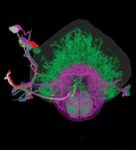
In this video from SC19, Berkeley researchers visualizes an entire brain at nanoscale resolution. The work was published in the journal, Science. “At the core of the work is the combination of expansion microscopy and lattice light-sheet microscopy (ExLLSM) to capture large super-resolution image volumes of neural circuits using high-speed, nano-scale molecular microscopy.”
Video: Intel and Lenovo Power Cannon Supercomputer and Project Everyscale
November 22, 2019 by

In this video from SC19, Scott Yokel from FASRC describes Cannon, Harvard University’s first liquid-Cooled supercomputer. Developed in cooperation with Intel and Lenovo, the new system’s advanced supercomputing infrastructure will enable discoveries into areas such earthquake forecasting, predicting the spread of disease, and star formation. “With the increased compute performance and faster processing of the Cannon cluster, our researchers now have the opportunity to try something in their data experiment, fail, and try again. Allowing failure to be an option makes our researchers more competitive.”
Harvard Names New Lenovo HPC Cluster after Astronomer Annie Jump Cannon
October 9, 2019 by
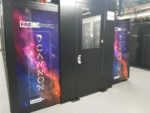
Harvard has deployed a liquid-cooled supercomputer from Lenovo at it’s FASRC computing center. The system, named “Cannon” in honor of astronomer Annie Jump Cannon, is a large-scale HPC cluster supporting scientific modeling and simulation for thousands of Harvard researchers. “This new cluster will have 30,000 cores of Intel 8268 “Cascade Lake” processors. Each node will have 48 cores and 192 GB of RAM.”
Aliro to make Quantum Computing accessible to any Developer
September 19, 2019 by

Today Aliro Technologies emerged from stealth with the closing of its $2.7 million seed round, led by Flybridge Capital Partners. “Aliro’s vision is to commercialize new software technologies that make today’s quantum hardware more accessible and useful for any coder, making hybrid classical-quantum programs the new standard. The company was spun out of Harvard’s quantum computing lab, co-founded by Prof. Prineha Narang, a luminary in quantum computing.”
HPC Elder James Cuff Joins Witnix Startup
August 21, 2018 by

In today’s Startup news, HPC elder James Cuff has joined a new company called Witnix. Most recently at The Next Platform, James spent most of his career at the HPC center at Harvard before he retired a couple of times. Just ask him. “We love working with new and established advanced technology organizations alike. When you find you have a scaling issue, want to grow, deliver results and build profits even faster, let’s talk about how our approach will help you.”