NewCon Press, 2025, 115 p. Reviewed for ParSec 14.
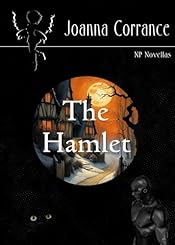
This was published as a novella but reads more like an assemblage of short stories with characters which cross over from one to the next, though outwith their own tale, usually only in brief appearances. Its background premise – something strange (but unspecified) has happened and people have been advised to remain indoors – may be a literary response to Covid. The setting is a small village in Scotland – locals call it a clachan but incomers have used the description hamlet (which I note is actually a particularly English designation) for so long that it has become more common. The village ‘spinsters,’ however, still frown upon it. Apart from the first, very short, chapter which introduces the strange event, each section is given over to the experiences of different characters, Beth, Polly, Helen, Eve, Robyn and Jeanie, with the novella ending with a sort of epilogue from the point of view someone called the Spaceman.
The stories’ time scales are not always immediately apparent as some chapters start before the strange event or more or less ignore it happening. However, there’s enough oddness going on even without it.
Responding to a voice calling to her, Beth, who has inherited her home from her mother and not improved it in any way, instead letting it run to squalor, manages to move through the pipes in her plumbing, whether by her shrinking or the pipes expanding is moot. Eventually she is drawn down to an underground chamber to chat with the spinsters about the end of the world. The chapters which follow may represent different ways in which that end happens.
Thanks to the green-suited spaceman who appears at her window one night, schoolgirl Polly travels the universe and becomes both a witch and a princess.
Helen begins to produce videos which attract internet followers but increasingly show her lack of control of her life.
To escape the locked down city Eve has come to the cottage she rents out to Matthew (known locally as the Pest.) Not a good choice.
At Helen’s request Robyn builds a doll’s house as an exact replica of Helen’s home but realizes it also needs a doll’s house inside it and then another inside that and so on down.
Jeanie begins to act strangely and eventually locks herself away from everyone. She is however revealed to be a figment, a skin the narrator wore to make her life more amenable. The implication is that all the viewpoint characters are such skins. (But this is the essence of fiction. The reader temporarily becomes – or at least empathises with – a book’s characters.)
The Spaceman is from another world.
The Hamlet has aspects of a fairy tale (but there do not seem to be any happy ever afters, except perhaps for Polly,) has some of the heightened sensibility of magic realism (with a faint echo of John Burnside’s Glister,) moments of horror, and makes a foray into Science Fiction. Whether the disparate elements necessarily cohere into a unified whole is a matter for the individual reader. Corrance can write though.
The following did not appear in the published review.
Pedant’s corner:- “The McIvor’s lived in” (the McIvors lived in,) sat (x 2, sitting, or, seated,) “Mums washing machine” (Mum’s,) “paper mâché” (paper mache: if its ‘mâché’ then it’s papier mâché,) “it sloped passed me” (past me,) airplane (aeroplane,) “the High-lands” (the Highlands,) curb (kerb.) “‘So where did you learn to cook?’ She asked.” (‘So where did you learn to cook?’ she asked,) “when they played drafts” (draughts,) dollhouse (doll’s house,) “most Saturday’s” (most Saturdays,) “and come pick me up” (come to pick me up,) miniscule (minuscule,) “the little girls’ eyes” (it was only one girl; ‘little girl’s eyes’.)