Search This Blog

Monday, January 5, 2026

Victorian Era's Impact on the Image of Fairies

 This article was originally written for my Patreon in 2023 and I am making it public now


Yesterday I gave a talk for the Folklore Podcast,  as part of a lecture series to raise funds for the Folklore Library. My focus was tracing the history of the Scottish fairy courts across the last 500 years, from folklore to fiction. In the Q&A which followed someone asked a question about why we envision fairies as we do today and while I answered in the moment I thought I'd also offer a more expanded answer here for my patrons.

The short answer is, of course, the Victorians.

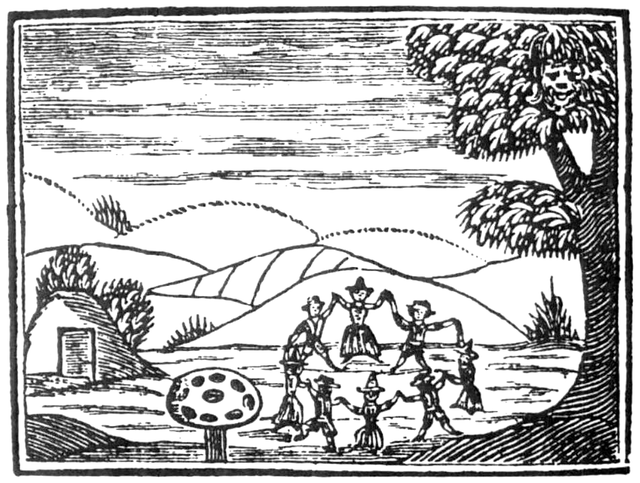
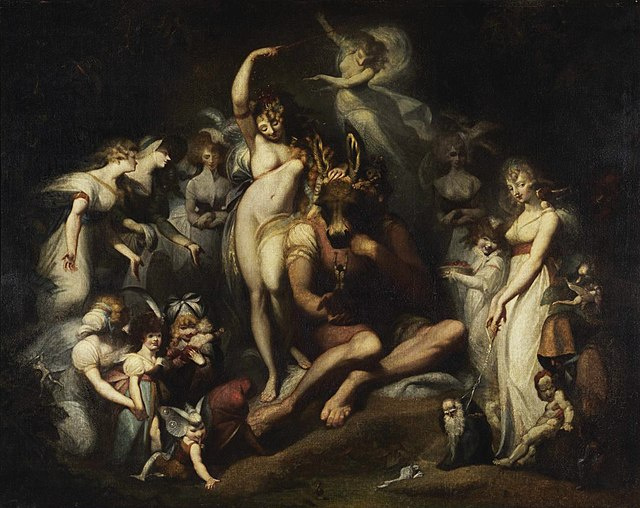
The long answer is that prior to the mid-19th century our understanding and perception of fairies was very different. They were not imagined with wings, or pointed ears, and were generally understood as being very human like in appearance, although not always in size, ranging from slightly less than two feet tall to around 6 feet tall (about 1/2 meter to 2 meters). The height often depended on the specific culture and the type of being, so that the Welsh Tylwyth Teg were described as 'the height of an 8 or 10 year old child' while the Irish Aos Sidhe were usually described as average adult height. Outside of this however there was rarely anything that physically distinguished these beings from humans, although they usually could be identified based on their words, actions, and a general aura of otherworldliness.
Image

17th century woodcut showing fairies dancing in a ring
Image

Henry Fuseli, 18th century, Titania and Bottom, showing the fairy queen Titania and her retinue of fairies with the donkey-headed Bottom

This began to change at some point in the early 19th century as fairies became popular in art and artists started depicting fairies with wings, and wingless elves with pointed ears. This may have been meant as a visual cue to viewers to make it clear the subject of the art were fairies or it may have represented a merging of the older understanding of fairies with the burgeoning idea of these beings as embodiments of nature and natural things, a concept which crystalized in the late 19th century with theosophies rewriting of fairies into elementals and nature spirits.

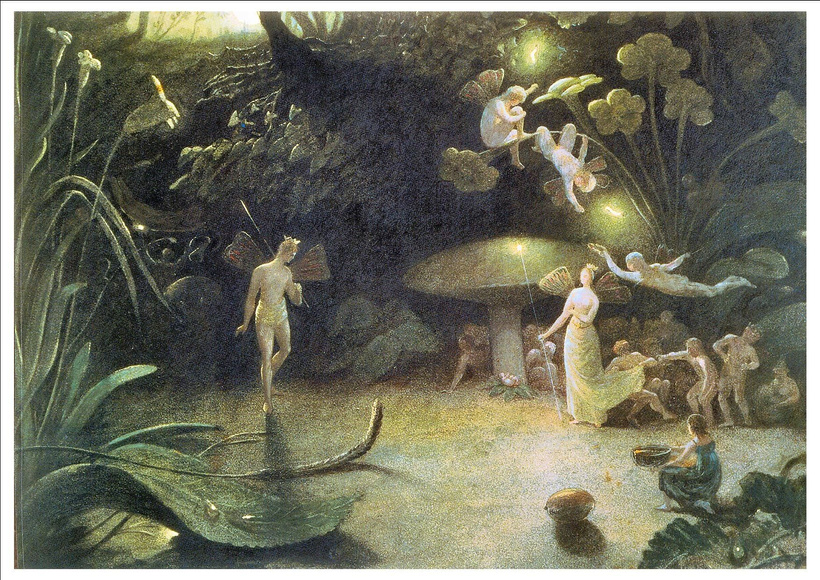
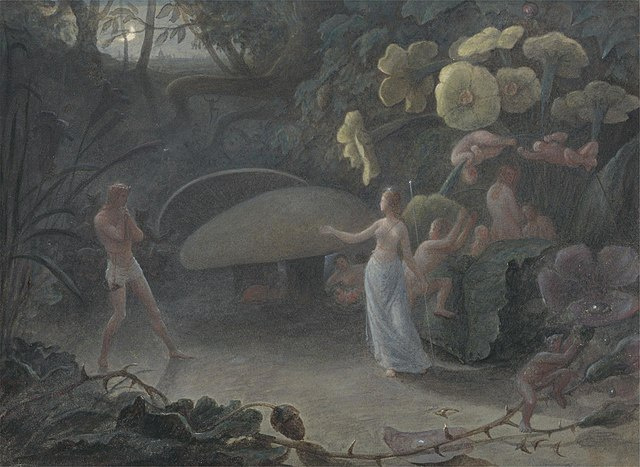
Initially however the change from non-winged fairies to winged wasn't decisive, and we see artists using both styles of imagery. For example the two following works by Francis Danby, the first of which from 1832 'Scene From a Midsummer Night's Dream' shows Oberon and Titania with wings while the second 'Oberon and Titania' from 1837 does not:
Image

Image

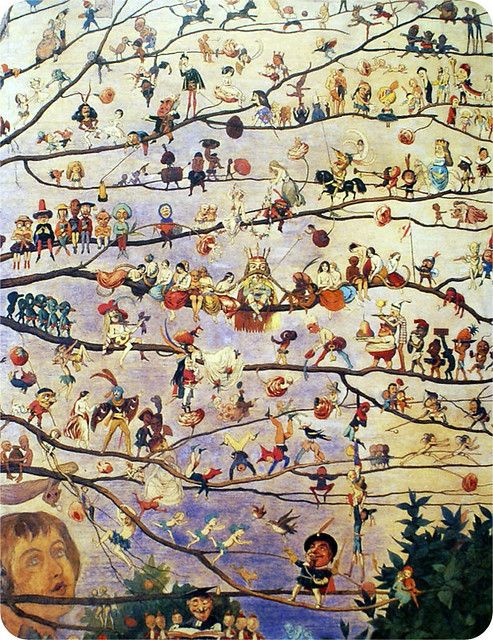
Through the 1870's we can find examples of fairies both with and without wings in art. For example this image 'The Fairy Tree' by Richard Doyle from 1865 shows 200 different fairy figures, none with wings, including several who appear to be flying:
Image

By the 1880s however the wings dominate and can be found in all or nearly all artistic depictions of these beings. These wings are most often butterfly wings, occasionally more general insect wings, and range from small to larger than the figure itself. We also begin to see these visual cues used to gender these beings with female winged fairies and male elves with pointed ears, although there is some crossover between the two types of imagery.

It is also at this point that Theosophy begins, both taking the visual imagery of fairies found in art and also creating - or solidifying - the idea that fairies are spirits of the natural human world who are less than and dependent on humans. The combination of these two factors, Victorian cultural depictions and Theosophical descriptions, would combine to entirely rewrite the popular culture understanding of fairies in ways that are still effecting us today.

By the late Victorian era we find the idea of winged fairies, as shown in art, starting to crossover into fiction, and during the Edwardian period and first world war the wider cultural concept of fairies as small, winged, and connected to the natural world becomes nearly ubiquitous in English and American culture so that by the late 20th century people start to describe personal encounters with small winged fairies.

We shouldn't underestimate the power of art and fiction to shape folk belief, and be aware of how the media we consume influences our understanding of these beings.


References:

Fairies in Victorian Art by Christopher Wood
Victorian Fairy Paintings edited by Jane Martineau

Monday, December 29, 2025

2025 Wrap Up

 It's been a very busy year, with less blogging and more working on bigger projects. 

  1. In 2025 I wrote 5 books (4 to be released next year)
Image


  1. I had 4 books published: Paid With A Kiss, Tales of the Tuatha De Danann vol 1, Pantheon the Irish, and Dangerous Magic
  2. I had four articles published in various magazines and journals
  3. Contributed to two anthologies which came out this year: Fairies a Companion, and Divine Wounds
  4. Wrote forwards for 2 books published this year: Defying Shadows and Divide Wounds
  5. Completed my translation of the Táin Bó Cúailgne, which was started in 2023
  6. Participated in 4 online pagan conferences/events
  7. Presented in person at the Morrigan's Call retreat
  8. Presented papers at two online academic conferences
  9. Wrote a chapter for a forthcoming academic work on Green Women
  10. Presented a class on the Aos Sidhe for the Irish Pagan School online
  11. Travelled to Ireland for a week long tour (and got to see a bunch of castles)
I'm exhausted just reading that over but like I said it's been a busy year. Next year is looking equally busy with three books currently under contract with Moon Books, and one on changelings for an academic publisher. 

In 2026 I will also be at the following events:
Harvest Gathering in person 
Changing Times Changing Worlds in person 

I had hoped to get back to Mystic South this year but that isn't looking likely for financial reasons. I have also applied for an academic conference but won't hear back about that until spring next year. 


Sunday, December 7, 2025

Fairylore in Stranger Things season1

 It's been awhile since I did a 'fairylore in popular media' article, but I thought this one would be worth digging into now. Stranger Things is a cultural phenomenon which I admit I've previously avoided. But at the urging of my 12 year old I've dived in and was pleasantly surprised to see the many echos of fairylore in the show, particularly the first two seasons, although I'm focusing just on season 1 here. I think it's worthwhile to explore the way some fairy themes crossover into this show in ways that may be subtle or obvious and how that can give the show a deeper feel. 

  In previous articles I've noted what were in most cases obviously intended to be reflections of folklore but in the case of Stranger Things I don't know for certain how many of the below listed things were intentional call backs to fairy beliefs and how much is coincidence, so my approach to this will be to simply present all of the points I've noticed as a fairy focused folklorist. Other people's opinions here might vary, and if I missed anything please suggest it in the comments. 

*Spoilers for Stranger Things season 1 Below*

Image
https://c4.wallpaperflare.com/wallpaper/622/739/588/stranger-things-netflix-clouds-bicycle-wallpaper-thumb.jpg


The Upside Down - A main premise of the show is that there is an alternate reality adjacent to and reflecting the human world but which is very different in nature; this is similar to a foundational premise in fairylore, that the world or reality of Fairy exists adjacent to but separated from the human world. Fairy has neither sun nor moon but exists in a perpetual twilight and the Upside Down also has no celestial bodies illuminating it but exist in a state of endless night. The Upside Down is a distorted, nightmarish counterpart to the human world, where the architecture and wilderness is the same but exist in states of decay; Fairy is sometimes described as identical to the human world but distorted in various ways. Both worlds, Fairy and the Upside Down, have different rules to the human world.

The Stolen Human - a staple in various fairy stories is the stolen human, a person who is taken by the fairies for a range of purposes, usually malevolent. Although popular stories tend to focus on infants the range of anecdotal material includes humans of many ages, with boys being the most common children taken and women the more common older children and adults taken. In the case of Stranger Things we see both as Will, a 12 year old boy, is taken first, followed later by Barb, a teenage girl. Both are taken into the Upside Down, although they meet very different fates there. As in fairylore Will and Barb are taken when they are alone and unprotected. 

The Changeling - A common theme in many stories of stolen humans is that of the changeling, an enchanted object or ailing fairy left in the place of a stolen human in order to deceive the person's family into either believing they died or to make it seem the person hasn't been stolen at all. In Stranger Things this manifests as a body left in place of the stolen Will meant to convince his family and the town of Hawkins that he drowned. This fake is revealed when the police chief, suspicious of what has been going on and swayed by the boy's mother who swears the corpse isn't her child, cuts into the corpse only to find that it is a lifelike doll stuffed with cotton. The police Chief keeps this knowledge to himself and the false Will is buried in a public funeral, leaving most people convinced he did actually die.

The Gate(s)- in the show the pathways between the human world and the Upside Down are called gates, and represent tears between realities that beings may pass through. Similarly in folk belief fairies are thought to live in the world of Fairy but access the human world through specific places that act as doorways. These may be hills, caves, trees, or rocks in folk stories; for example the cave of Uaimh na gCait (Tulsk, Roscommon) is said to be an entry to the Otherworld out of which assorted monstrous beings have appeared. In the show we find that the main gate created by one of the characters is underground, in a military complex that has a cave-like aesthetic, while a smaller gate is also shown in the woods as a hole between worlds opened up in a tree. 

Inhuman Monsters - a wider trope which is admittedly shared with a range of media including science fiction is the inhuman monster. This is also found in fairy belief where some beings from Fairy may look human but others are notably inhuman and clearly monstrous. These monsters do not follow the rules of the human world, even when they are within it, for example being almost impossible to injure or kill. In both the show and fairy stories these monstrous beings are notably vicious and brutal, while also clearly being intelligent in some way. The Demogorgons of the show, like some beings in Fairy, are superior in strength and speed to humans; like fairy beings who are described missing limbs or with a deformity, the Demogorgons have no apparent eyes, often described within the show as 'faceless'. 
They are not clearly fairies, as such, but they fit into the wider range of Fairy beings that can be found in stories.

Electrical Distortions - a key aspect to the first season of the show is Will's ability to communicate with his mother from the Upside Down using lights. Through this he can convey his presence to her and later spell out messages after she creates a clever communication method using a string of lights and letters painted on the wall. Electrical distortions are common features of supernatural encounters including fairy based ones, and the idea that lights appearing indicates the presence of otherwise unseen being is inline with wider fairy beliefs. It also represents in my opinion an interesting take on communication between worlds.

Monstrous Reproduction Via Humans - Fairylore is full of stories of humans taken in order to further the fairies agenda by providing offspring for them; in some stories the stolen human themself is transformed into a fairy. In Stranger Things it is implied in several scenes that the Demogorgons are using the corpses of the humans they kill to make more of themselves, including using the still-alive Will who in a final scene is shown vomiting up a slug-like creature which is revealed in season 2 to be the initial form of the Demogorgon. Through this means the beings reproduce, and their use of humans to do so echoes older ideas of fairies using humans as breeding stock. 

The Rescue - in stories of stolen humans there are usually two ways to rescue them, all of which must be done within a very short time limit. One way is, if the changeling left was a fairy, to torment that being until it chooses to either leave - hence returning the stolen human - or admits to its nature with the same result. The second way is to actively rescue the stolen human, usually by going to a place in the human world where the fairies are known to be at a specific time, but also in a few cases by going into the Fairy realm to bring them back, such as we see in Sir Orfeo. Stranger Things echoes this later trope, with Will's mother and the police chief venturing through the gate to rescue him and return him to the human world. This is accomplished in the show and in folklore by fighting through challenges and trials to find the person and win them back to the living world. 

Saved But Never the Same - A final note would be that after being successfully rescued Will shows clear signs that his experience has changed him on a deep, preternatural level - he has flashes of vision into the Upside Down and can sense the power that rules that realm. While some people rescued from Fairy in stories do go on to live apparently normal lives we also find tales of people so changed by their experience that they cannot reconcile it and pine away or seek to return to that world. There are also stories of people who would go on to be considered a bean feasa [wise woman] or fairy doctor who were taken into the realm of Fairy for a period of time and return with new abilities beyond the norm for humans and with a connection between themselves and the Otherworld. 

Friday, December 5, 2025

Changeling Survey

 As part of a book that I am currently working on I am doing a survey of modern changeling beliefs, particularly focused on people who identify as changelings. I am hoping to gather a range of responses that will help to illustrate the diversity of modern beliefs on this topic and the value of the concept to people who identify with it.

If you are interested in taking the survey you can email me at [email protected] and I will send you the forms. One is the survey itself and the other is a consent to have your responses used in my research, either by name or anonymously. 


Tuesday, December 2, 2025

The Dance: A Ritual for the Conjunction of the Pleiades and the Moon


The Dance: The 7 Queens and the Moon


The cycle of the Pleaides is something that I have found to be important within my spirituality across the last 7 years. I have, in that time, shared various rituals I have designed to help nurture a connection to the Other who are aligned with these stars. That cycle has slowly grown across time, moving towards a fully fleshed out ritual cycle, and focuses on points within each calendar year, however there are also two floating alignments which don’t occur within a yearly cycle but rather at intermittent points. I have previously discussed one of these points, when the Pleaides are conjunct with Venus, and now I would also like to offer a ritual for times when the Pleaides are conjunct with the moon. This occurs every month but not on a fixed cycle, as the timing is based on both the moon’s position and the variable position of the Pleiades.

For those who are fully immersed in a ritual cycle focused on the Pleaides this ritual might replace the more common witchcraft practice of celebrating the moon’s cycle alone, particularly the full moon. However the exact tone of each celebration would be influenced by the point in the moon’s cycle that it is conjunct with the 7 Queens. My personal preference would be:

Full moon – time for all magic and to celebrate the beauty of life

Waning moon – time for releasing and celebrating the joy of letting go of things that you have outgrown

New moon – time for deeper connection to the Good Folk and divination.

Waxing Moon – time for magic focused on growth and healing, and to celebrate the potential in all life

More generally the conjunction of the Pleaides with the moon represents a time to reflect on and embrace beauty, joy, and pleasure. It is a time to connect deeply to the Other and receive messages from them, as well as to take some small time to honour your own power and enjoy life. It is also a good time to bless items, such as ritual tools.


The focus of this ritual is particularly sensual so you might consider taking a ritual bath beforehand, incorporating things that make you feel happy or beautiful. You might add rose oil to the water, for example, to cleanse and bless, and make extra effort to dress up in a way that feels special to you personally. Have fun with it, because enjoyment is part of the point.


Ritual


Find a good space open beneath the sky where you can see the stars above you. If this is not possible due to weather concerns try to set up an altar near a window or perhaps arrange some appropriate artwork near your ritual space. If necessary this entire thing can be done as a visualization exercise. My own outdoor altar for ritual work usually contains space for offerings, water in an appropriate container, candles, and a token representing the Fairy Queen I honour. For this festival you might use something to symbolize all 8 Queens, or focus on a specific one, and you could design this cycle to focus on a different queen each month sequentially.

Have fresh water and some kind of offering on hand; I prefer apples, honey, or milk, but anything fresh and natural is a good option. Alternately one may offer song, dance, poetry, art, of items created with your own skill.


Create sacred space as you see fit if you wish to. I usually do this now by moving counterclockwise around my space sprinkling water and chanting to open the way between worlds. You can also dance the circle or sign it around as that energy aligns with the purpose of this ritual.


Invite in any goodly inclined spirits, allies, Fairy Queens or Kings, or Liminial Gods you wish to include. You might instead choose to invite all of the 7 Queens. We invite, we don't invoke, evoke, or compel. They either come as we call or they don't.


I might say something like:


"I call to all goodly inclined spirits,


spirits of the land, spirits of the air,


Fair Folk who would be my friends,


Friendly ones who aid my liminal path,


Liminal gods, Fairy Queens and Kings,


Lady of the Greenwood, Queen of the Wind,


Queen of the Wave, Queen of Winter,


Queen of Flame, Queen of Horns, Crane Queen,


I invite you all to join me here


As I honour the journey


Of the celestial Fairy Rade


Aligned with the dance of the Moon."


After this is done wait a moment and observe. Use all your sense to note if there is any obvious response to your call. This may be obvious, such as the wind picking up or the temperature changing, or it may be a more subtle feeling of presence. Don't rush but wait until things feel settled.


Say:


"Tonight the Seven Queens meet the moon


In their journey across the sky


A great dance in the heavens


7 shining stars burning brightly


Joined by the moon, dancing her[1] cycle


A time of joy and of magic,


A time of power and of pleasure,


The gates are open, may


They be opened wider


The Queens look upon the land


May they bless what they see"


Put out the offerings you have brought and pour out a bit of water.


"I offer sweet honey cakes [or whatever you are offering]


And pure clean water


To all the queens


To the liminal gods


To those beings that


would aid me


to the spirits of air


and of earth"


At this point if there is anything else you would like to do in your ritual - sing, dance, chant, divination, meditate, journey - do it. The conjunction with the moon is particularly good, as previously mentioned, for blessing items and for divination or journeywork to connect to the Other. Be open to hearing what they might tell you. Also keep in mind this ritual is intended to remind us of the beauty that surrounds us, through the dance of the stars, and should incorporate things that make you feel happy or express joy. Have fun in whatever you do, as much as possible.

When you feel ready to say goodbye, say:


"The Queens brighten the sky


The light of their celebration


Shining down upon us


Our worlds are intertwined


As they have been and will be


Praise to the 7 Queens,


May they bless us,


Praise to the moon,


May she bless us,


May their joy be ours


And our joy be theirs"


Pour out the water that is left. Say


"May my words honour the Queens


May my actions honour the liminal Gods


May my allies stand with me


May there be peace between me


And the spirits of the air and earth


May there be friendship between me


And all goodly inclined spirits."


Take down your compass/circle or sacred space however in a way that reflects how you created it. In my case here I'd normally walk it clockwise sprinkling a bit of earth or leaves and asking that the space be returned to its former state.


Take down your altar when you are finished.


Ritual Feast


Part of my own celebration will include a feast or meal following the ritual, including food that I particularly enjoy. A portion of that meal will be set aside and then left out as an additional offering. Dreams that happen following the ritual should be particularly noted.


[1] Alternately whatever gender for the moon you prefer here

Wednesday, September 10, 2025

Fairy Facts: Leprechauns

For this installment of  fairy facts lets look at a particularly complicated topic - the Leprechaun. this one is particularly tricky (pun intended) because it exist in two distinctly different forms between mythology and folklore. But that's also a great reason to include it here, so let's dive in.

Image
Leprechaun, 1900, public domain


 Name: Leprechaun, modern Irish Leipreachán or Lucharachán, alternately older Irish Lupracán, Luchorpán, Lupracanánach, Luchropánach
The meaning is uncertain with suggestions including 'little bodied one' [luch corp án] or connecting it to Latin influence from Lupercalia. Folk etymologies often claim it means 'little Lugh' 

Description: standing about a half meter or 18 inches tall, older versions look exactly like humans and can be any age or gender, more recent folklore depicts them us typically male and elderly in appearance. Oldest versions are described as wearing the same things the local humans wore, but over time they came to be associated with the colour red then more recently with green.

Found: In Irish myth and folklore Leprechauns may be encountered anywhere but are most strongly associated with bodies of water in mythology and with open fields in folklore. 

In Myth: The oldest appearance of Leprechauns is in two stories found in 8th through 11th century manuscripts the Echtra Fergusa meic Leidi and the Aided Fergusa meic Leidi. In these tales the Leprechauns live in a society that mirrors the contemporary human one, with a king and queen, royal poet, and commonfolk. They are inherently magical beings who exist separate from the wider world of the Aos Sidhe within their own kingdom. The are depicted as potentially dangerous but also very knowledgeable, and both cause harm and help humans within the stories. Despite the size difference the eponymous human hero takes the queen of the Leprechauns as his lover. 

Folklore: the more modern folkloric Leprechaun appears by the mid-19th century, initially in writing in a piece by an Irish-American author. This being is described as an older looking man, about 18 inches/half a meter tall, who is the shoemaker for the fairies. Folklore now describes Leprechauns as exclusively male and usually older, focused on their work, and dressed in green. Stories say that if one can capture a Leprechaun one will either be granted a wish or the Leprechaun will be forced to reveal the location of his gold; the Leprechaun always finds a way to trick the human however and retains his treasure. 
   One widespread story features a man who captures a Leprechaun and forces him to reveal that his gold is buried under a nearby bush in a field. The man ties his handkerchief on the bush and goes to retrieve a shovel to dig up the treasure only to return and find ever single bush in the area has an identical handkerchief hanging from its branches. Unable to find the treasure he eventually gives up looking.

Where It Gets Muddy: The lines between the folkloric Leprechaun and the older manuscript version can be confusing and its very unclear how one developed into the other across time. Once the more modern shoemaking Leprechaun was written about in a book that version took off and gained immense popularity, overshadowing the older version and largely replacing it in common understandings. Attempts to portray Leprechauns in modern media, from movies to tv shows, have added to the confusion with new layers of popculture based beliefs, such as the association with rainbows or leaning hard into anti-Irish stereotypes.

What They Aren't: Pretty much everything shown in the Lucky Charms commercials.
 Despite the current trend for Leprechaun traps around saint Patrick's day they were never thought to be caught via any kind of trap but could be grabbed and held; in some folklore to capture a Leprechaun you must keep your eyes on him without looking away. They aren't sweet or kind little fairies but were understood as potentially dangerous or at best extremely tricky to deal with, but modern perceptions increasingly show them as gentle older fairies with a jovial demeanor. 

Monday, August 25, 2025

Book Review: Ask: Building Consent Culture

 I'm stepping a bit outside my usual book review genres to tackle three books on consent, because I think its a topic that we don't talk about enough and that there aren't a lot of good resources for. 

  I recently read three books written by or edited by Kitty Striker, all of which focus on teaching consent culture. I'll give mini-reviews of each book separately below, but I want to say up front that I recommend these because they really offer a firm foundation to understand what consent is, the nuances around it, how to embrace it in our lives and also how to raise kids with a strong concept of consent. Too often I think we take consent for granted and also think of it as something that only applies or only really matters in sexual situations when in fact consent underpins almost all - if not all - social interactions, often in subtle ways.
So let's dive in. 


Image

Ask: Building Consent Culture, an anthology edited by Kitty Striker 2017
  This book was published 8 years ago and is an anthology featuring 22 essays organized into 7 categories: in the bedroom, in the school, in the jail, in the workplace, in the home, in the hospital, and in the community. While primarily discussing consent in various forms and situations the book also includes a range of excellent material on related subjects including community ethics, fatphobia, and role playing games. The range of material also highlights how embedded sex and sexuality is within the fullness of human interactions, highlighting the way that our bodily autonomy and that of other people intersects with everything else. 
  Particular highlights for me included Porscha Coleman's 'The Political is Personal: A Critique of What Popular Culture Teaches About Consent (and How To Fix It)' which tackles the deep seated effect of ingrained ideas around sex and misogyny impact our culture and normalize dangerous or predatory behaviour and ways to push back against that. Another standout was Cameryn Moore's 'Service with a Smile is Not Consent' which discusses and unravels the idea that specific industries or people are inherently sexual and their career choice implies consent to objectification, and offers some basic guidelines to avoid being creepy to workers. All three of the 'in the home articles' are in my opinion must reads for parents or anyone who regularly interacts with children. Kate Fractal's 'Games, Role Playing, and Consent' touches on issues I've seen myself in both table top and Live Action Role Playing and suggests ways to make these things safer and more fun. Finally Cinnamon Maxxine's ' Trouble, Lies, and White Fragility: Tips for White People' is a must read for everyone, highlighting ways that the power imbalance of race creates problems around consent, because as that author states "...if you don't feel safe to say no, your yes doesn't mean anything". 

Ask Yourself: The Consent Culture Workbook by Kitty Striker 2023
  This book follows up and builds on the previous anthology. It is broken up into four sections each with daily lessons for that week. Week 1 focuses on  what consent culture is and encourages the reader to think about things like what they want to gain from this, what their boundaries are or should be, and what stories have shaped them. Week 2 expands into our relationships with others, building off of week 1's focus on the self, and focuses on some vital questions like how do we hear no and ways consent can be sexy. Week 3 expands out further and encourages exploration of how we engage with our community and dives into complex topics including how we react to crossed boundaries and the complexity of consent. Week 4 wraps up by encouraging reflection on the material and subjects like personal accountability, supporting others, and understanding consent culture.
   The book's format works well in my opinion and while its set up for daily work across a month I think it could easily be adapted to a longer scale for those who want or need more time between each chapter. Everything builds nicely on previous sections which allows for a fairly complex topic to be taken in small pieces. I also really liked that it highlights both our consent as an individual and ways we can strive to respect other people's consent as well. It finds a nice balance between the two, individual and other, that is so important around this subject.

Say More: Consent Conversations For Teens by Kitty Striker 2024
   If you only get one of these three books it should be this one, especially if you are a teen or have teens in your lives. Honestly even if your kids aren't teens yet, read this and give it to them to read if they want to. As a parent of 3, with one young adult, one teen, and one pre-teen I wish this book had existed years ago. It really is essential reading to help kids understand what consent is and why it matters so much, and it manages to find that fine line between being age appropriate reading but not speaking down to its audience.
   This book includes 19 chapters, with two of those broken down into 3 additional sub-sections. It covers everything I would want to see in a book like this, from defining what consent is to suggesting ways to handle violations of consent. I also loved that it discusses the difference between coercion and consent and really digs into boundaries, what they are, how to establish them and how to respond when they are violated. Like Stryker's book Ask Yourself it tackles consent from both sides, that is how to consent and how to respect others consent/autonomy, which are so important for teens navigating the growing complexity of both their own lives and their social actions. 


Ultimately as I said at the start I highly recommend these books, and I'm so happy to see work like this out there in an accessible format.