About 10 years ago, the collagen supplement market started to boom, and now you can get everything from collagen coffee to super dose collagen bone broth. The marketing certainly works, and we all know that we have collagen in our bodies, but does eating collagen translate into building collagen? Building muscle? Repairing our skin? This article goes into these questions and gives you a better idea of whether you should consider collagen in your supplement routine.
Let’s dig in!
A little collagen primer
Collagen is a structural protein found mostly in connective tissues like skin, joints, ligaments, and cartilage. It’s part of a collection of the extracellular matrix (ECM) along with other components that act as a structural support system made up of proteins, polysaccharides, and glycoproteins. It’s like a scaffolding system that provides support and helps with communication, strength, and blood flow.
There are many types of collagen, but types I, II, III, and IV are the most common. From a “job” perspective, collagen wears a lot of hats including assisting in cushioning joints, providing flexibility, or repairing tissue.
Turnover rate can vary with types of collagen and structures. This leads to different timelines for skin, tendons, and cartilage turnover, ranging from months to decades for just partial renewal. However, it’s not just collagen turnover that can contribute to change and alterations in connective tissue resilience and hydration levels; ECM remodeling, cross-linking, and blood flow can lead to improvements. This is relevant even for supplemental collagen use because while it supports the idea that collagen is essential, the quality and organization of ECM components can be just as important.
And while it’s true that as we age, our ability and speed to grow muscle, bone, and collagen decrease, we can still support all of these components through diet, exercise, and lifestyle factors.
Understanding collagen and its amino acids profile
Collagen is made up of three protein chains twisted together into a triple-helix structure. Normally, I wouldn’t get into this level of detail, but since we’re about to talk about amino acids and their role here, it’s worth clarifying. The amino acid sequence in collagen always follows a repeating pattern: glycine, then two other amino acids (e.g., Gly-X-X). Proline and hydroxyproline show up a lot, while cysteine and tryptophan are almost never part of the sequence.
Why is that necessary to know?
Well, one of the first areas of debate and biggest point of consideration, is whether taking collagen supplements or eating collagen is needed versus simply getting enough of the individual amino acids.
| Amino Acid | Whey Protein (g/100g) | Generic Hydrolyzed Collagen Supplement (g/100g)** |
|---|---|---|
| Alanine | 4.1 | 8 |
| Arginine | 2.1 | 8.4 |
| Aspartic acid | 8.7 | 6 |
| Cystine | 1.9 | 0.1 |
| Glutamic acid | 13.9 | 11.5 |
| Glycine | 1.5 | 22 |
| Histidine | 1.5 | 1.2 |
| Isoleucine | 4.9 | 1.5 |
| Leucine | 8.6 | 2.6 |
| Lysine | 7.2 | 4 |
| Methionine | 1.6 | 0.6 |
| Phenylalanine | 2.6 | 2.1 |
| Proline | 4.7 | 12.4 |
| Serine | 4.2 | 3.5 |
| Threonine | 5.7 | 2 |
| Tryptophan | 1.5 | 0 |
| Tyrosine | 2.8 | 1.8 |
| Valine | 4.6 | 2.2 |
| *Hydroxyproline | 0 | 10.5 |
**These levels can vary per supplement, with some supplement sources providing complete proteins and others providing even less variety of amino acids presented here.
The most commonly studied and successful collagen supplement is hydrolyzed collagen. Collagen is usually obtained from different animal sources, ranging from bovine to marine. Then, a hydrolysis process breaks down the collagen into more easily absorbable peptides (di- or tri-). Because it is made from collagen, the composition of most collagen supplements is usually 16–18 different amino acids (though to be clear, this can vary), with higher concentrations of glycine, hydroxyproline, and proline.
Most collagen supplements are not complete protein sources as they miss at least two and sometimes up to four amino acids (or have very low values of specific amino acids, even if present). Therefore, an important takeaway from this topic is that if you’re supplementing with collagen, it should not replace a whole protein source, but instead be an addition to your protein.
Is oral collagen digested well? Do we absorb it?
So, as you can see, a collagen supplement puts what we use to construct collagen in a neat little protein package. The next question is, does our body use that package?
Research shows hydrolyzed collagen is absorbed, with collagen-derived peptides appearing in the bloodstream after ingestion. Differences in hydrolyzed collagen sources (fish, bovine, or porcine) don’t seem to affect absorption too much. Peptide size also doesn’t appear to be a major factor, as both small and slightly larger peptides are taken up at similar rates.
To offer a small comparison, undenatured type II collagen is derived from whole animal sources to maintain its full triple helix structure. It might break down slightly differently than smaller hydrolyzed peptides and could interact positively with the gut, playing a different role or pathway to helping with inflammatory conditions.
Studies have found collagen peptides in skin tissue while others suggest they stimulate fibroblasts. For example, a recent systematic review by Inacio et al found that collagen supplements can stimulate fibroblast activity, which are cells that help promote the repair of collagen and tissue regeneration. And while the study didn’t directly track collagen peptides into cartilage, it’s reasonable to think they might similarly support joint health (which we will get into more in a moment).
Factors that influence collagen synthesis
Collagen synthesis isn’t just about having enough raw materials, it also relies on cofactors that support the process such as vitamin C, copper, or iron. Meaning, filling our system with amino acids (whether individually or via a collagen supplement) doesn’t necessarily lead to faster turnover or repair. Now, that’s not to imply that the amino acids are “wasted,” but just to say there could be a question of diminishing returns.
Another consideration is that having the supply of all materials does not mean a structure will be built. And to that point, activity and mechanical stimulation could also be a factor in collagen synthesis. Something to consider is the role exercise plays in helping issues like osteoarthritis, where exercise seems to play a more important role versus just taking in solo collagen (or solo whey). Like with muscle mass, exercise stimulus could make a notable difference.
Also, as stated, there are different types of collagen, and there are different turnover rates with age and other ECM components that play a role. Certain forms of remodeling can take months, years, and even decades. To be clear, some of that is purposeful due to the sturdiness of design, so that’s not a bad thing; it’s just a thing. I read an analogy that I can’t find to credit, but you can think of a lot of collagen remodeling as sealing a cracked paved road. You’re not breaking up the whole thing and starting over, just filling in the gaps in a structure that is already there. While it’s not perfectly analogous to that, it’s something to keep in mind when considering “the goal” of collagen supplementation.
Because of the time it takes for turnover and the importance of repair within existing structures, it turns a reasonable skepticism toward short-term studies or, at the very least, suggests we should look at the broader factors beyond just turnover and into hydration, cross-linking, and more.
Collagen’s broader effects
There are also other reasons why collagen supplementation may be helpful beyond its direct effect on collagen turnover. For instance, proline and hydroxyproline have been shown to stimulate hyaluronic acid production in fibroblasts. This could help improve skin hydration by enhancing fluid retention in the extracellular matrix and may also contribute to joint comfort by supporting lubrication and tissue resilience.
One final consideration is that glycine intake plays a role in glutathione production, an important antioxidant in the body. Antioxidants help support the body’s defense system by protecting cells from damage. However, glycine is needed for glutathione synthesis, and low dietary intake could limit its production. Since collagen is a good source of glycine, consuming it helps ensure you’re getting enough to support glutathione production.
As you can see, there are many angles to consider when examining the potential benefits of collagen. Hopefully, this will give you a solid foundation before diving into individual studies and help clarify what we’re really looking for in the research.
Skin
I want to start with skin because collagen supplements have the strongest research backing in this area, with solid evidence supporting improvements in hydration, elasticity, and overall structure.
A systematic review and meta-analysis examined 26 randomized controlled trials (RCTs) with 1,721 participants to see if a hydrolyzed collagen supplement improved skin hydration and elasticity. For hydration, that’s examining how well the skin can retain moisture. Skin that can better retain moisture could look more plump, fuller, and less dry or fine-lined. For elasticity, it’s focused more on returning to its shape (after stretching), which can play a role in firmness.
The trial times varied, and they also didn’t focus on one specific collagen source, ranging from bovine to marine, to chicken, and others. Compared with placebo, there was an improvement in both hydration and elasticity. Researchers noted that the marine source seemed to provide an edge in hydration but that elasticity was similar across all sources.
To continue on this line, a recent study from Reilly et al conducted a 12-week trial on adults aged 40–60, with a majority being female, to examine the effects of 8g of hydrolyzed collagen taken daily versus every 48 hours compared with a placebo. Researchers found that daily supplementation led to more improvements in skin hydration (+13.8%), elasticity (+22.7%), and wrinkle reduction (–19.6%) compared with placebo, as well as some additional benefits over the 48-hour intake.
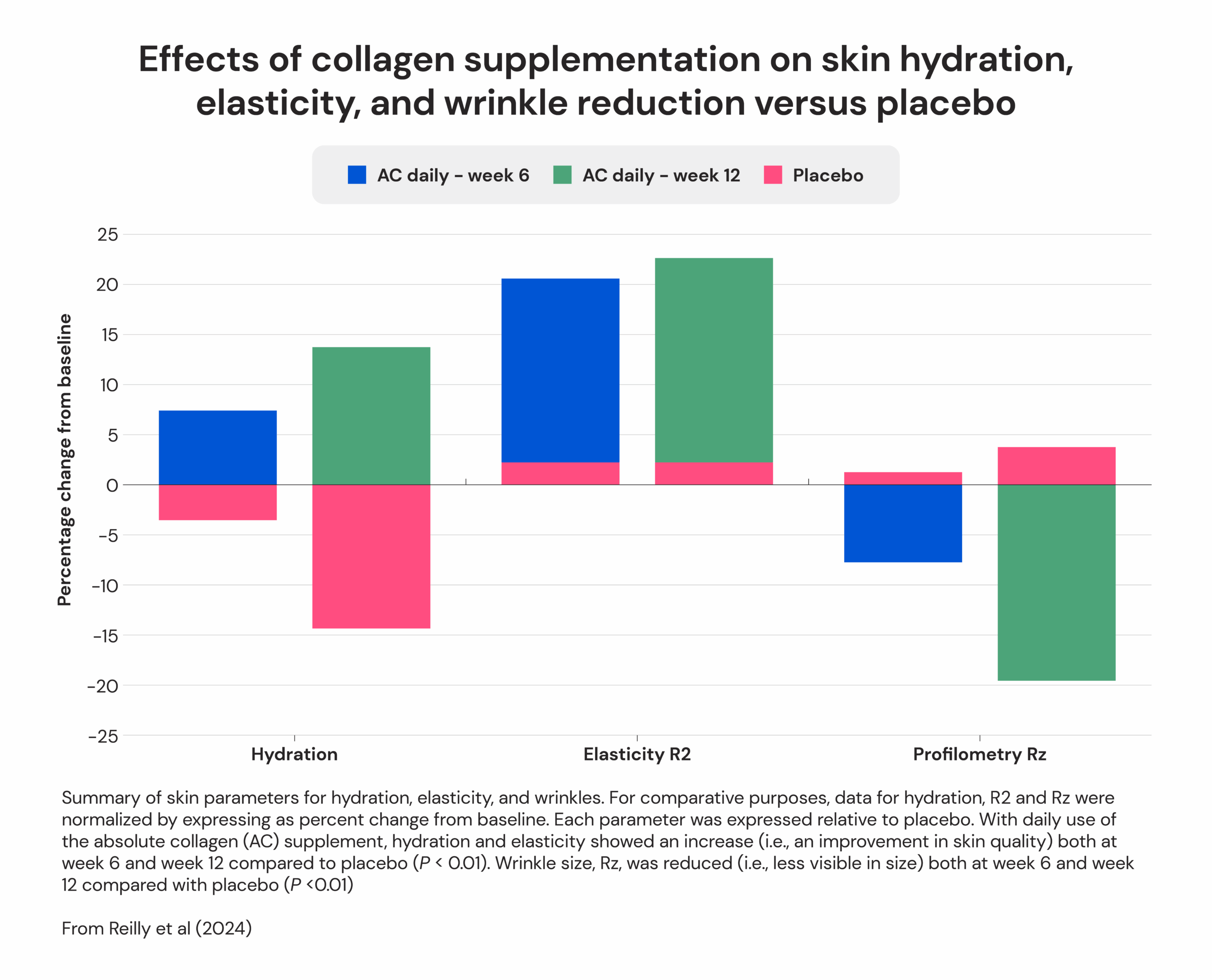
This study could also support the idea that collagen supplementation could play an important role in decreasing the breakdown and disorganization of collagen fibers in the ECM, potentially supporting small-scale turnover in the skin.
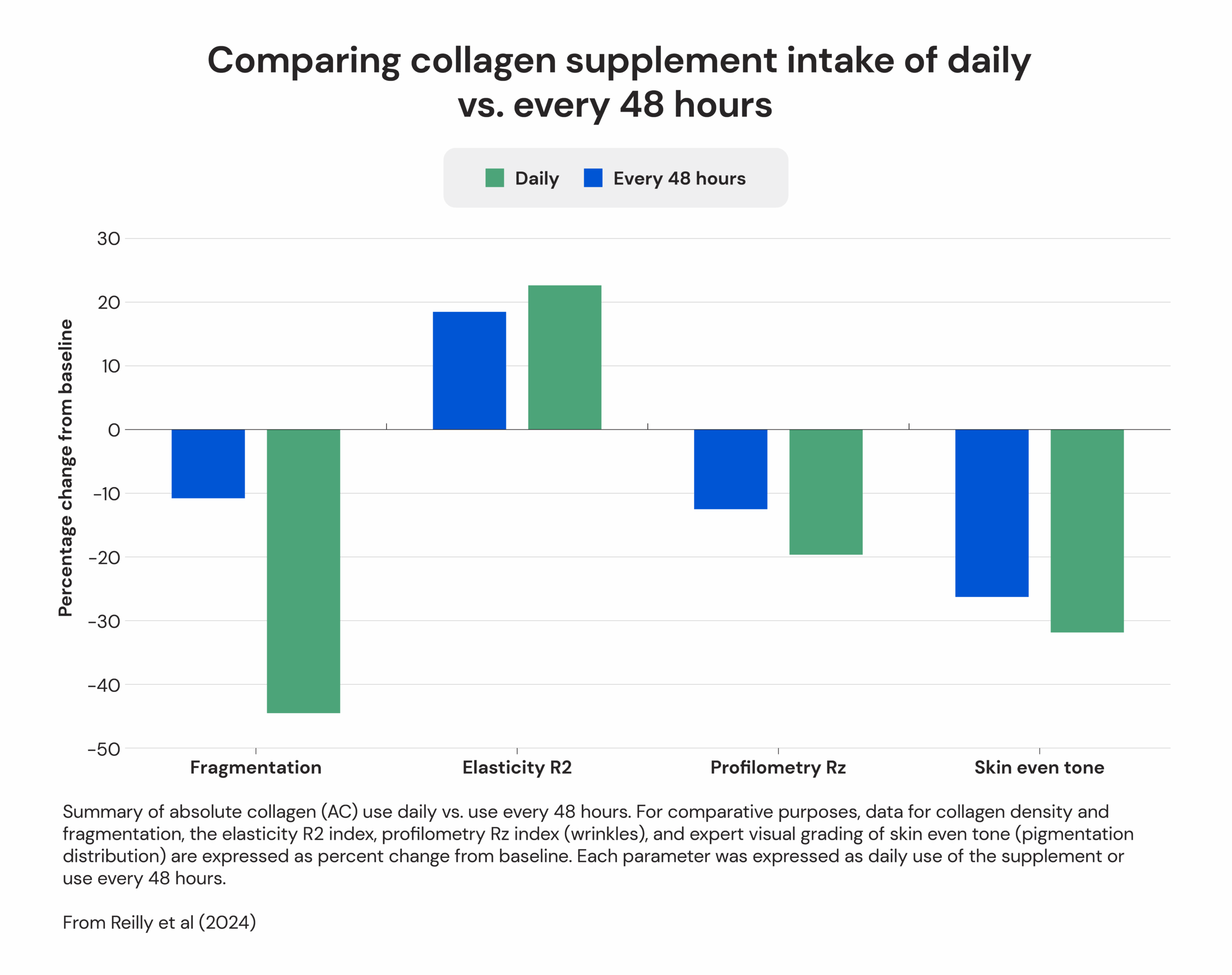
Again, this is going to vary in strength and relevance to different collagen types and areas, but it’s promising and why skin has some of the strongest supporting evidence.
Joints
Joint health is a little trickier. There’s some evidence that collagen supplementation can help, but how exactly? Some studies suggest structural effects, but do those actually translate to functional improvements? Most people don’t think about their joints until they start hurting or they’re putting them under heavy stress, so I focused on research most relevant to those considering collagen for joint function.
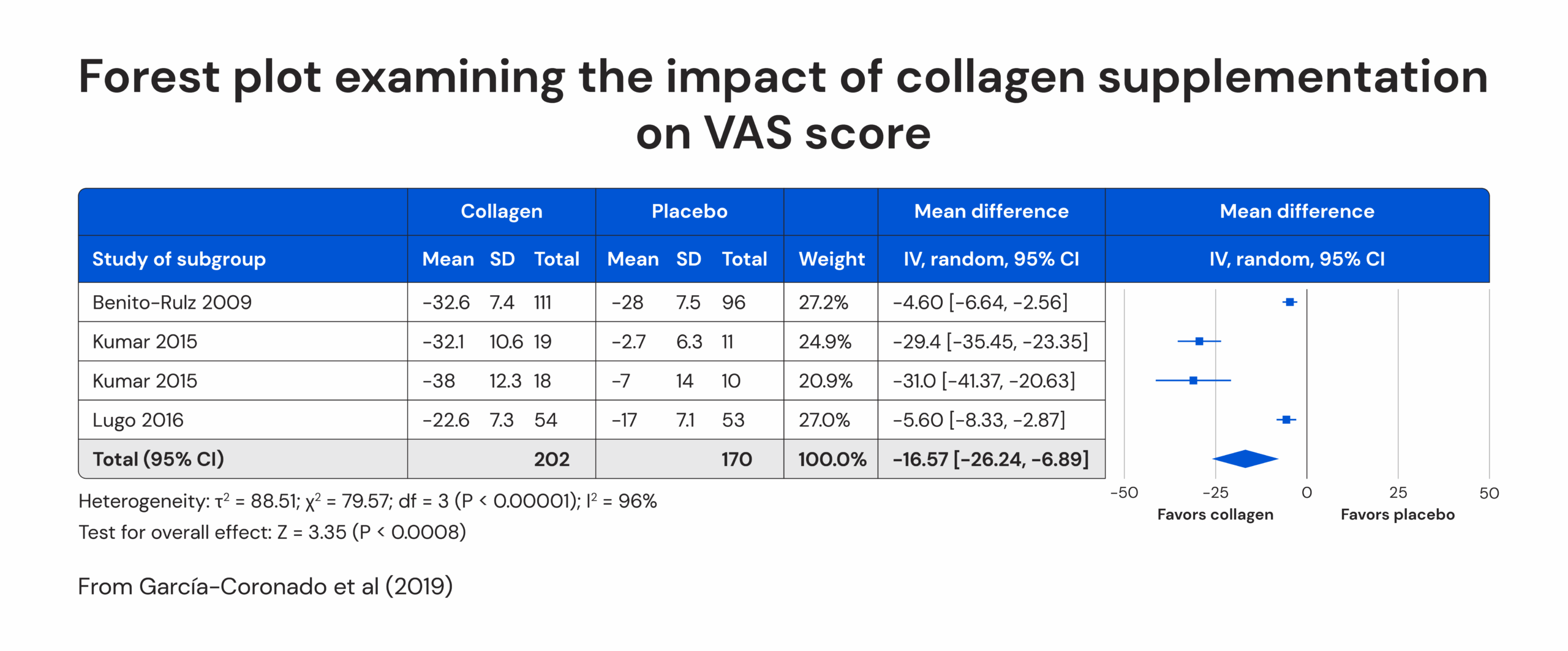
A meta-analysis by García-Coronado et al looked at whether collagen supplementation helps with osteoarthritis (OA) symptoms. It examined five RCTs with a total of 519 participants, all of whom had OA. The studies ranged in length of time from 10 to 48 weeks, with dosages ranging from 2g to 10g per day. I want to note that most of the studies used hydrolyzed collagen, but they included an undenatured type II collagen as well, for Lugo et al (2016).
The study used a WOMAC questionnaire to assess physical function ability, pain, and stiffness. It found that collagen usage reduced all scores but was more pronounced in perceived stiffness. The researchers also noted a reduction in pain.
A new 2025 study by Brueckheimer et al reviewed the effects of hydrolyzed collagen supplementation on bones, muscles, and joints, analyzing 36 RCTs. Populations ranged from healthy individuals to those with osteoarthritis, with supplementation doses ranging from 5g/day to over 20g/day and an average study duration of 15 weeks. While findings for bone and muscle health were inconclusive, collagen supplementation did show positive effects on joint function and pain reduction, particularly in individuals with osteoarthritis or previously existing discomfort.
Lastly, a systematic review looking at 15 RCTs in athletes, elderly individuals, and untrained pre-menopausal women found that collagen supplementation improved joint functionality and reduced joint pain, particularly when combined with exercise.
Collagen supplements seem to help with joint pain and function, but exactly how they work (and perhaps which type is best) is still up for some discussion. There are arguments that native type II collagen might be the better option if you’re looking for lower doses and a possible immune enhancement, while hydrolyzed collagen can provide good raw material. In general, more research is needed to nail these down.
Muscle growth
Collagen research gets a little slippery when we start looking at muscle growth. For instance, you can find a lot of studies that look at increases in lean mass or fat-free mass, but it doesn’t necessarily mean that these are increases in muscle fibers/hypertrophy. To add a little more complication to that, we could see an increase in tendon thickness or even fluid retention, but again, it’s not necessarily an increase in muscle mass.
So, to home in on things, let’s focus on studies that look to see if collagen can stimulate muscle protein synthesis (MPS).
A recent study in 2024 by McKendry et al looked at the effects of whey, pea, and collagen protein in healthy but older men (72 ± 4 years). Participants were randomly assigned to receive 50g/day of either whey, pea, or collagen protein. The results showed that whey and pea protein increased MPS while collagen had no effect. They also noted that whey and pea proteins activated mTORC1 signaling, whereas collagen failed to do so.

A study from Balshaw et al has made some appearances in arguments for collagen and muscle growth. It compared collagen peptide supplementation plus resistance training against a placebo. The collagen group did show some increases in muscle volume and signs of structural remodeling. However, those muscle volume increases were likely due to higher total protein intake rather than collagen itself driving hypertrophy. It’s interesting to see that even incomplete proteins can contribute to muscle volume, and the potential for collagen to support structural remodeling in muscle architecture is worth noting. But overall, this study doesn’t suggest that collagen should replace a complete protein source, just that it might offer some additional benefits.
If you are thinking, “What if they added more leucine (which is kind of a big dog amino acid in MPS research) to promote more growth?” Well, this study from Jacinto et al pitted whey against collagen and gave the collagen supplement group an additional leucine amount to match the whey protein leucine amount. While the collagen with the additional leucine still supported growth, it wasn’t as much as whey protein.
I will note that there has been some modest effect of collagen on recovery and fatigue. Additionally, some of the previous studies I mentioned showed positive outcomes regarding body composition and even strength, but again when they looked at muscle growth, it’s not where collagen seems to shine.
Dosage and safety
Collagen is generally safe for most people at moderate doses. However, higher intakes of hydroxyproline can increase oxalate production, which could raise the risk of kidney stones in some people. If that is a concern, moderating intake, balancing with other protein sources, or finding a collagen supplement with a higher glycine-to-hydroxyproline ratio is your best approach.
For most people, 5-15 g/day should be fine. And again, collagen should be added to your protein intake, not taken in place of your complete protein source. If you’re already hitting your protein targets, adding a small dose of collagen without cutting back on other protein sources is fine. While some studies explore 30 g/day or more, it’s still too soon to say if going that high is a real benefit.
Also, different types of collagen work on different timelines. For example, with joint health and skin, we’d look more at consistent daily intake, while lean mass benefits might be more responsive to acute intakes.
Lastly, as a reminder, cofactors and activity are important — so ensure that you’re getting adequate vitamin intake and participating in regular resistance training to maximize benefits.
Take home
I’m cautiously optimistic when it comes to collagen intake. Longitudinal studies would certainly be helpful as would more human and head-to-head studies looking at different protein sources and amino acids profiles. But it’s not a stretch to suggest that the average person may not get enough protein — let alone enough amino acids — to provide ideal collagen repair.
With that said, there is a lot of research to suggest that getting in more amino acids that help with the structuring and remodeling of collagen is, at the very least, worth a shot. From joints to skin and even body composition, there appear to be benefits. I’d like to end on a study that looks at collagen improvements in function, pain, and physical and mental outcomes, and it found that collagen could be helpful and could improve quality of life scores. So, I think collagen rates pretty well in the “Probably won’t hurt and could even help” category, which is a pretty good place to rank.
In small amounts, I could see a possible benefit and very little risk of harm, so I believe it’s worth it. I would just be careful with using large doses at this time. Instead, I’d focus more on getting in your overall protein, and then consider collagen. Lastly, there’s still a lot of dicey collagen marketing out there, so keep things simple and remember that at its core, you’re looking for amino acids and a continued solid foundation of micronutrients.