Table of contents
Introduction
Dietary fat has experienced a rollercoaster ride of PR over the last four decades. Once the enemy of the heart and arteries, people are becoming more aware of fat’s functionality and importance. We’ve also developed various categorizations and perspectives to examine how different types of fats affect our health. This foundational article will explore how much fat you need daily, what essential fatty acids are, and what makes fat important.
Let’s dig in.
What are fats?
Fats are a condensed energy source and have more than double the calories per gram than carbs or proteins. Fats are also vital to your cell structure. Every cell in your body has a semipermeable membrane lipid (fat) bilayer. This bilayer helps regulate what enters and exits cells and maintains overall cellular function. Lastly, some vitamins necessitate fat for storage; therefore, without fat, fat-soluble vitamins like A, D, E, and K can’t be absorbed.
| Common name | Main function | Examples | Calories per gram |
|---|---|---|---|
| Fats | Energy storage | Oils, butter, and seeds | 9* |
Structurally, fats consist of carbon, hydrogen, and oxygen atoms, but in different proportions than, say, carbohydrates. Because dietary fat is separated into saturated and unsaturated fat, it’s important to learn a tiny bit about the structure of fats.
Fat molecules have a long chain of carbon atoms bonded to hydrogen atoms. If a carbon is “saturated,” it connects to two other carbon atoms and two hydrogen atoms with single bonds. If carbons are “unsaturated,” they bond to only one hydrogen atom and form a double bond with the next carbon, causing a bend in the chain. This bend in the chain affects how the fats are packed together and how they react at different temperatures.
Most saturated fats are solid at room temperature, while most unsaturated fats are more liquid. These structure differences influence how fats function in the body and their impact on health.
Different fats play different health roles and should be ingested in various quantities.
Saturated fats
Due to their structure, most saturated fats remain solid at room temperature. Typically found in animal-based foods, saturated fats provide energy and aid in absorbing fat-soluble vitamins.
However, we should limit how much of our daily fat comes from saturated fat sources, due to their links to health problems like increased LDL cholesterol.The World Health Organization and the USDA recommend that saturated fat intake comprise no more than 10% of total energy intake.
Examples: Fatty portions of meat, cheese, and butter. Plant sources of saturated fat include coconut oil and palm oil.
Unsaturated fats
Due to their structure, unsaturated fats remain liquid at room temperature and contribute more positively to health, such as reducing inflammation or improving cholesterol. These fats are typically found in higher quantities in plant-based food and come in two primary forms: monounsaturated fats and polyunsaturated fats.
Monounsaturated fats
Monounsaturated fats have one double bond in their carbon chain, meaning that each molecule has a pair of adjacent carbon atoms (with a double bond between them).
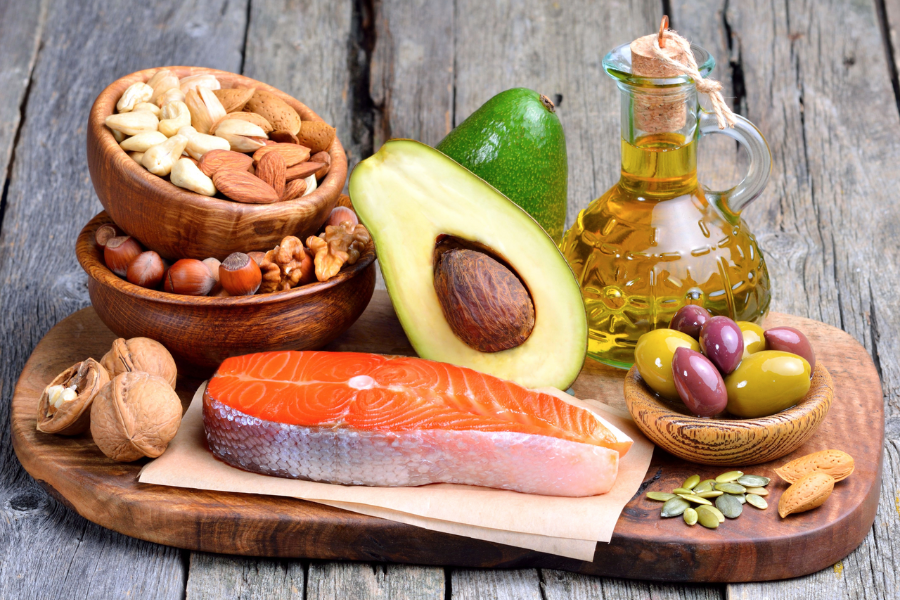
Examples: Olive oil, pumpkin seeds, and nuts.
These fats also provide energy and enhance vitamin absorption. While there are no specific intake recommendations for monounsaturated fats, it’s ideal to obtain most of your fat intake from monounsaturated and polyunsaturated fat sources.
Polyunsaturated fats
Polyunsaturated fats have multiple double bonds in their carbon chain, meaning each molecule has two or more pairs of adjacent carbon atoms (with double bonds between them), ergo the poly- aspect of the title.
Much like monounsaturated fats, polyunsaturated fats also have a neutral-to-positive impact on health, and also help the body absorb vitamins. However, polyunsaturated fats also encompass three essential fatty acids that the body cannot produce but we need for optimal health: omega-6 linoleic acid, and omega-3 EPA and DHA.
Examples: Fish, flax seeds, and chia seeds
Trans fats
Trans fats can be formed through a process of partially hydrogenating oils (PHOs). This process can stabilize the fat to decrease spoiling or withstand repeated frying. Generally speaking, partially hydrogenated oils have negative health effects if eaten in larger quantities. Intake should be restricted due to their links with increased risk of heart disease.
Trans fats of partially hydrogenated oils have been banned in many countries. The United States started the ban in 2015 and has ruled that artificial sources of trans fat cannot exist in the consumer marketplace.
It should be noted that a small amount of trans fats can also be found in natural animal sources. These are not usually associated with negative health outcomes.
Examples: In some countries, artificial trans fats are used in frying, shortening, and packaged foods. Naturally occuring trans fats are most commonly found in dairy products.
| Fat types | Description | Examples |
|---|---|---|
| Saturated fats | Due to their structure, most saturated fats remain solid at room temperature. Typically found in animal-based foods, saturated fats provide energy and also aid in the absorption of fat-soluble vitamins. | Fatty portions of meat, cheese, and butter |
| Unsaturated fats | Due to their structure, most unsaturated fats remain liquid at room temperature. They are typically found in higher quantities in plant-based food and come in two forms: monounsaturated fats and polyunsaturated fats. Some polyunsaturated fats are essential fatty acids: omega-6 linoleic acid, and omega-3 EPA and DHA. | Monounsaturated fats: Olive oil, pumpkin seeds, and nuts Polyunsaturated fats: Avocados, chia seeds, plant oils Essential fatty acids found in: Salmon, flax seeds, and walnuts |
| Trans fats | Trans fats can be formed through a process of partially hydrogenated oils (PHOs). This process can stabilize the fat to decrease spoiling or withstand repeated frying. Banned in many countries. | In some countries, artificial trans fats are still used in frying, shortening, and packaged foods |
What are essential fatty acids?
Essential nutrients are nutrients the body can’t make on its own; we must get them from dietary sources. For fats, these are known as essential fatty acids (EFAs). These sources come from polyunsaturated fats, specifically omega-6 linoleic acid and omega-3 EPA and DHA.
The biggest concern about not obtaining essential fatty acids from the diet is the risk of deficiency. Deficiency can lead to health issues such as reduced cognitive function, increased inflammation, and a higher risk of heart-related diseases.
The recommended daily intake of ALA is 1.1 grams for women and 1.6 grams for men, while the suggested combined intake of EPA and DHA is 250 milligrams per day.
Why are fats important?
Absorbing nutrients
Certain vitamins (e.g., A, D, E, and K) are fat-soluble. This means they require fat for proper absorption; therefore, a diet too low in fats could impair our body’s ability to absorb them.
Cell function
Our cell membrane is the structure that surrounds the contents of our cells. It’s composed of a double layer of lipids (fats) called phospholipids. This lipid bilayer allows things to enter the cells, but creates a barrier to keep other things out. All of this is very important for maintaining cell integrity and functionality.
Hormone production and health
Fat is needed to synthesize hormones, especially sex hormones like estrogen and testosterone. A low fat intake can disrupt hormone levels, leading to hormonal imbalances. Essential fatty acids also play a role in brain health and function, and a deficiency in these fats could contribute to decreased mental health.
How much fat do you need in a day?
Recommendations for fat intake are based on a variety of factors. Because there is a need for essential fatty acids, that marks one area of importance. Another area to consider is general overall fat intake and the ratio of types of fats.
Additionally, the way fats are recommended varies. Recommendations might be expressed as a percentage of total calories or in grams/milligrams relative to body weight, sex, or even activity level. Because of this, there isn’t a specific number to recommend (unlike some macronutrients – such as protein).
Here is a general overview of recommendations:
| Group | Fat intake | Additional information |
|---|---|---|
| Total Fat | 20-35% of total energy intake | Range can vary based on individual energy needs and body size. |
| Saturated Fat | <10% of total energy intake | High intake is linked to worse health outcomes; primarily found in animal fats. |
| Monounsaturated Fat | Part of the 20-35% total fat intake | Found in plant-based oils (olive oil), avocados, nuts; beneficial for heart health. |
| Polyunsaturated Fat | Part of the 20-35% total fat intake | Includes omega-3 and omega-6 fats; important for supporting cell function. |
| Omega-3 Fats (EPA and DHA) | 250 mg/day combined EPA and DHA | Found in fatty fish, flaxseeds, chia seeds; reducing inflammation and platelet aggregation. |
| Omega-3 Fats (ALA) | 1.1 g/day for women, 1.6 g/day for men | Found in flaxseeds, chia seeds, walnuts; conversion to EPA and DHA is inefficient. |
| Trans Fats | As low as possible | Linked to negative health outcomes; found in processed and fried foods. |
Can you eat too little fat?
As discussed, fats are an essential nutrient. Fat is a component of cell membranes, affecting their fluidity and function. Fat is also necessary to absorb specific vitamins and plays a role in hormone production. So, yes, you can eat too little fat. Doing so will decrease the functionality and optimization of these factors, so you should also probably monitor fat intake if possible. Do your best to hit your minimal daily fat intake (getting at least 20% of your daily calories from fat), while putting a special priority on essential fatty acids.
Does eating fat cause you to gain fat?
Gaining body fat comes down to caloric balance and the relationship between calories consumed and calories expended. You will gain weight if you consume more calories than your body uses (a caloric surplus). You will lose weight if you consume fewer calories than your body uses (a caloric deficit).
Eating fat alone doesn’t lead to excess fat gain; however, it should be noted that our bodies find it more challenging to convert other macronutrients, like carbohydrates and protein, into stored fat. It’s a more complex metabolic process to convert carbohydrates into fat and even more difficult with protein. The body preferentially stores circulating fat when there’s an excess of different macronutrients. However, a caloric surplus is still required for this storage process.
Dietary fat is also more calorie-dense than carbohydrates or protein. Fat provides roughly nine calories per gram, whereas carbohydrates and protein each provide approximately four calories per gram. This higher caloric density means consuming more calories when eating high-fat foods is easier, potentially leading to an easier accidental caloric surplus.
These factors can lead people to think that eating fat causes fat gain. However, fat itself in the absence of a caloric surplus does not cause fat gain.
What are the best fat sources?
It is generally ideal to get most of your fats from unsaturated fat, with a small amount (<10% of total daily energy intake) coming from saturated fat sources. With that in mind, here is a list of separated sources and grams per 100 calories. This also does an excellent job of highlighting how calorically dense fat items can be.
| Food | Grams of food or oil per 100 Calories | Leading type of fat |
|---|---|---|
| Polyunsaturated Fats | ||
| Chia Seeds | 20 g | Omega-3 (ALA) |
| Flaxseeds | 20 g | Omega-3 (ALA) |
| Walnuts | 16 g | Omega-3, Omega-6 |
| Salmon | 55 g | Omega-3 (EPA, DHA) |
| Sunflower Seeds | 18 g | Omega-6 |
| Soybean Oil | 11 g | Omega-6 |
| Monounsaturated Fats | ||
| Avocado | 60 g | Oleic Acid |
| Hazelnut | 16 g | Oleic Acid |
| Almonds | 18 g | Oleic Acid |
| Olive Oil | 11 g | Oleic Acid |
| Saturated Fats | ||
| Coconut Oil | 11 g | Lauric Acid |
| Butter | 14 g | Palmitic Acid |
| Cheese, cheddar | 25 g | Stearic Acid |
| Beef, ground | 50 g | Stearic Acid |