Introduction
In a recent article, we explored whether protein timing — specific windows for protein intake — can impact your results. This time, we are exploring whether the way you spread your protein intake throughout the day matters. Does it matter if you eat all your protein in a small window, or should you space it out? And if spacing your protein out is key, does frequency also matter?
Let’s dig in.
What is protein distribution?
Protein distribution refers to how you spread your protein intake throughout the day — whether that’s through meals, snacks, or shakes. The proposed goals of protein distribution are to optimize muscle protein synthesis, decrease muscle breakdown, and improve overall recovery. For example, researchers might examine whether evenly distributing protein across four meals leads to better muscle growth versus consuming most of your protein in the evening. Is there a difference? Do some people respond better to an “even” versus “skewed” distribution?
Example:
- Even Distribution: Eating 30g of protein at breakfast, lunch, and dinner.
- Skewed Distribution: Eating 10g of protein at breakfast, 20g at lunch, and 60g at dinner.
Why is it commonly believed that protein distribution matters?
When people argue for the importance of patterns in protein distribution they’ll usually rely on these concepts:
Protein meal limits
This suggests that there’s a limit to how much protein your body can use at once. For instance, it was once believed that the body only needed 20 grams of protein per meal, with anything beyond that amount being “wasteful.”
Revolving muscle protein synthesis
Eating protein across multiple meals may keep your body ready to build muscle by continually stimulating muscle protein synthesis.
Reducing muscle protein breakdown
Keeping a steady supply of amino acids could reduce the time your body spends in a catabolic state, potentially minimizing muscle loss.
There are also practical aspects to protein distribution, like its potential to influence appetite. However, these effects are very individual. In this article, my focus is less on those factors and more on whether protein distribution offers any metabolic benefits.
With that, let’s dive into the most debated topic — protein meal limits.
Understanding protein meal limits
In the protein timing article, we referred to a study by Trommelen and colleagues, which will be pretty relevant here as well. The idea of a per-meal protein intake limit stems from research examining how different protein doses impact muscle protein synthesis (MPS). These studies typically measure MPS over a short time frame and observe that higher protein doses increase MPS to a point (at around 20-25g), but even higher doses don’t stimulate much (if any) additional MPS. So, the thought is that more protein means diminishing returns. Meaning, in this argument, there is no reason to eat large quantities of protein in one sitting because it’s likely to be wasted and not produce more notable effects than smaller doses. Makes sense, right?
However, what if it turned out that we weren’t measuring long enough?
This brings us to the study by Trommelen et al.
Trommelen’s study was a randomized controlled trial comparing three groups: one received no protein (0g), another received a moderate amount (25g), and the last received a large dose (100g) following resistance exercise. Participants completed a single resistance training session before ingesting their assigned protein dose. Researchers tracked a lot of different metabolic markers, such as muscle protein synthesis rates and plasma amino acid levels, over a 12-hour window. The results? Larger protein doses led to a sustained anabolic response, and there was no evidence of saturation in muscle protein incorporation during the 12-hour period.
In other words, the idea that per-meal protein benefits are maxed out at 20-25g of protein was most likely an erroneous conclusion due to methodological shortcomings of older studies. The main benefit of higher protein doses is that they cause a much more prolonged increase in MPS, but prior studies were unable to detect this effect since they only measured MPS for 2-4 hours following a meal.
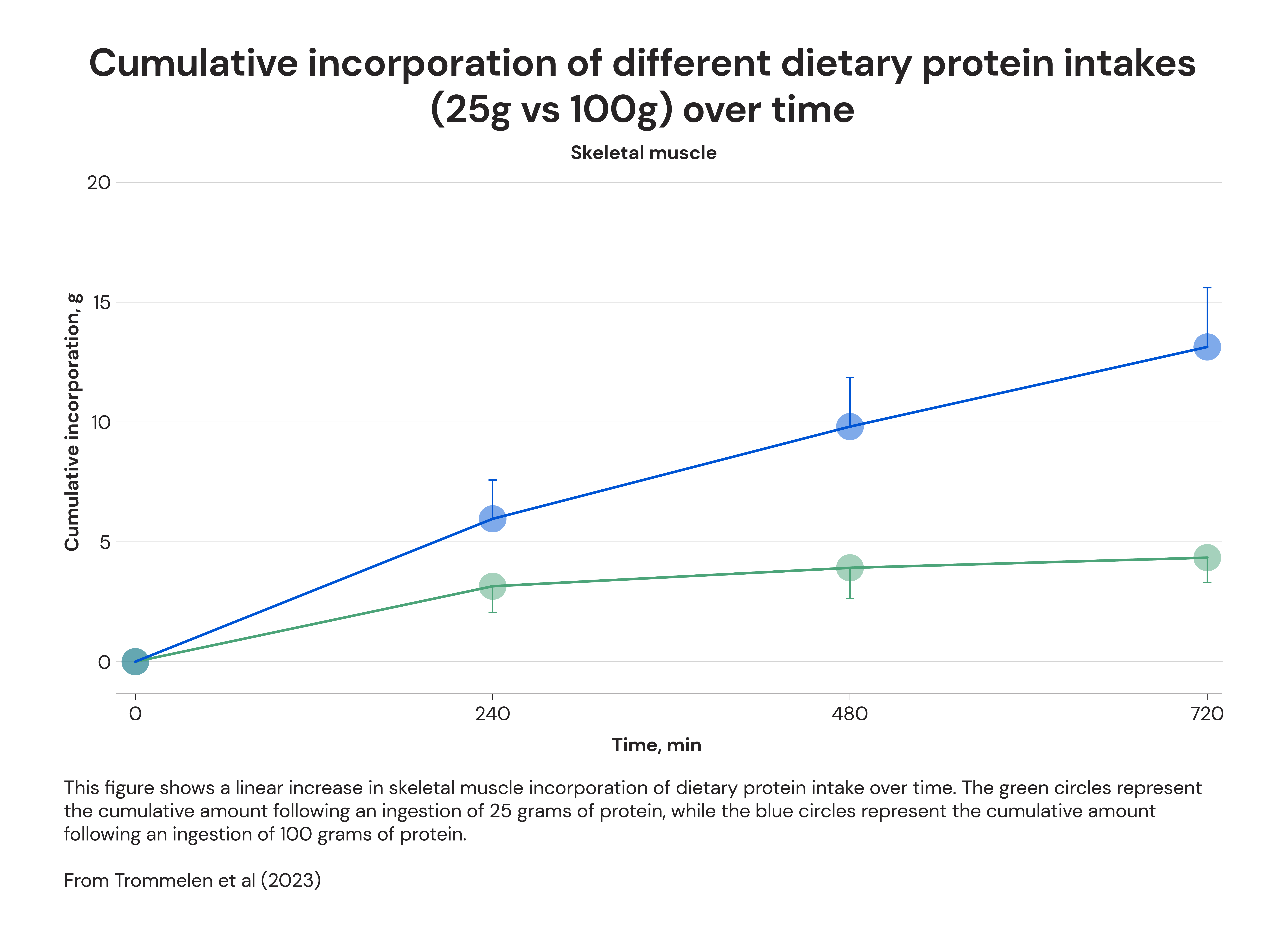
Now, the Trommelen et al study wasn’t a protein distribution study, and they openly acknowledge that. That said, when you consider the common reasons people argue protein distribution matters, this study addresses many of those concerns. It reinforces the idea that what really matters is the total daily protein dose.
With that said, let’s look more directly at a few protein distribution studies to ensure we are covering the nuances of this.
How time-restricted feeding ties into protein distribution
Time-restricted feeding involves intentionally limiting your eating to a specific window, typically 8-12 hours. During this window, you eat all your meals, and once it ends, fasting begins until the next meal. Some people naturally follow this pattern — for example, they might have coffee in the morning, delay their first meal for several hours, and finish eating for the day at an early dinner time. Others eat throughout the day, from morning until shortly before bedtime.
Protein distribution ties into time-restricted feeding because studies on eating within limited windows inherently affect how protein is distributed. By restricting eating to a shorter timeframe, protein intake shifts. To be clear, the distribution could also be skewed or even within these frames, but no matter what (be it in the morning or evening), there will be a larger space of time where food is not ingested.
A recent systematic review and meta-analysis by Ho et al examined the combined effects of time-restricted feeding (TRF) and resistance training (RT) on body composition and metabolic health in adults. The analysis included seven randomized controlled trials with a total of 164 participants. Study durations ranged from 4 weeks to 12 months, with most lasting around 8 weeks. Researchers compared an 8-hour eating window paired with resistance training to a habitual eating window. Protein intake was matched across groups, with most participants consuming at least 1.4g/kg/day.
The researchers found that the TRF + RT groups saw a reduction in fat mass but no loss in fat-free mass or muscle cross-sectional area. This indicates that TRF + RT works well enough to preserve muscle mass. Another TRF study excluded resistance training and found that while ad libitum eating also reduced fat mass, it resulted in modest decreases in lean body mass. I mention this to emphasize that while adequate protein intake is needed, resistance training is equally important for preserving lean body mass during fat loss.
Lastly, a study from Tinsley et al looked at the effects of TRF combined with resistance training on body composition in resistance-trained females (with at least a year of experience). This 8-week randomized controlled trial compared a 7.5-hour eating window to a habitual 13-hour eating window. Protein intake was matched between groups at 1.6 g/kg/day, and all participants followed a supervised training program. TRF has similar muscle and performance outcomes.
If protein distribution had a major impact on muscle growth or maintenance, you’d expect TRF to have a serious negative impact on muscle growth or maintenance, since a time-restricted feeding pattern necessarily constrains your ability to distribute your protein intake evenly throughout the entire day. However, since TRF seems to lead to body composition outcomes that are comparable to feeding patterns with more even protein distribution, the TRF research provides pretty strong evidence to suggest that protein distribution isn’t that important, assuming that total protein intake is sufficient.
More on different styles of protein distribution
Protein distribution and timing are distinct concepts, just as skewing distribution is different from time-restricted feeding (TRF). Therefore, I wanted to cover a little bit of that as well.
A study by Hudson et al focused on men and women engaging in resistance training while having a Calorie deficit. Both groups were in a pretty notable deficit and had their total protein intake matched, but their protein distribution differed:
- Even distribution: 30g of protein at breakfast, lunch, and dinner.
- Skewed distribution: 10g at breakfast, 20g at lunch, and 60g at dinner.
A commonly discussed study supporting the idea that even distribution enhances gaining lean tissue mass is a hypertrophy study from Yasuda et al. This 12-week study examined 26 young men with no recent training experience (at least a year). One group followed a more evenly distributed protein intake, while the other consumed a skewed intake that increased toward the end of the day.
| Meal | High Breakfast (HBR) Protein Intake (g/kg BW) | Low Breakfast (LBR) Protein Intake (g/kg BW) |
|---|---|---|
| Breakfast | 0.33g (25% of daily total) | 0.12g (10% of daily total) |
| Lunch | 0.46g (35% of daily total) | 0.45g (35% of daily total) |
| Dinner | 0.48g (35% of daily total) | 0.83g (55% of daily total) |
| Total | 1.3g/kg/day | 1.3g/kg/day |
The study found that the even distribution group gained more lean tissue mass than the skewed group. However, does something jump out at you about their setup in that table?
If you’re thinking, “Total protein intake seems a bit low for hypertrophy,” you’re probably right. Current recommendations typically start at around 1.6 g/kg/day for optimal muscle growth. This raises the question: If overall protein intake in this study had been higher, would the results have been different?
In contrast, let’s look at this study by Taguchi et al that examined male collegiate rowers with higher protein intakes, averaging 2.6-2.7 g/kg/day, which is well above the recommended level for optimizing hypertrophy. Despite differences in meal frequency (three vs six meals per day), fat-free mass (FFM) gains were pretty similar.
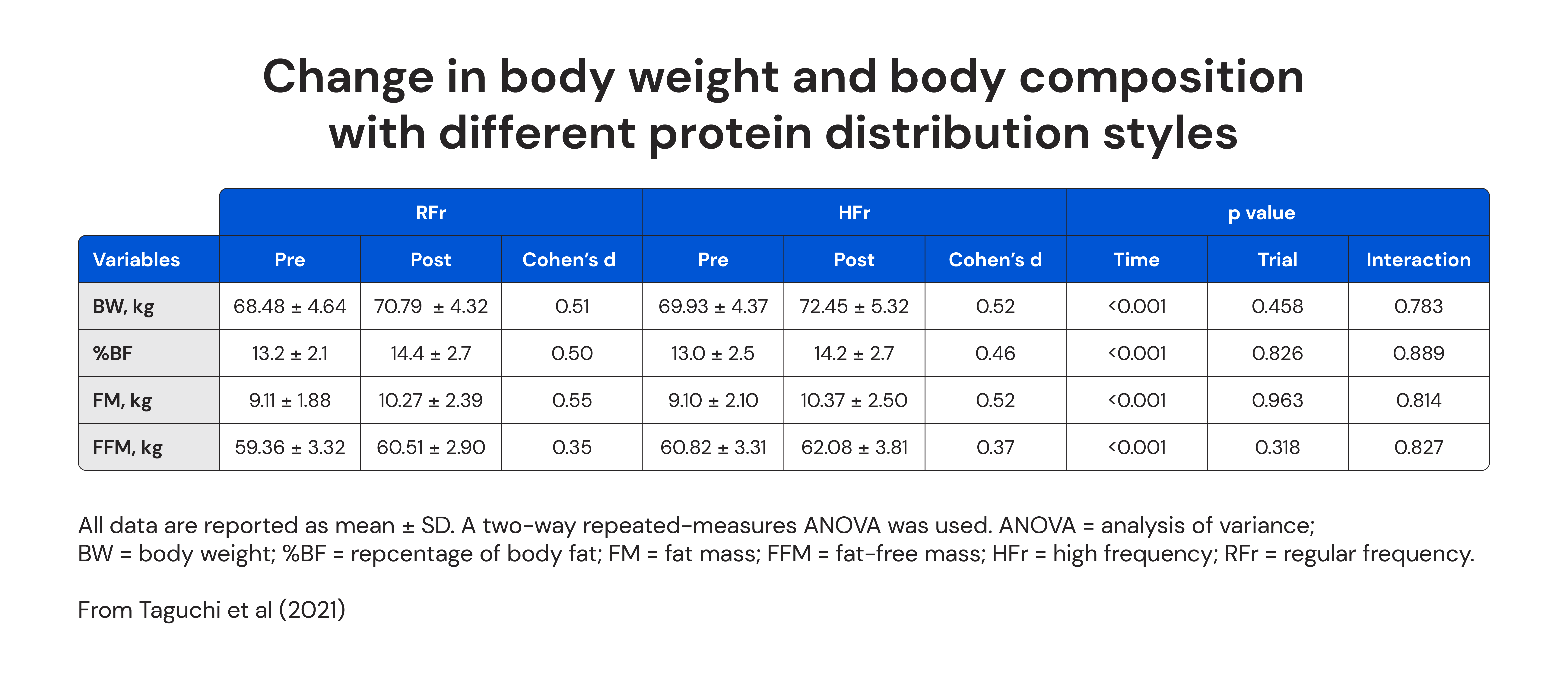
When we look at this research in totality, we see some evidence suggesting that protein distribution may be more important when total protein intake is lower. For example, if you only consume 1g of protein per kilogram of body mass (well below the levels that have been found to maximize muscle growth or retention), there may be benefits to trying to distribute your protein intake more evenly throughout the day. However, if your overall protein intake is higher (at least 1.4-1.6 g/kg), protein distribution seems to have a much smaller impact on your body composition outcomes.
How does all this information play out practically?
In our article on protein timing, we discussed how factors like age, training experience, exercise intensity, and nutritional state influence how long your body remains sensitive to anabolic stimuli. Goals and lifestyle also play a role. Simply put, there’s a difference between what’s technically accurate in research and what’s realistic for daily life.
Given the shorter feeding windows, you could argue that less frequent protein distribution or time-restricted feeding often aligns better with maintenance or Caloric restriction. However, that doesn’t mean you can’t make gains with time-restricted feeding — it’s just that smaller windows likely require more intentionality. Keeping protein intake and Calories high enough in a condensed timeframe can be challenging.
I think this graphic from Trommelen et al sums up the assumptions versus the reality of distribution nicely.

So, practically speaking, if you’re working with smaller feeding windows and aiming to lose body fat, you might feel like you get more food or do a better job controlling snacking outside of meals. There’s something to be said that many TRF studies lead to decreased fat mass.On the other hand, gaining muscle could be more manageable with even an all-day distribution, especially if you have a high daily Calorie intake. For some, it’s simply too much food to fit into smaller eating windows or a distribution skewed heavily toward one meal. Larger individuals with higher total energy expenditure may find frequent and more even protein intake more practical for hitting their targets consistently.
The point is, you don’t need to divide your protein into 4-6 meals to build or maintain muscle, but for some, this approach might simply work better. For certain individuals, protein distribution could be the difference between decent results and exceptional ones. However, from a mechanistic standpoint, we haven’t seen a definitive case for distribution making a major impact so far.
Conclusion
Similarly to protein timing, we return again to the total daily dose of protein intake as the most important factor. However, this doesn’t negate the role of lifestyle or the practicality of timing and distributing protein throughout the day. Articles like this aren’t meant to dismiss the value of distribution within a daily eating routine but rather to alleviate overthinking about optimal protein distribution.
If we wanted to err on the safe side, you could aim to spread protein across 3-4 meals a day and ensure you’re covered at bedtime (whether that’s with a larger dinner or a smaller pre-bed snack). I don’t think it’s a waste to eat a large amount of protein at once any more than it’s a waste to eat six smaller meals or four meals and two shakes or any other approach that works for you.
While total daily protein should be the top priority, I’d argue that practicality and sustainability should follow it. If it doesn’t fit into your daily life, it’s probably not going to happen.
Tl;dr: Total daily protein is the most important factor, but protein distribution can make a lot of practical sense depending on your goals and overall Calorie needs.