
Transformation challenges can help kickstart change. Whether it’s a group challenge or a personal goal with a deadline — like getting shredded before summer or dropping 30 pounds before a class reunion — these commitments often start with high expectations about our results.
But let’s be honest: The path to any significant transformation is rarely as smooth as we’d like. It’s not unusual to feel overwhelmed. And life doesn’t stop because you’re chasing a goal, and, for many, the setbacks can feel more frequent than the wins. Before you know it, you find yourself struggling to stay committed and thinking about starting over.
In this article, we’ll cover practical tips to help you stick with your transformation, navigate the rough patches, and maybe find ways to enjoy the process. Hopefully, you’ll discover that adjusting your expectations doesn’t mean failure; it’s just part of doing this in a sustainable way.
1. Start with clearly defined goals and reasons
For this article, we’re focusing on specific transformation goals — not casual efforts. There’s a difference between saying, “I’ll try to gain a little muscle” or “I might lose some weight this year” and committing to a time-sensitive plan, like losing 20 pounds in 12 weeks or gaining 5 pounds of muscle in 3 months. Specificity can be a good thing and help us narrow our focus. Though, to be clear, don’t confuse specific goals with aggressive or overly ambitious goals.
So, if you’re not yet clear on what you want to achieve, take the time to write it down: What is the goal? How will you measure progress? What is your time frame? This article assumes you’re working toward a more structured, time-bound transformation goal, but if not, start there.
Now, assuming you’ve got a specific goal, let’s address your “why.”
The reasons behind why we pick a goal or what drives us to achieve a goal are more complex. In research, what is often seen to aid change are instances of significant life events, particularly health scares and adverse salience. While this doesn’t mean you can only make dramatic transformations after getting out of a hospital or ending a marriage, it does suggest that it’s helpful when clear motivations are tied to specific goals.
A lack of strong reasons and intentions are a big contributor to intention-behavior gaps. These gaps refer to the difference between what you plan to do and what you actually do. For example, you might aim to gain 10 pounds of muscle and fully intend to stick to it. But despite your best efforts and repeated attempts, you skip workouts or do not follow the program as planned. While there are a lot of aspects to addressing intention-behavior gaps, at its core is making sure to examine the many intention-behavior moderators.
Intention-behavior moderators influence how you turn plans into action. I’ll highlight a few moderators throughout this article, but everything from identity alignment to habits helps hone how closely your goals can align with your “why” for pursuing change.
I won’t pretend I can solve or pinpoint your reasons in just a few paragraphs. But if you’re not clear on why you’re tackling your transformation, it’s more likely to feel like a chore, and your motivation will probably fade over time. While closing intention-behavior gaps is a multifaceted process, a good place to start is keeping a reminder of why you’re doing it. The more you keep your “why” top of mind, the more likely you are to bridge the gap between intention and action.
2. Set a realistic pace and rate of change
The pace we envision for achieving a goal — whether it’s gaining muscle or losing fat — often doesn’t match the reality of how these changes actually play out. A perfect transformation run is rare because so many factors must align. And more often than not, people set expectations that are overly ambitious for the timeline they have in mind.
With bulking, getting your pacing right can be crucial because you might hinder muscle growth if it’s too slow. Too fast, and you gain unnecessary fat. For example, beginners can typically afford to gain a little faster since their potential for muscle growth is higher. However, for intermediate and advanced lifters, faster rates of weight gain can lead to more diminishing returns in muscle growth and disproportionately higher fat gain. Gaining muscle has a lot of variables and moving parts, so understanding rates of change can help set up your timeline right. FYI, here is an article on how fast you should gain weight while bulking.
I know faster loss rates are more appealing with fat loss, but they often come with trade-offs. Hitting larger energy deficits can increase muscle loss, enhance fatigue, and decrease our ability to adhere to the deficit altogether. For most, getting worn out in the first few weeks is common, and people often fall off and try again later. It’s also not uncommon for regain to take place between stints, which can really damage people’s belief system in the process of fat loss and their self-efficacy. If need, you can read more about how fast you should lose weight here.
So remember, transformation is a performance effort and one that requires daily repetition. If you go too hard, too soon, you might burn out. Slowing your pace allows you to observe gradual changes as they happen. If you’re having a hard time sticking to your day’s Calories (be it high or low), the first thing to do is step back and see if it’s time to reset your goal rate. Note: Those using the MacroFactor app can read more about it here. If you’re unsure if your Calories are too high or too low, read more about that here.
In short, make extra effort to select the right balance of a motivating but sustainable pace for yourself. It’s easily one of the top tips for actually adhering to your transformation.
3. Create habits and set up your environment to support your goals
We’ve covered habits in an in-depth five-part series. If you’re struggling to make habits during your transformation, it’s a great read that could help ingrain better subconscious responses instead of always relying on conscious and proactive effort. The biggest reason to embrace habit formation is that once formed, habits can help us in the background of our lives.
We experience benefits from increasing automation in nearly every aspect of life, from work to health. If constructive habits are in place, while it doesn’t alleviate hard work, it can make the effort and hard work feel less intensive — and that’s saying something when you might find yourself in a place where you’re already struggling to achieve a goal. So, if you are struggling in your transformation, one thing you can audit is your habits. Ask yourself the following:
- Are your current habits supporting your goals?
- Do you have any counterproductive habits that make things more difficult?
- Can you find a way to increase constructive habits to make hitting your goals easier?
Oftentimes, it can be the slightest tweaks that make a difference. For instance, if you have a habit of rushing through meals and not being mindful of your eating, you can try adding this habit: Set your phone on the table and put the timer on just to make sure you’re more aware of time passing (and hopefully to help slow your eating).
Habits don’t have to be complicated, but they are often more easily created than broken, so consider where you can add good habits versus focusing on breaking bad habits.
A big part of making these habits more seamless is setting up your environment to support these habits.
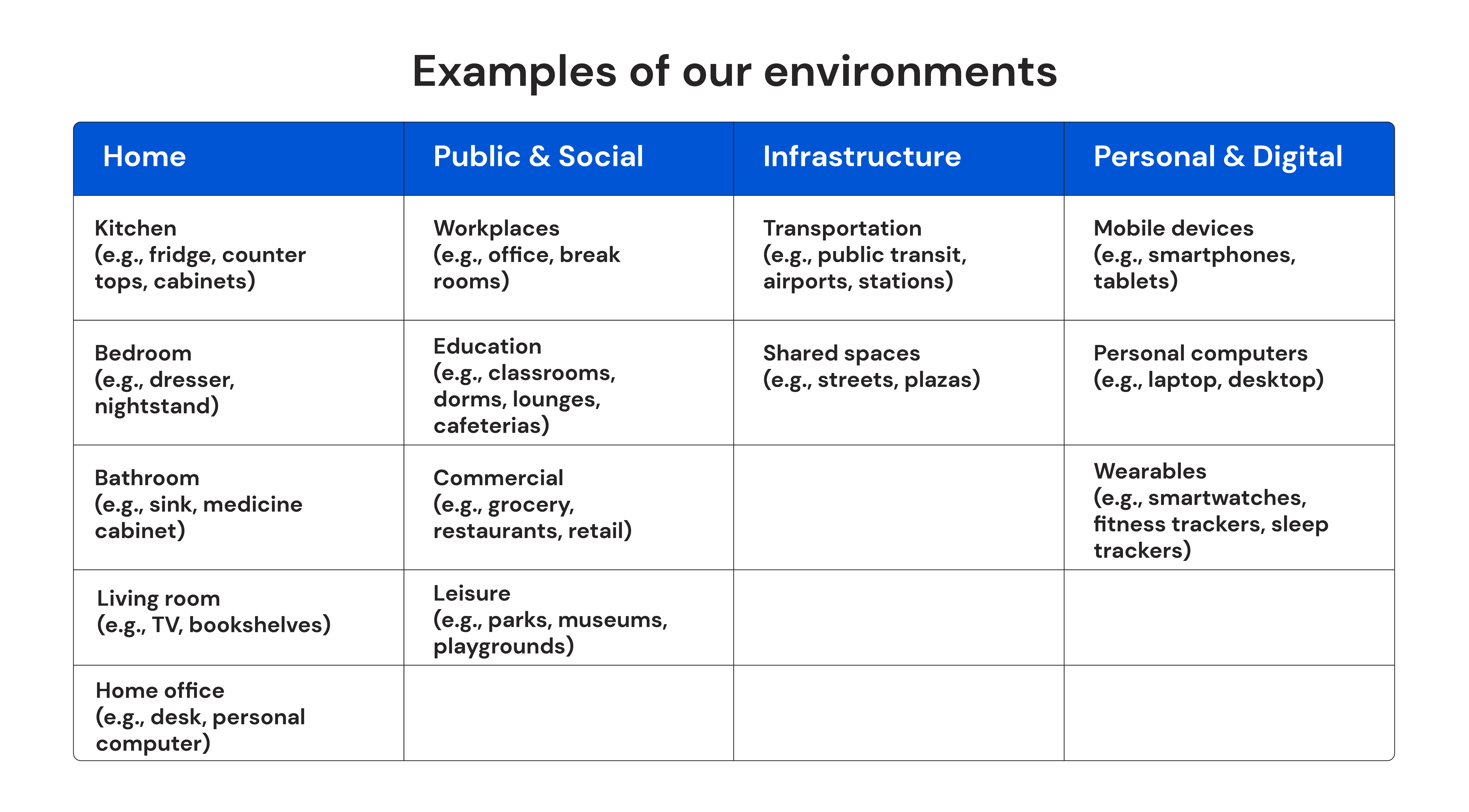
Looking at environment examples, think of how you can organize your home, work environment, or even driving route to support your transformation goals. For example:
- Kitchen (Home)
To achieve weight loss goals, clean out your pantry of quick-grab or easy temptations. For example, when participating in a cut, I never keep chips or snack foods around. It’s too easy for me to impulsively nibble when I’m hungry. Instead, I try to keep food items that require cooking and preparation to slow my impulse responses and allow me more time to think if that’s an action I really want to take. If I have “grab” items around, I ensure they are lower-Calorie fruits or simple protein snacks.
- Desk (Office)
If you are trying to gain muscle but find yourself getting lost in your work for hours, keep some snacks stashed at your desk, like protein bars, dried fruit, or nuts. This way, if it crosses your mind that you haven’t eaten for a little while, you can grab a quick nibble to keep your Calories up.
- Commuting (Driving route)
If you’re struggling to get to the gym, consider joining a gym near a daily driving route. If you’re in a spot where consistency of going still isn’t a habit, repeatedly seeing the gym or finding it conveniently accessible could help create more opportunities for going.
- Mobile Device (Personal/Digital)
Keep apps on your phone that help you along your journey, be it food-logging apps like MacroFactor or podcasts that keep you company while getting your steps. Mobile environments play a large role in our daily lives, and they should be just as supportive of your goals as your physical living spaces.
The take home message? Do everything you can to make your environment a place where you have to make fewer decisions and can just take action.
4. Anticipate setbacks and prepare for challenges
Even if you set what you think is a realistic pace and have tried to put some habits in place, with transformations, you have to assume there will be hiccups. In fact, the more you anticipate obstacles and prepare for them, the less likely they are to derail your progress. This is where proactive tools like implementation intentions and embracing strategies of acceptance and commitment can play a powerful role.
You can think of implementation intentions as “if-then” plans that make it easier to follow through on your goals. For example, if your goal is to establish a walking habit to assist your weight loss goals, an implementation intention might look like this: “If I want to watch a movie after dinner, then I’ll go for a 30-minute walk first.” Pre-deciding your actions to common scenarios can help remove friction and increase more desirable outcomes.
Here are a few more examples:
| If… | Then… |
|---|---|
| I’m at a party with lots of tempting food | I’ll use a smaller plate and try to keep veggies on it when I make new trips. |
| I get off track for a few days | I’ll dive back into my plans instead of aggressively restricting. |
| I’m not feeling great in my workout | I’ll focus on one lift versus multiple exercises. |
| If I go out to eat | I’ll try to look at the menu ahead of time instead of deciding on the spot. |
| If I’m diving into meal prep | I’ll start with all my protein first before focusing on other things. |
| If I’m feeling worn down | I’ll make a priority of sleep and recovery versus pushing myself harder. |
The goal of anticipating obstacles hits the core of understanding that things will probably not go perfectly. With a little planning and anticipation, you can fall back on different approaches and still get forward traction. This line of action helps minimize the “all or nothing” or perfectionist mentality that tends to halt our progress.
With acceptance and commitment strategies, you can navigate more of the emotional discomforts often associated with behavior change. These approaches encourage us to change how we relate to these feelings and have a more positive mindset when embarking on something challenging.
Let me caveat that this advice assumes you’re participating in a paced and reasonable program. I say this because if engaging in something unhealthy or too extreme, the last thing you want to do is discourage thoughts of taking care of yourself. Right? It’s why this comes after we’ve discussed reasonable paces and healthy habits.
Moving forward, let’s say during a healthy transformation program, you’re stuck on a thought like, “I can’t stick to this, this is too hard.” The acceptance and commitment strategies mostly work through defusing conflicts and acknowledging that these hard times are temporary and passing events. It allows you to make space and embrace a certain level of discomfort. You can use these frameworks to work harder in the gym or lean into (reasonable) food restrictions.
Examples of acceptance and commitment strategies for health behavior improvement
| Principle | Definition | Example in health behavior |
|---|---|---|
| Defusion | Reduce the influence and power of unwanted thoughts. | Instead of thinking “I’ll never lose all this weight,” reframe it as “I think I’m just feeling overwhelmed by my goal. I have made progress.” |
| Acceptance | Allowing the presence of uncomfortable feelings or thoughts and existing in their presence. | You feel (healthy) struggle and discomfort with eating more food but you keep pushing through because it aligns with your goal of muscle building. |
| Contact with the present moment | Avoiding excessive thought or rumination on the past or future events. | While training, stay focused on your breathing and focus on your form instead of dwelling on past events or worrying about future experiences. |
| Self-as-context | Separating your thoughts and feelings from yourself as a person. | Recognizing, “I just had a thought that I’m not going to stick to my diet today,” rather than letting that thought stop you from sticking to your meal plan. |
| Values | Naming and understanding deeply held beliefs that you want to guide your decisions. | Writing down all the reasons that drive you to want to be in better shape, take care of yourself, and make healthy decisions for your body. |
| Committed action | Taking movement and actions, despite challenges, toward your goals. | Setting specific goals to go to the gym three days a week or lose four pounds in the next six weeks, even if you’d rather achieve bigger goals. |
Inspired by Zhang et al (2018)
The point here is to combine planning with the right mindset, which will give you a higher likelihood of getting through a more intensive period of hard work and transformation.
5. Don’t get too caught up in short-term weight loss or gains — watch the trends
Daily weigh-ins can be pretty noisy as we can fluctuate up and down quite a few pounds for various reasons (volume of meals, sodium, hormonal shifts, etc.). Celebrating or being upset over short-term fluctuations generally makes you more frustrated than not. Therefore, it’s ideal to focus on weight trends.
Weight trends are the moving average of your weight data. It takes your weigh-ins and compiles them to create a clearer picture of reliable patterns versus isolated snapshots of your day-to-day life. Understanding these weight trends can prevent overcorrections. For example, if you only look at today and see you weighed 203 pounds (92kg) after having weighed 199 pounds (90kg) the day before, you might get upset and feel tempted to cut Calories or change your plan drastically. However, if you zoom out and look at your weight trend for the passing weeks, you’ll see that you’re actually down overall, and the 203 pounds (92kg) is well within your fluctuation range.
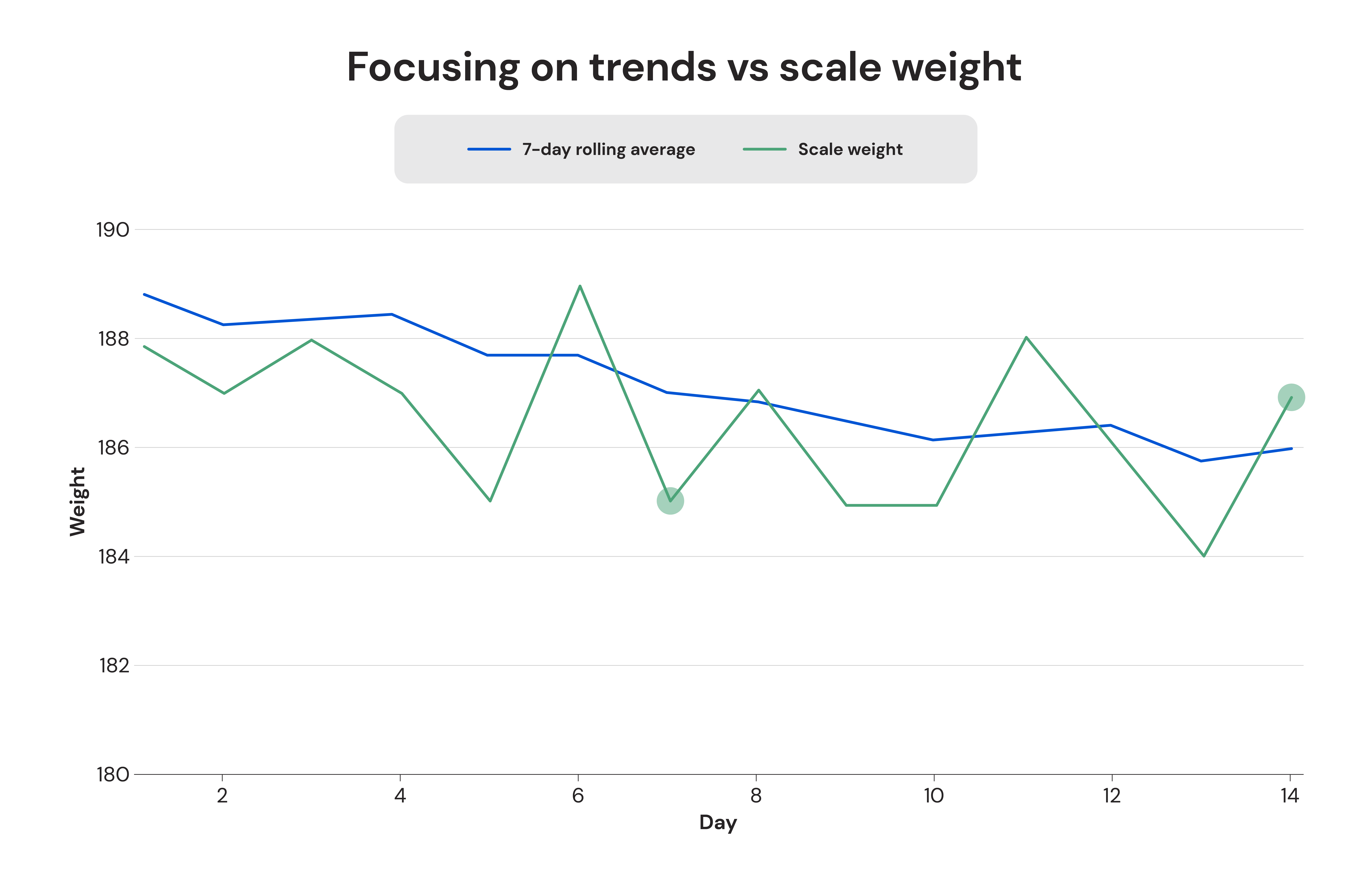
That said, sometimes the weight trend provides insight into the fact that changes need to be made in your planning. For instance, if your transformation involves gaining weight, and the trend shows you consistently maintaining or losing weight overall, this can be a sign that you might need to increase your Calorie intake (alongside adequate training).
Lastly, if you’re using MacroFactor, the app simplifies all of this. Even if you miss a weigh-in here and there, MacroFactor’s algorithm fills in the gaps using linear interpolation (meaning, if you weighed 181 pounds on Tuesday and 180 pounds on Thursday, the app will assume you weighed 180.5 pounds on Wednesday, even if you didn’t log it). This gives you a much clearer picture of your progress without worrying about daily noise.
In short, keep the big picture in mind, and don’t get too happy or deflated by movement in either direction until it’s been a while.
6. Celebrate all progress — every movement toward the goal is a win
While it’s good to focus on an intensive transformation goal, it’s just as important to recognize and celebrate every step forward along the way.
Having overly strict expectations with little flexibility could make things worse, not better. The better thing to do is reel in our expectations and allow for a range of what we see as victories. For example, setting a less aggressive goal is smarter, almost guaranteeing you achieve it. An attainable benchmark creates a more positive experience and even allows you to exceed your goals. This decreases the chance of feeling dejected for no reason other than the pressure you’ve put on yourself.
This isn’t just a participation trophy pep talk; it’s about building your self-efficacy and belief that you can do things. Feeling like your goals are realistic, achievable, and within your control is important.
One of the more difficult things about any goal we try to achieve is that progress is rarely easy to see in a short-term linear path. There can be many hills and shifts over many months and even years that can make it feel as if we are never getting to our destination. But if we take a moment each day to find a win, it can make the journey itself enjoyable.
So take time to recognize the incremental successes in your day — a high-protein breakfast, a workout logged at the gym, or a solid night’s sleep. These are all actions that reflect your efforts to improve your life. You showed up, even when you didn’t want to, and that’s a win. And these small wins add up and can create the momentum you need to push through those tough moments.
Closing
You could probably boil the majority of this article down to two key ideas: 1) things probably won’t go exactly as planned, but 2) if you expect that and plan for it, you’re likely to make pretty good progress anyway. While the frustration of not reaching your goals as quickly as you’d like can be tough, it’s nothing compared to not reaching them at all. So, embrace the process, adjust as needed, and keep moving forward.