

Handling memory-intensive models or massive datasets can push even the most advanced local hardware to its limits. For European AI researchers and data scientists, the search for high-performance cloud compute servers is all about achieving optimized performance and resource efficiency without sacrificing scalability. This guide spotlights cloud compute servers and the core concepts that drive flexible, scalable research infrastructure, so you can make informed choices for your next project.
Key Takeaways
| Point | Details |
|---|---|
| Dynamic Resource Allocation | Cloud compute servers offer flexible, on-demand resource allocation, allowing users to scale based on project needs. |
| Cloud Service Models | Understanding the differences between IaaS, PaaS, and SaaS is crucial for selecting the right infrastructure for specific computational requirements. |
| Performance and Cost Optimization | Implementing effective resource monitoring and cost control strategies can enhance computational efficiency while minimizing expenses. |
| Importance of Dedicated Resources | Dedicated cloud resources provide greater performance and reliability compared to shared hosting, essential for intensive workloads. |
Defining Cloud Compute Servers and Core Concepts
Cloud compute servers represent sophisticated technological infrastructure designed to handle intensive computational workloads with unprecedented efficiency. These powerful systems enable researchers and data scientists to process complex calculations and manage memory-intensive projects by providing dedicated computational resources through shared infrastructure models.
At their core, cloud compute servers leverage advanced virtualization technologies to allocate computing power dynamically. Unlike traditional dedicated hardware, these servers offer flexible resource allocation that can be rapidly scaled based on project requirements. Key characteristics include:
- On-demand computational resources
- Rapid provisioning and deployment
- Scalable infrastructure
- Consumption-based pricing models
- High-performance virtualization capabilities
The fundamental architecture of cloud compute servers is built around several critical components that differentiate them from conventional computing setups. These systems utilize powerful networks, sophisticated virtualization technologies, and distributed computing frameworks to deliver seamless computational experiences. By pooling computational resources, cloud compute servers can efficiently distribute workloads across multiple hardware instances, ensuring optimal performance and reliability.
Cloud computing models fundamentally transform how computational power is accessed and utilized. They enable researchers to transcend traditional hardware limitations by providing flexible, scalable solutions that adapt to complex computational demands.
Pro Tip: Always evaluate your specific computational requirements before selecting a cloud compute server to ensure optimal resource allocation and cost-effectiveness.
Types of Cloud Compute Servers for Intensive Applications
Cloud compute servers are specialized technological solutions designed to meet the complex computational demands of modern research and intensive applications. These systems are categorized into distinct cloud service models that provide tailored infrastructure for different computational needs.
The primary cloud compute server types can be classified into three fundamental service models:
- Infrastructure as a Service (IaaS): Provides virtualized computing resources
- Virtual machines
- Network infrastructure
- Storage systems
- Platform as a Service (PaaS): Offers development and deployment environments
- Integrated development tools
- Application hosting platforms
- Scalable computing frameworks
- Software as a Service (SaaS): Delivers software applications over the internet
- Ready-to-use computational tools
- Subscription-based software access
- Centralized application management
Beyond service models, cloud compute servers are also distinguished by their deployment architectures. Deployment models include public, private, hybrid, and multi-cloud configurations, each offering unique advantages for intensive computational workloads. Public clouds provide cost-effective, scalable resources, while private clouds deliver enhanced security and customization for sensitive research projects. You can explore these differences in our in-depth private cloud vs public cloud comparison.
Cloud computing infrastructure represents a revolutionary approach to computational resource management, enabling researchers and data scientists to access powerful computing capabilities without significant upfront hardware investments.
Here’s how deployment models compare for research-intensive workloads:
| Deployment Model | Scalability | Security Level | Best Use Case |
|---|---|---|---|
| Public Cloud | Highly scalable | Moderate | Cost-effective large workloads |
| Private Cloud | Moderately scalable | High | Sensitive or regulated data |
| Hybrid Cloud | Flexible | High | Mixed security requirements |
| Multi-Cloud | Extensive | Varies | Redundancy and vendor diversity |
Pro Tip: Select cloud compute server types based on your specific computational requirements, considering factors like workload intensity, budget constraints, and security needs.
How Dedicated Cloud Resources Outperform Shared Hosting
Dedicated cloud resources represent a transformative approach to computational infrastructure, offering unparalleled performance and reliability for intensive workloads. Unlike shared hosting environments, dedicated hosting provides exclusive server resources that ensure consistent and predictable computational power for demanding research and application requirements.
The key advantages of dedicated cloud resources include:
- Performance Isolation
- Exclusive access to computing resources
- No performance degradation from neighboring users
- Consistent computational throughput
- Enhanced Security
- Reduced risk of cross-tenant vulnerabilities
- Complete control over network configurations
- Customizable security protocols
- Scalability and Flexibility
- Rapid resource allocation
- Customizable hardware configurations
- On-demand computational capacity
Shared hosting environments typically suffer from significant performance limitations. Multiple clients sharing the same physical infrastructure create potential bottlenecks, where computational resources are divided and compete for processing power. In contrast, dedicated cloud resources eliminate these constraints by providing isolated, high-performance computing environments tailored to specific workload requirements.
Computational efficiency becomes a critical differentiator for researchers and data scientists requiring predictable and powerful computing infrastructure.
Pro Tip: Carefully evaluate your computational requirements and budget to determine the optimal dedicated cloud resource configuration for your specific research or application needs.
Industry Use Cases: AI, Rendering, and Data Science
Cloud compute servers have revolutionized computational capabilities across multiple industries, enabling complex workloads that were previously impossible or prohibitively expensive. AI and data science research increasingly rely on cloud infrastructure to process massive datasets and develop sophisticated machine learning models with unprecedented speed and efficiency.
Key industry applications for cloud compute servers include:
Artificial Intelligence
- Machine learning model training
- Deep neural network development
- Computer vision and image recognition
- Natural language processing
- Predictive analytics
3D Rendering
- Complex visual effect generation
- Animation and film production
- Architectural visualization
- Product design and prototyping
- Scientific visualization
Data Science
- Large-scale data processing
- Statistical analysis
- Predictive modeling
- Big data analytics
- Research simulation environments
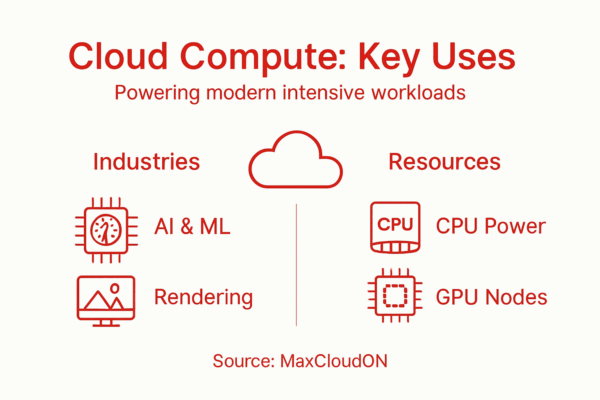
Small and medium-sized organizations can now access high-performance computing resources that were once exclusive to large enterprises. By leveraging cloud compute servers, researchers and companies can dynamically scale computational power, reducing infrastructure costs while accelerating technological innovation.
Computational flexibility represents a game-changing approach to solving complex technological challenges across multiple domains.
Below is a summary of cloud compute applications and their unique computational demands:
| Industry Application | Typical Workload Intensity | Key Resource Requirement |
|---|---|---|
| AI/Machine Learning | Extremely high | GPUs, fast storage |
| 3D Rendering | Very high | High CPU, graphics processing |
| Data Science | High | Large RAM, scalable CPUs |
Pro Tip: Prioritize cloud providers offering specialized hardware configurations tailored to your specific computational requirements, ensuring optimal performance and cost-effectiveness.
Performance, Pricing, and Common Pitfalls
Navigating cloud compute server infrastructure requires strategic understanding of cloud cost optimization techniques, which can dramatically impact overall computational efficiency and financial planning. Performance isn’t merely about raw computing power, but about intelligent resource allocation and cost management.
Key considerations for cloud compute server performance and pricing include:
Performance Management
- Real-time resource monitoring
- Dynamic workload scaling
- Predictive performance analytics
- Hardware configuration optimization
- Bottleneck identification
Cost Control Strategies
- Right-sizing computational resources
- Implementing auto-scaling mechanisms
- Utilizing reserved instance pricing
- Monitoring data transfer expenses
- Avoiding over-provisioning
Common Pitfalls to Avoid
- Unexpected egress fee accumulation
- Inadequate performance benchmarking
- Poor resource utilization
- Lack of transparent pricing models
- Vendor lock-in risks
Understanding the nuanced pricing structures of cloud compute servers is crucial for researchers and organizations seeking to maximize computational efficiency while maintaining budget control. Pay-per-use models offer flexibility but require continuous monitoring and strategic resource management.
Cost transparency represents a critical factor in successful cloud computing deployments.
Pro Tip: Develop a comprehensive cost tracking strategy that includes regular resource audits and performance benchmarking to prevent unexpected expenses and optimize computational investments.
Power Your Intensive Workloads with MaxCloudON’s Dedicated Cloud Servers
Struggling to find reliable cloud compute servers that deliver consistent performance and scalable resources for your intensive AI, rendering, or data science projects? This article highlighted the challenges of shared hosting environments and the need for dedicated, high-performance infrastructure that supports on-demand compute power without compromises. At MaxCloudON, we understand how critical it is to have exclusive access to computational resources that match your project intensity and security requirements while optimizing costs.
Explore our Tutorials Archives – MaxCloudON to deepen your understanding of cloud computing models and best practices. Whether you need GPU servers for deep learning, cloud desktops for virtual collaboration, or fully customizable compute environments, MaxCloudON offers instant deployment, transparent pricing, and robust security designed specifically for compute-intensive workloads. Visit MaxCloudON today to experience dedicated cloud resources that empower your most demanding applications with predictable, high-performance infrastructure. Learn more about our approach in the MaxCloudON Archives – MaxCloudON and get started with the confidence that your complex projects are supported by reliable technology tailored to your needs.
