The art of elocution once reserved for the grand stages and parlours of yesteryear is today replaced by speaking to pitch ideas, deliver a keynote or weave a captivating tale. These all rely crucially on how you speak.
1. Audibility: Make Yourself Heard
Audibility is more than just volume. It is about ensuring your voice reaches every listener, whether in a packed auditorium or on a video call. This means understanding your environment, using microphones effectively, managing background noise and projecting your voice confidently. Techniques like breath control, resonance and mastering your vocal registers help you maintain clarity and stamina, especially in longer sessions.
2. Distinctness: Speak Clearly, Be Understood
With diverse audiences and global reach, clear speech is essential to be understood. Distinctness involves crisp articulation of vowels and consonants, precise pronunciation and mindful enunciation. This also means being aware of regional accents, inclusive language and if presenting virtually, ensuring that your technology and slides don’t muffle your message. Practising ensures your words are easily recognisable and your message doesn’t get lost in translation.
3. Expression: Breathe Life Into Your Words
Storytelling is about connection and making your audience feel the emotions behind your words. Expression encompasses how you pace your speech (using pause and phrasing), where you place emphasis and how you modulate your voice with changes in rate, pitch and intensity.
Expression also means harnessing body language, gesture and facial expressions, even through a webcam. What we do can say more than our words.
Rhyme, rhythm, prosody and the subtle use of tone colour turn even the most factual presentations into memorable experiences.
The elements of elocution are:
Audibility
Distinctness
Expression
Audibility is the power of making the voice heard and includes the study of:
Breath control
Phonation (the act of producing voice by means of the vocal cord)
Resonance
Vocal registers
Distinctness is the power of making words easily recognisable and includes the study of:
Vowel and consonants
Articulation
Pronunciation
Expression is the power of making an audience feel the emotions and thoughts of the author – the voice and manner must suit the words. Expression includes the study of:
Pause and phrasing
Emphasis
Modulation including rate, pitch inflection and intensity
Rhyme, rhythm and prosody
Gesture and facial expression
Tone colour
Above are an excerpt from my grandmothers notebook.
Bringing It All Together
At its core, elocution is about authenticity and connection. By combining audibility, distinctness and expression, presenters and storytellers can engage audiences, foster understanding and inspire action.
When you are getting ready to next practice, present or share a story, remember – your voice is your instrument and every audience deserves to hear it played beautifully.
The best way to get better is to practice, present and tell stories more, obtaining feedback afterwards from your audience.
As 2026 begins, I am once again in the process of updating my Personal Knowledge Management System (PKMS). This update reflects the latest advancements in knowledge management, as well as my evolving personal priorities.
With an increase in walking I have been doing as part of my routine, my approach to learning has shifted towards podcasts and micro learning. Instead of spending time endlessly scrolling through information, I have leveraged AI to create podcasts and short, voiced snippets on various topics on interest. These concise audio segments help break down complex subjects into manageable, bite-sized chunks, making it easier to keep up with new ideas while on the move.
I am publishing these updates so that others may use this approach as a model for developing their own PKMS.
What is a PKMS?
The primary aim of a PKMS (Personal Knowledge Management System) is to enhance an individual’s capacity to learn, retain and apply knowledge efficiently in both their personal and professional life. By providing structure to the way information is handled, it supports ongoing development.
A well formed PKMS can help provide several benefits:
Continuous Learning: With the right mindset, a PKMS offers a systematic approach to acquiring, organising and reviewing knowledge, thereby supporting lifelong learning.
Increased Productivity: Having immediate access to relevant and organised information enables individuals to remain proactive and ahead of the curve.
Knowledge Retention: The ability to store information in an organised repository facilitates easy retrieval as and when needed.
Adaptability: As technology, information and data continue to evolve rapidly, a PKMS helps users stay informed and adaptable to change.
Maintaining a clear distinction between personal social and business social knowledge remains important, even though there are occasions when the two may overlap. While it is sometimes necessary for these areas to intersect, keeping them largely separate helps maintain clarity, focus and a layer of personal security.
Various tools are available that can be used to build a PKMS tailored to individual needs. The choice of tools may differ from person to person however, the underlying principle is to use resources that support the structured management of knowledge. The specific tools utilised can contribute greatly to the effectiveness of a PKMS.
Various tools are available that can be used to build a PKMS tailored to individual needs. The choice of tools may differ from person to person however, the underlying principle is to use resources that support the structured management of knowledge. The specific tools utilised can contribute greatly to the effectiveness of a PKMS.
Professional Life
Research
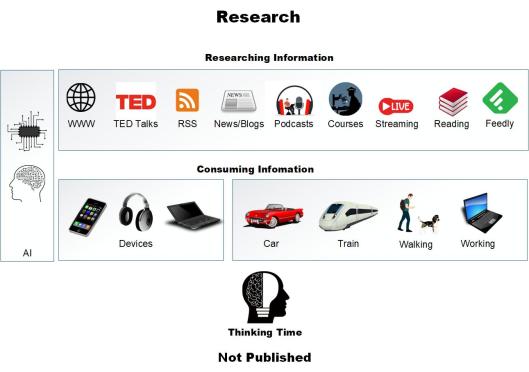
Research is an integral part of my Personal Knowledge Management System (PKMS). It involves gathering information that supports learning and integration into my work. Continuous learning is my key goal of my PKMS to stay ahead as a Technologist. Below is a high-level list of the types of content that I utilise for research and learning.
AI
Streaming Services
RSS Feeds
Podcasts
TED Talks
Web Searches
Blog Posts
Learning
Micro Learning
Reading
Some of these are fairly self explanatory as sources. I may expand on some of the sources I use in future posts.
AI (Artificial Intelligence)
Artificial Intelligence (AI) is growing in use and works well in my PKMS to enhance the way information is gathered, organised and retrieved.
AI is a good tool to ask as an assistant when researching, asking questions and can provide a reasonable summary of long documents and papers.
RSS
Some sites have an RSS feed which allows me to pull updates from sites directly into Feedly.
Podcasts
Podcasts cover both audio and video casts that I watch/stream online or download to my phone/media player to listen to when I am on journeys in the car or other transportation methods or out walking the dog. Daily walks with the dog provide a good time to listen to these acting as my daily comute to and from work (laptop).
Feedly
Feedly provides an aggregation tool that collects stories from various blogs and websites that I find useful for research and information . This generates a list of stories that can be quickly scanned on a single screen without having to visit multiple sites. Clicking on a story displays a snippet from the source site and provides a link to read the full article, if necessary. Using a series of keystrokes, it is possible to read the headlines, then move through the articles efficiently, stopping and opening them as needed.
Sources can be categorised to allow an all-view or just what’s new in a category.
Thinking Time
Thinking Time covers the time that I spend absorbing the PKMS information coming in from the different sources and then processing and applying it in different ways. It is also good to spend time reflecting on what I have learned and think of different and new ways to use the information and learnings.
Note Taking
I use two tools now for note-taking: OneNote and Obsidian. I favour Obsidian as it uses Markdown, which I use a lot for documentation and its ability to structure data in a logical way and allows you to query data in an interactive graph.
Being Social
I use several social channels to publish my thoughts as a Technologist. The main channel I use is this blog site.
Blog Site
www.maxhemingway.com is my main published site that I use to share my thoughts, leadership and updates through. From this I send out links to various social channels.
Podcast
My podcast “Technology Couch Podcast” has not had an update for a while (that said it does still get lots of downloads), but hopefully this will change soon. This can be found on my blog page and also normal podcast streaming sites.
Social Sites
I use social sites to publish my blog and podcast updates.
I use GitHub to store any code or projects that I want to publish externally.
Personal Life
Personal Journal
My personal journals have always been Moleskine plain pocket books, be more recently I have made a switch to using Rhodia range of pocket books with dots. My main reason was on price as Moleskine has risen a fair bit for their products. I have used a couple of Rhodia pocket books since my switch and I actually find the paper a lot better and its slightly thicker which can support more inks without a bleed through to the pages below.
I still favour the Pilot ball ink pens as before in 0.5 or 0.7 size.
To keep my work life separate from my personal life, I use social platforms like Instagram and Facebook for friends and family, ensuring that two-factor authentication and appropriate security settings are in place.
Even with these precautions, it’s essential to remember that anything posted online could potentially become public in the future.
Further Reading
If you are looking for inspiration in creating your own PKMS, Reddit has a great list of PKMS tools that is worth a look and a discussion board on setting up a PKMS.
Effective communication, whether you’re commanding a stage, weaving a story or pitching a big idea depend not only on your words, but on how you breathe.
Below, you’ll find an excerpt from my grandmother’s notebook, which, when seen through a contemporary lens, offers valuable lessons for present-day presenters and storytellers alike.
Notes on Breathing from the Notebook
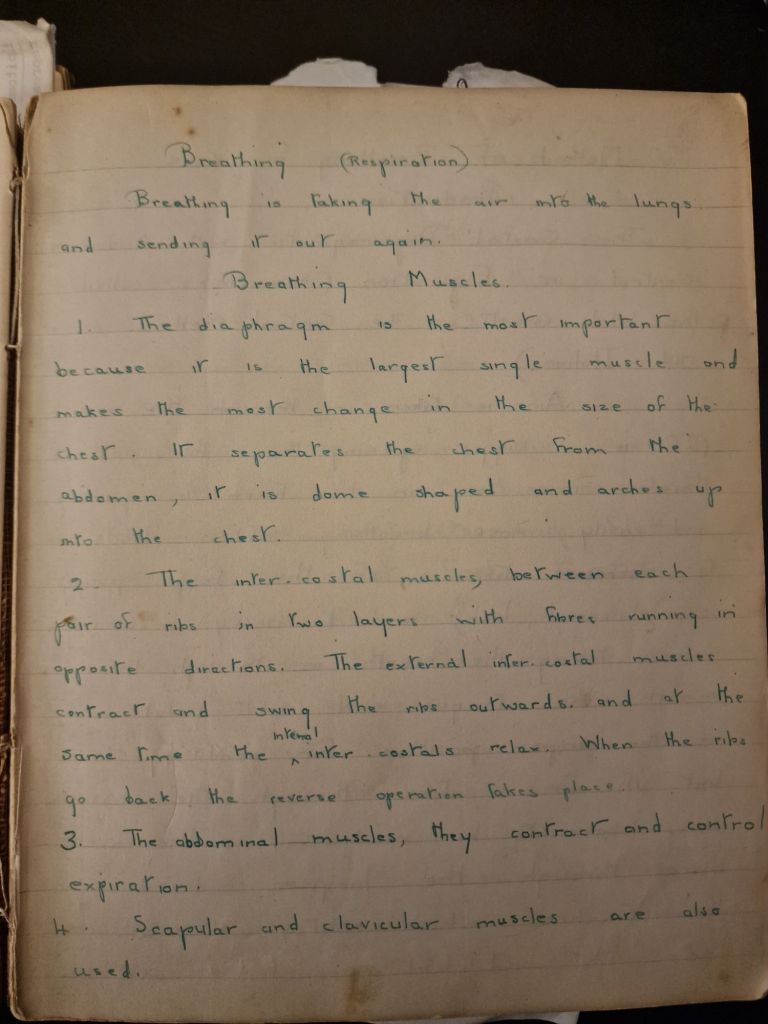
Breathing is taking the air into the lungs and sending it out again.
Breathing Muscles
The diaphragm is the most important because it is the largest single muscle and makes the most change in the size of the chest. It separates the chest from the abdomen, it is dome shaped and arches up into the chest.
The inter costal muscles, between each pair of ribs in two layers with fibres running in opposite directions. The external inter costal muscles contract and swing the ribs outwards and at the same time the internal inter costals relax. When the ribs go back the reverse operation takes place.
The abdominal muscles, they contract and control expiration.
Scapular and clavicular muscles are also used.
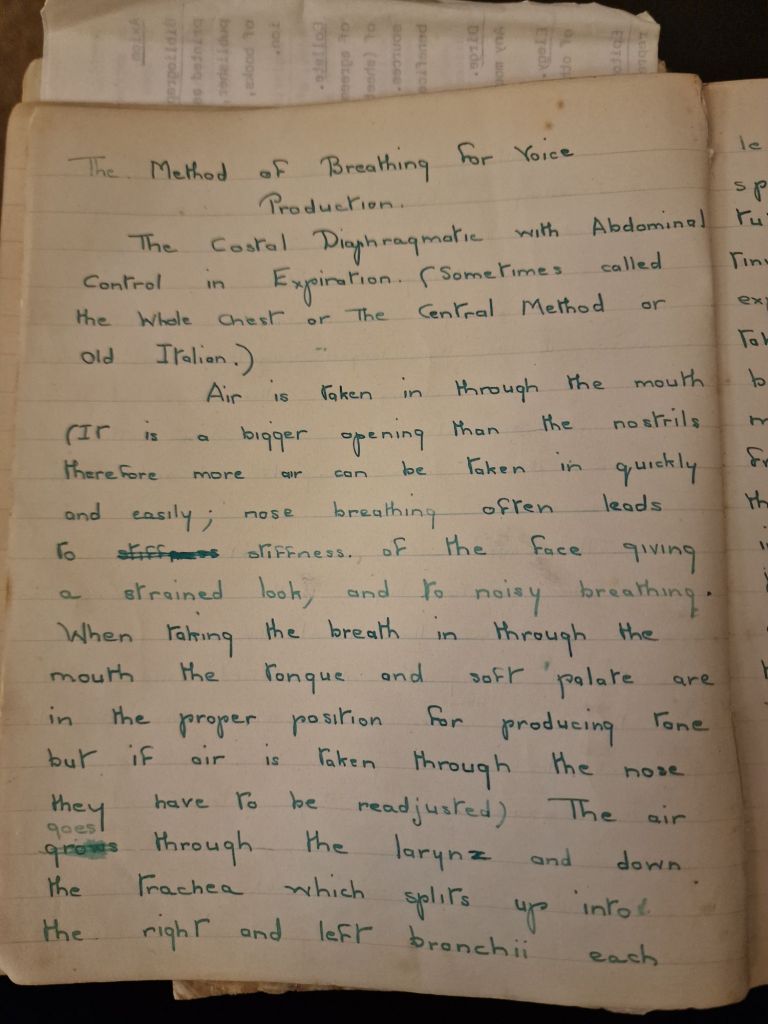
The Method of Breathing for you Production
The Costal Diaphragmatic with Abdominal Control in Expiration (sometimes called the Whole Chest or the Central Method or Old Italian).
Air is taken in through the mouth (it is a bigger opening than the nostrils therefore more air can be taken in quickly and easily; nose breathing often leads to stiffness of the face giving a strained look and to noisy breathing.
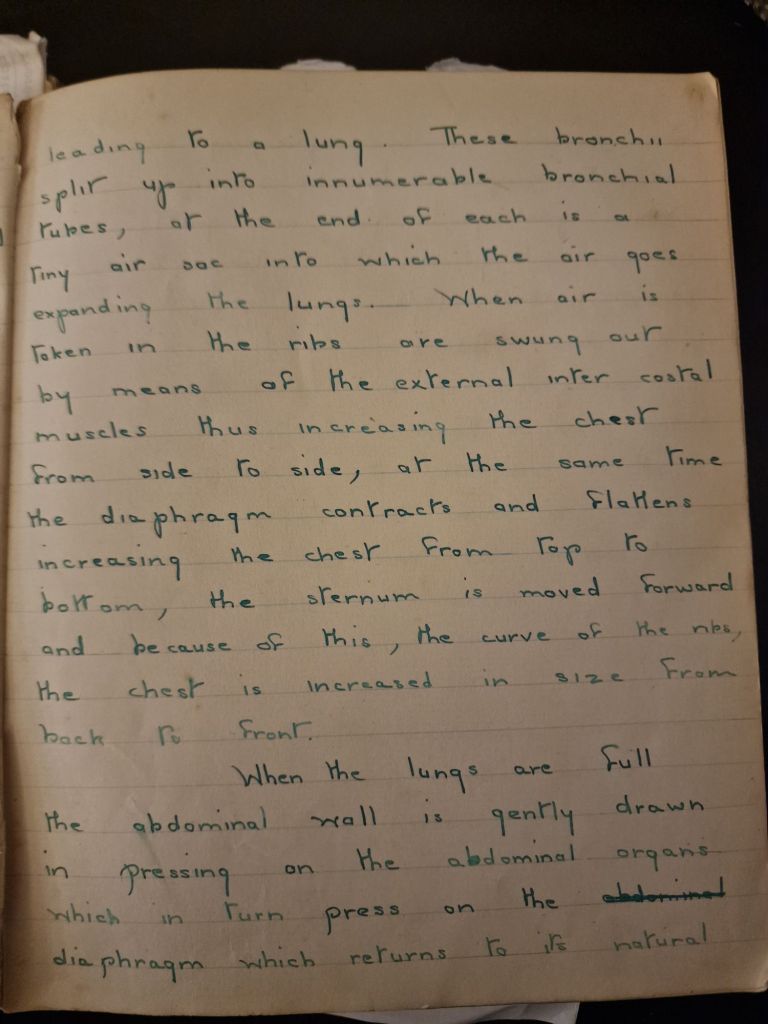
When taking the breath in through the mouth the tongue and soft palate are in the proper position for producing tone but if air is taken through the nose they have to be readjusted. The air goes through the larynx and down the trachea which splits up into the right and left branchii each leading to a lung. These branchii split up into innumerable bronchial tubes, at the ends of each is a tiny air sac into which the air goes expanding the lungs. When air is taken in the ribs are swung out by means of the external inter costal muscles thus increasing the chest from side to side, at the same time the diaphragm contracts and flattens increasing the chest from top to bottom, the sternum is moved forward and because of this, the curve of the ribs, the chest is increased in size from back to front.
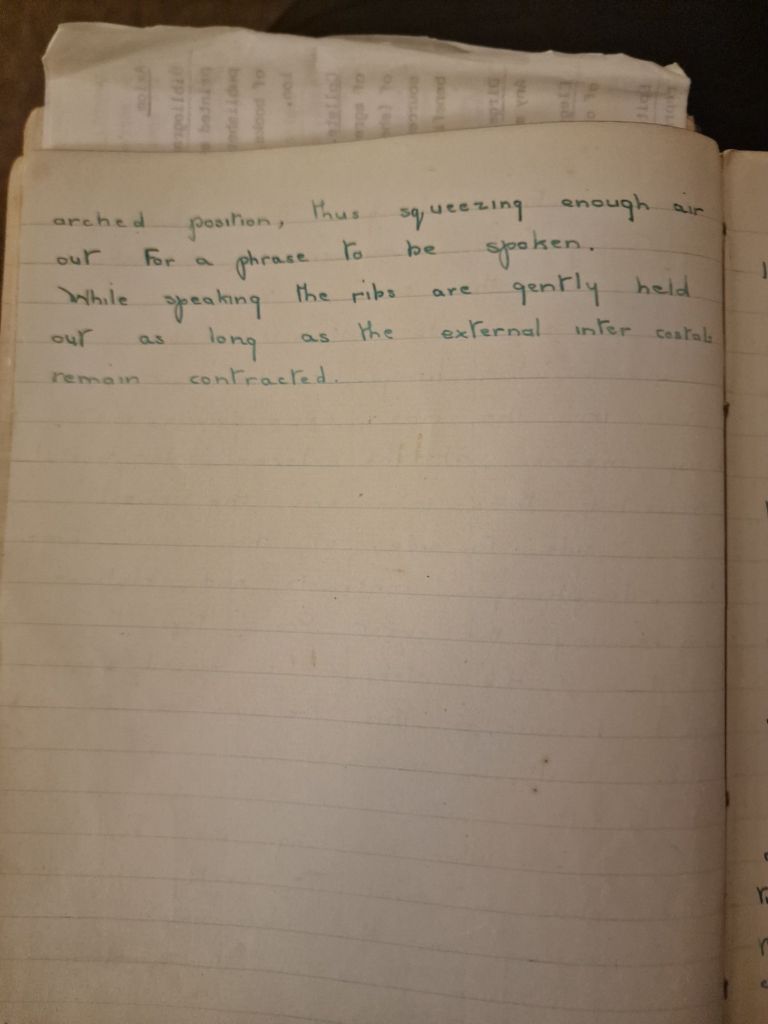
When the lungs are full the abdominal wall is gently drawn in pressing on the abdominal wall is gently drawn in pressing on the abdominal organs which in turn press on the diaphragm which returns to its natural arched position, thus squeezing enough air out for a phrase to be spoken.
While speaking the ribs are gently held out as long as the external inter costal remains contracted.
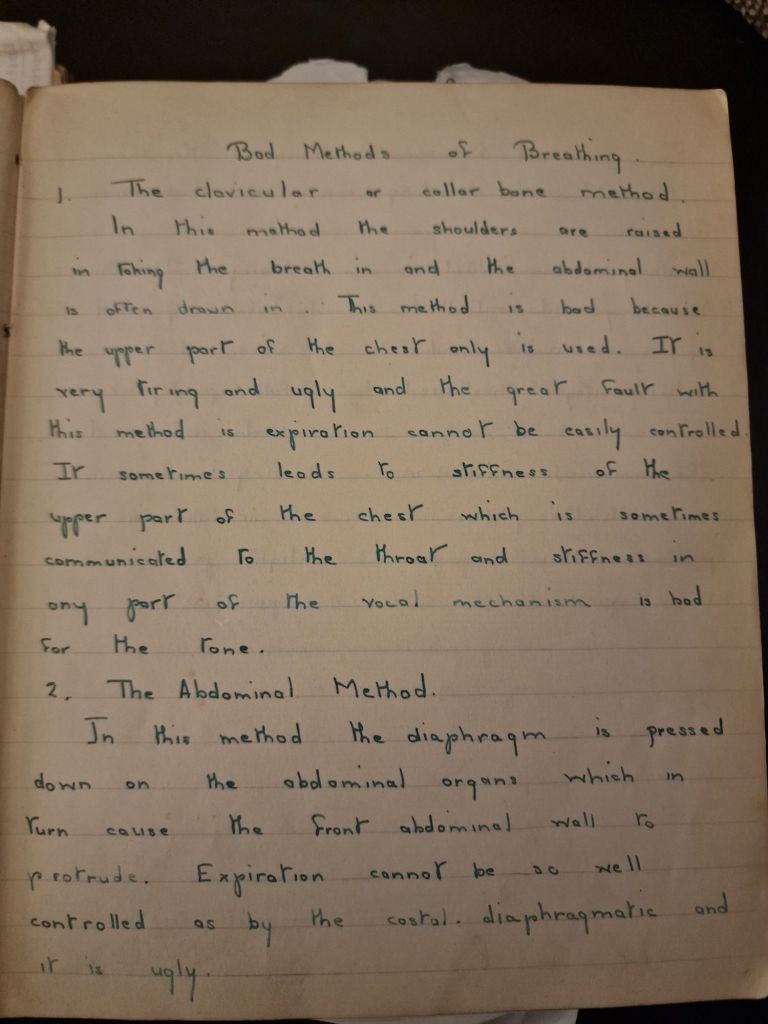
Bad Methods of Breathing
The clavicular or collar bone method. In this method the shoulders are raised in taking the breath in and the abdominal wall is often drawn in. This method is bad because the upper part of the chest is used. It is very tiring and ugly and the great fault with this method is expiration cannot be easily controlled. It sometimes leads to stiffness of the upper part of the chest which is sometimes communicated to the throat and stiffness in any part of the vocal mechanism is bad for the tone.
The abdominal method. In this method the diaphragm is pressed down on the abdominal organs which in turn cause the front abdominal wall to protrude. Expiration cannot be so well controlled as by the costal diaphragmatic and it is ugly.
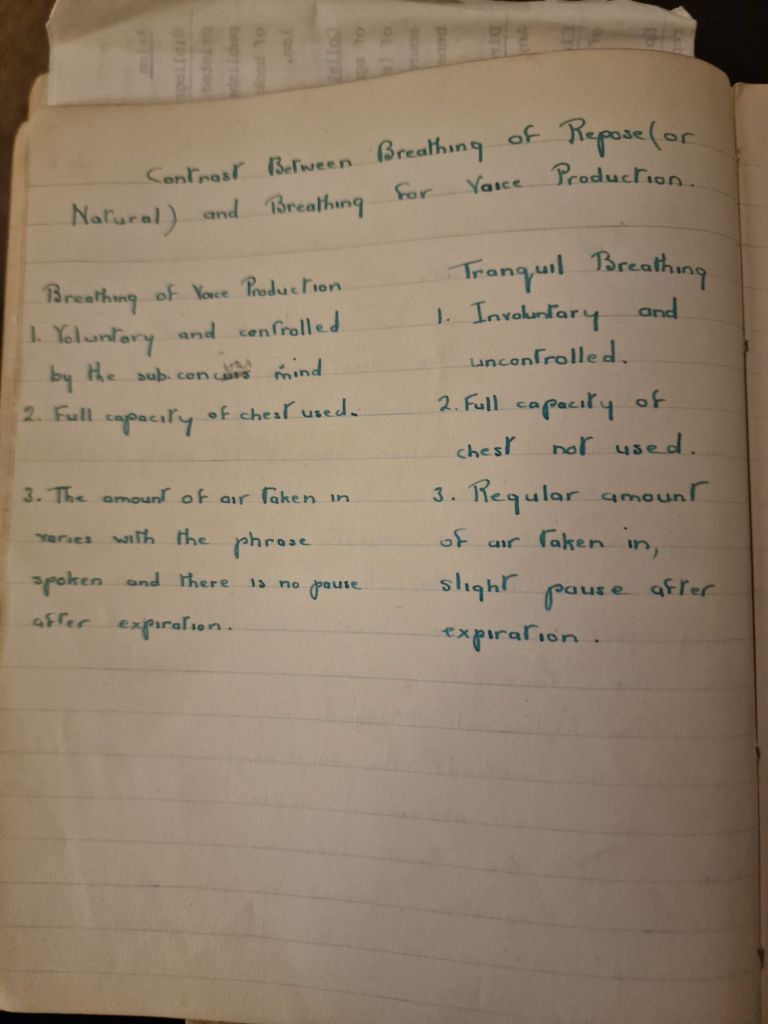
Contrast Between Breathing of Repose (or Natural) and Breathing for Voice Production
Breathing of Voice Production
Voluntary and controlled by the subconscious mind
Full capacity of chest used
The amount of air taken in varies with the phrase spoken and there is no pause after expiration
Tranquil Breathing
Involuntary and uncontrolled
Full capacity of chest not used
Regular amount of air taken in, slight pause after expiration
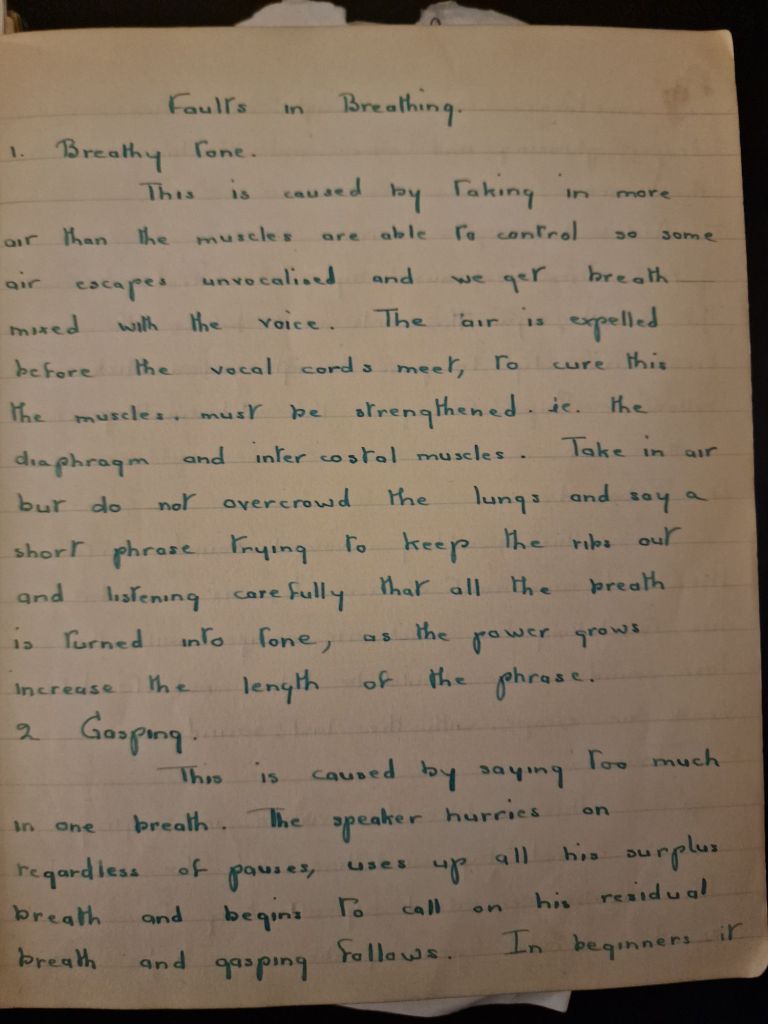
Faults in Breathing
Breathing Tone: This is caused by taking in more air than the muscles are able to control so some air escapes unvocalised and we get breath mixed with the voice. The air is expelled before the vocal cords meet. To cure this the muscles must be strengthened, ie. The diaphragm and inter costal muscles. Take in air but do not overcrowds the lungs and say a short phrase trying to keep the ribs out and listening carefully that all the breath is turned into tone, as the power grows increase the length of the phrase.
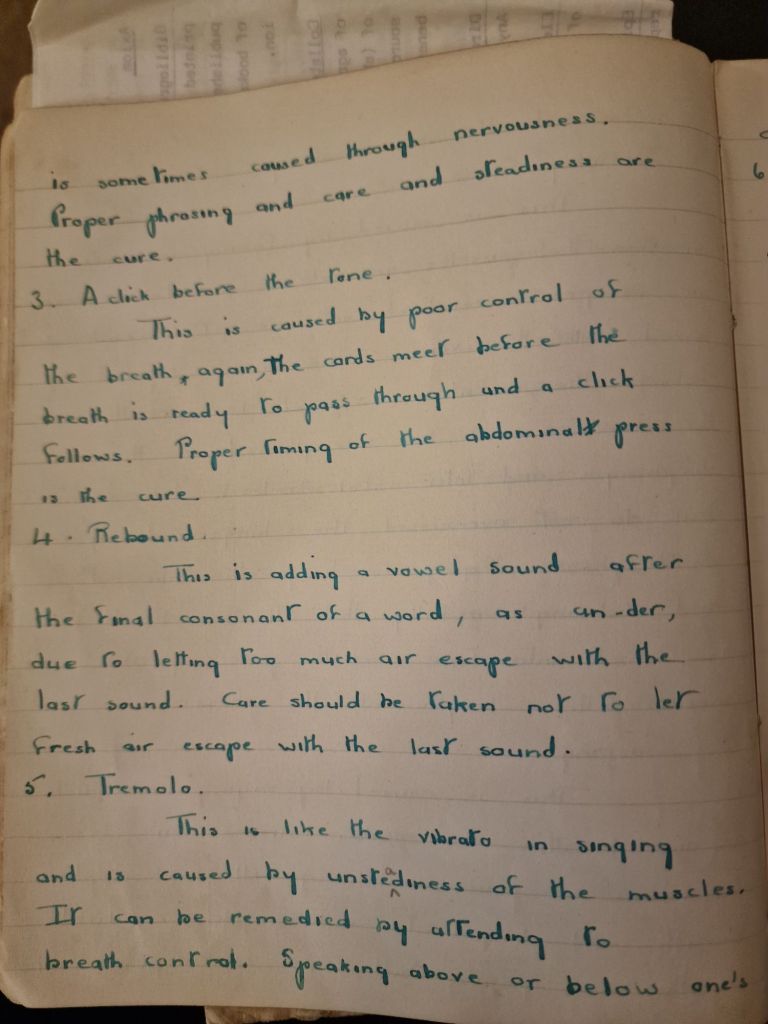
Gasping: This is caused by saying too much in one breath. The speaker hurries on regardless of pauses, uses up all their surplus breath and begins to call on their residual breath and gasping follows. In beginners it is sometimes caused through nervousness. Proper phrasing and care and steadiness are the cure.
A Click before Tone: This is caused by poor control of the breath again. The cords meet before the breath is ready to pass through and a click follows. Proper timing of the abdominal press is the cure.
Rebound: This is adding a vowel sound after the final consonant of a word, as un-der due to letting too much air escape with the last sound. Care should be taken not to let fresh air escape with the last sound.
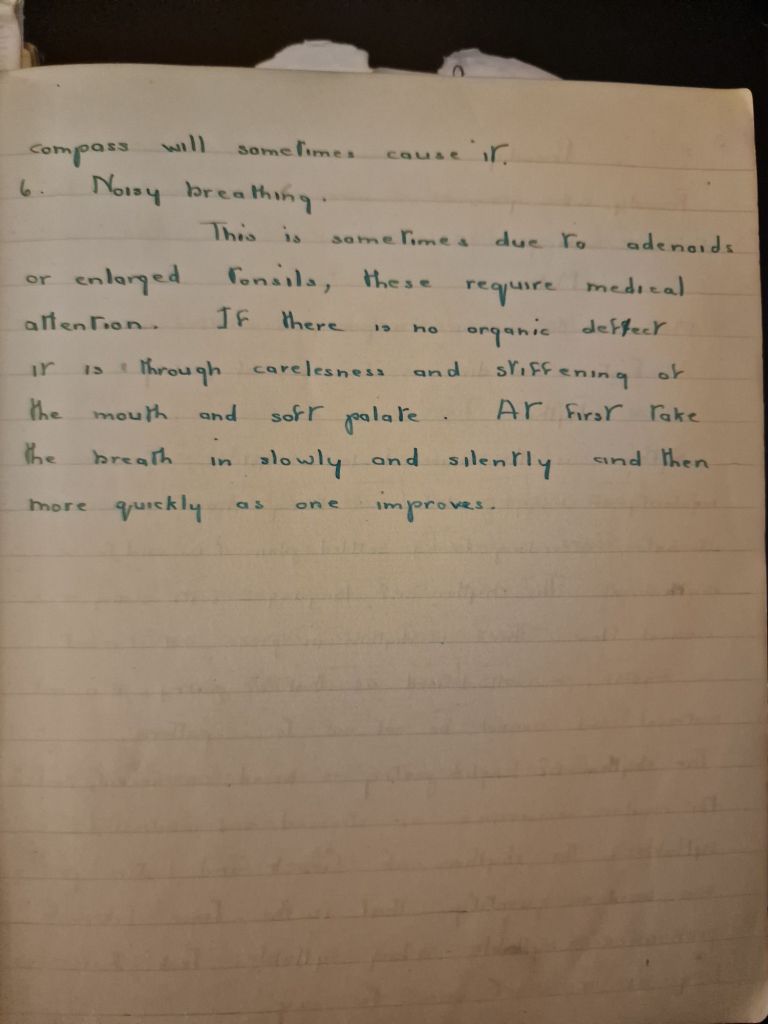
Tremolo: This is like the vibrato in singing an is caused by unsteadiness of the muscles. It can be remedied by attending to breath control. Speaking above or below one’s compass will sometimes cause it.
Noisy Breathing: This is sometimes due to adenoids or enlarged tonsils, these require medical attention. If there is no organic defect it is through carelessness and stiffening of the mouth and soft palate. At first take the breath in slowly and silently and the more quickly as one improves.
Above are an excerpt from my grandmothers notebook.
Modern Insights: Bringing Breathing Techniques into the 21st Century
Today experts in vocal performance, mindfulness and even sports science universally acknowledge (see further reading for articles) the value of deliberate breathing. The costal diaphragmatic method, as described above, remains central to performance technique but now we better understand its role in stress reduction, stamina and vocal clarity.
Mindful breathing is proven to lower anxiety before speaking, enhancing confidence and focus.
Nose breathing is preferred in general health to filter and humidify air, but for vocal projection, mouth breathing is effective when done consciously with relaxed facial muscles.
Apps and devices can now help speakers track and train their breathing, while modern trainers emphasise relaxation as much as control.
Warm-up routines for presenters often include breath exercises, stretching and even short meditation to prime both body and mind.
Understanding your own “breathing faults” helps tailor practice, video and audio feedback help track progress.
Blending this wisdom of past and present empowers presenters and storytellers to use breath as a foundation for authenticity and impact to as a key to unlocking their best voice.
As we begin the year the concept of what it means to be a well-rounded individual continues to evolve.
Traditionally, people were considered well-rounded if they demonstrated both intelligence and emotional awareness, measured through IQ (Intellectual Quotient) and EQ (Emotional Quotient). However with the demands of an increasing complexity of modern life, work and social environments, it now demands a more rounded and comprehensive suite of skills and attributes.
The addition of recognising and usinng more “Quotients” provides a broader framework for personal development, meeting the diverse challenges and opportunities we face.
Expanding Beyond IQ and EQ for a More Holistic Future
While IQ and EQ remain crucial, they can be accompanied by a range of other Quotients essential for success. Below is a list of the key Quotients and some of the reasons each is so important:
More Than Just IQ and EQ
AQ – Adversity Quotient: Represents the ability to withstand and recover from setbacks. Developing AQ involves learning to adapt, bounce back and thrive despite challenges.
BQ – Body Quotient: Encompasses physical health in a holistic sense, including fitness, nutrition, sleep, and overall wellness. Advances in technology (senors) allow people to better understand and improve their BQ, leading to enhanced quality of life and productivity.
CQ – Cultural Quotient: Highlights the importance of navigating diverse cultures with sensitivity and adaptability. CQ is important for building inclusive environments and succeeding in multicultural and diverse teams, both personally and professionally.
CQ – Curiosity Quotient: Reflects the motivation to pursue new knowledge, skills, and experiences. CQ helps individuals stay innovative and relevant.
DQ – Decency Quotient: Leadership requires more than intelligence and emotional awareness; it demands decency. DQ is about integrity, kindnes, and fairness, ensuring that everyone is valued and respected. DQ can help to distinguish good leaders.
EQ – Emotional Quotient: Mastery of one’s own emotions and understanding those of others is crucial for building relationships, resolving conflicts and leading with empathy. As collaboration is part of our daily lives EQ is increasingly valuable.
IQ – Intellectual Quotient: Cognitive ability remains fundamental for problem solving and analytical thinking. IQ should be integrated with other Quotients for genuine effectiveness.
LQ – Learning Quotient: The ability to unlearn old habits and embrace new ones is increasingly vital. Adaptability is anchored in continual learning and personal growth.
MQ – Moral Quotient: MQ serves as the moral compass, guiding individuals and organisations to act ethically and uphold values. With the onset of an AI world, dealing with complex ethical dilemmas and moral integrity is growing in importantance.
PQ – Physical Quotient: Focuses on self-awareness of bodily needs and limits, including stress and fatigue. Understanding PQ helps individuals maintain high performance and avoid burnout.
SQ – Spiritual Quotient: Involves seeking meaning, purpose and inner peace. SQ is not necessarily religious but about connecting with something greater and fostering a sense of balance and fulfilment.
SQ – Social Quotient: Social intelligence is essential for navigating complex networks, both online and offline. SQ supports trust-building, influencing others and effective teamwork.
TQ – Technology Quotient: As the transformation of technology and the workplace accelerates, comfort and fluency with technology (from artificial intelligence to remote collaboration tools) are fundamental for success in both professional and personal spheres.
Modernising the Equation for 2026
The well-rounded individual is defined not by a single strength, but by the ability to blend these Quotients into a harmonious whole. The equation for personal effectiveness is:
AQ + BQ + CQ (Cultural) + CQ (Curiosity) + DQ + EQ + IQ + LQ + MQ + PQ + SQ (Spiritual) + SQ (Social) + TQ = The Well-Rounded Person
Self-Reflection: Questions to Guide Your Growth
Which of these Quotients do you naturally excel in and which require more attention?
How can you combine your strengths across different Quotients to create greater impact?
What steps can you take to develop areas like AQ, CQ, LQ or TQ?
How might your Quotients support your personal and professional goals in 2026?
In what ways can you help others around you build their own Quotients?
The journey is ongoing, but the rewards (personal fulfilment, resilience and meaningful impact) make it a worthy pursuit.
Every January lots of people vow to turn over a new leaf with ambitious New Year’s resolutions only to feel beaten and deflated when their goals slip away just weeks later.
I have done this and lost count over the years starting with good intentions and then failing.
What if there’s a better way? Instead of chasing motivation that fizzles out, you can lay the groundwork for real transformation by building habits that last.
Why Habits Beat Resolutions Every Time
Habits focus on small, repeatable actions and are more sustainable than motivation-driven resolutions. Source: James Clear – Atomic Habits Principles
Resolutions might sound inspiring, but they can set you up for disappointment when not followed through. Habits centre on small, repeatable actions that naturally become part of your everyday routine.
Below are some habit building tips:
Use Consistency Over Intensity
Little actions done regularly are more sustainable than big one-off effort
Work on Process, Not Perfection
Habits focus on steady improvement
Automaticity
When a behaviour becomes a habit it is something you do it without needing to muster up motivation each time. It can take time to get to this stage though, builing the brain muscle memory.
Habits become automatic through consistent cues and responses, making them easier to maintain. Source: Behavioral Science Research on Habit Formation
Start Small: Make Daily Journaling Your First Habit
A journal is one of my daily habits and I have written 41 journals so far amassing over 7,000 pages of notes.
Keeping a daily journal or carrying a pocket notebook is one of the most effective productivity habits you can adopt.
A journaling habit can help to transform your day-to-day life by:
Boosting Productivity
Jotting down tasks, ideas and reflections helping you stay organised and focused
Enhance Memory and Learning
Writing things down cements knowledge and makes it easier to recall later
It can help reduce stress by recounting things and looking at the with a different lens.
Journaling provides a healthy outlet for processing your thoughts and emotions
A journal can sparks creativity and can lead to innovative thoughts
Regular writing can encourage new ideas and creative problem-solving
Journalling can help increase your ablities for storytelling
A journal also allows you to reflect back on what you have done and achieved over days, months and even years.
How to Build the Journaling Habit
Start Small – Jot down a single sentence each day or just a quick note about how you’re feeling. There’s no need for lengthy entries.
Tie It to a Cue– Link journaling to an existing routine, such as having your morning brew or winding down before bed.
Keep It Visible – Place your journal somewhere you’ll see it easily (on your bedside table, desk or in your bag) so you’re reminded to use it. Keep a pen with it as well.
Focus on Progress, Not Perfection – Don’t stress if you miss a day or your entry isn’t perfect. The aim is to build consistency and not to write a masterpiece.
Why This Approach Works
Unlike resolutions, habits don’t hinge on bursts of motivation.
They are built from small, consistent actions that accumulate over time, eventually becoming second nature. Like muscle memory, but using your brain as the muscle.
One of my previous posts from earlier this year is gaining a lot of reads recently as people search for the latest Chronodex for 2026. So I am writing this post to signpost where it has gone as the original site hosting the links and downloads to the Chronodex by the author has moved to a new site and a paid for download model.
The format of the downloads are primarily meant for the Midori Traveller Notebook system, but it can be used without by printing out and using an elastic band to hold the pages together.
Personally I have moved away from the downloadable PDF planner a while ago in favour of a stamp version of the Chronodex that I can add to my journals when I want to incorporate it in rather than keep a seperate notebook. There are plent of versions of the stamp avalible on Etsy and Amazon and a quick google search for “chronodex stamp” should point you to one. You will of course need an inkpad to use it.
What it is
The Chronodex is a clock-shaped calendar designed to help you visualise and manage your time more effectively. It is a manual task for the user to fill out with pens or markers and activities are shown as arcs or blocks around the circle as the day progresses. It is useful for productivity, journaling, ADHD-friendly planning, and creative workflows.
How it works (basic)
The circle represents a full day (midnight to midnight or waking hours)
Each hour corresponds to a position on the clock
You draw or color segments for activities (work, breaks, sleep, exercise, etc.)
Optional symbols or colors show energy, mood or task type can be added by the user
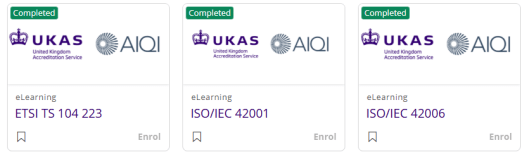
The AIQI Consortium has recently expanded its portfolio of educational offerings related to ISO standards and AI security controls. Following my previous experience with the ISO/IEC 42001 course, I have complete the next two and can recommend these to anyone wanting a greater understanding of the standards and looking to implement them.
Courses Offered
ISO/IEC 42001: Provides foundational knowledge of ISO standards specifically designed for Artificial Intelligence Management Systems. The course delves into the principles, requirements and implementation strategies necessary for compliance.
ISO/IEC 42006: Extends the learning to cover additional protocols and auditing techniques, focusing on advanced elements within the ISO framework. Learners gain exposure to practical applications and case studies relevant to complex organisational environments.
ETSI TS 104 223: Offers a comprehensive overview of the European Telecommunications Standards Institute technical specification, with a particular emphasis on AI security controls and risk management. The course equips participants with the tools to assess and enhance security measures within AI-driven systems.
Course Structure and Format
Each course is well structured, providing a good overview and understanding of the standards and ensuring a logical progression from fundamental concepts to more advanced topics. The modules are clearly organised, featuring worked examples and detailed guidance on auditing processes.
Where to take the courses
All three courses (ISO/IEC 42001, ISO/IEC 42006, and ETSI TS 104 223) are available on the UKAS website (enrollment required).
Body language is a powerful tool in any presenter or storyteller’s toolkit. Drawing inspiration from my grandmother’s notebook, let’s explore how the art of gesture and broader body language (once meticulously practised for public speaking) remains just as relevant today, albeit with some modern tweaks.
Why Gestures and Body Language Matter
Gestures and body language are more than just movements. They are physical expressions of feeling that bridge the gap between words and emotions. When you present or tell a story, your entire body naturally reacts to what you’re conveying.
As you walk onto stage and present the audience is already building a picture and opinion of you based on everything you do and you haven’t even spoken yet. Harnessing these non-verbal cues can make your delivery more authentic, engaging and memorable. Facial expressions, posture and even your stance contribute to how your message is received, often conveying as much meaning as your spoken words.
Guidelines for Impactful Gestures and Body Language
Keep It Natural: The best gestures and body movements don’t look forced. Let your movements flow from genuine emotion rather than mechanical choreography. Relaxed shoulders and an open posture instantly make you appear more approachable.
Express, Don’t Describe: Use gestures and body language to embody the emotion behind your words, not just to mime what you’re talking about. A smile, a nod or a gentle lean forward can express enthusiasm or empathy.
Emphasise Key Points: Align your gestures and body orientation with the most important ideas or words. This helps reinforce your message and adds drama at the right moment. Step forward when making a key point or use an open hand to invite attention.
Avoid Overdoing It: Gestures and body language should be neither stiff nor exaggerated. Subtle, fluid movements can often be more effective than grand, sweeping motions. Avoid fidgeting or pacing, which can distract from your message.
Move with Purpose: Curved, outward movements of the arms and open body language tend to appear more relaxed and inviting than sharp or angular ones. An upright but relaxed stance conveys confidence.
Finish Gracefully: After a gesture, let your hands and arms naturally return to a resting position. Don’t snap them back, let the movement dissolve gently and allow your posture to settle back into a comfortable stance.
Make Every Gesture and Movement Count: Each gesture and aspect of body language should serve your message, clarifying or amplifying your words rather than distracting from them. Maintain eye contact and be mindful of your facial expressions.
Develop Graceful Gestures and Confident Body Language
Becoming comfortable with gestures and body language takes practice and learning. You have to be more self-aware and confident at the same time. It is an investment that pays off in more confident and compelling presentations.
Loosen Up: Regularly stretch and move to keep your body relaxed and flexible. Tension can make gestures and posture look awkward or forced. Breathing deeply before you speak helps release stiffness.
Observe the Greats: Watch skilled speakers, whether on stage, in videos or even in photos. Notice how their gestures, posture and facial expressions support their message.
Practise with Purpose: Rehearse your talk in front of a mirror or record yourself. Focus on how your gestures, stance and facial expressions feel and look. Do they match the emotion and content you’re aiming to convey?
The Anatomy of a Gesture and Effective Body Language
Preparation: Start with the emotion you want to express. Let it build before you move, and allow your whole body to reflect that feeling, whether through an open stance or a thoughtful tilt of the head.
Execution: Make your gesture in a smooth, curved motion, reaching its peak on your key word or message. Let your posture and facial expression support the gesture, reinforcing your intention.
Release: Let your arm and hand relax naturally, completing the movement without abruptness. Allow your body to settle back into a poised, open position, ready for your next point.
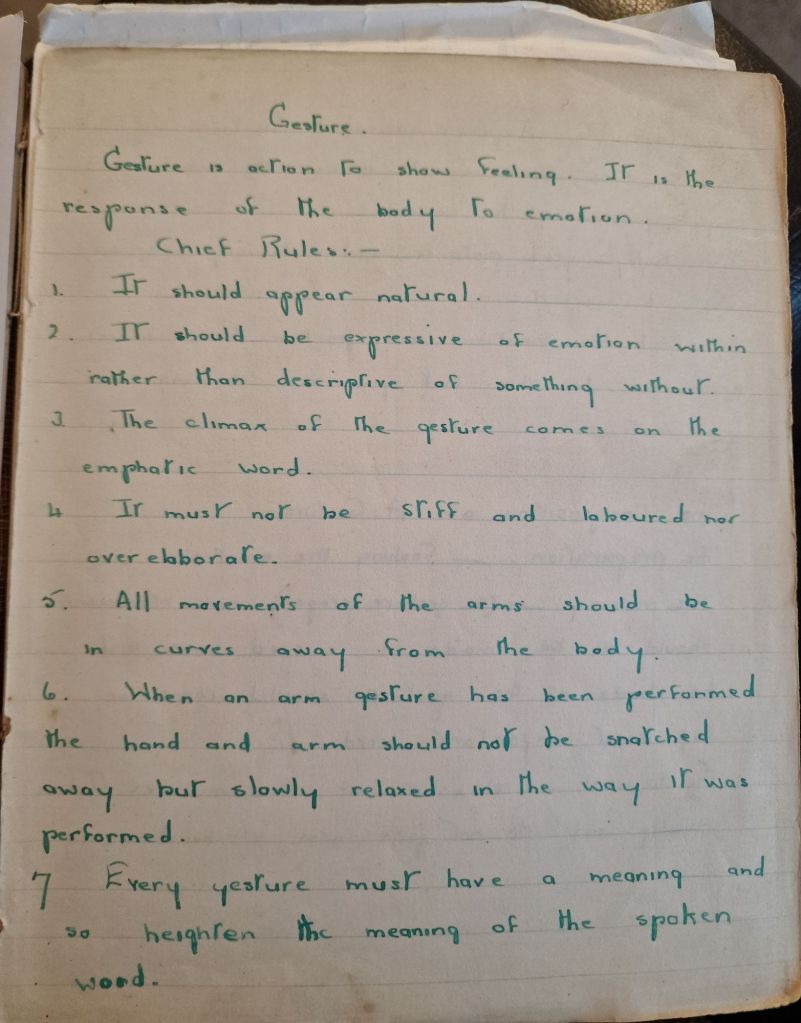
Gesture is action to show feeling. It is the response of the body to emotion.
Chief Rules:
It should appear natural
It should be expressive of emotion within rather than descriptive of something without
The climax of the gesture comes on the emphatic word
It must not be stiff and laboured not over elaborate
All movements of the arms should be in curves away from the body
When an arm gesture has been performed the hand and arm should not be snatched away but slowly relaxed in the way that it is formed
Every gesture must have a meaning and so heighten the meaning of the spoken word
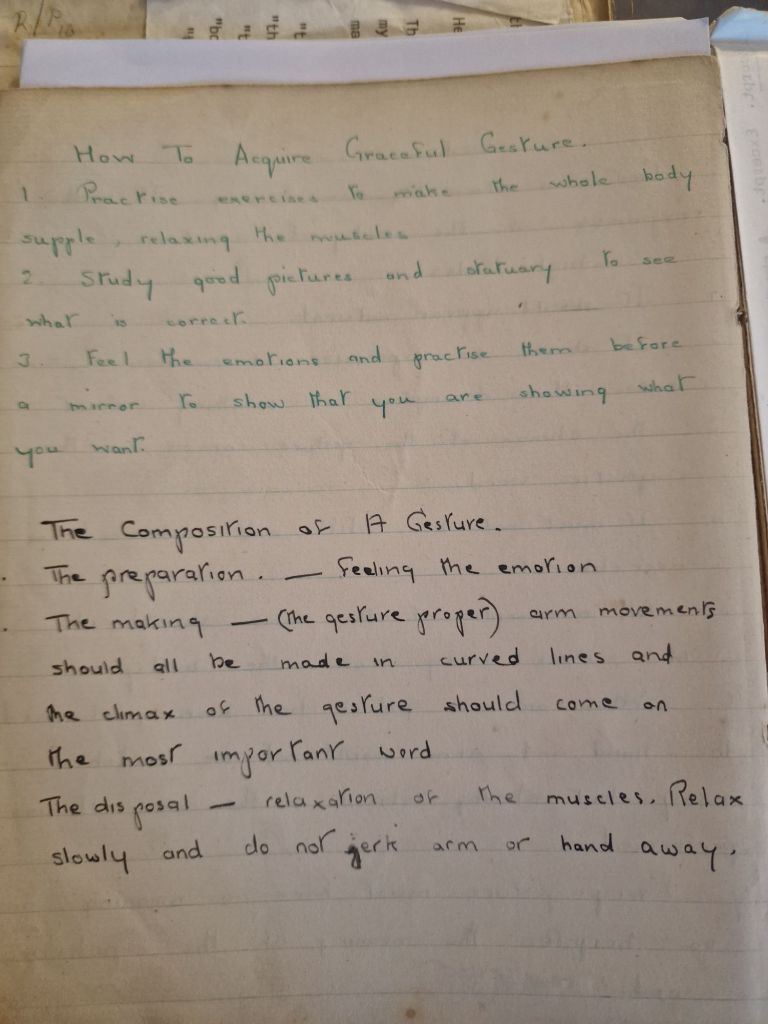
How to Acquire Graceful Gesture
Practice exercise to make the whole body supple, relaxing the muscles
Study good pictures and statuary to see what is correct
Feel the emotions and practice them before a mirror to show that you are showing what you want
The Composition of a Gesture
The preparation – feeling the emotion
The making – (the gesture proper) arm movements should all be made in curved lines and the climax of the gesture should come on the most important word
The disposal – relaxation of the muscles. Relax slowly and do not jerk arm or hand away
Excerpt from my grandmothers notebook.
Talks, presentations, meetings and virtual meetings, gestures and body language are still cornerstones of effective communication. Let your body language reflect your passion and conviction. Remember: authentic, purposeful gestures and confident body language never go out of style, they simply adapt to the times. What my grandmother wrote years ago still applies as much today as it did then.
The way we use our voice can make all the difference. One of the most subtle yet powerful tools in a speaker’s arsenal is pitch. The very note on which our words begin and the emotional current that runs through our spoken stories.
The Essence of Pitch
Pitch simply refers to how high or low our voice sounds as we speak. Just as a musical instrument offers a wide range of notes, our voices too have a spectrum of pitches.
We normally group pitch into three main categories: high, middle (or normal) and low.
High pitch is often reserved for moments of joy, excitement or surprise. Think of the thrill in your voice when recounting a plot twist of a book or movie or announcing good news.
Middle pitch is the mainstay for most descriptions and narratives. It is the comfortable, conversational tone that carries your story along.
Low pitch is best suited for conveying sorrow, solemnity or gravity. When sharing a poignant moment or delivering a serious message, a deeper tone draws listeners in and signals importance.
Adapting Pitch for Maximum Impact
Masterful presenters and storytellers instinctively adjust their pitch to reflect changes in subject, introduce new paragraphs or mark the entrance of different characters in a narrative. Even passages enclosed in parentheses often benefit from a subtle shift in pitch, helping listeners follow the thread of the story or presentation.
The Science Behind the Sound
So, what actually causes these changes in pitch? It all comes down to the vocal cords. When we speak in a higher pitch, our vocal cords tighten and only a small part of their inner edges vibrate rapidly.
With a lower pitch, the cords are looser and vibrate more fully across their length, breadth and thickness. The faster the vibration, the higher the pitch.
Pitch Versus Inflection: Knowing the Difference
It’s easy to confuse pitch with inflection, but they serve different purposes. Pitch is about the overall note on which a sentence or paragraph is set, determining the general ‘mood music’ of our delivery. Inflection meanwhile, is the subtle rise and fall on individual words or syllables, giving nuance and meaning to our message.
Pitch shapes the expression of entire sentences or sections, guiding the emotional journey of your audience.
Inflection dances within the pitch, clarifying meaning and intent word by word.
Bringing Stories to Life
Next time you share a story from your own life or step up to present,
Remember: the art of pitch isn’t just for singers, it is a vital skill you should use when next presenting or telling a story. Harness the heights, depths and comfortable middles of your voice and watch your words come alive.
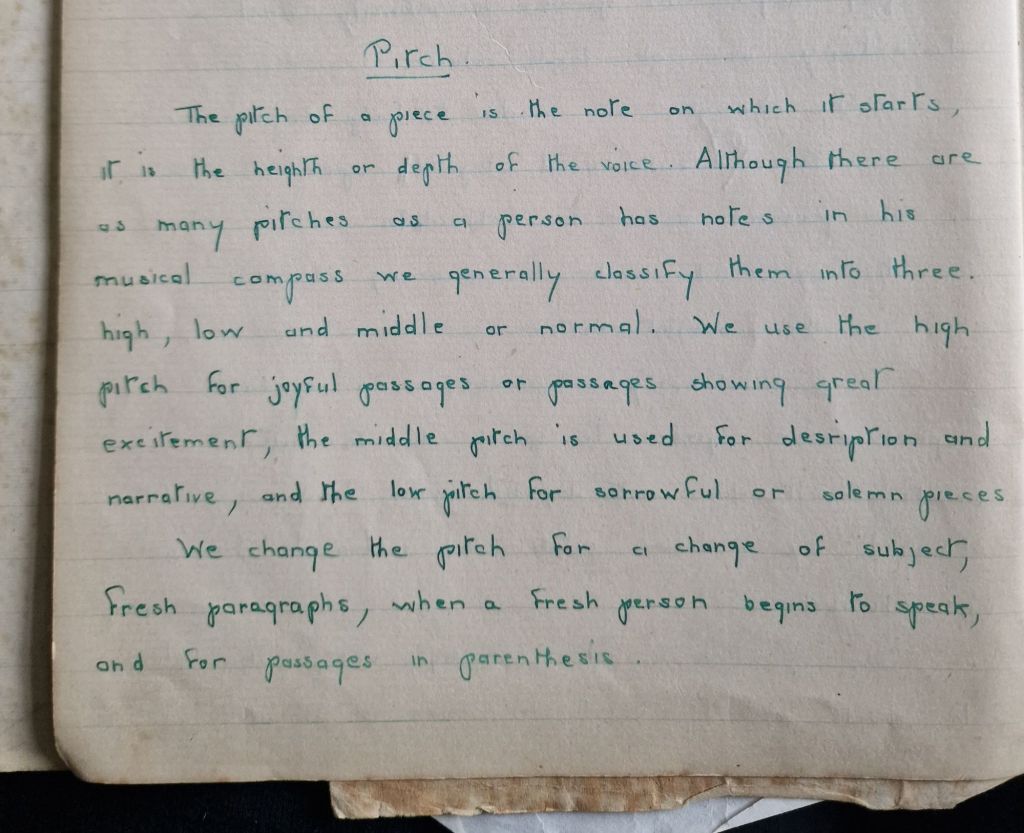
The pitch is a piece is the note on which it starts, it is the height or depth of the voice. Although there are as many pitches as a person has notes in their musical compass we generally classify them into three. High, low and middle or normal. We use the high pitch for joyful passages or passages showing great excitement, the middle pitch is used for description and narrative and the low pitch for sorrowful or solemn pieces.
We change the pitch for a change of subject, fresh paragraphs, when a fresh person begins to speak and for passages in parenthesis.
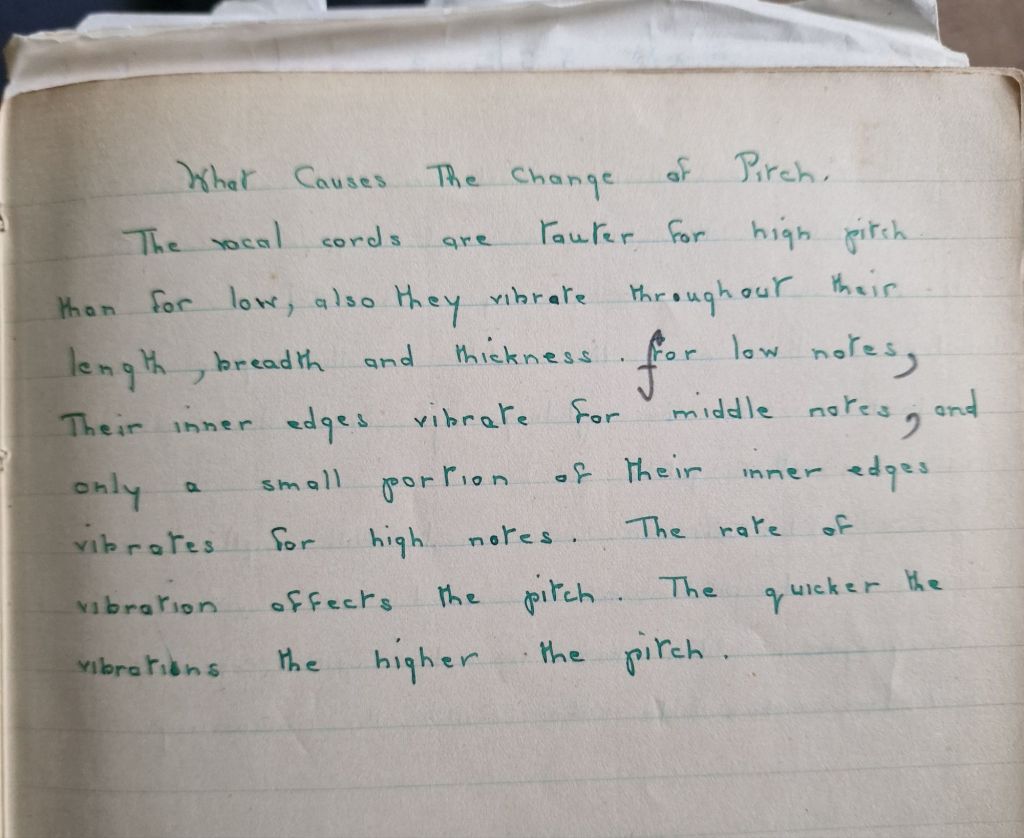
What causes the change in pitch
The vocal cords are tauter for high pitch than for low, also they vibrate throughout their length, breadth and thickness for the low notes. Their inner edges vibrate for the middle notes and only a small portion of their inner edges vibrate for the high notes. The rate of vibration affects the pitch. The quicker the vibrations the higher the pitch.
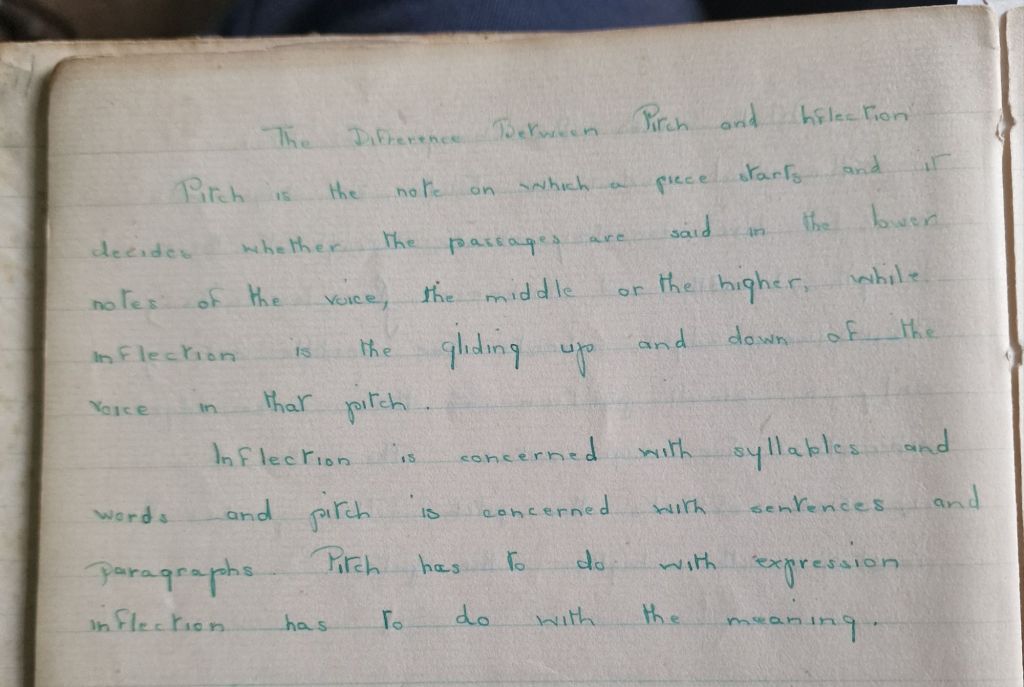
The Difference Between Pitch and inflection
Pitch is the note on which a piece starts and it decides whether the passages are said in the lower notes of the voice, the middle or the higher, while inflection is the gliding up and down of the voice in that pitch.
Inflection is concerned with syllables and words and pitch is concerned with sentences and paragraphs. Pitch has to do with expression. Inflection has to do with the meaning.
Excerpt from my grandmothers notebook.
Inspired by wisdom from my grandmother’s notebook, these insights remind us that the heart of storytelling and presenting lies not only in the words we choose, but in the way we bring them to life through the music of our voices.
Stepping onto a stage to deliver a presentation or a story, your voice is your most influential tool. Mastering the art of modulation though changing your pitch, pace and power can transform not only the way you speak but also how your message is received.
What Is Modulation?
Modulation is all about change. It is the dynamic variation in pitch (how high or low your voice sounds), pace (the speed at which you speak) and power (the intensity and emotion behind your words).
A well-modulated voice offers a pleasing rise and fall in tone, adjusts speed to match the mood and shifts intensity to suit the subject matter. This interplay of vocal elements adds colour and expressiveness to your speech, making it engaging and memorable.
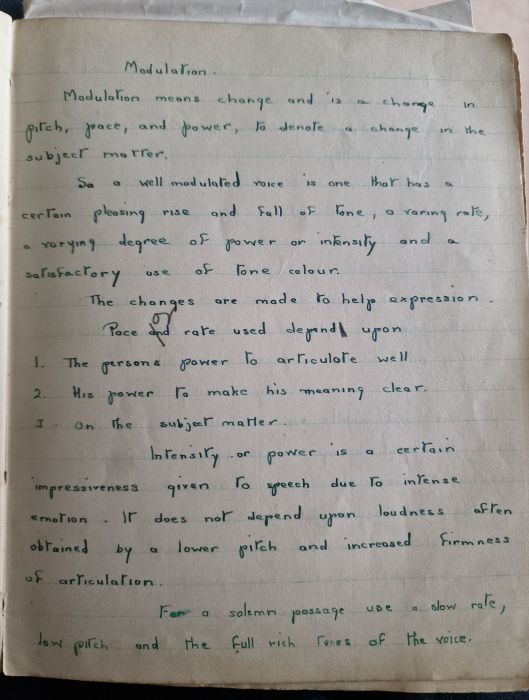
Modulation means change and is a change in pitch, pace and power, to denote a change in the subject matter.
So a well modulated voice I one that has a certain pleasing rise and fall of tone, a varying rate, a varying degree of power or intensity and a satisfactory use of tone colour.
The changes are made to help expression. Pace or rate used depend upon
The persons power to articulate well
Their power to make their meaning clear
On the subject matter
Intensity or power is a certain impressiveness given to speech due to intense emotion. It does not depend upon loudness often obtained by a lower pitch and increased firmness of articulation.
For a solemn passage use a slow rate, low pitch and the full rich tones of the voice.
For great sorrow, slow rate low pitch and the tone rather heavy.
For joyful passages quick rate, high pitch and the voice rather light in quality
For descriptions or reflective pieces use a moderate rate and the middle pitch
Excerpt from my grandmothers notebook.
Why Modulation Matters
Imagine listening to someone who speaks in a flat, unchanging monotone. No matter how compelling the content, the delivery quickly becomes tedious. Modulation on the other hand, breathes life into your voice, helping you articulate clearly and convey meaning effectively. It is not just about sounding good, but making your audience feel the emotions and understand the nuances of your story or presentation.
Practical Tips for Modulating Your Voice
Know Your Subject: Modulation should reflect changes in your content. Shift your pitch and pace to match the emotion or gravity of what you are saying.
Articulate Clearly: The ability to enunciate well is key. Modulation can help you stress important points and clarify your message.
Emphasise Emotion: Power or intensity in speech comes from genuine emotion, not just volume. Sometimes, a lower pitch with firmer articulation conveys solemnity far better than shouting.
Modulation for Different Moments
Scenario
Pace
Pitch
Quality of Voice
Solemn Passage
Slow
Low
Full, rich tones
Great Sorrow
Slow
Low
Heavy, sombre
Joyful Passage
Quick
High
Light, bright
Descriptive or Reflective Piece
Moderate
Middle
Balanced, thoughtful
Bringing It All Together
Next time you prepare a talk or craft a story, remember that your voice is a versatile instrument. With intentional modulation, your words will resonate long after you’ve spoken them.






 Max Hemingway
