
It’s probably not too hard to work out what this is. Whether you think it is a cool as I do, is probably an iffier proposition.
minor musings on the macrocosm
It’s probably not too hard to work out what this is. Whether you think it is a cool as I do, is probably an iffier proposition.

30 years ago, yesterday, I started breathing. 101 years before that, dude on the left, Alfred Wegener, showed up* which seems as good a reason as any to throw up a post that I have been meaning to put together forever.
Nearly every contemporary introductory geology or paleontology textbook–usually right next to the passing mention of Wegner’s frigid death collecting weather data on a Greenland glacier–reproduces some version of this figure:

It is a fantastic picture, one that helps to demonstrate one classic piece of evidence that helped to seal the paradigm shift of plate tectonics. It can be employed to address general concepts like the utility of fossils for addressing broader geologic questions; or to illustrate the actual relationship of the continents approximately 250 million years ago when most of the world’s landmasses were assembled into the massive supercontinent of Pangea.
It made several appearances in my History of Life and Paleobiology lectures this summer.
But there is something about it that has always bothered me: it’s totally bogus.
Well perhaps that is overstating it a bit. The nested ovals and zig-zags purport to show the distribution of several key Gondwanan fossil taxa across the landmasses that now constitute South America, Africa, Asia, India, Antarctica and Australia. The ranges of these species–terrestrial or freshwater plants and animals unlikely to cross major ocean barriers–strongly suggest that the southern continents were long ago connected permitting easy movement between land masses today separated by oceans. The fact that these fossils range from Permian to Triassic in age even gives us an approximate time range for this continental configuration.
But scrutinizing the actually ranges shown in the picture some problems arise. Mesosaurus–something of a poster-fossil for plate tectonics–has been found in Africa and modern day Brazil this map places it in Argentina. Cynognathus on the other hand is known from South Africa, Argentina and Antarctica, while this map appears to show it in Peru and central Africa. Glossopteris has been found across much of South America, India, Africa, Antarctica, Australia and beyond, however this map shows it in a very narrow zig-zag belt across these continents. One version of the figure maintains the overall shapes, but juggles the labels to bring it slightly more into accord with reality.
So what gives?
The map has its origins in a figure printed in Wandering Lands and Animals (1973) written by Edwin Colbert:

Colbert was one the paleontologists that uncovered the Triassic fossils in Antarctica represented in the figure. Clearly the map is meant to be diagrammatic, illustrating, as the original caption states “the paleontological links that bind it [Gondwana] together,” rather than a realistic depiction of the actual ranges of these fossils.
No harm, no foul, I guess although past experience dictates that we simplify the stories fossils tell at our own peril. Creationists (and other science deniers) have a thing for rigid literalism.
For fun, I thought I would fire up the Paleobiology Database to have a look at what the actual distribution of these fossils might look like. Among an assortment of fun tools, PBDB allows you to plot fossil distributions on paleomaps to get a sense for how the ranges of fossil taxa maps on to former continental configurations.
So I punched in Glossopteris, Cynognathus, Lystrosaurus and Mesosaurus, set the map to show the approximate location of the continents at the Permo-Triassic boundary, and here is what I came up with:

Lots of overlapping colored dots. Obviously it needs some more beautification to really bring out the story. So I decided to follow the overall look of the “iconic” version and place polygons over each species’ range:

I left off Glossopteris since it would effectively cover all the land shown in the map. I’m also choosing to sweep under the rug the case of the Chinese Lystrosaurus and Glossopteris which would require a more detailed discussion than I can feasibly get into here. That or I am part of a global tectono-evolutionary old-earth conspiracy that uses free publicly accessible data to deceive the masses.
Er, anyway. You can see the problem here. Glossopteris, Mesosaurus, Lystrosaurus and Cynognathus all overlapped extensively in space (though they were not all contemporaries) and any figure that accurately illustrates their ranges looses the striking aspect of Colbert’s map with four fossils stitching the southern continents together.
But when I started this post today was tomorrow and I am too lazy to go and fix that first paragraph. Time marches onward, the continents wheel about the planet, species evolve and ebb away. The great Glossopteris forests have evaporated, Rasmus Villumsen (dude on the right) lies buried under an estimated 100 meters of snow, Antarctic ice sheets peel backward revealing a long-lost Triassic menagerie. And I am going to bed.
*We share a birthday with Coco Crisp, Lyle Lovett and Bo Bice. True story.
What’s even cooler than a monster alligator?

A baby monster alligator.
Not that it’s particularly monstrous, this is your garden variety Alligator mississippiensis.
This one came from the Los Angeles Alligator Farm. Another specimen I saw today was marked “Locality Unknown” and below that some joker had penciled in “New York Sewer System.”

And what’s even cooler than a baby alligator skull? A full on ontogenetic series!

The big one is about 35 cm long, not nearly as beefy as the monster pictured on SV-POW and just a little better than half the size (by length anyway) of the record holder. Still, a pretty respectable animal.
I was planning to try to say something interesting about these, but after a day inhaling insecticidal preservatives and measuring a lot of skulls, I think I’ll just tap out. If you really want to jump down the well of ginormous gators, head to Matt’s post and follow the links therein.
Before you go, here’s another cutie. This is a tiny spectacled caiman (Caiman crocodilus).

Bad photo taken with my phone, but you get the idea, that’s my pinky for scale

In case you missed it, today marks the end of Cephalopod Awareness Day 2011. I cannot decide if it is comedy or tragedy that the cephalopod who garnered the most awareness this week is one that probably never existed. “Triassic Kraken” has already entered the hyper-meta phase: here is a reaction to the reaction to the reaction to the early “reporting” on the story.
But amidst the orgy of credulity, incredulity, joy, anguish, laughter and rage (and whatever this is supposed to be), it struck me that something was missing. I have seen loads of skeptical remarks from vert paleo types, and certainly we are well suited to critique the work, but it seems nobody thought to ask the opinions of those that have studied the middens left behind by living octopodes.
So I did.
I fired off a list of questions to two midden experts, Dr. Richard Ambrose and Dr. Jennifer Mather, both of whom have published multiple papers on the topic of octopus middens. Both were incredibly gracious in providing detailed and thoughtful replies within hours.
My interest here was not whether McMenamin’s scenario is realistic. Clearly it is, at best, wild and highly imaginative speculation.
But I was interested whether it might be feasible to identify octopus middens in the fossil record. How we might identify vertebrate victims of cephalopod predation? And, leaving aside the whole “self-portrait” thing, is it really feasible that a giant bathypelagic squid would be exhibiting behavior associated with shallow water octopods.
In short the answers seem to be: 1) “Probably” 2) “Hard to say” and 3) “No.”
Both Dr. Ambrose and Dr. Mather were kind enough to allow me to share their comments:

Probable example of an octopus bite mark on fossil bivalve shell from Harper 2002.
me: What are the prospects of successfully identifying octopus middens in the fossil record (i.e. are they permanent enough features that they would be likely to be buried by sediment, and would they be readily distinguishable from storm deposits)?
Richard Ambrose: I think middens could be discovered in the fossil record. Depending on the species, octopuses may den at the same location for a considerable time (“considerable” being relative, since octopuses are semelparous and most species live only a few years at most; even the giant Pacific octopus probably lives only 5 years or so) and they would continue to deposit midden items as long as they occupied the site. Moreover, good denning sites are often limited, so even once on octopus vacated the den site another would be likely to take up residence, further building up the midden. When we are looking for middens while diving, we focus only on the recent midden items because these are whiter and more conspicuous, but I would not be surprised to see an accumulation of midden items over many years.
Of course, many midden items are dispersed by currents. For example, we rarely find many crab exoskeletons because they are easily swept away by currents. Depending on the location, even heavier items like clam and snail shells can be dispersed. So for the middens to enter the fossil record, you would need some event, like dramatic sedimentation associated with a storm or perhaps an undersea slide, to preserve the items in place. But this is not inconceivable, especially after a storm. I do think they likely could be distinguished from storm deposits. Although storms might deposit a concentration of shells in one area because of local topography, most items would be widespread over the storm-affected area.
Jennifer Mather: Prospects would probably be good, some but not all fossil remains get buried in soft sediment. Distinguished from storm deposits would be possible. First they might have drill and chip marks on the shells–chips on clams, drills on clams, snails and sometimes crustacean claws. Drill holes of cephs are tiny, too and specifically placed (Marion Nixon did a lot on that). Not all shells are drilled or chipped, though. Second, they WOULD NOT be broken. Cephs have partial digestion externally, they scrape and digest out the soft parts leaving a disarticulated set of crab shell pieces or empty clean mollusc shells. Shell collectors prize octopus middens. So a midden would have a nice complete collection of crab parts, for instance, and if it was in soft sediment and got buried quite quickly, it might get well preserved. I remember watching the ‘fate’ of the eight blue shells of one octopuses chiton meal. They slipped down the pile and slowly got buried, when I exhumed the whole thing much later, the blue winged shells emerged one by one, very well preserved and with a drill hole in one valve.
me: Assuming vertebrate remains would not show the drill holes characteristic of shelled prey, what signs could we look for to indicate cephalopod predation?
RA: That’s true, only shells are likely to show indisputable evidence of octopus predation. (Octopuses also “drill” crabs, but those would be quite perishable.) For vertebrates, they would just eat the flesh. There might be some dis-articulation, but the fish eaten by the octopuses I’ve kept in the lab were not pulled apart, so I don’t know how common that would be. So it would be very hard to find marks or other characteristics that would indicate consumption by a cephalopod. There might be scrapes from the beak on bones, but I’ve never looked at/for these and I would think they would not be very distinctive.

Octopus midden from Flickr user Steven Severinghaus - Creative Commons 2.0
me: How widely distributed is midden building behavior among octopus species? Has it evolved more than once? Is it known from deep sea or pelagic species?
RA: This is really the key issue, I think. Midden building is very common among octopuses, but it seems to me that it is most likely a simple consequence of their denning behavior and the fact that they often (but not always) bring food back to their den for consumption. Hence, they discard prey items outside of their dens. There is some manipulation of discarded food items and other items – like rocks – by octopuses in their dens, most often to close or partially close the opening to the den. But I’ve never noticed anything like a systematic arrangement of items as a means of communication (like some birds do, such as bower birds) or artistic expression – no self-portraits that I’ve ever noticed, despite the intelligence of the species I’ve studied! Note: this is not to say that something like communication through prey discard items isn’t possible. I could see how it could evolve (and maybe that would be something to look for!), I just don’t know of any examples of it occurring.
So, as far as I know midden formation is likely to occur anytime octopuses den in one place for any period of time. This is restricted to relatively shallow water octopuses. Even then, most octopuses living on soft bottom habitats would not produce dens under most circumstances. Deep sea octopuses and pelagic species do not, as far as I know, take shelter in dens or produce middens. This makes sense; there are no caves or holes in the deep sea, for the most part. Especially any species that would forage widely, like up in the water column, would have little reason to return to a particular place to eat.
I know of no examples of non-octopus cephalopods (squids or cuttlefish) producing middens. Cuttlefish closely associated with reefs might be a reasonable candidate for producing middens, but I have never heard of this. Any cuttlefish or squid living in the water column would be extremely unlikely to produce middens.
JM: Middens aren’t really built. Octopuses do build ‘walls’ of rocks in front of the home. But when they eat prey at home, they just push out or blow out with a jet of water, or leave shell remains in the home. It’s more like a garbage heap. We don’t know a lot about octopus species, we’re particularly short of field work. However, midden remains have been assessed in the Mediterranean, the Caribbean and Bermuda, off the coast of Brazil and up the Pacific coast of North America (these are published papers, there are probably other assessments). My guess is that it evolved fairly early in the ancestry of octopuses, it’s likely widespread because all you need is a sheltering home and the habit of tossing your trash out. It is limited by topography, remains aren’t found where there is a strong current, they obviously get whisked away. Middens are NOT found in pelagic species because there is no place to put them, squid do not make middens and cuttlefish probably do not either. Deep sea octopus species might, it depends on what they find to eat.
Images
Top – Illustration from Victor Hugo’s Toilers of the Sea (1888 Crowell Edition).
Middle – Figure from Elizabeth Harper (2002) “Plio-Pleistocene Octopod Drilling Behavior in Scallops from Florida” Palaios 17:3 292-296 DOI: 10.1669/0883-1351(2002)017<0292:PPODBI>2.0.CO;2
Bottom – Photograph from Flickr user Steven Severinghaus – Used under Creative Commons 2.0.
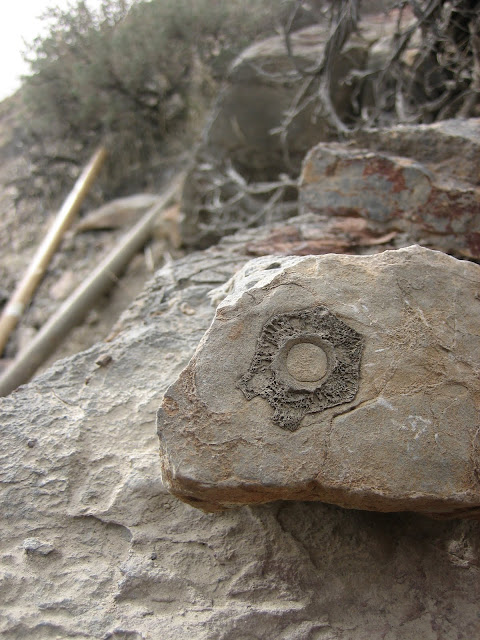
The recognition that Shonisaurus death assemblages preserved in the Late Triassic aged Lunning Formation represent large-format self portraits created by hyper-intelligent Kraken like cephalopods marks the beginning of a dramatic paradigm shift in paleontology. This break-through insight requires cold reappraisal of 200 years of research and a thorough re-imagining of more than 200 million years of evolutionary history. Here, we report surprising evidence that minimalist artistic traditions were already deeply entrenched among cephalopod artists by the late Early Triassic. A single small ichthyosaur vertebrae set in a lime mud matrix confronts the viewer with ambiguous questions about mortality, corporeality, decay and emptiness. Although the precise social context of this work remains unclear, perhaps the single bone was placed in an unusual setting that undermined the “authenticity” of the piece, and underscored the inherent absurdity of art à la Duchamp’s Fountain (1917).
It seems surprising that this abstracted form antedates the highly figurative I, Kraken piece which dates to the earlier late (or perhaps later early) part of the Late Triassic. Assuming this work of understated irony is a response to bourgeois excess, widely emulated figurative traditions must have been developed by the Permian. Alternatively, perhaps the historical trajectory of of cephalopod aesthetics followed a very different course than that of 20th Century Western societies (human). The identification of hyper-minimalist tropes approaching the Suprematism of Malevich or the early works of Rauschenburg, could help to better establish the temporal polarity of the evolution of aesthetic movements in Mesozoic (and even Paleozoic) cephalopod art. Thus particular attention should be paid to works of cephalopod art that show no clear signs of being “made,” whether they be barren bedding planes, massive mudstones entirely devoid of fossils, or even paraconformities.

If nothing else comes of all this ruckus, at least it was a good opportunity to sell some L.L. Bean boots, am I right? Sorry, I kid because I care. Well, not that much. But, like everyone else it seems, I did find Tom Clynes’s profile of Felisa Wolfe-Simon just published in Popular Science simultaneously fascinating and icky. Sort of like a mason jar full of anaerobic mud, I guess. Sure the rotten-egg aroma is off-putting but it also hints at something interesting and, dare I say, other-worldly lurking in the muck.
Huh?
David Dobbs and Carl Zimmer have each written thoughtful dissections-cum-rejoinders to the piece. And there is little for me to add. But I did want to call your attention to the timeline that Zimmer presents of the bi-polar responses to #arseniclife that played out in parallel online and in cytoplasm-space:

Notice anything missing there? Here, I fixed it:


 microecos
