
Petite balade alpine. This was the name of the WhatsApp group I had with some friends that helped me during the Alpine Connections; this journey across the Alps linking summits over 4000 meters. It had some irony but it was also because I believe what I did was not important, even if for me it was something that transformed myself deeply.
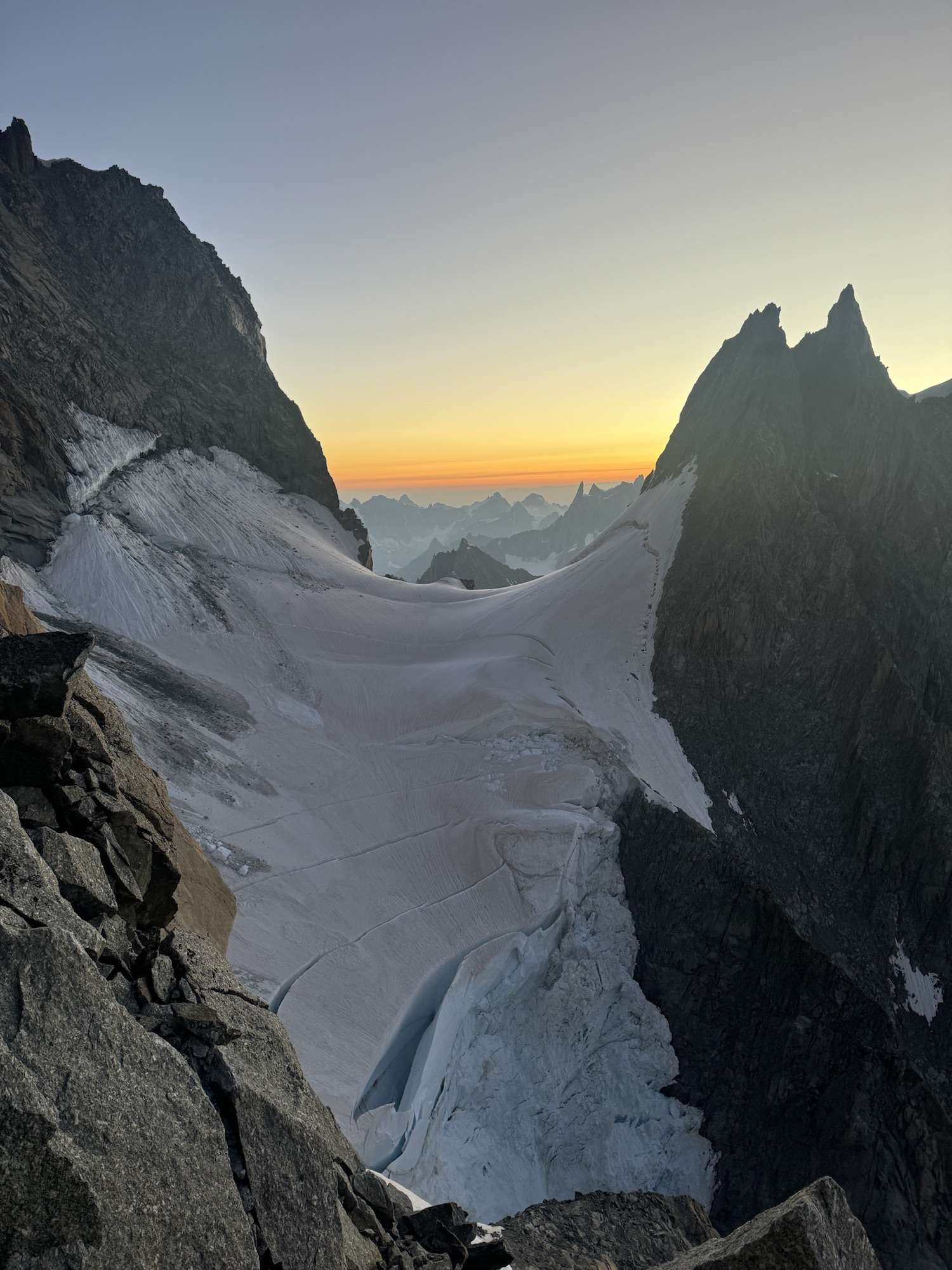
Before the memory makes its stains, I wanted to write à chaud what this journey has been. I know that at this point there are many things I need to reflect and assimilate. That the shadow of this traverse in myself will be long and demand a long period of assimilation and reflection. There will be probably a nice film when all this reflections are made and where we can enjoy the beautiful images captured by the team, but here come some first thoughts and things I take with me, and some shitty pictures I took with my phone during those days:
- It was an inner journey, a quest to discover who I am, my motivations, fears, and limits. The 4000s. The 82 peaks. They were the excuse, the framework that allowed this journey to unfold.
- To speak of records is prostituting the experience I lived. I got deeply inspired by Patrick Berhault vision, by Martin Moran and Simon Jenkins first 4000ers link up, by Franz and Diego’s or Ueli’s one, but even if we followed similar principles, were not seeking to break records but to explore the alps linking on a self powered way those summits, not the external performance.
- The connections are physical, rooted in the aesthetics of the routes, in the idea that once I reached a mountain range, I would stay up linking summits and not descend, moving continuously or resting in refuges or bivouacs until all the peaks were linked before moving on to another range. That was broken in Valais, where a snow storm happened and I went to check conditions and did the Nadelgrat and went down back to Saas-Fee before continuing the next day, then yes, in a 4 day push til Zinal.
- The connections are also human. It was great to share the journey with friends, both old and new that joined for short or long sections. Thanks Philipp, Matheo, Genis, Noa, Michel, Bastien, Jordi, Jules, Leo, Emily and Benjamin. Also the refuges for the warm welcome, bed or food, even in late hours – Finsteraarhorn hut, Monterosa hute, Capana Margherita, Hornlihute, Rifugio Aosta, Cabanne de la Dent Blanche, Schönbiel hut, Tracuit, Valsorey, Rifugio Torino, Refuge de Couvercle, Rifugio Monzino and Camping della Sorgente, Vitorio Emmanuele- And aslo a big thanks to the support team who followed all the journey, to bring what I needed in the valleys and to record this journey with images. Thanks Aina, my mom, David, Joel, Nick and the ones who joined for some days. Also to Jesus and Sergi to look into what was happening inside my body during this trip.
- I made decisions I am not proud of, which I need to revise and make me reflect on why I pushed at times to accept some risks that I consciously find unreasonable.
- Physiologically, I managed well. I didn’t lose weight, unlike in the Pyrenees, where the physical decline was constant. Here, I was able to recover and finish strong. Eating well and specifically, and “resting” were crucial. Thanks to Jesús and Sergi for all the advice on that!
- I flowed; on some ridges I didn’t feel the strain. I felt a deep connection with the mountain. The effort didn’t exist anymore, the time was stopped, my body wasn’t anymore but a one with the environment. It’s for these moments that I live for.
- It’s been 8 years since I left the Alps after living there for about a decade, and I was shaken by the changes in these peaks, and glaciers. The effects of climate change in glacier loss and permafrost melting are huge. The routes have changed, the conditions became more dangerous, the mountains are literally falling down. Here you can see some of the changes and the scientific explanations of it.
- To keep moving, no matter the conditions, weather or gear I had with me, I had to push myself to the absolute limit of my knowledge and beyond to make it through. The effort was physical, technical, but above all mental, in managing stress and emotions. The most difficult of such a journey was to stay fully concentrated for so many hours a day and to lower the stress in complicated situations to stay lucid to take good decisions and to not spend more energy.
- I witnessed breathtaking sunsets, full-moon nights, and crimson sunrises. I touched magnificent rocks that made me dance with them to progress. I experienced long, magnificent hours of solitude and shared laughter and ridges with friends. In the end, it’s these moments that will remain.
The idea and planning
After last year’s Pyrenees 3000’s traverse I got very taken by what I had experienced and it opened me to explore more in this direction. Back home it didn’t take long to imagine what I wanted to try. The Alps is a mountain range I’m familiar with after I’ve been living there for a decade. It isn’t far so it doesn’t involve much travel and It offers great possibilities for link ups in technical terrain. In the past I had done and imagined some long link ups in different ranges there, so why not to do one big link up englobing all of them?
In the past I’ve read about Berhault’s project, Moran and Nicolini books and followed Ueli during their traverses. And even if the frame was the same (to climb all 82 4000’ers in a human powered way) I wanted to do it on a way that felt more like a long “non-stop” link up than a multi ascent collection link up. So it was more to find a logical track inside each range, so when entering a mountain range, to find a ridge or a route that linked all the summits on the range without the need to go down outside the mountains before linking all the tops and moving to the next range. The aesthetics of it was what interested me the most, and even if I realized that the possibilities to make it possible due to weather, conditions, physical and technical capacities were low, I wanted to try it. I started designing the routes of the ranges I knew the most – Mont Blanc and Valais – then they were 4 ranges with isolated summits – Bernina, Weissmies, Grand Combin, that I didn’t knew, and Grand Paradisso and Ecrins that I knew – and another big range that I had never been before, the Bernesse Alps. After thinking of a track I thought doable I reached out to some friends and friends of friends to see what they thought of some parts, Andy Steindl, François Cazzanelli, Mitch Lanne, Philipp Brugger and Nicolas Hojac gave me their input and I had a base route to start. I then tried to found the topos of most of the routes of the traverse. In total it added more than 150 climbing routes to do, some easy and some harder, with some sections in between with not much information and some that were going to be for sure out of conditions for the time of the year. Even if I had a plan with a “A” route and some possible timings, there was important to expect and be prepared for many changes. To be prepare to improvise and find different solutions (alternative routes, places to stop, techniques to continue in different conditions…) in the moment when weather or mountain conditions were nos as expected.
Since we were planning to travel down to the Alps for Sierre Zinal with the family, I thought that the best would be to start some time after the race, to wait for a forecast that seemed reasonable and then go. I thought – and think – that in perfect conditions and forecast it’s possible to do in about 2 weeks of time. To do it this late the year had some advantages and disadvantages. On one side the glaciers are pretty dry what makes crevasses visible and less dangerous to fell in or break snow bridges and rocky ridges dry making progression faster, but in the other side, being that dry makes bergschrunds more difficult to cross and rocks in the faces more unstable, being more dangerous for that.
Gear
First, the gear itself doesn’t do shit. It’s our knowledge of the use of the gear and our comfort with it that will make the gear useful or useless.
- Shoes: I used the Tomir 2 shoes. 3 pairs of it. For most of the days I used a Tomir 2 waterproof, that was from day 1 til Torino hut after Droites ( day 16 ) I did use a pair of Tomir 2 non waterproof on the Nadelgraat so the waterproof ones could dry. From Torino hut I changed to another pair of Tomir 2 – non waterproof- for the last 4 days. The waterproof ones were basically done ( sole flat and some rips in the upper with the crampons and rocks) This are soft shoes which are good for running and walking and climbing in adherence technique but that require a good ankle and “10 pointes” technique when ice climbing with crampons as well as a different technique when climbing on rock compared to mountain boots.
- Clothes: From bottom to top, I used some Nnormal socks and some waterproof socks depending the stages, a pair of tights or a pair of active trousers depending the day. I had also a waterproof pants in case. A merino teeshirt, a midlayer jacket, a windbraker, a rain jacket, a down jacket. Buff and hat. I used climbing gloves – fake lather type – most of the time to protect my hands from the rock abrasion, I worn 4 pairs during the trip. I also had a pair of gaiters I used in stage 3.
- For sun protection I used sunglasses (I had 2 glasses of cat 4) and suncream for lips and face.
- For my protection and for progression I had a helmet, a light harness, an ice screw, 2 ice axes (I used one at a time but depending the stage I would take a carbon ice&rock or a grivel ghost tech), a pair of trail running poles, a pair of crampons (to fit well the shoes I used a petzl irvis base with a grivel soft front fixation, a edelrid back soft fixation and a petzl string). For some stages I used “spike chains” instead of crampons (Bernina and Gran Paradisso), 1 safety carabiner, 1 string and 1 carabiner, some cordelette, rope ( I had a 40m 5mm pure dynema and a 60m 5mm beal rad line depending the stage) 1 ice screw (blue ice 10cm) and a avalakov hook, 2 cams (BD 0,4 and 1).
- For the night I had a headlamp, a Moonlight 2000 with always an extra battery with me.
- For tracking and communication I had a phone with the maps, a Coros Vertix, a tracking device, a gopro, a powerbank with a cable, some money for the huts.
- For food and hydration I had 2 softflasks and carried some food for the stage.
- To carry it all I had a 25-30L prototype backpack.
Otherwise I had a bike kit for the transitions, with a road bike (Wilier Vertical) shoes, helmet, bike clothes and a Coros Dura.
The team
Even if I was doing the journey self powered, I was assisted. Aina, whom has been with me in numerous projects from the Himalayas to the Pyrenees was leading the team, ensuring that I had food and a place to sleep and managing the filming crew. Nuria, my mother was also there. The first week she stayed with Emelie and our daughters in the Valais and then she followed with Aina. To film, David Ariño, Joel Badia and Nick Danielson were going to capture the journey – at the end also Noa Barraw, a friend of Matheo Jacquemoud, joined for the last stages to film in the mountains too – For the first 10 days Jesus Alvarez-Herms and Sergi Cinca would follow to take physiological and cognitive measurements when I was going down in between mountain ranges to study the effects of these extreme events. Then some people came to help some days, Anouchka, Sofia, Joan, Andreu, came to help some days. Besides that I called a few friends to see if they wanted to join to share some part of the journey.

The Journey
After Sierre Zinal I took a rest day and drove to St.Moritz. Legs were still a bit sore but muscular soreness doesn’t last more than 70ish hours so I wasn’t worried. On Monday August 12 I prepared the gear and had a good night sleep.
Stage 1: Bernina
I meet with Philipp Brugger at Mortetatsh station at around 5 am. It had been long time since we meet each other so it was nice to catch up, talk about our kids and family and enjoy the climb up to Bernina via Spalla ridge. It’s a nice route, very variated and without any complications. The weather was perfect, sun and no wind and we could enjoy the climb and views.
When back at the base, I took the bike and ride til Grimsel Pass via some iconic passes such as the Oberalp pass and the Furka pass, a long but very nice ride. I arrived at Grimsel in the early night and it was a bit of a chaos since they were doing some work at the damm but finally we found a good place to sleep and could rest for some hours.


Stage 2: Bernesse Alps
A bit before 5 am I left Grimsel pass to run the loooooong moraine of Unteraargletscher, a 20km glacier moraine, not very difficult but progression wasn’t very fast in this terrain. I wasn’t feeling super fresh but not too tired either and I started climbing up towards Lauteraarhorn in a good pace. The uphill was very annoying with either very loose rock and sand or very soft snow. Every 2 steps I took up I was going down one. When I finally reached the summit ridge with more solid rock I started to be concerned by thunderstorms. The forecast announced some lightning for the afternoon and it seemed that it was arriving earlier than announced. For some moments I was balancing the options: going down, finding some kind of shelter or to continue, knowing that once I would start the ridge towards Schreckhorn there would not be many places to hide. I decided for the last one and I was climbing looking all the time for some options to throw the metal gear and find some cavities or shelter with the rocks to hide in case. The thunderstorm was coming from the west and I could hear and see the lightning approaching fast. I wouldn’t say I didn’t stressed a bit but finally the lightning passed a few hundred meters from me and kept going east. Following the thunderstorm it was the snowfall that came. So for the last part of the ridge to Schreckhorn it was pretty wet and snowy, but the rock was excellent and the climb great so I could enjoy it knowing there would not be any more lightning. The ridge itself it’s very beautiful, excellent rock and pretty sustained with nice ambiance and views – when the clouds let me see something- . At the summit I was in the fog so it was not easy to find the way down, that is pretty technical, specially the lower down climbing til the glacier. Once there, the sun appeared and it became a very warm afternoon.
To cross from Schreckhorn glacier til Finsteraarjoch wasn’t very easy. Long moraines, some climbing, and some crevasse navigation at the top. From there I took a long couloir up to Agassizjoch. To cross the bergschrund it was not very easy with the melting of ice of the last weeks but in the right side by the rock was possible to join the couloir and climb up, half way in the couloir in soft snow and half way on the rock. From there, the ridge to Finsteraarhorn was first very loose rock until reaching the junction with the normal route. I arrived there by sunset, and at the same time another snow storm arrived making the last part to the summit very slippery.
The way down in the glacier was ok, I could sometimes see some old tracks that made navigation easier. It was late in the night when I reached Finteraarhorn hut but the guardians were still waiting for me with a nice warm veggies soup that I enjoyed before a couple of hours of sleep.
About 2 hours after I put again my wet shoes – ouch- and started crossing the glacier towards Grunhornlucke, down east and up the normal route to Grunhorn where I enjoyed an amazing sunrise. There, the snow and rain from the previous evening made the rock pretty slippery so instead of following the ridge I went down half way in the west side glacier and crossed to reach the kleine grunhornlucke. The ridge began with pretty bad rock but higher up it solidify offering some very aesthetic climbing with a narrow long ridge til Hinter Fiescherhorn. There is where I saw the first people beside the hut guardians since I left Grimsel pass. I quickly crossed til Gross and took the north ridge down and the long glacier plateau til Monchhute where after 2 days of solitude, seeing so many people was a kind of chock. I ate a bit there and went up and down Monch, a pretty busy mountain with some nice rock scrambling and a narrow snow ridge with great views of all the Bernese alps. Crossing Jungfraujoch was pretty chocking with thousands! of people there in the glacier and the comercial center that the station has become. After some hard navigation in the commercial tunnels I finally find the exit to the Jungfrau glacier and left the noise to enter again the quietness of the mountains for the rest of the day. There were lots of tracks up Jungfrau but it was late afternoon so the snow was very soft. The views from the top were amazing, with the green valleys on the north; Interlaken, Grindelwald…lots of memories came from the 2 times I had been there before, in 2007 for a European skimo cup in Grindelwald and in 2015 when I joined Ueli Steck to climb the Eiger north face.
I took the way down to Jungfraufirn where there were some big crevasses and bridges to navigate to stay safe and then a long way down the glacier to Konkordia, where I took right up towards the north face of Aletschhorn. The plan was to climb the north spur and NE ridge, but when walking the glacier up to its feet it started to rain heavily. It was going to be dark soon and the long spur was taking lots of rain wetting the rock, besides, I was completely soaked and I wasn’t looking forward to the lower temperatures of the night being that wet. So I decided to change plans and go down to its south face, hoping the rain would stop and that the SE or the normal route would be a bit dryer. The way out Aletsch glacier was insanely long. And to cross the glacier wasn’t as straight as I thought with some big crevasses. At least the raising moon offered a incredible view. First I thought on staying on the right rive of the glacier to go up via the NE ridge but in the night I couldn’t find a easy way to exit the glacier and I decided to not spend time and energy looking for a way there but to keep moving and go down to the end of the glacier and take the normal route up. That added a lot of distance but luckily the rain stopped and with all this movement, even during the night my clothes dried a bit and I didn’t felt so cold.
The normal route to Alesch is a long way. After a long climb in the fields, a long balcony trail up and down, where I meet some wild and domestic sheeps in the dark took me til Oberaletsch hut, where I was pretty sleepy and tired, so I entered in the boots room, layed in the floor and set a 10 minutes alarm. The guardian, who just served the breakfasts for the climbers saw me and offered me a bed, but those 10 minutes seemed enough, but I accepted happy some breakfast. From the hut, long leaders to the glacier and a long moraine to start the climb. I could see many lights in front of me and in short time, despite feeling very tired and slow, I caught them. The climb there is very nice and variated. First some weird crossing over moraines and sand spurs to enter a easy scrambling spur, a short steep glacier section and a long scrambling in a spur til the summit. I reached the summit just after sunrise and enjoyed deeply the warm touch of the sun in my skin. I could see just under me in the north the place where I stood 12 hours ago in the rain. It was a long detour, but with those conditions I believe it was the right call.
The way down was long as hell. Climbing down all that was almost as slow as climbing up, but after some cake and drink back in the hut I felt a bit more energized and I could run down quickly to Bealp. A few kilometers before, I meet Emelie and we ran together til the village where Maj and Ylva Li, our daughters were waiting with the team.
I ate a bit – a lot – and took the bike for a short ride down the valley and up til Saas-Grund accompanied by Jordi Lorenzo. Emelie and the girls were staying at Saas-Grund since Sierre-Zinal and it was nice to spend some time together before starting early the next morning. They would be going back home the next day.


Stage 3: Saas-Grund
Matheo Jacquemoud joined me early morning and we started hiking up to Weissmieshute accompaigned by Nick Danielsson, one of the cameramen that was following the project. It had been long since we were together with Matheo but we had been sharing many moments together. From the Aravis crossing, Mont Blanc, racing together Pierra Menta, Rutor… So it was nice to be together in then mountains after the time. Catching up about our families, his job at ENSA or with the athletes and general life. When we arrived at Weissmieshute and seing that the weather was so so we decided to go first to Weissmies. The sun raised when we started crossing the glacier. Nick waited for us there and in short time we pass the numerous people that were climbing above us and reached the summit. There I took a sandwich while Matheo prepared his wing. He paraglided down quickly enjoying perfect conditions while I run down the glacier to catch him in the bottom. We climbed to Lagginjoch and the south ridge of Lagginhorn, an easy but very nice and long ridge with amazing views on the Valais mountains in one side and the italian plateau in the other. Then normal route of Lagginhorn is one of the easiest to climb a 4000m peak. All dry and with a trail, so the downhill was an easy run. Back at Saas-Grund I took the bike for a couple of kilometers to Saas-Fee. This day, with only 8h of activity felt like a rest day and I could see how I could recover from the previous days efforts.


Stage 4: Valais
The forecast announced some snowfall for the next day so I was doubting to take a rest day, but finally I decided to go up to see how much snow was coming. After a long sleep I left with the first light towards Mischabel hut, a vey nice “nid d’aigle” hut in the mountain. The ascent there is pretty direct so in short time I was in the glacier. I crossed it and climbed the ridge to Nadelhorn. During the night and morning there had been falling around 15 cm of snow. I felt like home in Norway. Some wind, some snow, rocky ridges, and that feeling of when seeing a centimeter of blue in the sky you can call it a sunny day! I climbed down the nadelgrat ridge til Dirruhorn and since there was a lot of rockfall in the couloirs I decided to climb back to Nadelhorn to saty safe. In the way down to Mischabel hute I meet with Ed Albrighi. A mountain guide and skyrunner who invited me for a warm chocolate in the hut before we ran down together to Saas Fee.
The next morning Matheo came back and we started climbing the same way I did the day before til Mischabelhute. There we climbed the NE ridge to Lenzspitze. With the fresh snow and slippery rock the climbing was a bit delicate, but the rock was very solid and the moves were great, like a dancing on the orange granite. We were waiting for the sun but it didn’t decide to show up, and a deep fog enveloped us while climbing up Dom. Opening a somehow deep track in the glacier and in this conditions it seemed that the day was going to be very long. From Dom, the ridge to Taschhorn is long, the rock is very poor at the beginning and the snow was covering most of the route so we decided to put the rope. It’s an easy terrain but very exposed. We thought of Patrick Berhault who lost his life there in a cornice when attempting this vision. When the wind opened the fog a bit, the views were majestic, like from another world with towers of black rock and clouds escaping from them.
After the lower point in the ridge, climbing towards Taschhorn, the rock becomes much better offering some very aesthetic climbing on a narrow ridge. One of the best in the traverse.
The way down is a easy ridge til Mischabeljoch, and an easy climb til Alphubel, where we finally meet the sun, and Genis Zapater with his friend Bryce. We went together til Allalihorn and there Bryce and Matheo went down. Matheo flying his glide and Bryce with David and Joel who were there to film us. I continued with Genis down towards Allalinpass in a pretty bad rock ridge. There we left some gear and did a back and forth run to Rimpfischhorn. The night caught us when we started the rock climbing. Genis waited there and I climbed in the dark. Solid black rock – for once – Red sky showing the silhouetes of the mountains in the north – the pyramids of Matterhorn, Zinalrothorn, Weisshorn – and the full moon raising in the south over the Italian plateau.
Back at Allalinpass we went down north in the glacier to contour Rimpfischorn and up til Adlerpass, where Genis waited while I did a quick ascent at Strahlhorn with the light of the full moon. We then climbed down to Adler glacier, Findel glacier and Gorner glacier towards the Monterossahute. Running down in that last glacier I tripped with my crampons and fell down in the ice. It was flat and hard black ice and with the things I had in the chest pocket (the GoPro, a gps tracker) I injured one rib. I didn’t know if it was broken or just fractured, but that was not the first time it happened so I wasn’t worried much about needing to stop but I knew that for the next two weeks it would hurt like hell when sleeping, when doing some far reaching moves with the left arm and when coughing. We had some info that we could cross the glacier pretty high to take some kind of via ferrata to enter the hut from above but in the dark of the night we coudn’t find it so we ended doing the loop in then moraine and taking the panorama trail to the hut where Joan and Andreu waited for us with some food.
After a couple of hours of sleep I ate a good breakfast and with the sunrise I left towards Monte Rosa. My expectations for the day were pretty wrong. I was waiting for a day with plenty of tracks making easy running trails in the glaciers but soon the reality told me otherwise. Up Nordend there was only a couple of persons I passed soon and from there I was oppening track. Same on the traverse from Duforpitze to Zumteinspitze. At Capana Margherita I stopped to eat and drink something. After a couple of days seeing no one, there were plenty of people on the summits here. The easy access and low technicality of those summits makes the area pretty popular. The route I followed that day is known as the Spaghetti tour for its shape, starting from Monte Rosa hut and linking the 18 summits over 4000m til Breithorn. Most of them are very easy, just running on the glacier up and down. That day it was very hot and the snow was melting fast, making the progression pretty slow and some holes opening under my feet.
When doing the Lyskamm traverse, a very aesthetic and narrow snow ridge. I got a call from the norwegian police. First I thought something had happened to Emelie or the girls but the stress lowered down a bit when they told me it was about my car, parked in an area they were to start some work and needed to be removed. After some calls and missing calls with the parking manager while I was running in the ridge back and forth to find good connection trying to find a solution, the manager noticed that my car could be opened and started via an app, so there I was in the ridge, trying to find great connection to open and start my car parked in Norway so the operator could drive it and park it in another place.
After that, I crossed Castore, remembering the multiple times I had been there training or racing Mezzalama. Pollux and went to the Breithorn’s traverse. At that point I was very thirsty, hungry and tired. When passing by Bivacco Rosi, a couple of alpinist making their dinner might saw my state they invited me to so eat some of their boiled carrots and some water that felt like heaven. I continued with the traverse with the last lights of the day painting everything orange. There is some nice climbing on there, never too hard but pretty cool and in good rock. The downclimb demanded a bit more on finding the best way to do without abseiling. When the night felt I reached the west summit of Breithorn, my first 4000m peak climbed when I was 6 years old with my sister and parents.
I ran down in the ski slopes of Zermatt til Theodulses lake and then crossed til Hornli hut. That was a long way in my tired state. Luckily, at the hut, Aina and my mom were still awake and I could eat some good food before a couple of hours of sleep.
I woke up before dawn and after a good breakfast I started climbing up Matterhorn. I started slow but felt good soon and went quickly to the summit. Conditions were great, not too much snow and as usual big tracks, but it was a windy morning. I thought it would be a busy morning in the mountain but I was gladly surprised on crossing “only” a dozen of teams in the mountain. At the summit I thought how cool it would be to have the fresh legs I had around the same date 11 years ago. The downhill in the Leone ridge was almost fully dry and went fast. At the Carrel hut, the Guides of Cervinia, offered me some food and I continued contouring the Testa del Leone to start the long ridge towards Dent d’Herens. In 2017 we did this ridge together with François Cazzanelli when we linked the Grandes and Pettites Murailles and I had some memories of the route, never too technical, but some climbing in very poor rock. The climb went well, it offers some great climbing and it’s a long ridge with multiple gendarmes, all of them with different characteristics of rock and formations that makes the route very variated. I was surprised to see some foot tracks every now and then in the route. It’s not a very common route to climb. After I learned that I was the 3rd person or team to climb it that year, just after Rolf Zurbrugg and his client. I know Rolf from when he was the coach from the swiss skimo team and it was a pleasure to meet him there at Rifugio Aosta after the climb. We chatted for some time about old and new times while enjoying some food and I left towards Cole della Divisione before it was too late. Before the pass I meet with Genis and Bryce that came to join me for the glacier traverse of Tête Blanche. Last time I did this glacier crossing, back in 2015 it was also in the late afternoon in a very hot day. The snow was soft and it took me hours to cross, almost falling in some crevasses and “swimming” over them to put less weight to prevent the snow bridges to collapse. This time it was much better. The snow was hard and the progression fast. We enjoyed another great sunset when we arrived at Cabanne de la Dent Blanche just for dinner, where the guardian, George, had prepared a delicious risotto with mushrooms and parmesan. After dinner, with Matheo, who had climbed with his friend Noa to the hut, and Genis, we continued to the summit of Dent Blanche. The ridge there is just beautiful. Perfect solid rock, some nice climbing, but never hard. I had done that route a few times, with Emelie and alone, but this time I was surprised on how little snow – well literally not any – was in the ridge. The full moon helped up to see better the route as well as offer an amazing night view of all the Valais mountains.
We downclimbed the same route and Noa went back to the hut while Matheo, Genis and I continued climbing down in a steep spur towards the Schonbiel glacier and then crossing to the Schonbielhute, in the early morning, where Joan and Andreu had prepared some sandwiches for us.
We slept one hour and with Matheo we continued running down the valley and then up to Arbenbiwak. The views there were astonishing. The sun was raising and enlightening the north face of Matterhorn, just on our backs. We meet a couple of bouquetins and saw some people in the ridge above us. The Arbengrat ridge at Ober Gabelhorn is one of the classic ridges in the Alps for some reason. Perfect orange rock in its major part, sustained easy climbing with amazing ambiance for pretty long til the summit, a small pyramid. We had some food at the top while enjoying the views before we started climbing down the north ridge, first with some steep rock and then some snow and ice up the Wellenkuppe. The traverse there is in itself a very complete route, with lots of variation between rock and snow climbing.
At the Rothornhutte, Matheo went down to Zermatt and I continued towards Zinalrothorn, another great rock route very similar to Arbengrat with some nice climbing til the narrow top. The downhill in the north offers equally some nice climbing. It was a nice surprise to meet there a familiar face in Bjørn Kruse, a mountain guide from Romsdal with whom I had been skiing, climbing and writing a steep skiing book from our home mountains.
When I reached L’Epaule I started to look at the time of the day. The ridge from there to Weisshorn is very long and it’s not easy. In 2015 I did it in the opposite direction and I remembered several abseils, some technical down climbing and a full gendarme of rock that collapsed a few minutes after we climbed it down. I saw that I had about 5 hours til sunset and I wanted to be above the difficulties in the south ridge of Weisshorn when the night was to come. First there is the 2 Morming summits, never to hard but with very poor rock and quite aerial. After that a steep way up in ice to Schalihorn followed by a long ridge with multiple gendarmes til Schalijoch, where there is a small bivouac hut. I felt good, maybe because of the adrenaline, but in short time In reached the bivouac and felt somehow relived to have a couple of hours to climb the south ridge before the night. At the bivi there were a team from Germany cooking and preparing for climbing the next day. We exchanged some words but without loosing so much time I started climbing that magnificent ridge.
Weisshorn is one of my favorite mountains in the Alps. There’s not a very easy way up to the summit and even if it’s eclipsed by its neighbor Matterhorn, its shape is a perfect pyramid with long ridges in all the sides. The south ridge is a long climb, of almost 800 m of ridge in very solid rock. It’s not very sustained but it has some steeps that demand some real climbing. What I lived there it will remain with me all my life. I felt effortless, like flowing in a cloud climbing up the ridge. The sun setting in the west and the clouds in the east gave me with the present of a broken spectrum following me all the climb, replicating all my movements in the sky. At some point I couldn’t tell if I was really there or if it was a dream.
I reached the summit before the sun left and after enjoying one of the craziest sunsets I’ve ever seen I started downclimbing the north ridge. That ridge is no joke do. Even if it’s way shorter than the south ridge, it involves several gendarmes, some narrow ice ridge and some steep rock climbing. Since I was starting to feel tired – I’ve been climbing for more than 40h with very little sleep – I decided to abseil down the steepest gendarme instead of climbing down the ridge. In the past I had always climbed down and followed the ridge but I knew that it was possible to abseil lower down and traverse on some ledges under the ridge. That was a bad decision. Either with the darkness of the night I couldn’t find the best way or those ledges were just on a very very poor rock. Anyway, I needed to put all my attention to not bring all the mountain down with me. After some careful hours there I could finally relax to climb up Bishorn and down to Cabane Tracuit, where the guardians had prepared some nice warm food. After eating a bit we ran down with Nick, who had came to film there, to Zinal. One week after I finished the race, I was back there, much slower and tired, but very happy to have completed the Valais couronne.


Stage 5: Grand Combin
After a long sleep – well at that point 5h felt like an oversleep night – I took my bike and went down the route I’ve done many times with the bus to take the start of Sierre Zinal. I cycled then at turtle speed til Martigny and started to feel more energized cycling up to Bourg St. Piere. Where I meet my team and recovered some energy with a good lunch while waiting for Alan Tissieres.
I knew Alan from his early years in skimo. He was one of the most talented young athletes and we had some great times – mostly partying together in the after race parties – That morning Alan was guiding at Dent Blanche but he decided anyway to come join me to climb “his” mountain, the Grand Combin, since he was born and has been living at its feet since then. It’s been more than 10 years since we had meet and now he is working as mountain guide, far from the competitions but still in great shape. i felt good after the long sleep and the easy ride and we went quickly til Cabane de Valsorey, where Alan’s cousin, the guardian, offered us some drink. After some discussion with her on why we were not wearing a helmet – Alan concluded that if one of the rockfalls was happening, the helmet couldn’t do much – we continued up til the pass where the Meitin ridge starts. More than a ridge, the route is a zig zag route in a big rocky face. with pretty solid rock if you don’t lose the way but very poor one if you get out of it, and believe me, it’s pretty easy to lose the way there. The climb itself is not sustained at all, there’s a lot of walking or easy scrambling followed by some meters of some climbing, and like that for about 500 meters. We got to enjoy – yes another- amazing sunset while reaching the first Combin, the Combin de Valsorey. In the west, the sun was setting behind the Mont Blanc range, and in the south, a thunderstorm was illuminating the Italian plateau. At the summit we put the rope and headlamps and followed the snowy ridge to Grand Combin, Aiguille du croissant and Combin de Tsessette, before coming back cutting under Grand Combin to the first summit and climbing down the ridge back to the hut, where Alan took out a couple of pieces of cake and we enjoyed eating them in the silence of a starry night.
Alan stayed to sleep there and I continued down to the village, not without some encouragement from the guardians, who were sleeping outside the hut under the stars.
Next morning, I took my bike and rode to the next valley. There Jules-Henri Gabioud was doing his last training before racing PTL the weekend and when he passed me I joined him for the last km to la Foully. He told me that it was better to take petit col Ferret to cross to Italy instead of the grand col, since that last one would be filled with runners, so after giving him all the best for his race I left the bike and hike / run up the pass and down to the italian side of Val Ferret til the Jorasses Camping, where the team was waiting.
At the camping, after eating and resting a bit, I double checked the weather forecast. Some storm and snow was announced for the next day. Since the next stage was going to be pretty hard both physically and technically, and to start with a bad weather day might compromise the feasibility of the climbs I decided to take a rest day and start at midnight after some quality rest.


Stage 6: Mont Blanc
Michel Lane, a long time friend that works at the PGHM with who we shared team and trail running races for long time came with a friend from the PGHM, Bastien, to join for the day. Matheo also came, and the 4 of us started after midnight hiking up from Val Ferret towards rifugio Boccalatte. We were moving pretty quick, without forcing but without stop. Before sunrise we had reached the summit of pointe Walker in perfect conditions of hard snow. It was a clear and pretty cold night so we didn’t stop much and continued to the west traversing the Grandes Jorasses. I had done this traverse in the past in the opposite direction and I thought that east to west wouldn’t be as nice, but I was surprised on how logical and nice it felt. There was not so much abseiling (only after Pointe Young) and the climbing of the gendarmes in this direction offered some nice climbing in good rock. The views and aesthetics of this ridge are unique. The history of the climbs in the north face of Jorasses is something very present you’re up there. It was quite a cold day so we kept moving all the time and we were very happy when the sun touched us when reaching poine Young. The four of us continued at good pace until Rochefort, where we meet Noa and with him and Matheo we went to climb Dent du Geant while Mitch and Bastien went directly to Torino hut. Dent du Geant is such a beautiful needle in the skyline of Mont Blanc range. A unique summit that offer some of the best granite one can imagine. Despite the amount of crags in the wall, some fixed ropes destroy a bit the feeling of mountaineering there. Anyway, it didn’t took long time until we summited and joined our friends at Torino hut for some snacks and drinks. There we called Tom Lafaille, who had been going down Mer de Glace a week before to ask for the conditions to cross the glacier. While Mitch, Bastien, Matheo and Noa remained at Torino, I went down the Vallée Blanche towards Refuge du Requin, not without some crevasse navigation to exit the glacier, and then up to refuge du Couvercle.
I arrived there pretty “early” so I had time to rest a bit and enjoy for once dinner with the other climbers and guardians.
It was a great surprise to see Simon Elias there. With him we climbed together the Colton McIntyre in the Jorasses north face in 2015. Now he combines his work as mountain guide with searching rock crystals in the mountains, that takes him to the most rotten walls of the mountain range, where these precious crystals are formed. That’s basically why he is spending the summer in this hut. We discussed a bit the conditions and since these were very bad – “Everything is collapsing up there” he said”- what could be the best route to minimize risks.
I woke up at 4 and after some breakfast I started walking from the hut contouring the Aiguille du Moine. Physically I felt good but my body was tired. I knew that the risks I would be taken that day would be high. It was a bit feeling like I was going to the slaughterhouse. I crossed the bergschrund with the first lights of the day and started climbing the arête du Moine towards Aiguille Verte. The arête I remembered didn’t exist anymore. The multiple rock falls and collapses had changed its shape and it had become a pretty unstable route. Half way up I found Simon four, where he had some tools and gear. It seemed it would collapse any day. I continued up to the summit of Aiguille Verte. I had been there a few times before, all in winter with my skis, and I must admit that it’s a much nicer summit in winter, when the snow and ice keeps it all together. The summit of Verte is spectacular. A bit retired from the main range it offers a unique perspective, with the north face of the Jorasses in front, the Argentière bassin in one side and the Mer de Glace with the Aiguilles de Chamonix and Mont Blanc in the other. There are not any very easy routes to the summit, that’s why the legendary alpinist Gaston Rébuffat said « Avant la Verte on est alpiniste, à la Verte on devient Montagnard ».
From the summit a narrow snow ridge drove me to the summit of Grande Rocheuse. from there the downhill and climb to Aiguille du Jardin started to show what would be the tonic of the day. Staying in the very ridge it was somehow ok rock, but when needing to go one side or the other it felt like playing Jenga with the rocks. Aiguille du Jardin is a very nice tower and the views are pretty incredible, but my mind was on what was coming. There was probably the last place I could decide to turn around and get down somehow safely. I decided to continue. The descent from there didn’t felt good. I did some abseils in poor “bequets” and old slings. A big part of the wall that I abseiled had been fallen down not long time ago. I could see the permafrost exposed to the sun, keeping for now the big blocks, size of a car, from where I was abseiling. I tried to go as fast as possible, abseiling and down climbing, to avoid the maximum of time exposed to that. A bit more to my right, every now and then, some big blocks of rock were collapsing taking with them big avalanches of rocks.
After some time where I think I grow some white hair, I arrived to the Col de la Verte. There the solidity of the rocks wasn’t better, but at least I was on the ridge so things from above couldn’t fall on me. The terrain here was basically sand. Sand standing together for the moment. I down climbed south to contour some needles and climb back again to the ridge as quick as I could. From there, the Droites ridges started. Not very technical at the beginning, but with some hard moves higher up when staying in the very ridge to avoid climbing in the sides. Once, when crossing a gendarme climbing in the north side, all the rocks I was holding on my feet and hands – except one hand – collapsed and fell down few hundred of meters to the Argentière glacier. I stayed hanging on one hand. Hoping the rock I was holding was going to stay in the wall for a bit longer.
I’m not someone who stresses much in general. I think that gives me an advantage in most of the occasions when racing or doing projects like that where concentration and keeping it calm all the time is key, but that was one of the few times I’ve felt in my like a knot in the stomach for hours. I really didn’t know if I was going to make it.
When I arrived at the summit of Droites I didn’t really enjoyed and just started to flind the best way down. The col des Droites seemed to be with snow and the safest way, but to arrive there, the couloir was a bowling. I decided to downclimb the spur and try to cross towards the snow fields from Col des Droites when I could see an opportunity. The downhill was somehow ok when staying in the very edge, and after a few hundred meters I found a possible traverse to cross that bowling and reach the snow. I felt safe for the first time in hours. I felt today I wasn’t going to die. While climbing down and traversing back to Couvercle I didn’t feel happy or sad. It was a strange feeling, not being well with myself and the decision I took to continue that day. I mean, the small decisions of where to abseil, where to pass, how to downclimb or how to protect myself had been good and that’s what kept me alive, but the decision when being in the first summit to keep going was something that I wasn’t happy about.
I arrived in the hut exhausted mentally. I discussed a bit with the guardian and ate a bit. Then I continued going down to Mer de Glace and up following my tracks from the previous day towards Torino hut. When entering the glacier after Requin it started to rain.
I arrived at Torino in the early night. There was Jordi Tosas, a good friend that was guiding there, Matheo and Noa, and Aina and my mother. I ate a great and copious dinner and had a good sleep, trying to clear my mind.
The next day, Jordi joined us for a few minutes before running back to his clients at the hut. Matheo and I continued in silence crossing the glacier around Grand Capucin in the dark. When we turned the corner we saw the headlamp of Noa who started a bit before to film us. The bergschrund to climb Col du Diable was pretty steep. We made a pedal with a ice screw and a sling and we pass each other a second ice axe to climb the steep 5 meters of ice. After we continued in pretty poor rook – felt like marble compared to the previous day – til the Col. There the sun started to raise giving us a breathtaking show of colors and views. While Matheo started climbing towards pointe Chaubert I did a quick back and forth to Corne du Diable and then we climbed the 3 of us together this magnificent ridge. The climbing there is real, great great rock – the famous Chamoniard orange granite – and every one of the gendarmes offers some athletic movements and perfect crags to climb. For sure one of the best rock climbs one can do in the area, for the quality of the rock, the beauty of the moves and the incredible views and surroundings. I really enjoyed that climb and even if we moved quickly we took the time to savor it. 6 hours after leaving the hut we reached Mont Blanc du Tacul where we meet David and Nick who came there to film us. We chatted a bit and continued towards Mont Maudit. There was not many people in the mountain that day, only a couple of teams going towards Mont Blanc. We stood alone in the summit of Mont Blanc, where I left the rope and some warm clothes I might need for the second part of the day and we ran down the normal route til Dome du Gouter and then towards Aiguille de Bionnassay.
I’ve done this summit several times in the past and I always remember it for being this perfect snow narrow ridge. This time I was surprised to see that the ridge had already some long rock sections. Nevertheless it remains one of the most aesthetic ridges one can imagine. Matheo and Noa continued going down from there while I turned around to climb back to Mont Blanc. It’s a long climb, almost a vertical kilometer, but I felt pretty good and it didn’t took much to be back in the top of the Alps.
I took back the rope and clothes and started going down in the south side of the mountain. There were some old tracks that gave me hope I would found some tracks lower down to cross the glaciers. When I started climbing down Brouillard ridge I meet a team of climbers that were finishing the integrale du Brouillard. I asked for conditions and it seemed that it was pretty dry, what for down climbing was perfect. Soon after Pico Luigi Amedeo I took off the crampons. The ridge is never too technical but has some steps up to 4 degree that down climbing can be a bit delicate. I was enjoying a perfect sunset with the ridge half in the sun and half in the fog giving honor at its name. The steep section til Col Emile Rey went smoothly well. Mostly down climbing, with a short abeseil. At the Col the night arrived. I took my headlamp and left my backpack. I followed the ridge pretty quick til Punta Baretti and back. Sometimes it was pretty foggy and with the night I used the track back function to not lose my way back to the col. There I climbed down the snow couloir to Glacier du Brouillard. It felt all surprisingly easy and smooth til this point. I crossed the glacier noticing some rock fall from the Brouillard face and the right branch of Col Emile Rey. When I started to climb towards Col d’Eccles I found a huge crevasse that occupied all the length of the glacier. I looked a bit around but couldn’t find an easy way to cross it. Shit! After some thinking I went back to see if it was possible to climb down / abseil the glacier du Brouillard to contour the rocks and climb to Eccles bivouac by its normal route, but the glacier was pretty rotten and I couldn’t find any reasonable way. A bit disappointed I thought that the unique reasonable solution would be to climb back Col Emile Rey and climb down the integrale du Brouillard til Val Veny and the next day climb up the normal route to Eccles and to Freney. When I crossed the glacier back towards the couloir of Emile Rey a big rock fall came from the top. I couldn’t see much but the sighs of the rocks hitting the wall and the huge sound of a mountain falling above me. I run to cover myself as well as I could in the open glacier and a few seconds after I saw in the beam from my headlamp rocks the size of basket balls flying in the air. After some seconds of chaos the noise calmed and a deep cloud of sand and dust covered me for the next ten minutes. Well, that was a close call! No way I was going to climb back there so I needed to find a solution in that crevasse. I crossed back and find a snow bridge in the crevasse that could lead me to the other wall of it. I then climbed the 5 or so meters of it with the ice axe in one hand and using an ice screw with the other hand to progress. It was slow but safe. After some searching I found a way in the rock to climb to Eccles bivouac and entered the shelter pretty done emotionally. Better to call it a day, rest a bit and wait for some light to see where the rocks were falling from before continuing.
I ate the rest of the food I had and drank the water I had. I took off my wet shoes and socks and covered myself with the 3 blankets I found. I slept like an angel. 3 hours later I woke up and waited for the light to come. I exited the bivouac and climbed Pic d’Eccles. The sunrise offered me one of the best views I’ve ever enjoyed, with the light entering from Col du Peuterey between the 2 summits I was going to climb and behind, the Verte, Droites, Dent du Geant and Jorasses where I had climbed the previous days felt far away. I did a short abseil to the pass with the remaining of the rope I had – the rope had suffered multiple cuts in the past days with rockfalls in Droites and Brouillard – and climbed down in a dry couloir til Freney glacier. The glacier was in perfect conditions, with hard snow and not any transversal crevasses so in no time I reached Col de Peuterey. There I first went towards Grand Pilier d’Ange, keeping the climbing well in the right ridge to avoid being exposed to the constant rock fall of the central part of the wall. The climb there is a bit more technical but way safer. After some time I reached the summit. I saw and took with me some (very) old pieces of ropes I thought they could help me for the abseils in Aiguille Blanche and down climbed to the pass, leaving a piece of rope to cross the bergschrund. I climbed Aigulle Blanche, one of the most beautiful summits in the area, and in the summit I saw a team coming from the south probably doing Peuterey ridge, I stayed a bit in the summit of Blanche, enjoying the views and the luck I had to be there, in such a beautiful place doing what I like to do. Then I climbed / abseiled down with the short ropes I had and crossed back to Col d’Eccles, the bivi and down towards Monzino. At the hut I ate and drank a bit, it was more than 10 hours since my last drop of water or food. And went quickly til Camping della Sorgente, where Matteo Pellin and its family welcomed me in the best possible way.
With all the team reunited there it felt somehow that all the dificulties of the project were done. That from there on it was just a matter of physical effort to do the last 3 summits. I could rest well, take a shower and eat plenty to regenerate body and mind.


Stage 7: Grand Paradiso
Right at sunrise Vivian Bruchez, who introduced me to steep skiing more than a decade ago and who has been doing the incredible project of skiing all the 82 4000’s of the alps over the past decades, and Matheo Jacquemoud joined me for a nice – social – bike ride towards Pont. Half way through Henri Aymonod, a young strong mountain runner from Val di Rhemes joined us and we continued chatting about life til we reached Pont.
There Viv turned around – he has been injured so he couldn’t climb but bike – and Emily Harrop, a ski mountaineering world champion, joined us to climb Grand Paradiso. I felt very good that day. I don’t know if it was the long sleep, the amount of food or to get over the most cognitively demanding journeys but I could go pretty fast and easy up. With Henri we reached the top and ran down – with a short stop at Vitorio Emmanuele hut for a crostata – to Pont in what it felt a recovery run. I ate a lot while waiting for Matheo and Emily while Henri started driving for a race he had the next day, and where he finished 3rd with a very strong field!
I then ran a very nice trail up to Colle del Nivolet and Col de la Loze and down to Le Fornet, close to Val d’Isère, where the team was waiting for me and we could have a long 7h sleep!


Stage 8: Ecrins
With the sunrise I started riding up Col de l’Iseran. I had done this pass multiple times, biking when i was young and roll skiing when we were doing summer stages in Tignes with the skimo national team. It’s a very nice pass, with great views over this part of the alps with plenty of glaciers and green fields. After I climbed Col du Mont Cenis, that has an incredibly beautiful and big lake at its top and a long way down to Susa, where temperatures were crazy hot. I climbed to Montgenevre and down to Briançon. I felt somehow in a cloud. I was reading easy, just enjoying the fact that it would be the last day of a incredible journey that took me physically from 1000 kilometers in the east to here, and emotionally to places I had never been before. At Vallouise, Leo Viret, a old friend from the skimo years, now coach of many of the best skimo athletes and alpinists joined me for the last kilometers. We discussed a bit physiology, training philosophies and lifestyle. I arrived at Pré Madamme Carle a bit after 4. Matheo was coming from Chamonix and would arrive later, so I waited while eating and talkling with Aina and my mom about what had been the past weeks. “it’s not done yet…but it felt so close…”.
A bit after 5 Matheo arrived and no longer after Benjamin Vedrines. One of the best alpinists of this generation who just came back from K2 joined too. We started walking up towards Glacier Blanc. Not fast nor slow, chatting. About projects and life, about all and nothing. When we reached the glacier we started jogging. It felt good to be moving after so many days. 20 years ago, I ran in this glacier to do my first FKT, bettering Jean Pellissier’s time up Dome de Neige. A decade later Matheo bettered my time. It was nice to be running there together, and with Benj, who is leading the next generation of technical and fast alpinists. The sunset caught us under the summit of Dôme. Red mountains in the north. It was some crevasses to navigate but the route was pretty smooth. After Dôme we followed the rocky ridge til Barre des Ecrins. A hug, short and deep. A few words, some laughs and a muffin than Benj carried in his backpack. It was quiet, there in the dark, with the silence of the night broken by our words, but it was beautiful.
We climbed down the ridge and the glacier. A couple of climbers that were doing a bivi in the glacier welcomed us naked celebrating our journey. In the way down Benj twisted his ankle – I hope him a fast recovery for the amazing projects he has in mind – and before midnight we arrived at Pré, where Aina, Nuria, David, Joel, Nick and Joan were waiting for us. We didn’t say much, it wasn’t needed. We ate a bit, and went to sleep.


What I’ve learned
It will take some time to assess and integrate such a journey, but here some thoughts on what I’ve learned.
I think that physically I managed this traverse very well. My weight was stable all the time. While in the pyrenees my weight decreased and my degradation was constant, here I could loose a couple of kg in a long stage but recover them quickly in easier stages. At Sierre Zinal I weighted 54kg and after the last stage in Ecrins I was 54kg. Besides that, even if I lost power and speed, I could keep a descent constant pace all along. The last 2 days at Grand Paradisso and Ecrins showed that metabolically I hadn’t lost much. When it comes to pain and so, the hands were pretty ok. That I think is due to arriving very healthy / in shape to the start of the project (look at my training for this year ) And the fueling strategy during the traverse, based on following the circadian rhythms, eating not a lot of times during the day but great quantities and when I was down in between the mountains eating some food that I could absorb well (anti-inflammatory, managing acidity, increasing protein, fats…) And hydrating, since when I was in the mountains I couldn’t drink much (basically about 1L per day when I was climbing). It was a great help to have Jesús and Sergi giving me tips on what could be the nutrients (macro and micro) to recover from day to day, and to be able to absorb the quantity of nutrients and energy I needed. Therefore the management of nutrition, not only calories in/out but the nutrients necessary to absorb those calories and to restitute systemic functions during this long term projects is key. When we have analyzed all the data collected during the project we will be able to have more clear conclusions on what are the internal processes that happen during this kind of efforts.
I climbed most of the time with gloves and that saved most of my skin, and my feet, even if they had some hard points under the feet or where the crampons, were ok. The rib and my left extensor retinaculum were sore but due to accidents. It was interesting to see that the rib was pretty painful for the next 2-3 days after braking it, specially when doing some opposition movements while climbing but then the pain faded completely, until after finishing, and while back home the pain came back at high intensity for 2 more weeks. Probably due to the neural signal management / avoidance during a period of time where my routine involved many hours and movements where the rib was mobilized. Here it was a interesting learning on how in different situations we can hormonally and neurally adapt to manage those situations, both in short term (for example when a fall, avalanche or rock fall the adrenaline levels give us a boost in energy) in middle term (f. ex: in a unavailability of energy intake in a situation of risk we are able to keep going at different intensities for a day or so until reaching a safety situation) or long term (how the pain neural signal from a broken bone is eliminated for several weeks in a situation where the bone is mobilized continually, until the situation is ended).
On that it was also very interesting to see how hormonal response on dangerous situations could make a energy boost in intensity and duration. The release of hormones such as adrenaline, cortisol, etc. in situations where I needed to keep going without any food, to go faster than I was able in the previous minutes/hours or to do a movement that required more strength than the one I believed I had, was very noticeable and entering a fight-or-fight mode was equally interesting in a physiologically and cognitive spectrum.
I think the most difficult of a traverse like this is to keep alert and concentrated for such a long time, knowing that conditions will be challenging at times. If the physical toll is one (that hopefully with the data we collected we can soon determine) the emotional and cognitive fatigue is, in my opinion, bigger.
To compare the effort with other projects I’ve done I would say that the biggest difference was the continuity of concentration. When doing the Pyrenees project last year, Physically I finished much more tired, I believe due to a worst approach on fueling and “resting”. but the mental toll was lower since the only danger was my possible technical fault. In a expedition in the Himalayas trying a difficult route the amount of mental stress is high but often concentrated in the few days of the push, since there’s a lot of rest in between the pushes. In this traverse, since the route was mostly staying day and night up in the ridges to link peaks, demanded to stay alert to dangers most of the time, those being internal (technical fault, neuromuscular fatigue…) or external (crevasses, seracs, rock falls, rocks collapse…).
Link ups in mountains has been done since the begins of alpinism. And with the evolution of gear, physical and technical capacities as well as knowledge on strategies and logistics the possibilities for longer or faster link ups has been increasing exponentially. One great example was when Ueli took his paraglide to get down from some summits during his link up. A strategy that evolved enormously when this spring and early summer, para-alpinists Peter Von Kanel and Chrigel Maurer linked all the 82 4000ers in 51 days, using their paraglides not only to get down from the summits but to climb them or to travel the great distances from range to range, opening a world of new possibilities for para – alpinism in the future.
I believe that the fact that I used 19 days to climb the 82 4000m peaks in the Alps, compared to the previous link ups from Franz and Diego or Ueli in 60 and 62 days is not due to that amount of physical capacities improvement but to a different approach to link the summits.
When we look to previous link ups we could see mostly “short” link ups (when it can be done from several hours to 3-4 days push) made as a non stop push where several summits / faces were climbed in a push with no or short stops, or “long” link ups (more than 1.5 / 2 weeks push) with multiple summits / faces where the strategy was to climb a summit or a “classical” daily link up, then go down to its base, get some rest and climb another summit.
For me the question to resolve during this project was to merge the two approaches. To do a “single push” style in a long link up. The physical question was one, how many hours can we push before we need to take some rest, how long needs to be this rest and how can we manage the energy intakes for it. The second question was on conditions management. When we do a “short” link up we often look for a good weather forecast and to wait for the best conditions to start and it’s somehow “easy” to schedule the timings to pass some sections to be there when conditions such as temperature, stability of the rocks, snow hardness… are good. When doing a long single push, it’s impossible to predict weather for so long and at some point also to manage where we will find good conditions for progression and safety. So how to manage bad weather, bad conditions was in my opinion key to success in a long push. That involved at the end to have a big room from improvisation, to have a knowledge of techniques and strategies to stay safe when those conditions arrive and at the end to manage the stress from it. On that last point it was my last question: How to keep attentive and concentrated when doing high stress activities for many hours with fatigue and sleep deprivation day after day for long. In that I believe there’s on one side the experience of doing high stress activities (climbing solo, on bad rock, at night, at bad weather…) for long so when facing it we don’t need to think too much to make a decision but it’s automatic with the past experience, and on another side, there’s one’s temperament; being able to get back to calm and baseline stress / relax levels after high stress situations is key to reduce cognitive and energetic load from it.
Long time ago, when my first experience in the Himalaya, inside the lodge drinking tea while the winter was bringing more snow to the mountains we wished to climb, I was listening with attention to my companions, both of them with a wide experience in technical mountaineering and high altitude. I remember Coro saying that “Alpinism” was that day when you come back home and you can’t describe what you have done. “I’ve been climbing? Yes, but that’s not what made it special… I’ve been sleeping outside in the snow? Yes, but is not about it… I’ve been walking on exposed terrain getting physically exhausted? Yes, but is not that…” Maybe, only maybe, Alpinism is using the tools and knowledge acquired during years to solve the problems the mountain presents us in different forms. In this project, the numbers don’t represent anything. The most technical graded route in the traverse was a 5c, but there it was good rock, a common route where navigation was not in the equation. Many easier graded routes felt much more technical, a IV grade in sand, or under the snow storm can easily became much more complicated. In this traverse, I didn’t do any new route, I didn’t do any hard climbing, but at the end it was difficult to describe what it was, and at the end this is what is beautiful, to feel what it is without the capacity of describing it because there are no measures and tags that can explain the most deep emotions.
Some random data
While waiting we can process the data we took to analyze the effects of such an effort in the metabolism, the epigenetic, physiology, microbiota and cognitive impact. Here some very random data without any utility:

Profile with mountain ranges, weather conditions, favorite climbs, rock falls, climbing/walking and bike sections, huts where I slept, sections done accompanied and alone, and days on the journey.

| Range | Day | Hours of activity | Distance | Elevation | Sleep | Summits |
|---|---|---|---|---|---|---|
| Bernina | 1 | 6h42 🚴 8h55 | 29,1km 🚴 213km | 2573m 🚴 4077m | 4h | 1 |
| Oberland | 2 | 17h06 | 37km | 4496m | 3h | 3 |
| Oberland | 3 | 32h30 | 99km | 7890m | 0h15 | 6 |
| Weissmies | 4 | 2h12 | 🚴 46km | 🚴 888m | 5h | – |
| Valais | 5 | 8h10 🚴 22′ | 30km 🚴 5km | 3400m 🚴 260m | 7h | 2 |
| Valais | 6 | 8h41 | 23,7km | 3246m | 7h | 4 |
| Valais | 7 | 21h27 | 47,7km | 6139m | 1h30 | 7 |
| Valais | 8 | 17h45 | 46,5 | 4907m | 3h | 18 |
| Valais | 9 | 18h08 | 30,8km | 4142m | 2h | 3 |
| Valais | 10 | 18h32 | 36,8 | 4300m | 3h45 | 4 |
| Combins | 11 | 🚴 4h40 9h21 | 🚴 110km 24km | 🚴 1490m 2800m | 6h | 3 |
| 12 | 🚴 1h20 2h26 | 🚴 29,4km 15,6km | 🚴 728m 870m | 9h | – | |
| 13 | – | 3h | – | |||
| Mont Blanc | 14 | 18h22 | 28,3km | 4200m | 4h | 8 |
| Mont Blanc | 15 | 17h26 | 24km | 3470m | 5h | 4 |
| Mont Blanc | 16 | 20h10 | 27km | 4000m | 3h | 14 |
| Mont Blanc | 17 | 9h15 | 13,8km | 973m | 5h | 2 |
| Grand Paradiso | 18 | 🚴 2h34 7h30 | 🚴 54,6km 37,8km | 🚴 1300m 3270m | 7h | 1 |
| Ecrins | 19 | 🚴 7h54 6h11 | 🚴 172km 24,6km | 🚴 3850m 2300m | 2 |
- Weight of the pack: most of the time in the mountains my pack was between 4 and 7kg
- I did 34 summits accompanied and 48 alone.
- My shortest sleep was 15 minutes and the longest was 7 hours.
- Mathéo followed me the most, completing himself 30 summits!
- The most common food for me in the mountains was sandwiches with avocado, oil and fresh cheese or with some homemade “cacao cream” with beans, cacao, nuts, coconut oil.
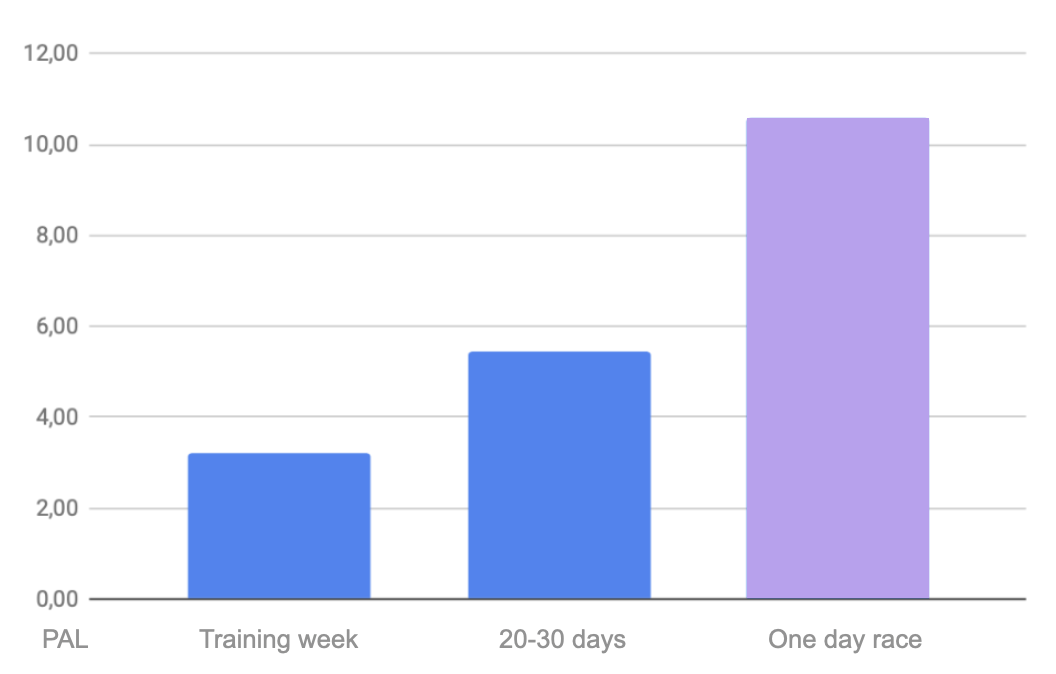
- I spend an average of 8300cal/day and a PAL of 5.58 (analyzed with doubly labeled water for the first 7 days)
- I enjoyed 12 beautiful sunsets and 11 amazing sunrises while climbing.
- I didn’t saw any person on 2 days.
- The summits I meet the most people were Aletschhorn, Monte Rosa, Matterhorn and Gran Paradiso.
- Most “enlightening” moment was climbing up Weisshorn, with the sunset, the broken spectrum, and feeling like flowing up.
- To recover, one of the things I drank the most was oregano infusion with coconut oil and Beetroot, ginger and curcuma smoothie.
- The night I slept the best was at Eccles bivi, only for 3h but very deeply.
- I used 4 pairs of gloves during the crossing. All of them were completely worn, with holes in all the fingers.
- I did climb up or down more than 160 different routes during the trip. Some were nice, some very nice and some not so much. The ones I enjoyed the most, for its rock quality, the ambiance and/or the aesthetics were the Lauteraarhorn-Schreckhorn traverse, Dom-Täschhorn, Rimpfischhorn, East ridge at Dent d’Herens, Arbengrat at Ober Gabelhorn, Rothorngrat at Zinalrothorn, Schaligrat at Weisshorn, Jorasses-Rochefort, Aiguilles du Diable, Arête du Brouillard.



Leave a Reply