EUROPARC is the winning proposal for the European Parliament (competition 2020) that mysteriously was never further developed. The project is the collective effort of a Pan-European team consisting of Coldefy (FR), Carlo Ratti Associati (IT), Ensamble Studio (ES), JDS (DK) and NL Architects (NL) with the support of UTIL (BE) and Ramboll (DK).
A model of EUROPARC is currently on display at Aedes in Berlin in the framework of the Democratic Design exhibit still on show until January 28.
The European Parliament building in Brussels, the so-called Paul-Henri SPAAK building, is often referred to as CAPRICE des DIEUX, literally translating to the “Whim of the Gods”: a heavenly mild and creamy soft ripened cheese in a unique oval shape: “Pur par Nature”
The SPAAK building, no longer meets functional and environmental standards. Through selective demolition, material reuse and new insertions, the design re-imagines the Parliament as an ecological and democratic landmark, providing optimal working conditions and a new degree of openness, accessibility, and transparency fostering new connections.
Its preserved structure reduces the carbon footprint while a Civic Foyer could be created serving as a new public passage through the SPAAK connecting Palais de Bruxelles and Parc Léopold: a new route through the city that finally provides an inviting entrance for the Parliament.
The adjacent Spinelli building obscures the view. A careful incision along the Station Europe-axis creates an open-air gateway towards the Parliament and liberates the wonderful inviting gesture latently present in the Spinelli.
A high-performance facade braces the structure, integrates sustainable climate control, and redefines the identity of the Parliament.
The current Chamber is considered too small and will be relocated to a higher and more central position, with panoramic views to and from the city.
The rooftop garden unites vegetation from all member states, forming a European ecosystem that references the ancient Agora and facilitates encounters between politicians and the public.
The Black Redstart originally inhabited stony ground in mountains, particularly cliffs, but since about 1900 has expanded to include similar urban habitats including bombed areas during and after World War II and large industrial complexes that have the bare areas and cliff-like buildings it favours. (Wikipedia)
The rather melancholic perhaps even desolate “rattling song and tick call” is the delightful Sound of the Zuidas.
Thank you auau Kurator*innen for inviting us to be part of the exhibition series “Neighbors”.
Our contribution, currently on show at the blrm Architekt*innen in Hamburg explores the potential impact of books on public space.
The exhibition features two facilities centered around books: Forum Groningen and Brug 171. These two spaces could not be more different in scale, yet both represent successful variants of “Third Places” – social environments that exist outside of home and work.
The Forum, a vast cultural facility in the heart of Groningen, sometimes referred to as a “Kultur Gebirge,” was conceived as an effort to revitalize a neglected part of the historic city by introducing a public library.
On the opposite end of the spectrum lies Brug 171, a modest intervention adjacent to the office of NL Architects: a remarkably successful adaptation of an underutilized public space, initiated by a homeless artist from the US, later embraced by the local community, and now a thriving spot for exchanging books, socializing, or simply waiting for the bridge to close.
It is evident that while the Forum has evolved far beyond the role of a traditional library, functioning as a dynamic hub with various purposes, such a multifunctional approach is seldom observed in Germany. The roles that libraries play in Germany and the Netherlands appear to differ slightly. What might account for the differences between these ‘neighbors’? This exhibition aims to initiate a comparative study to explore these questions.
As part of the exhibition, there is an attempt to recreate the vibrant social interaction seen at Brug 171 in St Pauli by installing a public bookshelf at the entrance of the blrm Architekt*innen headquarters. The entrance area of their remarkable office shares similar qualities: an inviting canopy that offers shelter for both the content of the bookshelves and its visitors, hopefully providing an ideal setting for such an initiative.
This interactive feature will invite not only exhibition visitors but also the neighbors to engage with the space and with one another.
Concept, Research and Exhibition Design: NL + Tom Deichsel
Brug 171 is an important node in the network of Amsterdam. The bridge was designed around 1930 by Piet Kramer, one of the main architects of the ‘Amsterdam School’ movement, often linked to German Brick Expressionism. The drawbridge opens several times each day to let tall ships and cargo pass. For the operation it features a wonderful bridge keepers house (now obsolete due to the introduction of centralized remote control and recently turned into a hotel room: sweet: ) On the other side of the canal a generous and inviting ‘abri’ is located: a covered space were you can wait until the bridge is closed again, a sophisticated ‘bus stop’.
Since a few years a Public Bookshelf came to life in this shelter. A public bookshelf or free library, book swap, or street library –Minibieb or Buurtbieb in Dutch- is a cabinet placed in public space which can be used for the exchange of books without the administrative rigor (or cost or potential loss of anonymity) associated with formal libraries. These Bücherbuden come in endless variations and are omnipresent since the early nineties. In Germany alone over 3000 ‘lilliput libraries‘ are documented. Several online maps are available indicating the locations of these initiatives.
Brug 171 is located directly next to our office. We witnessed its emergence as an informal ‘third place’. A homeless artist from the US turned the ‘bridge shelter’ into his studio. He collected an endless pile of ‘carefully’ curated household goods that he found along the sidewalks, including books. However at some point another neighbor came along that had just before discovered the potential of Minibiebs on a nearby square. He now ‘curates’ several sidewalk libraries and introduced a more orderly arrangement: Billy, the iconic IKEA bookcase, with over 140 million sold, is his preferred building material. Six white shelves (80x28x202 cm and 40x28x202 cm) were slightly modified to fit the dimensions of the existing structure with its curvy backwall.
Brug 171 has become immensely popular. Every single time we pass people are browsing through the content on the shelves. It seems to catalyze social interaction. What determines the success of this particular book shack?
The marvelous design with its generous canopy apparently forms the ideal backdrop for such an initiative. The cantilevering roof provides precisely the right amount of cover and openness for comfortable engagement. The shelter keeps the books dry and prevents the Billies from disintegrating. The existing structure by Piet Kramer features two cute rounded sidewalls, in brick, for extra protection. These small ‘cheeks’ have precisely the same dept as the Billies; the flimsy sidewalls of the shelves are hidden: a truly miraculous fit. And the shelves are white, so the emphasis is clearly on the books.
Since it is located on the bridge an entire neighborhood is funneled through it, creating instant clientele. And if the bridge is open, you might as well check out some books while waiting. The ‘nature’ of the neighborhood itself might also play a role. It has a background as a squatters quarter (not too long ago it was a no go area for police), with many activist. Although pretty much gentrified by now the residents are still quite social and open minded. Not everyone is rich.
Another aspect is the scale of the operation: it is bigger than most lilliput libraries. The entire length of the bookshelves is about 20 meters: quite a large number of books can be on display. The size of the shelves allows for several people engaging with the books at the same time. Even bigger set-ups exist elsewhere in the city. The drawback of these might be that the bigger Minibiebs require more effort in keeping them well organized. The number of 6 Billies proofs ideal.
Popularity in itself perhaps is a factor too: people bring and take frequently; new content is on display all the time: the perpetual renewal of the stock triggers return visits.
The curatorship is most essential. A small group of volunteers arranges the shelves on a regular basis; they have been categorized in compartments with different genres: specific sections for novels, crime, chick lit, children’s books (on the lower level), philosophy. There is a spot for odd sized coffee table books. And also for English, Deutsch and Français which makes the space interesting for foreign speakers as well. ‘Crappy’ books, like manuals about Windows 2000 for instance, are removed.
The neighbors seem to take the initiative seriously. The involvement is profound and inspiring. Occasionally garbage collectors bring books they find along their route.
In the words of Tijs van den Boomen in Dutch newspaper NRC: “I found a fairly intact copy of the pre-war history of Amsterdam, written by Richter Roegholt. I wasn’t looking for this book, but it found me and so I’m reading it now.
Recently we visited our dear friends of ABT. In their very nice office building in Delft large photographs are on display of projects they have been working on. This one caught my eye: the renovated Hoog Catharijne.
When it opened in early seventies, Hoog Catharijne was one of the most controversial buildings in the Netherlands. An immense shopping mall, a brutalist ‘flying carpet’ with an endless interior, hoovering over the Utrecht Central Station .
“The most vulgar nightmare that ever emerged from the corrupted brain of an architect” according to novelist Gerrit Komrij.
This sublime biotope for heroin junkies in the eighties was designed by three architects: G.J. van der Grinten, Bart van Kasteel and K.F.G. Spruit. During our studies we had learned that Joost Van Grinten right after completion of the building turned to another profession: he became a violin builder! Quite a career change!
So, I thought the Stradivarius sign in the photograph was a tribute to this architect. But it turns out that it is just another clothes brand.
The city of Amsterdam recently introduced a speed limit of 30 Km/H for all its streets. When working on the IJburg Boulevard in 1999 we proposed a new sign: 31 Km/H. The idea was that it is more of a challenge to drive precisely 31 than roughly 30 … more people would stick to the limit.
WOS 8, the black rubber heat transfer station in Utrecht, is now officially a monument!
When the design process started there strangely was no location yet for this crucial facility providing warm water and heating for the first homes in Leidsche Rijn. There was no site! Still we had to get to it. Ornament and Crime was the first proposal addressing what seemed the most pressing concern of such unmanned building: vandalism.
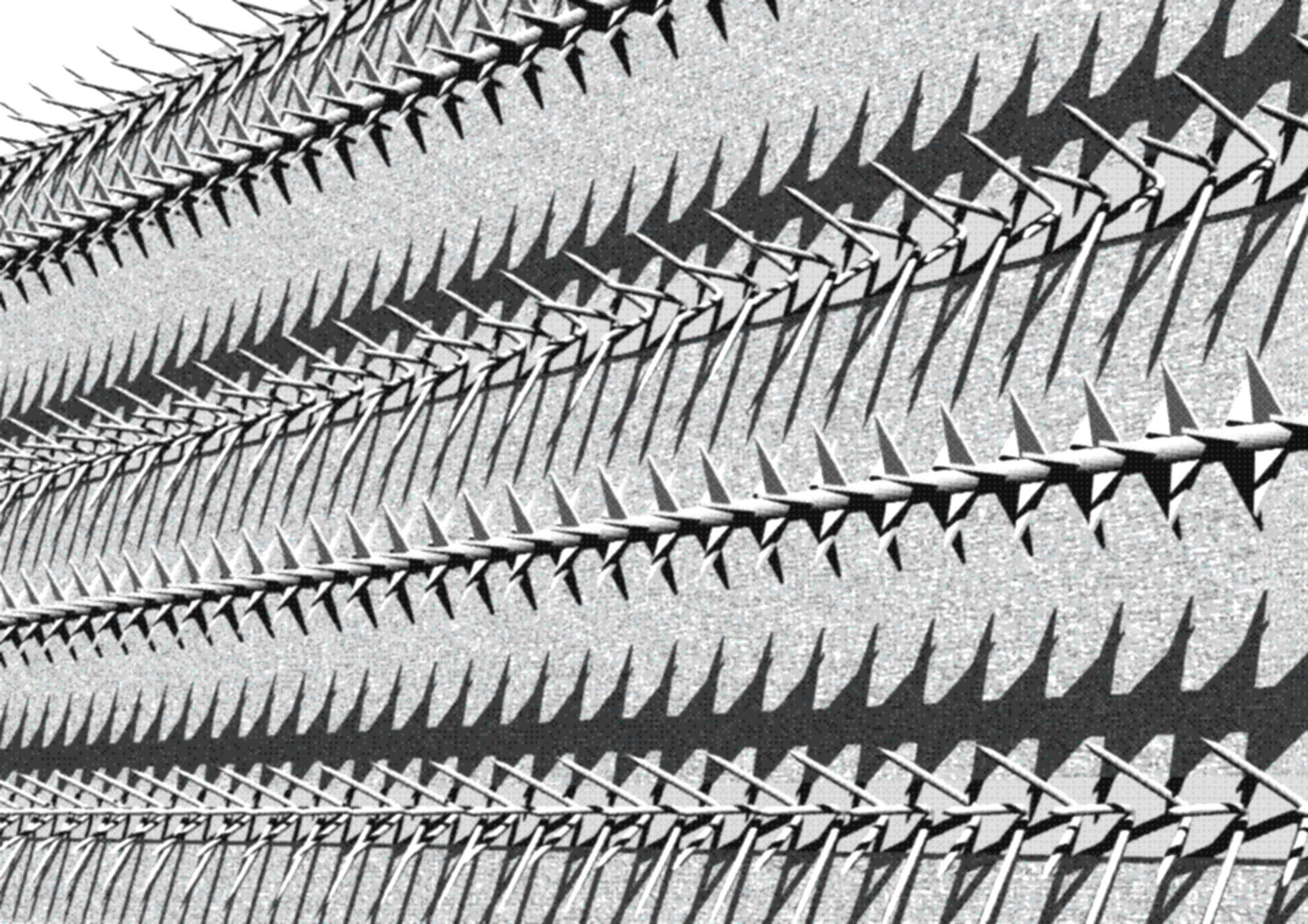
Ornament and Crime puts the hardware deployed to protect property from victimization to a fundamental use. Cobra-spikes, rotating spike-combs, glass splinters, super-spikes and barbed wire. Could we turn these usually unappreciated ‘needles and pins’ into functional decoration?
“The modern man who tattoos himself is either a criminal or a degenerate”.
“The evolution of culture is synonymous with the removal of ornament from utilitarian objects”.
“We have outgrown ornament; we fought our way through to freedom from ornament. Soon the streets of the city will glisten like white walls”.
The modern man who holds ornament sacred as a sign of the artistic super-abundance of past ages will immediately recognize the tortured, strained, and morbid quality of modern ornaments”.
Excerpts from Adolf Loos, Ornament und Verbrechen, 1908
A Dutch building tradition suggests to organize a celebration once the highest point of a structure is reached. The client provides food and drinks for all workers: Pannenbier! The current industrialization of the building process has a surprising side-effect. Modular building technology makes it possible that much of the construction takes place in the controlled environment of a production plant. This means that most workers are no longer present on the actual building site! So how to celebrate Pannenbier?
The Utrecht municipality has recently expressed its intention to classify 38 city buildings as ‘Young Monuments.’ These structures, dating from the period after 1970, hold substantial cultural-historical value for the city of Utrecht. These Young Monuments will receive a higher level of protection.




 NL Architects Blog
