11 January 2026

On writing a Liveable Rule of Life: The Three-Stranded Braid

ImageOver the years, I have written a lot here about how to write a Rule, what makes such a Rule "liveable", what I look for (or suggest dioceses look for) when reading a Rule. Throughout these posts, I have grown both in my appreciation of the importance of the task of writing one's own Rule, and in the way a truly liveable Rule aids the diocese in the discernment of an ecclesial vocation and readiness for or the prematurity of public commitments. I have also grown in my appreciation of the formative power of the very act of writing such a Rule, and sharpened my own sense of the journey a Rule should reflect and how it should function in assisting the hermit to continue to ever-deeper union with God. My concern has always been with what constitutes a liveable Rule because some Rules are clearly inadequate to the burden a liveable Rule must bear while others function for the whole of a hermit's life as a source of inspiration and empowerment in coming to live the silence of solitude not only as context, but as goal and charism of the solitary hermit life.

That last sentence is important because it points to the way a Rule really functions in the life of a hermit as her journey to union with God deepens and intensifies. As I have written over the years, really liveable Rules work first of all to remind us of our own story and the way God is and has been at work in that story. Of course, they can demonstrate not only how we understand the elements of canon 603, but they will also demonstrate implicitly how we have grown in embodying these elements (and the canon itself). As noted, they serve to inspire us when life gets difficult, and we wonder if we have discerned rightly about eremitic life (especially in this form)! They can "slow us down" when we are discerning possible avenues within the Church for ministry, study, living arrangements, and so on, and they will help empower us when the next step forward seems too daunting for us or when illness strikes, and our energy levels are low. Even more foundationally, Rules and the act of writing a truly liveable one over time can assist one's diocese in discerning with the hermit whether or not she is called to live this vocation in the name of the Church, as well as whether one's petition for admittance to profession or consecration is timely or premature.

Image
Several images will be familiar to readers; these capture some of this and including trellises, stair banisters, and maps or topographies (a more adequate image than map). A newer and important image summarizing what a Rule includes is that of a three-stranded braid. Each strand is critical, fundamental, while it is the whole braid that makes a Rule strong, liveable, and the vocation a gift to the Church. Those strands are 1) a sense of one's personal story, 2) an intimate understanding of the elements of canon 603, and 3) a sense of the ecclesial nature of this vocation.  The first strand need not be extensive (this is not an autobiography, after all), but it does need to be present and function like the key signature in a piece of music functions. That is, it will set the key in which everything else moves forward, sounds, and makes sense; it will allow one to articulate throughout the entire Rule, "why this vocation and no other?" Especially, it will allow those discerning with the hermit, and the Church more generally, to see the redemptive thrust of this vocation in one's life. That is, it will allow the way God is working in one's life through and within this vocation to become clear not only to oneself (this kind of writing always functions in this way), but to those discerning with one on behalf of the Church

The second strand involves the constitutive elements of canon 603. One should understand these on their face. What does it mean to speak of the silence of solitude, for instance, or stricter separation from the world and assiduous prayer and penance? How does one live religious obedience or religious poverty, for example? What does supervision by one's bishop look like and mean? However, these constitutive elements also function to provide access to the deeper world associated with c 603 as well. I sometimes speak of the canon as a topography of a journey one is making to ever-deeper union with God. The constitutive elements serve as doorways to or windows on depth, ultimacy, and Mystery. They are like facets of a gem, each of which allows one to enter into its depths and explore a reality that "the world", with all of its distractions and illusory character, obscures and may even deny. They are significant (meaningful) landmarks of a very specific and inner journey. An intimate knowledge of the constitutive elements of c 603 will include some sense of both of these levels of meaning. (These correspond to and allow the hermit to demonstrate not only her own story but the way God has been at work in a solitary eremitic context.)

Image
The third strand is less easy to describe. It includes, first of all, a sense that this vocation belongs to the Church before it belongs to the individual hermit. It will include a sense of the way eremitic life represents the heart of the Church, and how hiddenness functions therein. It will at least begin to demonstrate how the solitary eremitical vocation allows the hermit to serve in Christ as intercessor for the Church and world, and how it is that a journey to deeper union with God in Christ locates a hermit right where genuine intercession takes place. Here is the place where the Rule as Gospel rather than Law really assumes its full weight, and the redemptive thrust of the hermit's life and vocation achieves its full depth and clarity. This is the strand in which the hermit recognizes most fully that c 603 is a gift of God entrusted to the Church, a gift the Church entrusts to the hermit after sufficient discernment, and a gift that the hermit lives exhaustively so that the Church might truly be the Church she is called to be. It is a gift that the hermit in her hiddenness returns to the Church and lives for the sake of God, the Church, and the salvation of the world.

A profound sense of this third strand takes time to develop, and beginners will not likely be able to articulate all of the ways this vocation is an ecclesial one in their first (or even their second) Rule of Life. Even so, in the Rule they provide for profession, it needs to demonstrate some clear sense of this quality in the way it treats the issues of assiduous prayer and penance, supervision by one's bishop and/or delegate, avoiding individualism in all its forms, and serving the salvation of the world, for instance. Other dimensions of this vocation's ecclesiality will emerge over time, as well as in accompaniment by one's spiritual director, one's conversations with one's delegate, and with the diocesan formation team and bishop. Still, it needs to be a substantive part of the hermit's Rule because it is an element that allows the life to be coherent and witness appropriately to both Church and World -- even as it protects the hermit from individualism, misguided autonomy, and so forth.

Feast of the Baptism of Jesus

 Of all the feasts we celebrate, [today's] feast of the baptism of Jesus is one of the most difficult for us to understand. We are used to thinking of baptism as a solution to original sin instead of the means of our initiation into the death and resurrection of Jesus, or our adoption as daughters and sons of God and heirs to his Kingdom, or again, as a consecration to God's very life and service. When viewed this way, and especially when we recall that John's baptism was one of repentance for sin, how do we make sense of a sinless Jesus submitting to it?

ImageI think two points need to be made here. First, Jesus grew into his vocation. His Sonship was real and completely unique, but not completely developed or historically embodied from the moment of his conception; rather, it was something he embraced more and more fully over his lifetime. Secondly, his Sonship was the expression of solidarity with us and his fulfillment of the will of his Father to be God-with-us. Jesus will incarnate the Logos of God definitively in space and time, but this event we call the incarnation, encompasses and is only realized fully in his life, death, and resurrection -- not in his nativity. Only in allowing himself to be completely transparent to this Word, only in "dying to self," and definitively setting aside all other possible destinies does Jesus come to fully embody and express the Logos of God in a way which expresses his solidarity with us as well.

It is probably the image of Baptism-as-consecration and commissioning then, which is most helpful to us in understanding Jesus' submission to John's baptism. Here, the man Jesus is set apart as the one in whom God will truly "hallow his name." (That is, in Jesus' weakness and self-emptying, God's powerful presence (Name) will make all things Holy and a sacrament of God's presence.) Here, in an act of manifest commitment, Jesus' humanity is placed completely at the service of the living God and of those to whom God is committed. Here, his experience as one set apart or consecrated by and for God establishes God as completely united with us and our human condition. This solidarity is reflected in his statement to John that together they must fulfill the will of God. And here too Jesus anticipates the death and resurrection he will suffer for the sake of both human and Divine destinies, which, in him, will be reconciled and inextricably wed to one another. His baptism establishes the pattern not only of HIS humanity, but that of all authentic humanity. So too does it reveal the nature of true Divinity, for ours is a God who becomes completely subject to our sinful reality in order to free us for his own entirely holy one.

ImageI suspect that even at the end of the Christmas season, we are still scandalized by the incarnation. (Recent conversations on CV's and secularity make me even surer of this!) We still stumble over the intelligibility of this baptism, and the propriety of i,t especially. Our inability to fathom Jesus' own baptism, and our tendency to be shocked by it because of Jesus' identity,  just as JohnBp was probably shocked, says we are not comfortable, even now, with a God who enters exhaustively into our reality. We remain uncomfortable with a Jesus who is tempted like us in ALL THINGS, and matures into his identity as God's only begotten Son.

We are puzzled by one who is holy as God is holy and, as the creed affirms, "true God from true God" and who, even so, is consecrated to and by the one he calls Abba --- and commissioned to the service of this Abba's Kingdom and people. A God who wholly identifies with us, takes on our sinfulness, and comes to us in smallness, weakness, submission, and self-emptying is really not a God we are comfortable with --- despite three weeks of Christmas celebrations and reflections, and a prior four weeks of preparation -- is it? In fact, none of this was comfortable for Jews or early Christians either. The Jewish leadership was upset by JnBp's baptisms generally because they took place outside the Temple precincts and structures (that is, in the realm we literally call profane). Early Christians (Jewish and otherwise) were embarrassed by Jesus' baptism by John --- as Matt's added explanation of the reasons for it in vv 14-15 indicates. They were concerned that perhaps it indicated Jesus' inferiority to John the Baptist, and they wondered if maybe it meant that Jesus had sinned prior to his baptism. And perhaps this embarrassment is as it should be. Perhaps the scandal attached to this baptism signals to us that we are beginning to get things right theologically.

After all, today's feast tells us that Jesus' public ministry begins with a ritual washing, consecration, and commissioning by God, which is similar to our own baptismal consecration. The difference is that Jesus freely accepts life under the sway of sin in his baptism, just as he wholeheartedly embraces a public (and one could cogently argue, a thoroughly secular) vocation to proclaim God's sovereignty. The story of the desert temptation or testing that follows this underscores this acceptance. His public life begins with an event that prefigures his end as well. There is a real dying to self involved here, not because Jesus has a false self which must die -- as each of us has --- but because in these events his life is placed completely at the disposal of his God, his Abba, in solidarity with us. Loving another, affirming the being of another in a way which subordinates one's own being to theirs --- putting one's own life at their disposal and surrendering all other life-possibilities always entails a death of sorts -- and a kind of rising to new life as well. The dynamics present on the cross are present here too; here we see only somewhat less clearly a complete and obedient (that is, open and responsive) submission to the will of God, and an unfathomable subjection to that which human sinfulness makes necessary precisely in order that God's love may be exhaustively present and conquer here as well.

28 December 2025

Feast of the Holy Family

Image

 Of all the feasts I have come to love, the Feast of the Holy Family has grown to have the most meaning for me. That is, naturally, due to my close connection with Sister Marietta and how she has shown me the heart, mission, and charism of the Sisters of the Holy Family. A few years ago, when I had given Marietta a copy of my newly revised eremitical Rule, she gave me a copy of the Constitutions of the Sisters of the Holy Family (Fremont, CA). In that set of constitutions is an image of the painting by Jean-Francois Millet, 'Gleaners at Work'. These peasant women toil in the fields to garner all the bits of precious harvest that might otherwise be left behind to die or be raked together to be burned as waste/chaff. In the OT (see Ruth), the poor followed behind harvesters and were able to glean bits of wheat that had been dropped or otherwise abandoned as fruitless or without relative value.

So many were fed in this way and in many Christian kingdoms throughout the centuries, "gleaning" came to be a legal right of the poor who followed behind the reapers. Millet's picture was made in 1857 and featured the lowest classes of French rural society in a sympathetic way. Apparently, it was not well-received by the French upper classes. It is the charism of the Sisters of the Holy Family (1872-present)  to be present in our society to the weakest among us, especially families and children, in a way that allows the least and lost to be valued and nurtured in the way God does. 

Image
Families are meant to be sanctuaries where the weakest and neediest among us, our children, are loved, fed, taught, nurtured, and protected from harm. It is the family that is the natural context in which human beings grow to maturity and begin to realize the potential that is given to them by God. Every family is meant to be a network and context of loving and challenging relationships where an infant can become the kind of loving, trusting, and trustworthy human being who will one day go their own way in strength and integrity to change society and the world for the better with their presence. The potential for things to go awry in such a situation is huge, of course, but it is on today's Feast that we celebrate one of those graced occasions when family was all it was meant to be. 

This tiny community of love gave us a savior, someone like us in all things, yet without sinning! Yes, of cours,e Jesus was the Son and gift of God entrusted immediately to Mary, Joseph, and their relations, but it was the family, this holy famil,y that allowed Jesus to grow in his relationship with God, with God's People, and humankind as a whole --- and ultimately, to realize the potential of his identity and calling. When Luke recounts Jesus returning from Jerusalem with his family and says he "grew in wisdom and stature," this is what Luke (2:4) is speaking of. It was this Holy Family that was iconic of what every family is meant to be --- and too, what the Sisters of the Holy Family give their lives to help assure happens for every family and child to whom they minister.

Image
Bro Mickey McGrath, osfs
My thanks to God this feast day for the Holy Family and to the Sisters of the Holy Family, their Associates, all of whom renew vows and covenant bonds on this feast, and any and all who share in such an awesome ministry and mission! God comes to us in littleness and weakness; it is the Holy Family and those who act in their name who show us what it means to truly offer this God our hospitality, our love, and our commitment to (his) own enterprise of love. At a time in our own culture when children and families are being harmed at an alarmingly increased rate, I pray the image of the Holy Family, and the mission of the Sisters of the Holy Family to carefully glean so that nothing and no one might be lost or treated as inconsequential stubble and fruitless chaff, will be a prophetic image and mission we each and all make our own. 

25 December 2025

A Contemplative moment: Haphazard by Starlight

Image

BC:AD

This was the moment when Before
Turned into After, and the future's
Uninvented timekeepers presented arms.

This was the moment when nothing
Happened. Only dull peace
sprawled boringly over the earth.

This was the moment when even the energetic Romans
Could find nothing better to do
Than counting heads in remote provinces.

And this was the moment
When a few farmworkers and three
Members of an obscure Persian sect

Walked haphazard by starlight straight
into the kingdom of heaven.

by U. A. Fanthorpe

Taken from Janet Morley's Advent/Christmas collection
of poems, haphazard by starlight


Where God Dwells

Image
[[ Sister Laurel, what does it mean to say, "No hermit should get along with the temporal Church"? (I think temporal here is opposite spiritual.)]]

I'm afraid I can't really answer your question. My understanding of the Church says it is an institution that exists in space and time with dimensions that transcend these. It is spatio-temporal at the same time it participates in the life of God, and thus, it anticipates the Kingdom of God. Thus, it makes no sense to me to suggest that no hermit should get along with the temporal Church. I am aware of one person online who divides the Church into temporal and spiritual, and also speaks as though one can be spiritual without also being temporal, but to be frank, that just makes no sense. After all, the Risen (and differently embodied) Christ is present in our world and is mediated by spatio-temporal things. This is why we have sacraments, of course! It is also why we celebrate today's Feast of the Nativity of Jesus and the beginnings of a process of Incarnation wherein Jesus grows to full stature as Son of God.

In fact, one of the most important truths (and one of the most difficult) about the reality we call Christianity is that it is rooted in historical events. God comes to us in a human being and is most exhaustively revealed in Jesus' death on the cross and resurrection from the dead. Even the appearances of the risen Jesus to the scared and dispirited disciples following his death are marked by events underscoring both the historicity of the events as well as their transcendent nature. Disciples touch the wounds, Jesus cooks and eats fish on the beach, even as he is capable of walking through walls, etc. Christianity is all about God making human history his own. It is not about a devaluing of time and space, but a transfiguring of these. This is why the Scriptures speak of God making a new heaven and a new earth where all will dwell in harmony. Our ultimate hope is that the God who reveals himself as Emmanuel will remake the whole of reality in the power of the Spirit and dwell with us in this new reality.

Image
The idea that only the spiritual counts while the realm of the spatio-temporal should (or even can) be eschewed is a Gnostic one and thus, quite old. (It is Platonic as well, and finds contemporary representative in The Catholic stress on Sacraments demonstrates that God comes to us in the things of this earth, the temporal, if you like. Bread and Wine are raised to their highest potential (made infinitely nourishing) and made capable of truly mediating Jesus and the power to be a single family to us. Sacraments are not about the spiritual alone, but the spiritual made real in the spatio-temporal and material. The Church, and here I mean the historical reality that is called the primordial sacrament, is precisely the place where human beings are transfigured and made new by the power of the Holy Spirit. God is certainly Spirit and eternal, but what is also true is that God has chosen to be Emmanuel, God With Us, here in this world with all its spatio-temporal problems and limitations. 

There is no other Church than the historical one we all know. Yes, it has different dimensions, and for that reason we speak of the Church militant, or the suffering Church, or the Church triumphant, but it is still one Church, and it is a historical (spatio-temporal) reality informed by the presence of the Trinity. Catholics embracing eremitical life do so within this historical Church. That is especially true when they do so publicly, as "Catholic Hermits" in ecclesial vocations lived in the name of the Church. Moreover, we do so as human beings who are thoroughly conditioned by space and time, even as we allow God to be Emmanuel and the Holy Spirit's transfiguration of all we are and know. As we move through Advent into Christmas, it is a good time to remember that every religion except Christianity tried to escape history to bind back (re-ligio) to God. Christianity is the only faith we know whose God assumed flesh and came to dwell with us, then made a place for us (newly embodied human beings like the risen Christ) in his own eternal life, and promises a new heaven and new earth where He will be all in all

Image
The nativity of Jesus marks the coming of this God among us, and that has always been a scandal, though especially to those with a Gnostic mindset. The scandal is increased with Jesus' crucifixion and death. A God who could allow himself to be "touched" (not to say tainted) by such realities and participate in our own humanness while raising us to participate in his divinity (theosis) was and, it appears, remains a stumbling block for some. The hermits I know take God as Emmanuel seriously. They take their own call to union with God seriously as well. And while they do live a stricter separation from the world, they are very careful in the way they define this reality. When I was newly consecrated and began this blog, I wrote the following. I think it is pertinent to your question.

[[. . . First of all, "the world" does not mean "the entire physical reality except for the hermitage or cell"! Instead, the term "the world" refers to those structures, realities, things, positions, values, etc, which are antithetical to Christ and promise fulfillment or personal [dignity and] completion apart from God in Christ. Anything, including some forms of religion and piety, can represent "the world" given this definition. "The world" tends to represent escape from self and God, and also escape from the deep demands and legitimate expectations others have a right to make of us as Christians. Given this understanding, some forms of "eremitism" may not represent so much greater separation from the world as they do unusually embodied capitulations to it. (Here is one of the places an individual can fool themselves and so, needs the assistance of the church to carry out an adequate and accurate discernment of a Divine vocation to eremitical life.)]]

Image
It seems to me that anyone who divvies reality neatly up into the temporal and the spiritual, for instance, and tries to live in this way is really fooling themselves. On this Feast of the Nativity, it is particularly important that we learn to let go of any theologies that take the embodiment of divinity and the spiritual less seriously than Christianity calls us to do. Human beings ARE embodied Spirit. We don't merely have bodies, we ARE embodied.  Pope Benedict XVI (as Joseph Ratzinger), wrote in his Eschatology, Dogmatic Theology vol 9, about the Christian sense that the human soul yearns to be embodied and, following Thomas Aquinas, is actually the form of the body -- not the other way around as when the body is thought of as a container for the soul and the soul is thought to escape the body at death with heaven conceived of as the dwelling place of disembodied spirit! Both Jesus' bodily Resurrection and Ascension counter this understanding. So does Mary's Assumption.

Thus, on this Feast, we must take time to appreciate how it is that, in Christ, we see God becoming Emmanuel as he had willed from the beginning. The Divine, the Eternal and Spiritual, makes the spatio-temporal and material its truest home. Like Jesus did exhaustively, we are each called to allow the Holy Spirit to live in us and enliven us fully. In this way, in Christ, we ourselves become Emmanuel, God With Us. If we can take Christianity seriously, and not replace its sacred materialism with neo-Platonic or Gnostic thought, which is what our thought of a disembodied heaven reflects, we will take historical (the spatio-temporal) reality seriously as the place where God wills to dwell "on earth as it is in heaven". Hermits, especially, are called to believe this foundational truth of our faith, to pray this petition, and to allow it to be realized in their lives. In this way, they become ecclesiolae, little Churches, that are both sacramental and prophetic precisely because they are simultaneously historical (embodied) and enlivened by the Holy Spirit (spiritual). Similarly, we will begin to prefigure the coming of that new heaven and new earth where all reality is sacramental, and we ourselves have "grown to full stature" as embodied Spiritwhen God is all-in-all

All good wishes for a wonderful Christmas!!

22 December 2025

Tracing the Roots of Canon 603: A Brief Look at Hermits in the 13-14 C

Image
[[Dear Sister Laurel, I've read what you wrote about why c 603 came to be, but what about before c 603? Isn't it the case that people could just go off and become a hermit on their own just because God called them to this? Isn't c 603 something of a novelty? Because hermit life is so old I think people should be cautious about taking on a form of the life that is novel. You can understand that, can't you? Also, I think [the hermit you disagree with on all of this] has a point about wearing habits like those in religious communities. Is that another novelty you came up with because you had been a religious in a community?]] (Redacted from much longer email)

It may surprise you, but c 603 is not absolutely unique. Yes, it is binding universally and establishes hermits in law in the consecrated state and that is new (there was no mention of hermits in the older 1917 Code), but there have been canons in the Church before that bound hermits from this or that diocese in very much the same way c 603 does today. Because I don't much like copying long texts from other sources here, what I would like to do is quote a couple of paragraphs from a book including hermits and recluses of the Middle Ages that touches on the way hermits were regarded, the authority of the local bishop, and the service of investiture with the habit. This is a summary without detailed examples --- though these are available for the asking. I may also add something about the nature of the hermitage and solitude in the hermitage that also conflicts with the person you have referred to in your question, but that depends upon time. Since it is an important issue I could also hold it for another post.

Image
Writing about hermits in the early 14 C and before, Edward L Cutts says in Scenes and Characters of the Middle Ages, [[ A man could not take upon himself the character of a hermit at his own pleasure. It was a regular order of religion, into which a man could not enter without the consent of the bishop of the diocese, and into which he was admitted by a formal religious service. And just as bishops do not ordain men to holy orders until they have obtained a "title," a place in which to exercise their ministry, so bishops did not admit men to the order of Hermits until they had obtained a hermitage in which to exercise their vocation.]] (page 98)

Cutts then examines the nature of a vow made by a hermit. The form is taken from the Institution Books of Norwich, lib.xiv. fo.27a: (I have translated this into contemporary English just for this article.) [[I, John Fferys, not married, promise and avow to God, our Lady Saint Mary, and to all the saints in heaven, in the presence of you reverend Father in God, Richard bishop of Norwich, the vow of chastity, after the rule of Saint Paul the hermit. In the name of the Father and the Son and the Holy Ghost.]] (dated in the Chapel of Thorpe) (pp 98-99)

Image
Here I simply want to point out the similarities between c 603 professions and this one. The Church today takes the time to discern the nature and quality of the vocation before them, she makes sure that the candidate for profession can take care of herself (i.e., is self-supporting in some substantial and stable sense), has a proper place to live where she can carry out her ministry, and requires that she writes a proper Rule of Life in light of which she will live her profession. John Ferris, above, apparently was able to use the Rule of Saint Paul the Hermit, but all of this including the ascertainment of Ferris's unmarried state (part of what I often call "the canonical freedom" to enter another canonical state of life) is familiar to anyone with a knowledge of c 603. For many years now, I have been accused of supporting a way of eremitical life that is a distortion of the "tried and true" way of becoming a hermit, namely, by just going off and becoming one, but here, in an example from 700 years ago it is very clear that c 603 has picked up in a careful and faithful way, something that was already established in the Church in the early Middle Ages at least. Canon 603 is not novel except in what it establishes in universal law.

Image
Cutts also summarizes the service for habiting and blessing a hermit (from "Officium induendi et benedicendi heremitam"). This is taken from the pontifical of Bishop Lacy of Exeter (14C.) [[It begins with several psalms; then several short prayers for the incepting hermit, mentioning him by name. Then follow two prayers for the benediction of his vestments, apparently for different parts of the habit; the first mentioning 'hec indumenta humilitatem cordis et mundi contemptum significancia," -- these garments signifying humility of heart and contempt of the world; the second blesses "hanc vestem pro conservande castitatis signo,"-- this vestment the sign of chastity [in celibacy]. The priest then delivers the vestments to the hermit kneeling before him with these words, "Brother, behold we give to thee the eremitical habit (habitum hermiticum), with which we admonish thee to live henceforth chastely, soberly, and holily; in holy watchings, in fastings, in labours, in prayers, in works of mercy, that thou mayest have eternal life and live forever and ever." And he receives them saying, "Behold, I receive them in the name of the Lord; and promise myself to do so according to my power, the grace of God, and of the saints helping me." Then he puts off his secular habit, the priest saying to him, "The Lord put off from thee the old man with his deeds;" and while he puts on his hermit's habit, the priest says, "The Lord put on thee the new man, which after God, is created in righteousness and true holiness." There follows a collect and certain psalms, and finally the priest sprinkles him with holy water and blesses him.]] (Op Cit. p 99)

Image
There are numerous descriptions of the nature of the eremitical habit in this particular chapter of Cutt's book, but they are all pretty similar in certain ways. They tend to have a tunic, scapular, and perhaps a cincture as well as a hood or cloak with hood. Some have TAU crosses, many take up the hermit's staff, and the colors of these various habits differ, though blue, brown, black and grey are prominent. Cutts also refers a bit earlier in the chapter to habits worn according to Papal authority for the "Eremiti Augustini" which are constituted the same way though with white tunic and scapular and (for choir or going out) a black cowl and large hood. 

Image
Habits were important, as they are today, because people of all ranks and stations became hermits and most hermits dealt with those from all ranks and stations. Let me point out briefly then that while a habit signifies poverty, it also allows a person to move easily between various social strata without having to be concerned with "dressing the part". In this sense too, the habit is a sign of stricter separation from the world and its various strata. For the purposes of this post, however, what I really want to make clear is that the clothing of a hermit in a religious habit is not new with me or even with c 603 itself. It goes back much further than the Middle Ages. Though I have only referred back as far as the 13C here in this post, I have noted before that the giving of the hermit's tunic is linked even to the Desert Fathers and Mothers.

I sincerely hope this is helpful to you and gives you a different perspective on what is novel or not in c 603 eremitical life and in what I write here. While I believe there are some relatively novel things about what I write here, I also believe they are deeply rooted in the living tradition of eremitical life and assist hermits and dioceses in discerning, forming and living these vocations well in a way that is truly edifying for the entire Church and world. After all, c 603 has to be contextualized to be understood, not just in terms of contemporary life, but also in terms of the whole history of eremitical life. I will hold for another post what Cutts has to say about the nature of hermitages and solitude, especially regarding the variety of ways solitude was provided for in hermitages. In this too you will find c 603 and what bishops allow are not so novel as all that.

21 December 2025

Why Make Vows to or be Consecrated by a Bishop Rather than God?

Image
 [[Sister Laurel, why would you, or anyone really, want to make vows to or be consecrated by a bishop instead of God? Why accept someone who is merely a "stand-in" for God? Why not let God consecrate you directly as a hermit if that's so important to you? Do you love the temporal Church more than the spiritual? What happens when you grow spiritually enough to let God act in your life?]]

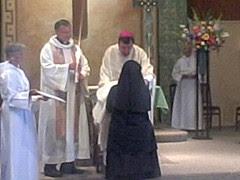
Where to begin? First, thanks for your questions (and, despite the borrowed language and accusations, I am assuming they are your own). They are timely for Christmas, as I hope to be able to show you. Let me begin by correcting some significant misunderstandings. First, my vows are made not to the bishop but to God. They are made in the hands of the bishop, yes, but they were and are made to God and represent part of an official act of worship in the Roman Catholic Church. The others witnessing my profession and receiving this act on behalf of the Church serve God in this way. In other words, they participate in this act of worship in their unique roles. Everything that happens does so in the Name of God. 

To say this is not to point to people doing something instead of God, but to people acting because of God and in and through the very authority, power, and presence of God. Secondly, I have been consecrated by God, not by the bishop serving as a "stand-in" for God. God is certainly mediated in many ways in the Mass and in the Rite of Profession, including in the actions of the bishop, but it is still God doing the receiving of vows, or consecrating, and commissioning me as a hermit of the Local (Diocese of Oakland) and Universal Church. There is a difference between standing in for God, in the way you seem to be using the term (i.e., as somehow opposed to or other than God acting himself) and acting to participate in the actual mediation of God's presence. 

Image
It is important, I think, to realize that each person standing with me at the chair during my profession or nearby me as the solemn prayer of consecration was prayed over me was participating in an act of worship and mediation. God was actively present within, among, and to everyone in that Church that day. In fact, the entire Church in heaven and on earth was present and worshipping God as they heard, supported, and rejoiced with me that day. (I was keenly aware of this, especially during the Litany of the Saints!) This was very much about what we pray for in the Lord's Prayer when we ask that God's will be done on earth as it is in heaven. Similarly, this was an experience of heaven and earth interpenetrating one another, because this was the historical Church open to the transcendent God and the entire Communion of Saints and choirs of heaven acting in surprising and awesome ways right here in space and time. This is a hint of what the new heaven and new earth will look like, and it is not divvied up, as the Gnostics might have it, into the temporal and the spiritual, or the human and the divine!

Image
You see, I love the Church, the WHOLE Church in heaven and on earth. I recognize that God has chosen to reveal himself exhaustively in a historical (spatio-temporal) human person and to continue doing so to everyone who, in Christ, allows him/herself to incarnate God in our world. If you take anything away from Christmas this year, I hope it will be the fact that God did not eschew the historical, the spatio-temporal. He made it his own, not for a brief period of "slumming" as one author of a book on the Ascension put the matter, or an act of docetic play-acting, but in an act of costly kenosis and incarnation for eternity. Because of Jesus' life, death, resurrection, and ascension, there is no merely spiritual or merely spatio-temporal Church. Because of the Christ Event with its bodily resurrection and ascension, heaven and earth interpenetrate one another. God is not yet all in all, as Revelation puts the matter, but we cannot forget the way reality was changed in this Event --- both earthly and heavenly reality!! This is what God's reconcilation looks like. This is the way God does justice in mercy. God became Emmanuel in Christ and invites us, in Christ, to become Emmanuel as well. There is more to say about the importance of canonical acts, but I think this is good for now. Best wishes for a profound and profoundly revealing Christmas!

15 December 2025

Do Hermits Watch the News?

Image
[[Hi Sister Laurel, I wondered if hermits watch the news and if they don't, is this because they are turning away from the world? If they do watch the news, then why do they do this? Aren't they supposed to be separated from the world?]]

Interesting questions, thank you.  I can't speak for hermits generally in this, so let me answer in terms of my own life. I don't watch the news usually because I don't have cable, but I do catch up with things on my computer. I tend to listen to or watch several programs regularly, including Rachel Maddow (Mondays), along with the writing and videos of Heather Cox Richardson. Prof. Richardson, a historian at Boston College, does a daily letter and a video of what's going on. This last January, watching the news in any way whatsoever became really difficult for me, and because it is important for a hermit to know what is really going on, I decided I could not forego watching. Instead, I made some choices about what I would and would not watch and prayed before "the news," and also prayed and read Scripture afterwards.

So, why is watching the news (or catching this in some other way) so important that I had to add prayer periods to make it possible? It is critical, I believe, to have a strong sense of the suffering of the larger world, not in some general or abstract way, but through one's compassionate attention to real people and contemporary stories. More, it is critical to the hermit's vocation to be aware of the profound questions people struggle with and are, so that one may be an interceding or intercessory presence in the Church and larger world. At the same time, the hermit represents these questions; she poses her own and comes to embody the answer that is God in Christ. Beyond intercessory prayer, the hermit takes on a role as intercessor in Christ, and in all of this, she becomes more compassionate and loving in and of the suffering world. 

Image
It is critical that the hermit participates in the ongoing suffering of the world and in the life of God at the same time. Ponam in Deserto Viam sees the hermit's intercession not only as valuable in itself, but as a substantive preventative of self-centeredness that can come from a solitary life merely seeking personal holiness. Like any Christian, the hermit grows as she learns to love both God and mankind together. Ponam quotes Pope Francis: "prayer will be all the more pleasing to God and more effective for our growth in holiness if, through intercession . . . it is an expression of our fraternal concern for others. Of those who commit themselves generously to intercessory prayer, we can apply the words of Scripture: "This is a man who loves the brethren and prays much for the people." (2 Mac 15:14) in Gaudete et Exsultate, 154.

The primary world from which hermits maintain a stricter separation is that reality which is resistant to Christ, not the larger world of God's good creation. Yes, these overlap, and living the stricter separation appropriate to the hermit takes discernment and care because some separation from the larger world is essential to achieving the silence of solitude; still, relatedness is also part of true solitude, and intercession, in particular, is a matter of witnessing to the larger world. Turning away from everything outside the hermitage to pursue personal holiness alone is misguided and a betrayal of the eremitic vocation. Ponam in Deserto Viam points out that, "By interceding, the hermit brings into this world the image of the world to come, in which God will wipe away every tear (Rev 21:4) and the communion of saints will be fulfilled."

14 December 2025

Gaudete Sunday, Opening ourselves to a God of Surprises

Image

Advent is a time of preparation, a time when we ready ourselves to see God acting in our world in a new, special, and surprising way --- a way that comes to us from beyond anything we have ever imagined. Many of the season's readings encourage us to pay attention and do so in a way that allows a response that is truly worthy of us and the God who comes to dwell with us in smallness, powerlessness, and homelessness. One of the most striking to me is the passage from Matthew 11: They are like children sitting in the marketplace and calling out to one another: ‘We played the flute for you, and you did not dance; we sang a dirge, and you did not weep.’ What I have said about this before is: . . . it occurs to me that the people of "this" generation to whom Jesus spoke were seen as incapable of or entirely resistant to being themselves in response to whatever "tune" God plays or sings. It is an almost inconceivably tragic portrait of who we have become when the best analogy to that is of children who themselves resist or have actually become incapable of play! In light of this, I want to make two suggestions folks might practice in this preparation time for the celebration of Jesus' nativity. 

Approaching the Rest of Advent:

Image
First, take time to play --- take time for serious play in something both easy and absorbing. Jesus' example of children who are incapable of playing in ways that prepare them for adult roles in the Kingdom is a devastating one. Again, there is nothing more tragic than children who cannot play, who cannot enter into the games their playmates begin and encourage them in. The Jewish theologian Martin Buber once called play "the exaltation of the possible." Adults often have had the capacity for play bred right out of themselves and this has serious consequences for their capacity to be surprised by a God who is the ground and source of the (unimaginably) possible. We have been so conditioned to work incessantly (even at recreation) and to have the answer to everything (or to Google it immediately!), that we are often incapable of the play which allows the deep questions of our lives to surface. Therefore, the first thing we need to allow ourselves the freedom to do is play in a way, perhaps, we have not done in a while. Perhaps you paint or color, or love jigsaw puzzles; maybe you used to do photography. If so, time to take these up again --- gently, not obsessively, but with a quiet focus that increases attentiveness and openness to the new and unexpected. Play!! It's important and serious work, especially in preparing for the surprising coming of God!

Image
Secondly, while at play ask yourself the question associated with this Friday's Gospel and one of those associated with Advent in general, namely, [[What am I looking for?]] (This, along with the corollary, [[What am I being asked (or allowed) to see?]] would be wonderful questions to allow to rise within us before peering at the world through the lens of a camera, for instance. We are so apt to become aware of the unexpected and hitherto unseen at such times.) God is coming to dwell amongst us, even within us, so what are we looking for? What are we yearning for, dreaming of? What do we need this Christmas to be in light of Christ's birth amongst us?? We have taken the time to travel into the "desert" of play (and yes, it is a desert where we ourselves, God, and demons may be met!), we have relinquished control and allowed the eyes of our hearts to open gently and wide in this way. It is a perfect time to consciously "live the question" as Rainer Marie Rilke once reminded a young poet. We must allow ourselves to stop and explore the question, [[what did you come to see?]] Was it merely the expected or was it the unexpected? And how will we respond if and when the God of surprises comes? Imagine this!!! Prepare yourself!! Allowing the serious yet joyful living of such questions seems to me to be part of the very essence of play --- and also of Advent!

May we each open ourselves this Advent to become people who exalt in the possible, people who play and dream, and in this way are readied to partner with God in God's unimaginable enterprise of love!

12 December 2025

Our Lady of Guadalupe: God is the One Who Lifts up the Lowly (Reprise)

 Fifty years ago at Vatican II, the messiest, most passionate, and often "dirtiest" fighting to occur during the council happened during discussions of the Dogmatic Constitution on the Church, Lumen Gentium. Out of nearly 2400 bishops, the fight was divided almost exactly evenly between two factions, those nicknamed the maximalists and those nicknamed the minimalists. Both factions were concerned with honoring the greatness of Mary in our faith, but their strategies in this were very different from one another. The maximalists wanted the council to declare Mary Mediatrix of all Graces and to proclaim this as a new dogma in the Church --- never mind that the thrust of the Council was not toward the definition of new dogmas. They wanted the council to write a separate document on Mary, one that effectively made her superior to the Church.

ImageThe minimalists also wanted to honor Mary, but they wanted to do so by speaking of her within the document on the Church. They desired a more Scriptural approach to the person and place of Mary, which honored the dogmatic truth that Christ is the One unique Mediator between God and mankind. The Church would be spoken of as Mother and Virgin, for instance, and Mary would be seen as a type of the Church.

The minimalist position won the day (had only 20 Bishops voted differently it would have been another matter) and so, in Lumen Gentium after the Church Fathers wrote about the Mystery of the Church, Church as People of God, the hierarchical nature of the Church, the Laity, the universal call to holiness, Religious, and the Church as a Pilgrim people, they wrote eloquently about Our Lady in chapter VIII. Mary is highly honored in this Constitution --- as it says in today's responsorial psalm, she is, after all, "the highest honor of our race", but for this very reason the Church Fathers spoke of her clearly as within the Church, within the Communion of Saints, within the Pilgrim People of God, not as a rival to Christ or part of the Godhead, but as one who serves God in Christ as a model of faithfulness.

It is always difficult, I think, to believe and honor the Christmas truth we are preparing during Advent to celebrate, namely, that our God is most fully revealed to us in the ordinary things of life. We are a Sacramental faith rooted in the God who, for instance, comes to us himself in bread and wine, cleanses and recreates us entirely with water,  and strengthens and heals us with oil. Especially at this time of the liturgical year we are challenged to remember and celebrate the God who turns a human face to us, who comes to us in weakness, lowliness and even a kind of dependence on the "yes" we are invited to say, the One who is made most fully real and exhaustively known in the unexpected and even the unacceptable place. Advent is a time when we prepare ourselves to see the very face of God in the poor, the broken, the helpless, and those without status of any kind. After all, that is what the Christmas Feast of the Nativity is all about.

I think this is one of the lessons today's Feast of Our Lady of Guadalupe teaches most vividly. We all know the more superficial story. Briefly, in 1531, Juan Diego, an indigenous man and Christian, encountered a beautiful Lady on the hill of Tepeyac; she told him to ask the Bishop to build a church there. The Bishop refused and required a sign of the authenticity of Juan Diego's vision. Diego returned home to find his uncle dying. He set out again to fetch a doctor and avoided the hill where he had first met the woman and went around it instead --- he did not want to be distracted from his mission! But the Lady came down to him, heard his story about his uncle, reassured him his uncle would be well, and told him then to go to the top of the hill and pick the flowers he found there. Diego did so, gathered them in his tilma or mantle, and went again to the Bishop. Juan poured out his story to him and he also poured the flowers out onto the floor. Only then did he and the Bishop see a miraculous image of the Lady of Tepeyac hill there on the tilma itself.

ImageBut there was a deeper story. Remember that Juan Diego's people were an essentially subjugated people. The faith they were forced to adopt by missionaries was geared toward the salvation of souls but not to what we would recognize as the redemption of persons or the conversion and transformation of oppressive structures and institutions. It was more a faith enforced by fear than love, one whose central figure was, a la Anselm, a man crucified because an infinitely offended God purportedly willed it in payment for our sins. Meanwhile, the symbols of that faith, its central figures, leaders, and saints, were visibly European; they spoke and were worshipped in European languages, were dressed in European clothes, were portrayed with European features, etc. At best, it was hard to relate to; its loving God was apparently contradictory and remote. At worst, belief in this God was incomprehensible and dehumanizing. Moreover, with the "evangelizers" who had forcibly deprived the Indians of their own gods and religion came diseases the Indians had never experienced. They were dying of plagues formerly unknown to them, working as slaves for the institutional and patriarchal  Church, and had been deprived of the human dignity they had formerly known.

It was into this situation that Mary directly entered when she appeared on Tepeyak hill, the center of the indigenous peoples' worship of the goddess Tonantzin, the "goddess of sustenance". The image of the Lady was remarkable in so many ways. The fact of it, of course, was a marvel (as were the healing of Diego's uncle, the December roses Diego picked and poured out onto the Bishop's floor or the creation and persistence of her image on Diego's tilma), but even more so was the fact that she had the face of a mixed race (Indian or Mestiza) woman, spoke in Diego's own language, was pregnant, and was dressed in native dress. And here was the greatest miracle associated with OL of Guadalupe: in every way through this appearance the grace of God gave dignity to the Indian people. They were no longer third or fourth-class people but persons who could truly believe they genuinely imaged the Christian God. The appearance was the beginning of a new Church in the Americas, no longer a merely European Church, but one where Mary's Magnificat was re-enacted so that ALL were called to truly image God and proclaim the Gospel. One commentator wrote that, [[Juan Diego and millions after him are transformed from crushed, self-defacing and silenced persons into confident, self-assured and joyful messengers and artisans of God's plan for America.]] (Virgilio Elizondo, Guadalupe and the New Evangelization)

Here too, then, in the truly unexpected and even unacceptable place, our God turns a human face to those seeking him. He, and those who are from and of him, come to us in weakness and lowliness as one of the truly marginalized. In the process, we see clearly once again the God of Jesus Christ who scatters the proud in their conceit, unseats the mighty from their positions of power, and lifts up the lowly. During this season of Advent, Our Lady of Guadalupe calls us especially to be watchful. God is working to do this new and powerful thing among us --- just as he did in the 1st Century, just as he did in the 16th, just as he always does when we give him our own fiat.

11 December 2025

US Air Force One Voice


I thought this was a particularly apt song and production given the recent conversation here about Peter Damian's ecclesiology and Ponam in Deserto Via. I especially like the way the idea of "one voice" moves back and forth between singularity in plurality, and multiplicity expressing a single Spirit. (That is, sometimes "one voice" means a single voice in the midst of many, and sometimes it means many persons singing with the same Spirit.)  A hermit participates in and recognizes both realities in her solitude. Others, I believe, should be able to recognize the same in her.

My first experience of community was not Church; it was orchestra. So, when I hear something like this, it reminds me of that first awesome moment when the conductor brought down her baton and all of our individual parts, parts we had learned at home and only heard alone, came together in a sound I had never imagined or guessed was possible! It was my first introduction to a hint of the reality Peter Damian describes in his Letter #28. In one way and another, whether as a violinist playing in orchestras, a Franciscan praying in community or working in a clinical lab, a theologian reading the Scriptures and people like Peter Damian, or a solitary hermit journeying toward deeper union with God, it has always been about "surrendering to the Mystery," that both transcends and enlivens our world.

Question on Non-Canonical Hermits and the Danger of Individualism

Image
[[Sister Laurel, do you think non-canonical hermit lives are individualistic?]]

This is a great question, and an important one called for, not only by contemporary circumstances, but by the entire history of hermit life. So let me say that every hermit's life is tempted to individualism. What I have written about my own vocation is that being subject to canon law and the various elements of life in the consecrated state (supervision, rule or proper law, public role and visibility, public vows, etc.) helps avoid that temptation and assures a stronger bond to the whole Church. Because in this way of living eremitic life, the silence of solitude is not merely about being alone but is an availability to God that includes solidarity with others, the hermit is called to ever-deeper understanding and representation of the ecclesial dimension of the eremitic life. 

Non-canonical hermits are called to realize and represent the same truth of any hermit's role within the Church and world. What you may or may not remember is that years ago, I was asked if it was easier or harder to live either canonical or non-canonical eremitic life. My answer was that I thought it was harder to live as a non-canonical hermit. I wrote: [[While there are greater explicit rights and obligations associated with canonical standing, the discernment and profession/consecration with and by the Church ensures that one also experiences a greater correlative permission to stand in the face of the values of the world around us and to be the person one is called to be by God in his Church. That permission is part of what leads to greater freedom to be oneself.]]

Image
In the rest of the piece, I argued that I thought the constraints of canon law and the other elements of canonical life led to a freedom that was greater than that of non-canonical life because I defined freedom in terms of the power to be the persons God calls us to be. What I discerned with my Diocese and the persons involved in that process was that this was the way I could grow into the person God called me to be. I accepted the constraints of canon law, an approved Rule of Life, a Delegate who worked both on my behalf and that of the Diocese and Church more generally, and the profession of vows in a commitment that made me responsible for witnessing to the nature of eremitic life in the Catholic Church and the Church herself in this contemporary world. I also did so because I had the sense that I had something (both in terms of giftedness and limitations) that I was called to bring to the Church in this vocation.

If a non-canonical hermit makes a conscious choice to remain non-canonical, to embrace eremitic life on the basis of their baptismal consecration alone, because this is the way they perceive God calls them to realize their vocation to authentic humanity, then that is their way to the kind of freedom I experience within the canonical and consecrated state. If, as was the case in my own diocese for the first number of years I lived as a hermit, a person's diocese will not implement c 603, and will not consecrate c 603 hermits, then the person has, in the main, two alternatives and must determine which of these will lead to greater freedom and the power to become the persons God calls them to be. They may either live as a non-canonical hermit and revisit the possibility of consecration with their diocese from time to time over the years, or they may need to move to a diocese where c 603  is already implemented or will be implemented upon the appearance of a truly suitable candidate. Unfortunately, there are no guarantees here; the process of discernment is not necessarily easy. (As one Vicar I know put the matter, "It's not easy. I always thought the process of discernment was more art [than science]!")

Image
There is nothing automatically or inherently individualistic about non-canonical hermit lives, no. Neither is the canonical hermit life automatically free from individualism. Both are capable of being lived in the way c 603 and groups like the Camaldolese, Carthusians, Carmelites, et al. live them. I continue to believe it is harder because I am aware of the obligations and responsibilities that mark my own life precisely as a member of the consecrated state of life. Every day, and especially when I meet with other c 603 hermits in our "virtual laura", post here, or reflect on the beauty and nature of c 603 life, I am aware of not allowing my own life to become individualistic. Similarly, when I see the examples of "private" hermits who are present online, it seems to me that some are not aware at all of the danger of individualism, much less of the fact that they may well have fallen into this disedifying trap.

It is important to remember that eventually hermits died out in the Western Church, whereas in the Eastern Church, where hermits were always integrally tied to monastic communities, hermits never died out. Whether one is canonical or non-canonical, hermits are called to be actively involved in the liturgical and sacramental life of the Church. To sever ties with the Church and become a lone pious individual is to betray the very heart of the vocation within the Church and subject it to a quick death in its individualism. Non-canonical hermits who maintain their ties (say, through membership and activity as part of a parish) and who believe they are called by God to witness to the same realities canonical hermits are responsible for in law can, even if this is difficult, certainly avoid the temptation of individualism. Once again, I hope that such hermits will begin to reflect on and write about their lives as lay (or clerical) non-canonical hermits. Their witness is important and needs to be heard!

On Peter Damian's Letter #28 and the Ecclesial Nature of c 603 Vocations

Image
[[Hi Sister, you referred to Saint Peter Damian's Letter #28 (Dominus Vobiscum) and cited Ponam in Deserto Viam too. I am not clear why the ability to say, "The Lord be with you" is such a question. Also, Ponam in Deserto Viam speaks of two phrases in par 16. One is solitudo pluralis and the other is moltitudo singularis. I dont understand these or their importance, and I didn't hear Ponam make that clear. (I honestly read par 16 several times and just felt more confused.) Can you help me with this? Why begin with such a meaningless question and take it into the kind of difficult terms Damian does?]]

Important questions. Thanks!! One key to understanding the phrases in Par 16 of Ponam is Par 15. In these references, Ponam is exploring the nature of eremitical solitude and the way it represents and even defines the ecclesial role of the hermit life.  It says, [[In the Latin tradition, as Peter Damian (1007-1072) wrote. . .radical solitude most carefully defines the ecclesial role of the hermits' way of life. Hermits are like a microcosm of the world and the Church in miniature. Therefore, they cannot forget the Church and the world which they represent in their totality. The more one is alone before God, the more one discovers within oneself the deeper dimension of the world. With an expressive phrase, Peter Damian underlined this openness: 

. . .by virtue of the Holy Spirit, who is in each one and fills all, on the one hand one perceives a singularity [or perhaps singleness or solitariness] that has plurality in itself [solitudo pluralis], on the other hand a multiplicity that has singularity [or perhaps, singleness] in itself [moltitudo singularis].

Image
Then, as you know, Ponam (par 16) explains something of these two phrases, solitudo pluralis and multitudo singularis, and concludes, "The hermit's life is not one in which its subjective distinctiveness becomes the criterion of all. Rather, it is a life in which plurality (personal and social) finds meaning in the only One who is necessary. Thus, the complexity of the individual part is integrated as in a microcosm of the whole. True identity is rooted in a vital tradition that neither excludes nor rejects, but includes, integrates, and reconstructs." I think that it might be important to look at some of what Peter Damian says in his 28th letter. In some ways, I think he is clearer than Ponam manages in its brevity. Damian says, 

"Truly the Church of Christ is so joined together by the bond of love that in many it is one, and in each it is mystically complete. Thus we at once observe that the whole Church is rightly called the one and only bride of Christ, and we believe each individual soul, by the mystery of baptism, to be the Whole Church. . . . If you search diligently through the open fields of Holy Scripture, you will frind the Church is often represented by one man or one woman. And although, because  of the great number of people, the Church seems to be many parts, it is still one and simple in the mystical federation of one faith and one divine regeneration.. . .  And so we conclude . . . since the whole Church is symbolized in the person of one individual, . . .holy Church is both one in all and complete in each of them; that is to say, simple in many by reason of their unity of faith, and multiple in each through the bond of love and the various charismatic gifts [gifts of the Holy Spirit], since all are from one, and all are one." (The Fathers of the Church, CUA Presspp 262-263)

Peter Damian's letter goes further and speaks about hermits who might misunderstand the nature of their vocation: 

"It is possible that in their simplicity some of the brothers might be tempted while living alone to think that they are somehow separated from the community of the faithful, and that they would also be loathe to use the common language of the Church in their prayers." . . . For we are not here concerned with the number of persons but rather with the mystery of the Church's unity. Here indeed, unity does not exclude multiplicity, nor does multiplicity violate unity, for one body is at once divided among many members, and from the various members one body is made complete. Nor are many members lost in the unity of the body, nor is the wholeness of the body minimized in the multitude of its members." (Ibid. pp 271, 274)

Image
In recent years, I have stressed that the canonical eremitic vocation is ecclesial. This does not mean that other hermits, especially non-canonical hermits, do not belong in an integral way to the Church, nor that they do not give their lives to the Church. Instead, it means that canonical hermits have accepted a public role in the very life of the Church that reminds every person, at least implicitly, of the two dimensions Peter Damian and Ponam in Deserto Viam put at the center of understanding eremitical solitude (in our oneness we are always part of a multiplicity, and in our multiplicity, we are one in the Spirit). Part of this witness by hermits embracing ecclesial vocations requires a canonical commitment to the life of the Church as consecrated hermits in order to witness to the very nature of the Church and the consecrated life within it. Solitude in such vocations is marked by a serious and radical aloneness, and at the same time, it participates in and reflects community in an equally radical way. One source says it this way, [[the solitude of the hermit is a solitudo pluralis, a corporate solitude, and (her) cell is a miniature Church.]]

The canonical hermit participates fully in the Sacramental life of the Church. She prays the Church's official prayer (Liturgy of the Hours); she may join with other hermits in lauras --- including virtual lauras that are non-geographic and allow for the strengthening of ecclesial bonds and witness. She lives her life according to an approved Rule of Life and under the supervision of Bishops (and often, accepted delegates) and spiritual directors. She does not live an individualistic life where canon law is dismissed as something only legalists or the "less spiritual" or "more temporal" choose. Instead, she allows herself to become subject to additional canons beyond those associated with baptism alone, because she understands that hermit life is a radically ecclesial and incarnational life, that, in a unique way, sees the multiplicity in one, and the one in and as the many. She wants to witness to this double reality in her own life and to do so officially for the sake of the Church and world.** Of course, it goes without saying that no hermit is alone because she lives with and from God, but what is also true is that no hermit is ever alone because we each carry the entire Church with us in our solitude. In fact, we are that Church.

Image
While the question that begins Peter Damian's essay in this letter seems almost meaningless to contemporary readers, I personally love it. What I see Damian doing is taking a tremendously small act in the daily schedule of eremitic life, and demonstrating how it and, in fact, every single act done in cell is shot through with both the solitude and the multiplicity of the Church. This solitude and solidarity were what Pope Leo XIV spoke to in his address to hermits during recent Vatican festivities. Canonical standing, again, helps witness to these values and distinguishes the eremitical life from the individualism noted above. When I speak of the structure of canonical eremitic life protecting from the dynamics of "the world," the temptation to individualism is one of these.
___________________________________________
** When one does something officially, it really does have greater effectiveness than doing something unofficially. The very fact that the Church chose to create c 603 in response to interventions at the Second Vatican Council indicates the Church's openness to freshly evaluating or re-evaluating the importance of solitary hermits in the life of the Church as well as looking at the reality of religious life not associated with membership in an institute of consecrated life. The cogency of Peter Damian's ecclesiology in Letter #28 is strengthened by the contemporary establishment of c 603 and solitary hermits. These are very good reasons for the "official" or canonical establishment of the solitary eremitical life.