
1. A Heat-Wave equation in Morrey spaces
This notes is an exposition of the article written by me in join with full professor Lucas Catão de Freitas Ferreira and therefore no proofs will be given in general.
Throughout this notes, the symbol 


Here we are interested in a semilinear integro-partial differential equation, which interpolates the semilinear heat and wave equations which reads as follows

where 


where 


Differential equations of time-fractional order appear naturally in several fields such as physics, chemistry and engineering by modelling phenomena in viscoelasticity, thermoelasticity, processes in media with fractal geometry, heat flow in material with memory and many others. The two most common types of fractional derivatives acting on time variable 


Between interesting points obtained, let us comment about technical ones. Due to the semigroup property (21), further restrictions appear in our main theorems in comparison with classical nonlinear heat equations. Making the derivative index 


2. Morrey spaces
In this section some basic properties about Morrey spaces are reviewed. For further details on theses spaces, the reader is referred to Kato, Peetre, Taylor. Let 


where 


is a Banach space. For 


Taking 


Morrey spaces present the following scaling

and

where the exponent 

Let us define the closed subspace of 


This subspace is useful to deal with semigroup of convolution operators when the respective kernels present a suitable polynomial decay at infinity. In general, such semigroups are only weakly continuous at 


Morrey spaces contain Lebesgue and Marcinkiewicz spaces with the same scaling indexes. Precisely, we have the continuous proper inclusions

where 

In the next lemma, we remember some important inequalities and inclusions in Morrey spaces, see e.g. Kato, Taylor.
Lemma 1 Suppose that
,
and
.
- (Inclusion)
, i.e., if
and
then
- (Sobolev type embedding) If
and
then
- (Holder inequality) If
and
then
and
- (Homogeneous function) Let
,
and
. Then
, for all
.


We finish this section by recalling estimates for certain multiplier operators on 
In the next posts, inspired in the work of Taylor, we given a proof based in the Theorem 7 given in the post A fractional Hörmander type multiplier theorem.
Lemma 2 Let

and
Assume that there is
such that
for all
with
and for all
Then the multiplier operator
on
is bounded from
and the following estimate hold true
where
modulo polynomials with


3. Mittag-Leffler Function
Differential equations of time-fractional order is old, but even being old, the fractional calculus is little studied by mathematicians. Possibly, because many of them are unfamiliar with this topic and its applications in various sciences. After Liouville and Riemann, deep developments was obtained by many authors. Today, time-fractional order integral and derivative is known as Riemann-Liouville’s integral and derivative. More precisely, let 


and Riemann-Liouville’s derivative by

where 

Hardy and Littlewood give wider properties about this integrals. His showed, for instance, the boundedness of 


Related the theory of partial differential equations, much works is devoted to find an unified theory of Green functions associated to fractional problems. In this way, fractional diffusion-wave equation is a celebrity, and an unified theory of the heat equation and wave equation was obtained. Fujita, Schneider and Wyss, for instance, founds the special function to represent the Green function associated to the linear part of the diffusion-wave problem (FPDE)

such special function, is knew as Mittag-Leffler function. More precisely,

and the Green function, defined via Fourier inversion, is given by

which generate the following semigroup of operators 

In what follows, we recall some functions which is useful to handle the symbol of the semigroup 

and

Lemma 3 Let
and
be as in (18). We have that
and
for all
Moreover,
,
is a probability measure, and


Proof: Except for (22), all properties contained on the statement can be found in Fujita and Hirata-Miao when 

In order to prove (22), we use Fourier inversion and (18) to obtain

The desired identity follows by taking 

4. Some estimates
The aim of this section is to derive estimates for the semigroup 
Lemma 4 Let
and
There is
for all
![\displaystyle \left\vert \frac{\partial^{k}}{\partial\xi^{k}}\left[ \left\vert \xi\right\vert ^{\delta}E_{\alpha}(-|\xi|^{2})\right] \right\vert \leq C\left\vert \xi\right\vert ^{-\left\vert k\right\vert },\text{ } \ \ \ \ \ (23)](https://s0.wp.com/latex.php?latex=%5Cdisplaystyle+%5Cleft%5Cvert+%5Cfrac%7B%5Cpartial%5E%7Bk%7D%7D%7B%5Cpartial%5Cxi%5E%7Bk%7D%7D%5Cleft%5B+%5Cleft%5Cvert+%5Cxi%5Cright%5Cvert+%5E%7B%5Cdelta%7DE_%7B%5Calpha%7D%28-%7C%5Cxi%7C%5E%7B2%7D%29%5Cright%5D+%5Cright%5Cvert+%5Cleq+C%5Cleft%5Cvert+%5Cxi%5Cright%5Cvert+%5E%7B-%5Cleft%5Cvert+k%5Cright%5Cvert+%7D%2C%5Ctext%7B+%7D+%5C+%5C+%5C+%5C+%5C+%2823%29&bg=ffffff&fg=000000&s=0&c=20201002)
In the sequel we prove key estimates on Morrey spaces for the semigroup

Lemma 5 Let
,
and
. There exists
for all


Proof: Let 


![\displaystyle \begin{array}{rcl} F(D)f & =&[(-\Delta)^{\frac{\delta}{2}}G_{\alpha}(1)]f=h_{\alpha} (\cdot,1)\ast f(\cdot),\nonumber\\ (\lbrack(-\Delta)^{\frac{\delta}{2}}G_{\alpha}(t)]f)(x) &=&t^{^{-\delta\frac{\alpha}{2}}}\left( h_{\alpha}(\cdot,1)\ast f_{t^{\alpha/2}}(\cdot)\right) _{t^{-\alpha/2}}(x), \end{array}](https://s0.wp.com/latex.php?latex=%5Cdisplaystyle+%5Cbegin%7Barray%7D%7Brcl%7D+F%28D%29f+%26+%3D%26%5B%28-%5CDelta%29%5E%7B%5Cfrac%7B%5Cdelta%7D%7B2%7D%7DG_%7B%5Calpha%7D%281%29%5Df%3Dh_%7B%5Calpha%7D+%28%5Ccdot%2C1%29%5Cast+f%28%5Ccdot%29%2C%5Cnonumber%5C%5C+%28%5Clbrack%28-%5CDelta%29%5E%7B%5Cfrac%7B%5Cdelta%7D%7B2%7D%7DG_%7B%5Calpha%7D%28t%29%5Df%29%28x%29+%26%3D%26t%5E%7B%5E%7B-%5Cdelta%5Cfrac%7B%5Calpha%7D%7B2%7D%7D%7D%5Cleft%28+h_%7B%5Calpha%7D%28%5Ccdot%2C1%29%5Cast+f_%7Bt%5E%7B%5Calpha%2F2%7D%7D%28%5Ccdot%29%5Cright%29+_%7Bt%5E%7B-%5Calpha%2F2%7D%7D%28x%29%2C+%5Cend%7Barray%7D+&bg=ffffff&fg=000000&s=0&c=20201002)
that is,

where the symbol of 


and therefore,

Now, using Sobelev embedding (11), and afterwards (25), we obtain

because of (26).
5. Self-similarity and symmetries for a fractional-wave equation
The problem (1) can be formally converted to the integral equation (see [Hirata-Miao])

with

which should be understood in the Bochner sense in Morrey spaces, being 

From now on, we perform a scaling analysis in order to choose the correct indexes for Kato-Fujita spaces. A simple computation by using

shows that the indexes 


is a solution of that, for each 

Making 

Solutions invariant by (31), that is

are called self-similar ones. Since we are interested in such solutions, it is suitable to consider critical spaces for 

Consider the parameters

and let 


which is Banach with the norm

Notice that the norm (36) is invariant by scaling transformation (31).
From Lemma 1, a typical data belonging to

where 


Our well-posedness result reads as follows.
Theorem 6 (Well-posedness) Let
,
, and
. Suppose that
and
- (i) (Existence and uniqueness) There exist
and
such that if
then the equation (1) has a mild solution
, which is the unique one in the ball
. Moreover,
in
as
- (ii) (Continuous dependence on data) Let
The data-solution map is Lipschitz continuous from
to
.

Remark 1
- (i) With a slight adaptation of the proof of Theorem 6, we could treat more general nonlinearities. Precisely, one could consider (1) and (29) with
instead of
, where
,
and there is
- (ii) (Local-in-time well-posedness) A local version of Theorem 6 holds true by replacing the smallness condition on initial data by a smallness one on existence time
. Here we should consider the local-in-time space
and
such that
In particular, this condition is verified when

Let 


Theorem 7 Under the hypotheses of Theorem 6.
- (i) (Self-similarity) If
, then the mild solution given in Theorem 6 is self-similar.
- (ii) (Symmetry and antisymmetry) The solution
, when
- (iii) (Positivity) If
and
(resp.
) then

Remark 2 (Special examples of symmetry and antisymmetry)
- (i) The case
corresponds to radial symmetry. Therefore, it follows from Theorem 7 (ii) that if
- (ii) Let
be the reflection over the origin and let
be the identity map. The case
corresponds to parity of functions, that is,
is even and odd when
and
, respectively. So, from Theorem 7 (ii), we have that the solution
when
is even (resp. odd).
 and
and  . If for
  we have
 is a Fourier multiplier on
  ,
,  is a Fourier multiplier on
  , that is, if
 . If
. If  , the Fourier multiplier
 .
. . As
. As  it follows from [p.26,
 as
as
![\displaystyle f_{0}=\chi_{B_{2r}(x_{0})}f,\text{ }\,g_{j}=f\chi_{A_{rj}}\text{ and } A_{rj}=\{x\,:\,2^{j}r\leq|x_{0}-x|\leq2^{j+1}r]\}.](https://s0.wp.com/latex.php?latex=%5Cdisplaystyle+f_%7B0%7D%3D%5Cchi_%7BB_%7B2r%7D%28x_%7B0%7D%29%7Df%2C%5Ctext%7B+%7D%5C%2Cg_%7Bj%7D%3Df%5Cchi_%7BA_%7Brj%7D%7D%5Ctext%7B+and+%7D+A_%7Brj%7D%3D%5C%7Bx%5C%2C%3A%5C%2C2%5E%7Bj%7Dr%5Cleq%7Cx_%7B0%7D-x%7C%5Cleq2%5E%7Bj%2B1%7Dr%5D%5C%7D.+&bg=ffffff&fg=000000&s=0&c=20201002)
 and
and  easily gets by
 denotes the conjugate exponent of

 be vector-spaces of
  be a
be a  to
to  . Recall that
  for all
  and
and  . Let
. Let  and
and  with
with  , we found that each such operator
  such that
  for every
  (Schwartz space). So taking Fourier transform
  into
into  we have
  . This motivate us to define a
  given by
 is a tempered distribution
  and
and  denotes the Fourier transform
  to relate it with more general operators
  so-called
  ,
,
 , the above symbol can be written as
  , where
  . It’s well-known that the condition
  and
and  is necessary for
  be a Fourier multiplier on
  (see e.g.,
  and
and  is bounded on
  for
for  . In this post we will work with symbols more regular than (
 .
. to itself (see
 and
and  . In this post will be showed that if
  , then its satisfies the inequality (
 away from the origin. If for

 and
and  , a function
  if for every
  with
with  there exists
  such that

 is the derivative of
  ) and we write
  in
in  equipped with the norm
 coincide with inhomogeneous fractional Sobolev spaces
  because of the norm equivalence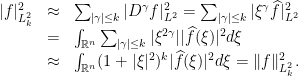

 as
as
 on
on  and zero otherwise, we get
 one has
  . Hence, by (
 . Therefore, inserting (
 ,
,
 which implies (
 Being simple
