




OATC Documents
- Home
- OATC Documents
About the OATC
The increasing consumer demand for access to video on devices other than TVs led representatives from cable companies and content owners to meet to discuss the interoperable technical means by which they could enable consumers to access content on the content providers’ web properties and efficiently obtain authorization from MVPDs (distributors) that maintain subscriber account information.
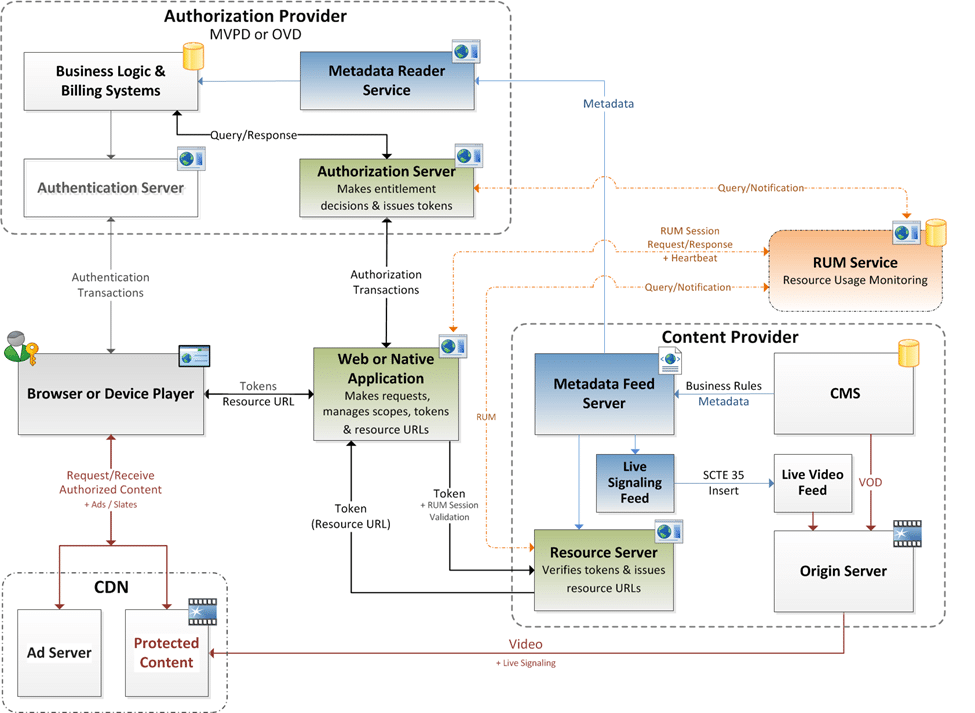
The initial scenario the companies considered was: To enable consumers to access premium video content on websites hosted by the content providers, the consumers needed to be Authenticated and Authorized by their MVPD.
- First the consumer would visit a Content Provider website and select a piece of content .
- Then the website would prompt the user to select their MVPD from a list of the names of potential MVPDs.
- After choosing their MVPD the viewer would be asked to enter their MVPD account information into a web form. This would then be authenticated by the MVPD to the content provider to verify that the consumer was authorized for the specific channel associated with the content they wanted to access.
In early 2010, approaches were devised based on the existing SAML Authentication and Authorization specifications to enable authorized customers of MVPDs to view video content from the 2010 Vancouver Olympics (NBCU) and March Madness (Turner) on the web and on internet connected devices like phones and tablets.
From these early experiences it quickly became clear that an open-standards based interoperability solution defining the Authentication (AuthN) and Authorization (AuthZ) protocols would benefit content owners and distributors by reducing the complexity of the software integrations between each content provider and all of the distributors that offered their content, while allowing for a more consistent and intuitive user experience for consumers. On the distributor side each MVPD might need to integrate their backend billing/authorization systems with as many as 50-100 channel providers. This realization led to the formation of the OATC in 2011.
The SVTA absorbed the Open Authentication Technology Committee (OATC) in 2023. Part of that was committing to making their documents available.
The Challenges Addressed By The OATC's Work
The OATC served three primary markets
01. MultiChannel Video Programming Distributors (MVPDs)
02. Content Providers and Programmers
03. Technology Vendors and Developers
OATC Documents
This SVTA document has the following previous revisions.