




ODDS 2022 Review – Vienna

ODDS 2022 – a Constant in an Industry in Transition
Experts, government representatives, technologists and commentators gathered in Austria’s stunning capital city of Vienna (11 – 13 April) to share recent technical developments in the fields of optical and digital document security.
The Optical & Digital Document Security (ODDS) Conference has its roots in the highly respected Optical Document Security Conference, held every two years since 1996, and Digital Document Security, a spin-off event first held in 2019. In combining the two events, conference organisers Reconnaissance wanted to recognise the important role that optical technologies continue to play in securing documents as they transition to the digital domain.
Following the two seminars on the first day of the event covering ‘International Standards’ and ‘Securing Digital Currency and Identity’, the conference was opened (12 April) by Michael Fuchs, Austria Ministry of Interior, who stressed the continuing importance of protecting government issued documents against fraud.
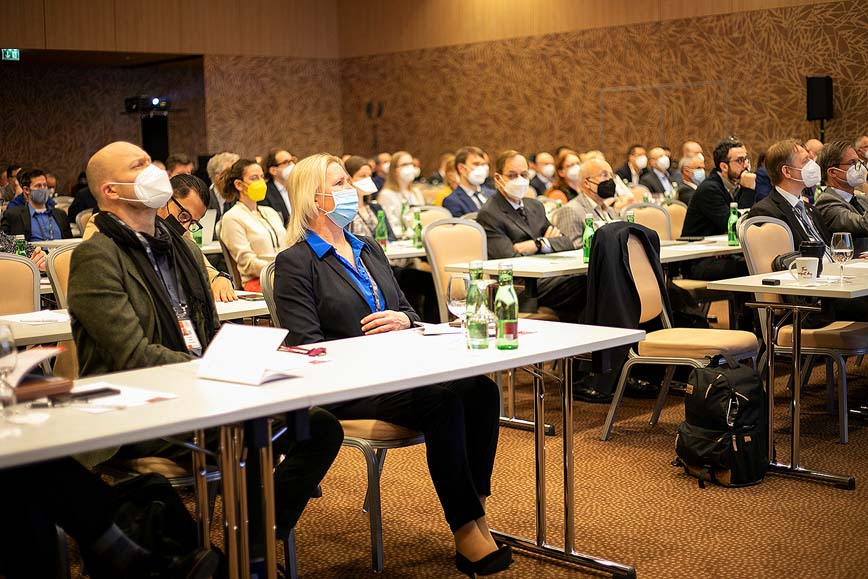
Then after the welcome address from Ian Lancaster, Conference Chair, the attendees were treated to a thought provoking and, at some points, contentious keynote address from author, advisor and commentator – David Birch.
The first technical session, ‘The Transition’, looked at three distinct approaches to bridging the gap between the physical and digital worlds. OeSD International (Austria), TECH5 (Switzerland) and COLOP Digital (Austria) each had their own strategy for the authentication of what are increasingly being called ‘phygital’ documents.
Following from this, ‘New Approaches to Document Security’ contained two papers on novel optical devices.
Peiman Hosseini from Bodle Technologies (UK) described a novel switchable optically variable ink (SOVI), which has the capability to switch between two stable, highly contrasting, colour states generated by an optical nano-cavity featuring ultra-thin phase change materials using laser excitation.
Caleb Meredith, from Pennsylvania State University (US) in his paper titled ‘Iridescent Films Utilising Structural Colour from Reflective Microstructures’ described a method for making iridescent security films exhibiting tuneable colour-shifting appearances, with wide angular colour separations. In his presentation he demonstrated an optical effect enabling the generation of optical interference from concave reflective microstructures ranging from 10 to 100 microns in size.
For the remainder of the first day, the conference split into two parallel streams: one for securing identity and the other for protecting currency & payments. In common, they described the use of optical and physical technologies for protecting against existing and emerging threats to the integrity of documents of value.
The conference reconvened to a single stream for the second day (13 April) to tackle the topical issues of the role of optical and digital technologies in securing health status passports, before taking technical submissions in the areas of micro- and nano-optical structures and other new approaches to document security.
This conference filled the gap between physical and digital security. The agenda was more than excellent.
Apart from the content of the sessions, I would like to remark the good organisation of the event (audio & video connections, quality of signal, presentations available to download…)
ODDS was very good because the conference showed clearly that digital technologies are the game changers in the community. Therefore, DDS is necessary and it will grow.
Gallery
Conference


Seminar


Table Top Exhibition & Dinner


Welcome Reception


A very good start with some technical and policies perspective are discussed in the conference. An eye opener and a must for any security printing industry players to welcome the future of the industry.
An interesting and thought provoking conference, bringing together many technologies and perspective, united by the common theme of digital security. I think the conference fills a gap, perhaps many gaps, and I look forward to the next.
Very well organised/managed conference. The level of expertise in the group of presenters and audience is of high standard. I greatly benefited from my attendance. Very friendly and supportive staff.
Attendees
They were many interesting topics, especially about counterfeiting and “new” security features. I met many people who are experts in their field. Thank you.
Very well organised, the sessions were grouped well. Logistics were so nice – food, stay, breaks. Very good mix of delegates, speakers & companies. Message was very clear. Thank you!
After all discussions I’m still not sure it is wise to replace physical ID with some virtual electronic ID. There were some very good remarks about life cycle of IDs vs life cycle of electronic components like mobile phones.
Programme
Monday 11 April 2022
09:0 – 12:30 International Standards Seminar
Seminar Leader, Dr Alan Hodgson
Learn the why, how & what of International Standards for physical and digital document security.
Plus a guide to ISO/IEC 18013-5:2021, the just-published international standard for Mobile driving licence (mDL) application, with Loffie Jordaan, Convenor of the ISO/IEC Working Group that developed this standard.
Standards have a vital role to play in an interactive, international, transitioning society. In this seminar Alan Hodgson will explain:
- The rationale for and role of International Standards
- Specifically, what they offer and how they can enhance this field
- The opportunities and threats that Standards of all types can bring
- How the International Organization for Standardization (ISO), the International Electrotechnical Commission (IEC), the International Telecommunication Union (ITU) and others develop and facilitate these standards
- The structure and organisation of International Standards development
- How you can be involved and why you should want to be.
He will also give an overview of the relevant standards development structures that apply to the security of digital transactions, to digital and virtual identity and to security documents in the physical world. We will cover examples of International Standards in optical, print and digital domains.
Using examples from a number of International Standards committees Alan will lead us towards a roadmap and gap analysis on the direction this work should take for our community, leading into the formulation of an action plan.
The seminar will then focus on the new ISO/IEC 18013-5 International standard for Mobile Driver’s License (mDL). Loffie Jordaan of AAMVA, Convenor of the ISO/IEC Working Group that developed this standard, will take participants through its key points and explain what it means for driving licence issuers.
Alan Hodgson brings a broad perspective to this topic from over 20 years of working on International Standards. He spent 9 years as Chair of an IEC Technical Committee and by the time ODDS meets he will be Chair of one within ISO. For the past 15 years he has chaired GB National Committees for both IEC and ISO work, convened Working Groups and has been Project Leader for a number of International Standards. He has also been President of two sponsoring organisations spanning this field.
Over this period he has worked mainly as an independent consultant but also within the image printing industry and for 3M on passport and visa print testing standards. Alan is also a Contributing Author for the RI newsletters and past joint-Chair of the Digital Document Security conference. He has led a number of seminars on topics that include International Standards to a variety of audiences.
13:30 – 17:00 Masterclass on Securing Digital Currency and Identity
Seminar Leader, Dr Hermann Sterzinger
Digital data has started to replace physical documents as the ultimate proof of identity. The digital data is the proof, not an image capture of that data or a cross reference back to a record of the original data. This change makes the capture and origination of the digital record and the holding of that record immeasurably more important, valuable and high risk.
A similar situation exists with currency. Central banks are now working intensively on how to create digital currencies (CBDCs). China and the Bahamas have issued retail CBDCs but over 80 other central banks are working on them. The design of those CBDCs is being debated and a core part of that debate is how to secure the CBDC and deliver on the other objectives.
This Masterclass, led by Hermann Sterzinger, will bring together representatives from governments and central banks, suppliers and experts in the field to explore the security pros and cons of different ways to record, store, access and use high-risk, potentially vulnerable, data.
The Masterclass will start with an introductory overview of the principles of securing data, a review of how it has been done historically, the changes brought by the shifts in data use, the challenges to overcome and a summary of the options. There will be an explanation of the cybersecurity risks and mitigations faced today.
The Masterclass will then split into currency and identity groups. Each session will review the options relative to what must be achieved.
The Currency session will start with an explanation of design choices and their implications for security, both for wholesale and retail CBDCs. There will be an explanation of how to secure a centralised database and how to secure a distributed ledger, comparing the characteristics of these two fundamentally different approaches. The session will end with a discussion about how to secure CBDCs and achieve the associated policy goals.
The Identity session will describe the security challenges that migrating to virtual-from-start identities will bring. This will be followed by a briefing on the vulnerabilities posed when digital personally identifiable information (PII) is centralised and the current best practice in protecting PII. The session will then explore new methods for securing identity data that help governments deliver on policy objectives while maintaining trust with citizens and consumers.
The two groups will come back together and their discussions will be fed back as a summary to the whole group.
Dr Hermann Sterzinger is a lecturer in Informatics in the Technical University of Munich, Chairman of the Advisory Board for Augentic GmbH and was Chief Operating Officer at Veridos, the Bundesdruckerei/Giesecke & Devrient joint venture for physical and digital identity documents until December 2019.
Tuesday 12 April 2022
Underlined text on the programme is interactive, click for the abstract or biography popup.
The Transition
9:00
Conference Welcome
Michael Fuchs
Austrian Ministry of Interior (Austria)
9:20
Keynote: Digital, Not Digitised: Security and Privacy, Identity and Credentials
David G.W. Birch
Author, advisor and commentator on digital financial services. (UK)
10:00
Bridging the Gap Between the Physical and the Digital World
Claudia Schwendimann
OeSD International (Austria)
10:20
The digital/physical transition, interface and balance
Rob Haslam
TECH5 (Switzerland)
10:40
Seamless Authentication of Phygital Documents
Alex Breton
COLOP Digital (Austria)
New Approaches to Document Security
11:30
A Switchable Optically Variable Ink (SOVI)
Peiman Hosseini
Bodle Technologies (UK)
11:50
Iridescent Films Utilizing Structural Color from Reflective Microstructures
Caleb Meredith
Pennsylvania State University (United States)
12:10
Phygital IDs and the Vision and Implementation of a Federated eGovernment Ecosystem
Xavier Prost
Veridos Identity Solutions (Germany)
Securing Currency and Payments
14:00
Data Embedding in Intaglio Motives
Pablo Sempere
SICPA (Switzerland)
Thomas Kern
OeBS (Austria)
14:20
O.V.M Technology: When Chemistry bridges Optics toward Disruptive Security Features
Jérémy Malinge
Crime Science Technology (France)
14:40
Intaglio Style Transfer on Computational-Resource-Limited Systems such as Mobile Devices
Anton Pfeifer
inIT, Technische Hochschule Ostwestfalen-Lippe (Germany)
15:00
Towards a General Approach for Cryptoanchoring Security Documents
Ernesto González Candela
UnderCurrency (Mexico)
Securing Identity
14:00
Passport Fraud Trends and Ways to Combat Them
Joachim Caillosse
Secure Identity Alliance (France)
14:20
Digital Identity at the Crossroads Between Centralized and Decentralized Solutions
Christian Casari
youniqx Identity AG (Austria)
14:40
Why Optical Variable Elements (OVE) are important for securing the secondary portrait
Patrick Guthmann
IDEMIA (France)
15:00
TrustFace: a new digital authentication feature for physical portraits
Nuno Gonçalves
Portuguese Mint and Official Printing Office (Portugal)
Securing Currency and Payments
16:00
3D Security Feature Detection using High-speed inline Computational Microscopy
Laurin Ginner
AIT (Austria)
16:20
LightSafe: An Interactive Security Technology for Banknotes and ID Documents
Martin Eichenberger
Orell Füssli (Switzerland)
Guillaume Basset
CSEM (Switzerland)
16:40
Pitch Correction Methods and Effects in Micro-Optic Design
Robert Stewart
Koenig & Bauer (Switzerland)
Securing Identity
16:00
Recapture Detection to fight Deep Identity Theft
Marc Pic
SURYS (France)
Marc Pic
SURYS (France)
16:20
Role of the Micro Controller and its Secure Embedded Software
Xavier Banchelin
Thales Identity & Biometric Solutions (France)
16:40
Laser Personalized DOVID Based on Double Metal Layer Systems
Sebastian Mader
OVD Kinegram (Switzerland)
Harald Walter
OVD Kinegram (Switzerland)
Wednesday 13 April 2022
Securing Health and Vaccination Passes
9:00
Who Are We and How Does It Affect our Security?
Ian Lancaster
Reconnaissance International (UK)
9:30
Proof of Health Status – International Comparisons 2022
Francis Tuffy
Reconnaissance International (UK)
9:50
High Security Standard for Health Pass
Marc Pic
SURYS (France)
Micro-and Nano-scale Optical Structures
11:00
Plasmonic Pixel based Full Parallax Multi-colour OVDs
Clint Landrock
Nanotech (Canada)
11:20
High-speed Fabrication of Durable Optical Features using Direct Laser Interference Patterning
Christoph Zwahr
Fraunhofer Institute (Germany)
11:40
The Next Level of Micro-Mirror Technology
Tobias Sattler
Louisenthal (Germany)
12:00
Printing Variable Holographic and Optical Structures with Differing Encrypted Holographic Information
Dan Lieberman
Holomex/Nanografix (Mexico)
Dan Lieberman
Nanografix/Hologramas de México (Mexico)
New Approaches to Document Security II
13:45
White Light Interferometric Artifact Metrics
Tsutomu Matsumoto
Yokohama National University (Japan)
14:05
Detection of Digital Forgeries in Remote Identity Verification: Countermeasures and Counter-forensics
Marc Pic
SURYS (France)
14:25
Highly Personalised Anti-Counterfeit Features using Laser Marking Technologies and Novel Optical Materials
Garry Mudd
OpSec Security (UK)
Robert Renton
OpSec Security (UK)
Panel Discussion
15:15
The future evolution of optical and digital document security
- Ian Lancaster – Reconnaissance International – Chair
- Dave G. W. Birch – Author & Commentator on Digital Identity
- Jörg Fischer – Bundesdruckerei
- Loffie Jordaan – AAMVA – American Association of Motor Vehicle Administrators
- Francis Tuffy – Reconnaissance International
- John Winchcombe – Reconnaissance International
It is a great event, absolutely necessary, came at the right time. A good mixture of technical and general topics.
First year attending conference- generally happy with programme and aligned with expectations – personally found presentations from universities and smaller collaborators more interesting as more technical content than established companies where it felt more of a sales pitch.
Yes. Interesting presentations and discussions, as always. I would like some more exhibit time, if possible.
Table Top Exhibitors
Many thanks to the following exhibitors for taking part in our table top exhibition on Tuesday evening.
