





ODDS 2023 Review – Prague

The Optical & Digital Document Security Conference Review
Overview
Two underlying themes emerged at the ODDS conference in Prague, Czech Republic: concerns about data privacy and the use of personally identifiable information (PII), and the continuing difference in the drivers for the traditional security document community and digital systems developers. In the words of Ian Lancaster, conference Chairman, the former is driven by the need for security, while the latter are driven by their desire to develop new and easier ways for financial transactions and identity verification. Or, as Garry Sidaway of NTT Security, has put it, “Convenience and security are uneasy bedfellows”.
Attendance
The conference was attended by 167 people, from 27 countries and 94 organisations. Of these organisations, 42 are involved with physical security documents – as issuers, printers or component suppliers; 16 are in the digital arena and 12 work on optical features. Although the majority of participants represented established companies, the public sector and innovative organisations were well-represented, as shown on the pie chart.
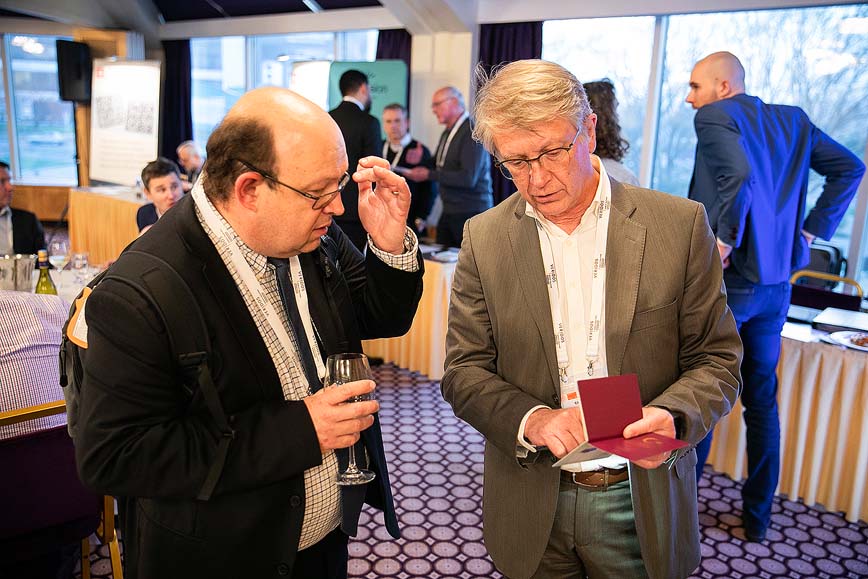
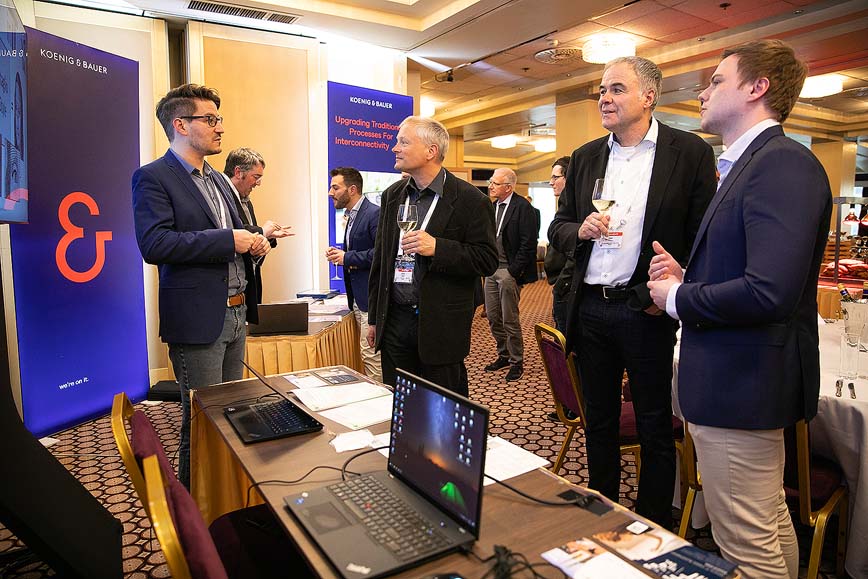
The interest in this sphere from all participants was well-demonstrated at the conference dinner and exhibition on the Tuesday evening, when the dozen exhibitors were kept busy showing and talking about their work – be it a trade association seeking more members or a start-up company demonstrating its new technology. And this despite the excellent food and drinks available!
Programme
The conference got under way on Monday afternoon with a well-attended seminar presented by Dr Alan Hodgson, in which he addressed whether smartphones are “effective and/or convenient” in this era of digital transactions. He covered the technology of smartphones before considering socio-economic factors, pointing out the transition of power and responsibility from governments and banks to the tech giants. He concluded that perhaps the environmental, social and governance (ESG) issues will come to play a bigger role in the development of smartphone use in the ODDS sphere.
The Programme of Presentations
Two days of conference presentations were kicked-off by Tony Poole from the Document Security Alliance (DSA), running through some alarming statistics about identity fraud in the USA, as a way of giving context for the following presentations which mainly covered security techniques. Tony pointed out that the internet is now a major source of fraudulent ID documents, but people requesting such items online are at risk of their PII (personally identifiable information) being used for other criminal purposes.
The first conference session explored the phygital – the links between the physical and digital worlds. Duncan Reid presented his findings on “Banknotes in a Digital World to 2032”, with Marc Pic of Advanced Track & Trace explaining the transformation of banknotes to digital currencies. Landqart and Tech5 then showed how they are producing laminated substrates with digital data securely inlaid.

This first session set the tone for the conference, as it became apparent that ODDS participants view physical and digital systems working in parallel in the foreseeable future.
It remains true that ODDS is more representative of physical secured documents than the digital or virtual ID and transaction field. Perhaps this is inevitable given the conference’s genesis in the Optical Document Security conference, although the balance has improved since the first conference.
So it was that there were two sessions on document security and two sessions on new optical security techniques, sandwiching sessions on protecting Identity in the digital age – perhaps now one of the most important topics in the conference.
Among the issues covered in these ID sessions were centralised or decentralised digital ID ecosystems; biometrics; the challenge of quantum computing and artificial intelligence; MRTDs (machine readable travel documents); the latest security features on the German ID card, in presentations given, respectively, by Veridos, the Security Identity Alliance, Bundesdruckerei, Veridos (again), the University of Twente and Bundesdruckerei (again). Also in these sessions Sergei Toedtli of Thymaris gave examples of how digital security features have been counterfeited and Claudia Schwendimann, of the Austrian State Printing House, gave a case study on the new Ghanaian health insurance app.
Interestingly, in the document security sessions there were two presentations about banknote design, from UnderCurrency and Banco de España, illustrating the point that there is still interest in improving banknote security. These sessions included presentations on new magnetic ink (MagVision); micro- and nano-security elements (Surys); detecting non-artificial microstructures (Koenig & Bauer); authentication using super-resolution images (Advanced Track & Trace), and verifying certificates for personal protective equipment (InIT).
The optical security sessions comprised presentations from well-established providers as well as new entrants to the field – again, showing continuing interest and inventiveness. The former included OVD Kinegram’s presentation on structural colours; SICPA presenting its new LCD printing for vehicle licence plates and IQS Group (which sponsored the conference in its home city) showing its work on spiral configurations for DOVID design. Newcomers showing their technology were Chromatir, a Penn State University spin-off, which has invented a novel optically-variable device technique; 4Plate explaining how it’s integrating optical security in to the body of plastic cards; Distinkt, a collaborative venture between four Catalan institutions, revealing its NIR-induced colour-changing inks; and Soochow University presenting its new approach to microlens array security devices.
The Panel Discussion
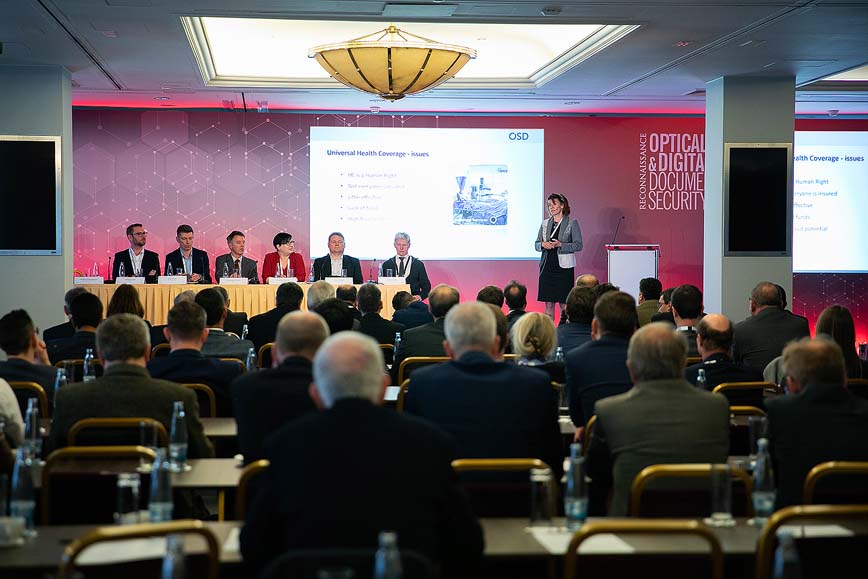
Halfway through the second day, Ian Lancaster chaired a panel of Joachim Caillosse, Security Identity Alliance; Volker Lohweg, InIT; Tony Poole, DSA and Jörg Fischer, Bundesdruckerei, addressing the question of whether there is a future for physical security documents. After a brief statement from the panel members (each affirming from their different perspectives that there is a future), Lancaster opened it for general discussion. But before doing so he asked anyone under 30 in the hall to put their hand up. When no-one did (except the members of the Reconnaissance team!) he suggested that “perhaps we are the wrong generation to consider this question.” Nonetheless, a lively discussion followed, where the concerns about privacy and PII security were to the fore.
Attendance stayed healthy right to the last presentation and participants commented on the value and interest of the event. Nonetheless, the Conference Committee recognises the need to create a programme with a better representation from the digital community.

This conference filled the gap between physical and digital security. The agenda was more than excellent.
Apart from the content of the sessions, I would like to remark the good organisation of the event (audio & video connections, quality of signal, presentations available to download…)
ODDS was very good because the conference showed clearly that digital technologies are the game changers in the community. Therefore, DDS is necessary and it will grow.
Gallery
Conference


Seminar


Table Top Exhibition & Dinner


Welcome Reception


A very good start with some technical and policies perspective are discussed in the conference. An eye opener and a must for any security printing industry players to welcome the future of the industry.
An interesting and thought provoking conference, bringing together many technologies and perspective, united by the common theme of digital security. I think the conference fills a gap, perhaps many gaps, and I look forward to the next.
Very well organised/managed conference. The level of expertise in the group of presenters and audience is of high standard. I greatly benefited from my attendance. Very friendly and supportive staff.
Attendees
They were many interesting topics, especially about counterfeiting and “new” security features. I met many people who are experts in their field. Thank you.
Very well organised, the sessions were grouped well. Logistics were so nice – food, stay, breaks. Very good mix of delegates, speakers & companies. Message was very clear. Thank you!
After all discussions I’m still not sure it is wise to replace physical ID with some virtual electronic ID. There were some very good remarks about life cycle of IDs vs life cycle of electronic components like mobile phones.
Programme
Monday 17 April 2023
13:30 – 17:00 Smartphones in the New ODDS World: Effective and/or Convenient?
Seminar Leader, Dr Alan Hodgson
Smartphones are now indivisible from optical and digital security for financial transactions, identify verification, document and product authentication and supply chain security.
Whether you carry your identity information digitally or want to order a taxi online, you need your smartphone. Similarly, smartphones are becoming indispensable in supply chain monitoring, product authentication and validating your means of payment.
But how good are they in actually keeping you and your personal information secure? And what happens if you don’t have a smartphone – or there is no network coverage where you are?
In this seminar Dr Alan Hodgson will address these questions – and more. He will take a critical look at smartphone technology, lifecycle and more to address the issue of whether we are becoming over-reliant on them in this new digital and virtual world.
He will start by analysing the broad landscape for smartphones in this new world, looking at political, economic, social and technical issues. Then he will get more specific about smartphone technology and security, covering topics such as the camera performance and its suitability for verifying optical features and 2D codes; and, because smartphones largely depend on connectivity to do their job, he will look into the security of networks and wifi systems.
The seminar will include case studies on the use of smartphones as a substitute for cash, as provers of our identity, for reading codes – where he will consider the different requirements of consumers and inspectors – as well as comparing smartphones with more specialist purpose-built devices.
In the later part of the seminar Dr Hodgson will consider emerging technologies, both those pertinent to smartphones and those that might compete with or usurp them.
What this will create is a seminar that addresses the fundamental issues of the balance between efficiency, convenience and security of smartphone solutions. It will ask are we right to become so dependent on them and if not what do we do about it; and where does control lie in the complex issue of electronic payment/identity/authentication? This is the issue that will be covered in a panel discussion that will close the seminar, which will be your chance to ask about these absolutely key matters.
This will be an important participatory seminar to kick off Optical & Document Security 2023, and vital for you to attend if you are active in optical or digital security of ID and transactions – especially if you are placing smartphones in the mix of security verification.
About Dr Alan Hodgson
Dr Alan Hodgson has a background in printing and holography, initially from the photographic industry and then with 3M in security printing. He now works as an independent consultant in the field of printing and imaging.
His interest in smartphones started with the early days of phone cameras and their photographic capabilities. As the smartphone platform developed into the multiple capabilities we see today he continued to study these, noting the trade-offs between capabilities and vulnerabilities and between threats and opportunities across a range of applications. This seminar will provide a summary of the learning on this journey.
Alan is a Visiting Academic in Material Science at the University of Manchester and an Expert Fellow to the SPRITE+ university collaboration which investigates Security, PRivacy, Identity and Trust Engagement in the digital space. Supporting these he is active in the field of International Standards for photography, printed electronics and wearable devices.
He is a contributing author to a number of the Reconnaissance International publications and has presented papers and courses at their events.
Tuesday 18 April 2023
Underlined text on the programme is interactive, click for the abstract or biography popup.
The Link Between the Physical and Digital Worlds
08:30
Welcome
Ian Lancaster
Reconnaissance International (UK)
08:40
The Impact of Counterfeiting of Physical and Digital Identities
Tony Poole
Document Security Alliance (USA)
09:00
The Future of Physical vs Digital Currency: Banknotes in a Digital World to 2032
Duncan Reid
Smithers (UK)
09:20
Hybrid Currencies : How to Transform Banknotes to Digital Currencies
Marc Pic
Advanced Track & Trace (France)
09:40
Securely Combining Physical Security Documents with the Digital Realm
Hanno Goldbach
Landqart (Switzerland)
Andy Gray
TECH5 (Switzerland)
New Approaches to Document Security I
10:40
Magnetic Codes in Security Printing
Allan Harle
Magvision (UK)
11:00
Rapid Iteration Testing for Banknote Design
Ernesto González Candela
UnderCurrency (Mexico)
11:20
A New Way of Designing Cash using Neuroscience
Ruben Ortuño
Banco de España (Spain)
11:40
User Experience of Robust Micro- & Nano-security Elements
Nelson Gananathan
SURYS (France)
New Approaches to Document Security II
13:30
Development and Application Test for the Detection of Non-Artificial Microstructures
Marc Hunsaenger
Koenig & Bauer (Germany)
13:50
Multi-Images Super-Resolution to Help Authenticate ID Documents, BankNotes and Products
Marc Pic
Advanced Track & Trace (France)
14:10
Semi-automated Certificate Authenticity Verification on the example of medical personal protective equipment
Volker Lohweg
Institute Industrial IT (Germany)
Protecting Identity in the Digital Age I
15:10
Biometrics in Identity: Building Inclusive Futures
Thilo Utermark
Secure Identity Alliance ()
15:30
Trust Services and Digital ID Solutions
Franziska Muschik
Veridos (Germany)
Alexander Winnen
Veridos (Germany)
15:50
Protecting ID Systems in the Quantum Era
Jörg Fischer
Bundesdruckerei (Germany)
16:10
Reaching New Levels of Identity Document Quality with AI
Michael Schalk
Veridos (Germany)
16:30
Universal Health Coverage Made Accessible
Claudia Schwendimann
Austrian State Printing House (Austria)
Wednesday 19 April 2023
Protecting Identity in the Digital Age II
09:00
Introduction to ODDS Day 2
Ian Lancaster
Reconnaissance International (UK)
09:05
Experiences with Counterfeits of Digital Security Features
Sergej Toedtli
Thymaris (Switzerland)
09:25
CITE: Country Independent Template Extraction from MRTDs
Eric Santiago Garcia
University of Twente; InverID (Netherlands)
09:45
Self-Protecting Portrait – Polycarbonate Inks Beyond Digital Watermarking
Oliver Muth
Bundesdruckerei (Germany)
New Optical Techniques for Security I
10:45
Structural Colours – Powerful & Self-explaining Design Elements
Eduard Miloglyadov
OVD Kinegram (Switzerland)
11:05
Anti-counterfeiting Imaging Device Based on Microlens Array
Su Shen
Soochow University (PR China)
11:30
NIR-induced Colour/Fluorescence Changing Inks
Alex Julia
Distinkt (Spain)
New Optical Techniques for Security II
14:00
Optically Variable Films Harnessing Colour-shifting Microstructures
Caleb Meredith
Chromatir (United States)
14:20
Your Document is an Optical System
Yit-Shun Leung Ki
4Plate (Germany)
14:40
DOVID Design in a Non-orthogonal Co-ordinate System
Vladimir Kolarik
IQ Structures (Czech Republic)
15:00
Licence Plate Authentication with Liquid Crystal Printing
Christophe Garnier
SICPA (Switzerland)
Nicola Duca
SICPA (Switzerland)
It is a great event, absolutely necessary, came at the right time. A good mixture of technical and general topics.
First year attending conference- generally happy with programme and aligned with expectations – personally found presentations from universities and smaller collaborators more interesting as more technical content than established companies where it felt more of a sales pitch.
Yes. Interesting presentations and discussions, as always. I would like some more exhibit time, if possible.
Table Top Exhibitors
Many thanks to the following exhibitors for taking part in our table top exhibition on Tuesday evening.
