Is Your PC Holding You Back? Find Out with Our Bottleneck Calculator!
Your gaming and work performance depends on a perfect balance between your CPU and GPU. But what if one is slowing down the other? Our Bottleneck Calculator helps you to instantly check if your system is running at full potential or if an upgrade could unlock better performance.
Simply enter your PC specs, and let our tool do the rest. No more guesswork just clear insights into what’s limiting your system and how to fix it. Try it now and optimize your setup!
Core Features of Our PC Bottleneck Calculator
User-Friendly Design
Effortlessly input your CPU and GPU details to get a quick analysis.
Hardware Compatibility Analysis
Ensure your CPU and GPU work together seamlessly for peak performance.
Detailed Performance Insights
Obtain a straightforward rating (0-100) that highlights any potential performance issues.
Personalized Upgrade Recommendations
Get simple tips on upgrading your hardware to make your PC run faster and fix performance issues.
Was your PC running slow, and you could not figure out why? The same thing happened to me. My games lagged, and tasks took forever. After a lot of research, I found the Bottleneck Calculator, and it helped me to understand the real issue.
This tool showed me whether my CPU or GPU was holding back performance. I just entered my hardware details, and it quickly told me if they were a good match. It was simple and saved me from guessing which part needed an upgrade. This helps you to understand if your system is balanced or if you need an upgrade for better performance.
Instead of wasting money on unnecessary upgrades, I fixed the exact problem. My PC now runs smoother and faster. If you are struggling with slow performance, then this tool can help you too. Let’s explore this tool together, I will give you full insights of this tool, such as how to use or interpret it.
What is a Bottleneck Calculator?
If one part of your PC affects the other part and you want to know which part causes the problem, then Bottleneck Calc is the best tool to go. It checks how well your processor and graphics card work together. You will check the CPU GPU bottleneck with the help of this CPU GPU bottleneck calculator.
If one is much weaker than the other, then it creates a bottleneck, which means the stronger part can not perform at its full potential. This tool is useful for gamers, video editors, and PC builders who want to get the best performance from their systems.
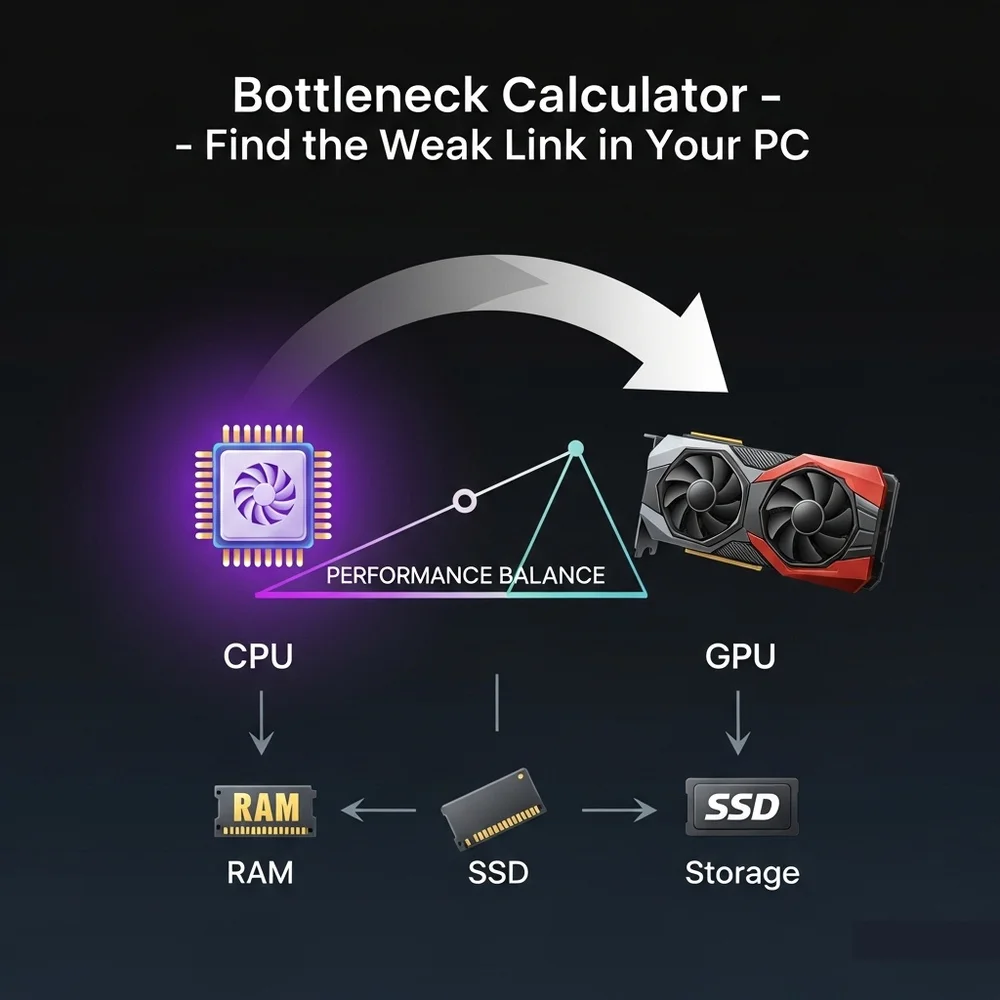
Bottlenecks happen when a CPU, GPU, RAM, or storage device is too slow as compared to other parts. You can use this tool to estimate the issue instead of guessing which component is causing the issue.
You can see if they are a good match or if one is holding back performance by entering the mentioned details. This helps you to make smarter upgrade decisions and avoid spending money on unnecessary parts.
CPU Bottleneck Calculators
If your processor is too slow as compared to your graphics card, then you can use the Bottle neck calculator to check its performance. The CPU handles game physics, AI, background processes, and system operations while the GPU focuses on rendering graphics. As we mentioned earlier, you will estimate CPU and GPU bottleneck by using this CPU GPU bottleneck calc on connectionsnyt.
If your CPU does not work well then your GPU also does not receive data fast enough which leads to low FPS, stuttering, and lag. If the percentage is high, then you need to upgrade your CPU, and if the percentage is low, then you do not need any changes.
GPU Bottleneck Calculators
If your graphics card is not working well as compared to the CPU, then you can use the bottleneck calculator pc to assess its performance. The GPU is responsible for rendering images, textures, and video.
If the GPU can not process graphics fast enough, then it creates a bottleneck that makes games run at low FPS with poor visual quality. This is common when using an old or low-end GPU with a high-performance CPU.
What are Bottlenecks in PC Systems?
A bottleneck happens when one part of your PC is too slow compared to the rest. This slows down performance because the faster parts have to wait for the slower one to catch up. It is like a highway with a narrow lane, no matter how fast the cars are, they all get stuck at the slowest point. In a PC, bottlenecks usually happen in the CPU, GPU, RAM, or storage.

A CPU bottleneck happens when your processor is too slow compared to your graphics card. This is common in gaming or tasks which need a lot of processing power, like video editing. If your CPU can not process game data fast enough, then your GPU will not get the information it needs on time, which causes lower frame rates and stuttering.
Signs of a CPU bottleneck:
- The most famous sign is low GPU usage (below 90%) while CPU usage is high (90-100%)
- The major sign is game stuttering even with a powerful GPU
- Slow performance in tasks like simulations, video rendering, or large spreadsheets also indicates a CPU bottleneck
How to fix it?
- You have to upgrade to a faster CPU with more cores and a higher clock speed
- You should lower CPU-heavy settings in games, like draw distance and physics effects
- Close background apps which use a lot of CPU
A GPU bottleneck happens when your graphics card is too weak compared to your CPU. This is common in high-resolution gaming or graphics-heavy tasks like 3D rendering. If your GPU can not process images fast enough, then your CPU will sit idle waiting for it to catch up.
Signs of a GPU bottleneck:
- The major sign is high GPU usage (above 90%) while CPU usage is low.
- Also low FPS in games, especially at high settings, indicates GPU bottleneck.
- Long rendering times in video editing or 3D modeling are also a sign.
How to fix it:
- You should upgrade to a better GPU if your CPU is strong enough
- You have to lower the graphics settings in games, like resolution, textures, and shadows
- Enable DLSS or FSR if supported to boost performance
A RAM bottleneck happens when your system does not have enough memory to handle tasks smoothly. When RAM is full, then your PC has to use slower storage, which causes lag and delays.
Signs of a RAM bottleneck:
- Slow game load times or sudden freezes show a RAM bottleneck.
- If your programs take a long time to open or switch between them, then it shows a RAM bottleneck.
- High RAM usage (above 80-90%) in Task Manager is also a sign
How to fix it:
- You should go for more RAM (at least 16GB for gaming and multitasking)
- Kindly close your unnecessary programs to free up memory
- You have to use faster RAM if your motherboard supports it
A storage bottleneck happens when your hard drive or SSD is too slow. This affects loading times, boot speed, and how fast your system accesses files. A slow drive can slow down the entire system even if your CPU and GPU are powerful.
Signs of a Storage bottleneck:
- You should face long Windows startup times
- Slow game or program loading times influence storage bottleneck
- Frequent freezes when opening large files are also indicative of a storage bottleneck
How to fix it:
- You should change your HDD to an SSD for faster load times
- You have to use an NVMe SSD for even better speed in modern systems
- You should keep at least 20% free space on your drive for smooth performance.
How to Avoid Bottlenecks
To avoid CPU and GPU bottlenecks:
- Make sure your CPU and GPU are compatible with each other.
- Keep drivers updated and hardware maintained.
- Upgrade components when necessary.
A PC bottleneck calculator can help you analyze if your CPU or GPU is holding back your PC and suggests you upgrade any component if needed.
Factors Affecting Bottleneck Performance
Many factors play a role in determining how a bottleneck affects your pc’s performance. Here I will discuss some of the most common factors which affect the performance.
CPU and GPU Compatibility
If your CPU is too slow as compared to your GPU, then it will not send data fast, which causes CPU bottlenecking, as in the same sense, if your GPU is too slow as compared to the CPU, then it will not render graphics quickly, which causes GPU bottlenecking. So a balanced combination of CPU and GPU is important for smooth performance.
RAM Speed and Capacity
If your RAM is too slow or too small, then it can also slow down data transfer between the CPU and other parts of the system. This can cause stuttering in games and slow overall performance.
Storage Type and Speed
A slow, hard drive like HDD can limit the data to load into memory quickly. So the use of a Solid State Drive like SSD instead of an HDD can reduce loading times and improve system responsiveness.
Game or Software Optimization
Some games and programs depend more on the CPU while others mostly depend on the GPU. So if a game is not optimized well, then it may cause a bottleneck even on high-end hardware.
Screen Resolution and Refresh Rate
As we know, higher resolutions like 4K put more pressure on the GPU while lower resolutions like 1080p depend more on the CPU. So if your monitor has a high refresh rate (144Hz or more) but your GPU can not produce enough frames, then it creates a bottleneck.
Background Processes and Software
If too many programs run in the background, then they can use CPU, RAM, and disk resources, which may slow down your system. You have to close unnecessary apps and disable startup programs to reduce bottlenecks.
Overclocking and Cooling
You have to know that no doubt, overclocking your CPU, GPU, or RAM can improve your performance, but it may also cause overheating. So proper cooling solutions like better fans or liquid cooling help you to prevent thermal throttling, which slows down components.
How to Use the Bottleneck Calculator?
The use of bottle neck calc is simple and also helps you to find out if your CPU or GPU is slowing down your PC.
Below I will discuss a step-by-step guide on how to use it:
Step 1: Enter Your Complete System Specifications
To begin, you need to fill out all the details about your current PC hardware. The tool requires the following:
- CPU: Select your processor model.
- GPU: Select your graphics card model.
- RAM: Choose the amount of system memory you have.
- Storage: Select the type of storage you use (e.g., HDD, SSD, NVMe).
Step 2: Define Your Usage Scenario
Next, provide context on how you use your PC, as this heavily influences performance.
- Select Resolution: Choose the screen resolution you play games at (e.g., 1080p, 1440p, 4K).
- Select Game: Pick the specific game you want to analyze the performance for.
- Graphics Settings: Select the in-game settings you use (e.g., Low, Medium, High, Ultra).
- Refresh Rate: Choose your monitor’s refresh rate (e.g., 60Hz, 144Hz, 240Hz).
- Purpose: Specify the primary use of your PC (e.g., Gaming, Streaming, Video Editing).
Step 3 (Optional): Test a Hypothetical Upgrade
This tool has a powerful “What If” feature that lets you see the impact of an upgrade before you buy any new parts.
- WHAT IF: TEST CPU UPGRADE: If you suspect your CPU is the bottleneck, you can select a potential new CPU here to see how it would perform with your current GPU.
- WHAT IF: TEST GPU UPGRADE: If you think your GPU is the weak link, you can select a new GPU to test with your current CPU.
Step 4: Analyze Your System
After you have filled in all the necessary fields, click the large blue “ANALYZE” button at the bottom. The tool will then process all this information to give you a detailed bottleneck report.

How to Interpret Bottleneck Calculator Results?
The results from this tool will be much more specific than a simple percentage because it considers the game and settings you chose.
- Game-Specific FPS and Bottleneck: The analysis will likely show you the expected Frames Per Second (FPS) in your chosen game and pinpoint whether the CPU or GPU is the limiting factor at your selected resolution and graphics settings.
- CPU-Bound vs. GPU-Bound:
- If the results indicate a CPU bottleneck (or “CPU-Bound”), it means your processor is struggling to keep up with the demands of the game, preventing your powerful GPU from reaching its full potential.
- If the results show a GPU bottleneck (or “GPU-Bound”), it means your graphics card is the component limiting your performance, unable to render frames as fast as the CPU can process them. This is common at higher resolutions and settings.
- “What If” Upgrade Analysis: If you used the upgrade testing feature, the results will compare your current performance directly against the hypothetical performance with the new component, helping you make a smart purchase decision.
Interpreting the Example Results
Continuing with our example:
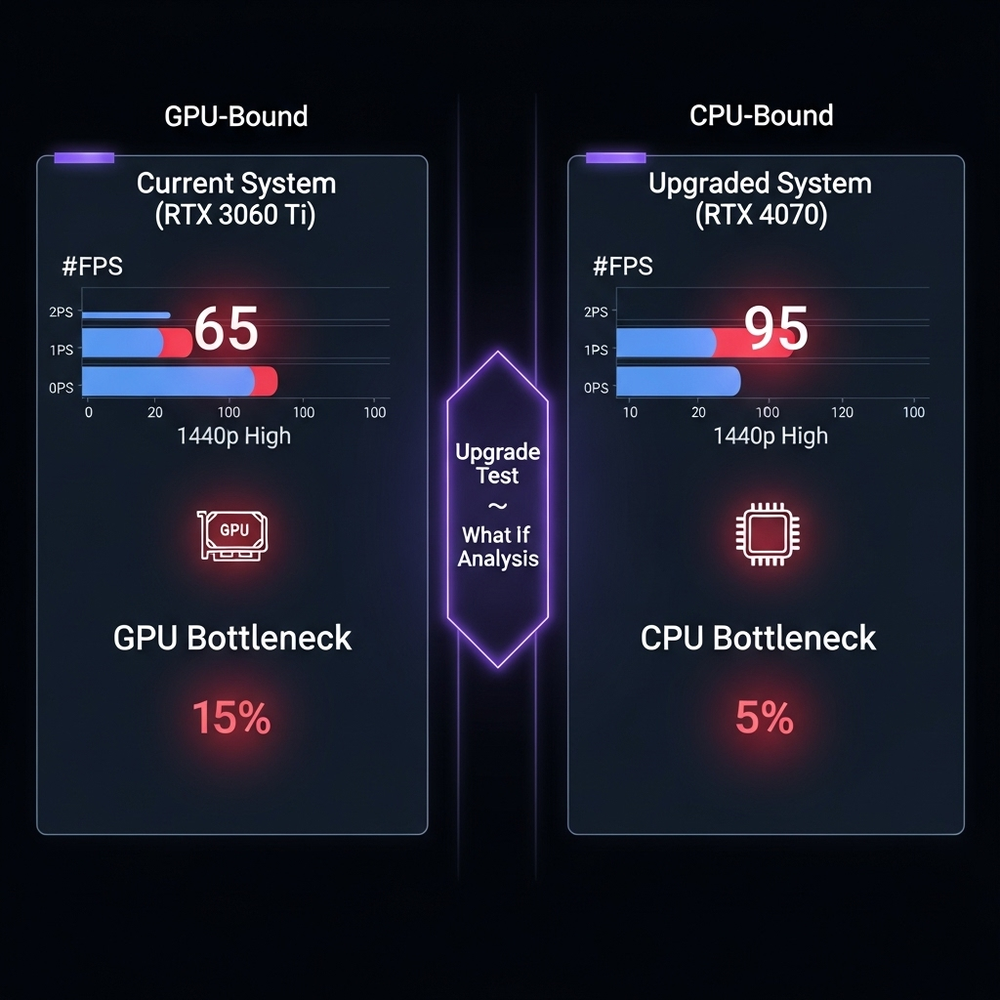
- Current System (RTX 3060 Ti): It might show that at 1440p High settings, your system produces around 65 FPS, but with a GPU bottleneck of 15%. This means the RTX 3060 Ti is the primary factor limiting your frame rate.
- Upgraded System (RTX 4070): The analysis for the upgraded PC might show the FPS jumping to 95 FPS, with the bottleneck shifting to a CPU bottleneck of 5%. This tells you that the new RTX 4070 is so powerful that the Ryzen 5 5600X is now the (very slight) limiting factor.
This result would clearly show that upgrading your GPU would give you a significant performance boost in this specific game and scenario, making it a worthwhile purchase.
Practical Example: A Walkthrough
Let’s imagine you have a mid-range gaming PC and you want to check its performance in a demanding, modern game.
Your System and Scenario:
- Your PC:
- CPU: AMD Ryzen 5 5600X
- GPU: NVIDIA GeForce RTX 3060 Ti
- RAM: 16GB
- Storage: NVMe SSD
- Your Goal:
- Game: Cyberpunk 2077
- Resolution: 1440p (2560×1440)
- Graphics Settings: High
- Refresh Rate: 144Hz
- Purpose: Gaming
Filling Out the Calculator:
- CPU: Select “AMD Ryzen 5 5600X”.
- GPU: Select “NVIDIA GeForce RTX 3060 Ti”.
- RAM: Select “16GB”.
- Storage: Select “NVMe SSD”.
- SELECT RESOLUTION: Select “2560×1440 (1440p)”.
- SELECT GAME: Select “Cyberpunk 2077”.
- GRAPHICS SETTINGS: Select “High”.
- REFRESH RATE: Select “144Hz”.
- PURPOSE: Select “Gaming”.
At this point, you could click “ANALYZE” to see your current performance. But let’s say you’re considering an upgrade. You feel your GPU might be holding you back and are thinking about an RTX 4070.
Using the “What If” Feature:
- WHAT IF: TEST GPU UPGRADE: Select “NVIDIA GeForce RTX 4070”.
Now, when you click “ANALYZE”, the tool will calculate the performance for both your current setup and your hypothetical upgraded setup.

Benefits of Using a Bottleneck Calculator
When you run a bottleneck calculator’, it gives you a percentage showing how much one component is slowing down the These are the major benefits of using a gaming bottleneck calculator
Saves Money on Upgrades
As we all know, upgrading the PC can be expensive, but it is easy to replace the wrong part. Bottleneck pc calculator shows if your CPU or GPU is causing the issue, so you can only upgrade what is necessary. In this way, you spend wisely and get the best performance for your budget.
Improves Gaming Performance
You know how frustrating it can be if your games are lagging or stuttering. This pc bottleneck checker helps you to find out whether your CPU or GPU is struggling. A weak CPU can slow down processing while a weak GPU affects graphics. Once you know what is causing the issue, then you can tweak resolution, textures, and shadows for better performance without rushing to buy new hardware.
Helps in Future PC Upgrades
If you are building or upgrading your PC, then you want to choose the right parts. A bottleneck calculator helps you to see if your CPU and GPU will work well together before you buy them. This means no surprises and no wasted money on mismatched components.
Optimizes PC for Different Tasks
Your PC is not just for gaming. You might use it for video editing, 3D rendering, or multitasking. This benchmark calculator helps you to see if your system is powerful enough for what you do most. In this way, you can adjust settings or upgrade only when needed.
Avoids Performance Issues in High-Resolution Gaming
If you play games at 1440p or 4K, then your GPU needs to handle the extra load. If you stick to 1080p then your CPU has to work harder. A trusted bottleneck calculator helps you to adjust settings for the perfect balance so you do not get frame drops or lag while gaming.
Laptop Bottleneck Calculator
A laptop bottleneck calculator is a valuable tool for identifying and resolving hardware limitations that impact your laptop’s performance. With the increasing demands of tasks like 4K gaming, advanced video editing, and multitasking in 2025, tackling bottlenecks has become more crucial than ever.
Bottlenecks occur when components such as the CPU, GPU, RAM, or storage fail to work in harmony, causing performance issues. For instance, pairing a high-end GPU with an outdated CPU can limit gaming performance, while insufficient RAM can slow down multitasking or intensive applications.

Upgrading to a faster SSD, increasing RAM to at least 16GB, or ensuring a balanced CPU and GPU pairing can help overcome these issues. Additionally, optimizing system settings, keeping drivers updated, and reducing graphical demands in games can significantly reduce strain on weaker components.
In 2025, addressing bottlenecks ensures your laptop operates at peak efficiency, delivering smoother workflows, better gaming performance, and enhanced productivity for all modern tasks. A laptop bottleneck calculator simplifies this process, helping you make informed decisions and maximize your system’s potential.
Tips to Troubleshoot Bottlenecking Issues
If your system has a bottleneck, then it means one part is weaker than the others, which causes performance issues.
These are some simple ways to fix it and get your PC running smoothly:
Adjust In-Game Settings
If you notice lag or stuttering while gaming, then tweaking your settings can help to solve this issue. As we know, lowering resolution, texture quality, and shadows can shift the workload between the CPU and GPU.
If your CPU is struggling, then increasing resolution can help you to move some of the work to the GPU. In the same manner, if your GPU is the problem, then lowering graphics settings will make things smoother.
Close Background Applications
As we all know, too many programs running in the background can overload the CPU and RAM. You should close unnecessary apps, disable startup programs, and use Task Manager to free up resources. This can instantly improve your PC’s speed without any hardware changes.
Overclock Your CPU or GPU
If your processor or graphics card is running below its potential, then overclocking can give it a boost. Many modern CPUs and GPUs support safe overclocking through built-in software. You just have to monitor temperatures to prevent overheating
Upgrade Your RAM
If your PC has low RAM, then it can slow everything down. You have to upgrade it to at least 16GB or more for heavy tasks like gaming or video editing. It can also reduce bottlenecks and make multitasking smoother. Faster RAM speeds also help the CPU to process data more efficiently.
Use an SSD for Faster Storage
A slow hard drive can bottleneck your system, especially when loading games or applications. So, upgrading to an SSD can reduce load times, improve responsiveness, and help your CPU to access data faster.
Improve Cooling and Airflow
Overheating can slow down your CPU and GPU, which causes thermal throttling. You have to check if your PC has proper airflow, clean the dust from the fans. You have to also consider adding better cooling solutions like extra case fans or a more powerful CPU cooler.
Frequently Asked Questions
Final Suggestion
Finally, we know that Bottlenecks can make even powerful PCs slow. You have to use the Bottleneck Calculator as it helps you to find out which part is causing the problem so that you can fix it. The right component upgradation can boost your performance and improve your PC experience.
