TORMENTOR

Image
We’ve all been there, Tony.
(The Torment of St. Anthony, by Michelangelo.)

Demons are a lot like humans, some of them are devious schemers… and some are just jerks.

Tormentors are the second kind.

Medium outsider (demon)
No. Appearing: 1d6+2
Hit Dice: 2d8 (9 hp); saves as a fighter. Tormentors are immune to poison and disease and resistant to fire.
Armor Class: Medium (Otherworldly flesh + above average Dexterity)
Movement: As a normal, unencumbered human
Demeanor: Gleefully sadistic, boundlessly contemptuous of mortal authorities and institutions. Tormentors have no plan other than to move fast and break things.
Attack:
– Raking claws +1 (1d6 damage) x2. If both claw attacks hit the same target, they become grappled by the tormentor. OR
– Gnashing jaws (2d4 damage). A tormentor can make 2 gnashing jaws attacks against a target it has grappled.
Special:
Fiery Death: When a tormentor’s hit points are reduced to 0, it explodes, dealing 3d6 damage to everything in a 5-foot radius, leaving behind a cloud of noxious smoke that fills a 10-ft x 10-ft x 10-ft cube. The cloud blocks line of sight and living creatures that start their turn inside it must succeed a Constitution saving throw or be unable to do anything but cough and choke on the fumes. A strong wind will disperse the cloud instantly; otherwise, it will dissipate in 1d4 rounds.

Demonic Detail (roll 1d6):
1 – Wings: The tormentor can fly as fast as they can walk. Flying tormentors like to drop grabbed targets from great heights.
2 – Spikes: The tormentor is covered in long spines. A creature making a melee attack against a spiked tormentor takes 1d4 damage if they miss. As an action, a spiked tormentor can pluck off a spine and hurl it like a dart (+1 ranged attack, 30-foot range, 1d4 damage).
3 – Second Face: The tormentor has another, complete face somewhere on their body. They cannot be surprised and they gain Advantage on saving throws to resist mind-affecting spells and effects.
4 – Club: The tormentor wields a gnarled cudgel (replaces 1 claw attack, +1 to hit, 1d6 damage, when it deals max damage against a living creature, that creature must succeed a Constitution saving throw or be stunned until the start of the tormentor’s next turn).
5 – Taloned Feet: The tormentor has clawed feet as strong and prehensile as their hands. They can move along vertical surfaces as fast as they can walk. Creatures grappled by a tormentor with taloned feet have disadvantage on ability checks to break free.
6 – Proboscis: Instead of gnashing jaws, the tormentor has an extendable, blood-sucking proboscis (melee attack, 1d6 damage and target must succeed a Constitution saving throw or suffer Disadvantage on Strength-based rolls for a number of rounds equal to the damage inflicted).

WINTER WARLOCK

Image

Winter warlocks are the mortal agents of the otherworldly entity known as Ithaqua, the Wind Walker. They haunt the coldest corners of the world, where the nights are long and the wind howls louder than the wolves.

Medium humanoid (human)
No. Appearing: 2d3-1, often accompanied by winter-aspected seely wights or itinerant berserkers in their thrall
Hit Dice: 5d8 (23 hit points); saves as a magic-user. Winter warlocks are immune to damage from cold-based spells and abilities.
Armor Class: Low (frost-encrusted furs and hides + average dexterity)
Movement: As a normal, unencumbered human. Winter warlocks are unaffected by snowy or icy terrain. When walking through snow, they can choose to leave no tracks or misleading tracks.
Demeanor: Cunning and callous; occasionally distracted as they listen for Ithaqua’s words on the wind. Bright lights and open flames make them uncomfortable.
Attack: by weapon, usually spears or axes (+3 melee or thrown, 1d6 damage)
Special:

  • Boreal Fiends: As their action, the winter warlock makes weird, discordant music. 1d3-1 rounds later, 1d4 boreal fiends appear out of a freezing mist. The boreal fiends will obey the commands of any winter warlock; if none exist, they will disappear back into freezing mist. Boreal fiends can only be summoned once every 24 hours.
  • Grip of Winter: As their action, the winter warlock can grab a creature within reach (a +3 melee attack). On a hit, the target suffers 2d6 damage and is grappled by the warlock. Every subsequent round, if the target is still grappled on the warlock’s turn, they suffer another 2d6 damage. Breaking free from the warlock’s grasp requires an opposed Strength check, which the warlock makes with a +5 bonus. After using this ability, there is a 1-in-6 chance it recharges at the start of the warlocks next turn.
  • Winds of Limbo: As their action, the winter warlock summons powerful, bitterly cold winds that swirl in a 10-foot radius around them, forcing out creatures that fail a Strength saving throw. The affected area is considered difficult terrain and creatures have disadvantage on missile attacks targeting the warlock. The winds last as long as the warlock maintains concentration. The warlock can end the effect by concentrating the winds into a blast targeting a single creature. If the target fails a Strength or Dexterity saving throw, they are hurled backwards 50 feet; if they strike a solid obstacle before reaching that, they suffer damage as if they had fallen from a height equal to the distance they moved. A warlock can also end the effect early to propel themself into the air, flying a maximum of 5 miles before landing. After using this ability, there is a 2-in-6 chance it recharges at the start of the warlocks next turn.

I Loot the Body (roll 1d8):

1-3: Rawhide pouch of animal grease. A character that slathers this gamy-smelling paste over their body gains Advantage on saving throws to resist cold-based spells and effects. Can also be used as rations in a pinch, but characters with a Constitution score of 12 or less must succeed a Constitution saving throw or become sickened for 1d4 hours after eating. The pouch contains 2d3 applications.
4-5: Ivory effigy: Scrimshawed carving of a humanoid with its head thrown back in a howl. A character that succeeds an Intelligence roll can identify it as a depiction of Ithaqua. May be of interest to scholars or occultists. While in possession of the effigy, a character has a 1-in-20 chance every time they go to sleep that they dream of a wind-swept, frozen wasteland where a giant humanoid figure can be seen prowling on the horizon.
6: Carnivore Mask. A chimerical construction of bones from various predatory animals. The wearer gains the ability to speak and understand the languages of carnivorous animals, but has Disadvantage on all rolls related to interacting with prey animals.
7: A flute made from a human thigh-bone. When played, a boreal fiend will arrive out of a cloud of freezing-cold mist 1d3-1 rounds later. The creature will obey the commands of the flute-player for 24 hours, after which it will disappear back into rapidly dispersing mist. There is no limit to how many times the flute can be use, but unless the player is a winter warlock, there is a cumulative 1-in-20 chance per use after the first that the instrument breaks, releasing all of the summoned fiends to act as they wish.
8: A book bound in human leather containing rambling screeds and unsettling diagrams. A character that succeeds an Intelligence saving throw can discern from the contents the instructions for summoning the Winds of Limbo. Non-spellcasters who study the text can use the ability once per day. Spellcasters can add Winds of Limbo to their list of spells known. Whether or not a character is a magic-user, every time they summon the Winds of Limbo, they must succeed a Wisdom saving throw or lose 1d3 Charisma as Ithaqua claims a piece of their soul.

BOREAL FIEND
Fragments of Ithaqua manifesting on the Material Plane, boreal fiends look like the corpses of humans who have died of exposure – pallid, emaciated, noses and lips frostbitten away, fingertips worn to jagged bone.

Medium outsider
Hit Dice: 1d12 (7 hp); saves as a fighter. Boreal fiends are immune to cold-based damage and effects, but take double damage from fire.
Armor Class: Medium (otherworldly flesh + above average Dexterity)
Movement: 50% faster than an normal, unencumbered human. Boreal fiends are unaffected by snowy or ice terrain.
Demeanor: Malevolent and aggressively hostile. Boreal fiends are immune to fear-based spells and effects.
Attack: Bony claws x2 (+2 melee, 1d8 damage)
Special: Fiendish Frost – As its action, a boreal fiend can unleash a terrible cry, exhaling a 15-foot long conical blast of ice. Creatures in the area of effect that fail a Dexterity saving throw suffer 1d10 damage and have Disadvantage on Strength- and Dexterity-based rolls until the start of the fiend’s next turn from the numbing cold. Targets that succeed the saving throw take half damage and don’t suffer Disadvantage. After being used, this ability has a 1-in-6 chance of recharging at the start of the fiend’s next turn.

CARNIBURR

Image
illustration by me

Medium beast
No. Appearing: 2d4
Hit Dice: 4d6 (14 hp); saves as a fighter, has advantage on saving throws versus lightning-based spells and effects.
Armor Class: Medium (Calcareous exoskeleton + above average dexterity)
Movement: As a normal, unencumbered human. A carniburr can move across walls and ceilings as if they were floors.
Attack:
– Sharpened limb-end +2 (1d6 damage and the target must make a Constitution saving throw. On a failure, the target is incapacitated with a fit of laughter for 1 minute; on a success, they suffer disadvantage on rolls until the start of the carniburr’s next turn, due to uncontrollable giggling.)
OR
– Bite +0 (2d6 damage)

Carniburrs are terrestrial, carnivorous cousins of sea urchins with the curious ability to secrete a substance that induces hysterical laughter. Their roe is prized as a delicacy. (Requires a successful Intelligence check to identify and a successful Dexterity check to extract the roe intact. Extremely perishable and worth 1d4x100 gp.)

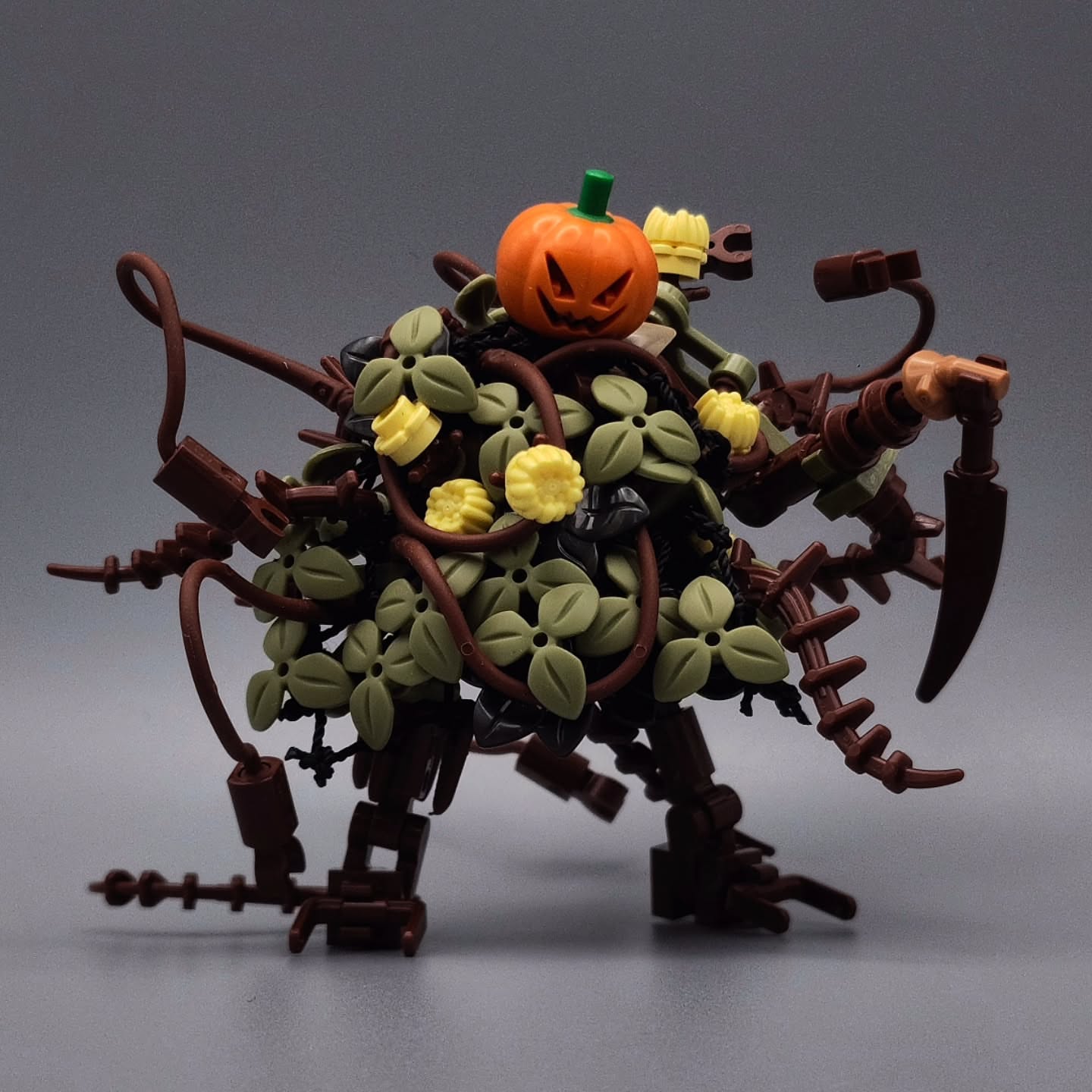
IT’S THE GREAT PUMPKIN BLIGHT, CHARLIE BROWN… RUN!

Image
photo by Zakar.ion

Often used by professional dowsers (and charlatans pretending as such) as a reason farmers should hire them, a pumpkin blight (also known as a calabasher) is the result of planting a pumpkin patch on the site of a great bloodletting. Some scholars of necromancy posit that the burgeoning gourds, full of vitality and potential life, are a magnet for any unquiet spirits linked to the area. Others suggest that the psychic residue of so much violence and death is a potent mutagen.

Whatever the case may be, eventually a monstrous agglomeration of pumpkin vines, wormy earth, and moldering bones erupts. A pumpkin blight exists for only a few days, after which the plant matter holding it together rots away, leaving behind a mound of stinking, mushy debris.

Large undead (plant)
Hit Dice: 10d10 (55 hit points), saves as a fighter.
Armor Class: Medium (Made of bones, dirt, and plants; low dexterity)
Movement: Half the speed of a normal unencumbered human, but a pumpkin blight is unaffected by difficult terrain.
Demeanor: Hungry and hostile. A character attempt telepathic contact with it must succeed a Wisdom-based saving throw or be stunned, paralyzed by visions of terror and violence.
Attack: 
– Slam attack +5 (10-foot reach, 2d6 damage; when doubles are rolled, target must succeed a Strength-based saving throw or be knocked prone) OR
– Chuck pumpkin +5 (30-foot range, 2d4 damage; when doubles are rolled, target must succeed a Strength-based saving throw or be knocked prone)
Special:

  • Vicious Vines: As its action, the pumpkin blight launches a web of tendrils in a 30-foot long cone. Creatures in the area of effect must succeed a Dexterity-based saving throw or become entangled in the vines. As a move-equivalent action, the pumpkin blight can attempt to pull entangled creatures into its body; targets can resist this forced movement with a successful Strength-based saving throw. The vines can also be severed by dealing any amount of damage directly to them (this damage doesn’t count against the pumpkin blight’s hit points). Creatures pulled inside the pumpkin blight take 1d10 damage every round as they are simultaneously crushed and suffocated. Creatures can dig their way out with a successful Strength check

I Loot the Body: A character digging through the remains will find 1d4 intact pumpkins (GM’s call as to whether they’re just pumpkins) and 1d4x10 gold pieces worth of buried trinkets.

Some Semi-Organized Thoughts on Draw Steel

Image
No Land Beyond, 108 W. North Avenue, Baltimore, Maryland

This past Sunday, I visited No Land Beyond for the first Flagons & Dragons in their hip new digs.

Firstly, for any readers in the greater Baltimore area, y’all should really check this place out. Full service bar, tasty food, well-stocked game library, impeccable vibes. With that out of the way, let’s get down to brass, er, steel tacks.

On more than one occasion, I’ve gone on record here as standing up for Fourth Edition D&D. Draw Steel seems to be directly descended from it – it’s a leveled, class-based system where every class has distinctive powers.

The first big difference is that Draw Steel is not a d20 system; it uses 2d10 plus a modifier. The next big difference is that those 2d10 rolls don’t determine success or failure, but degree (or “Tier,” to use the game’s parlance) of success. In the demo encounter I played, the PCs never missed an attack, but neither did their foes.

Image

Each pre-generated character had their own little booklet. As the demo scenario progressed, more of the character’s features would be explained, which I think is a smart way to run an introduction to a new game.

If you’re at all familiar with 4E mechanics, you can get a handle on the system. There are healing surges (called “Recoveries”). There is advantage and disadvantage (called “Edges” and “Banes”). Instead of hit points, you have “Stamina.” Some things didn’t get covered in the demo; I don’t know what “Stability” does or what “Project Points” are for.

Every character class has a unique resource. For example, the character I played, a monk analog, generated “Discipline” every round; different levels of discipline granted additional effects. I didn’t get a chance to look through all the other characters’ booklets, but most of the typical fantasy archetypes were covered: in the group I played with there was a “Fury” (barbarian), a “Censor” (paladin), a “Troubador” (bard), and a fire-based spellcaster whose class name I can’t recall. Also, there was a “Talent” in the party, which is a psionic controller-type character. My character, the “Null,” was also psionic. (Sidebar: I think “Null” is a bad choice for a class name. It evokes… well, nothing. Imagine you’re sitting down to make a character and looking over list of options, does seeing “Null” pique your interest compared to “Fury” or “Troubador”? Honestly, it sounds like it could be slur: “Watch out for that null over there.”)

The bulk of the demo consisted of a combat encounter against some goblins. It was very tactical, with a lot of forced movement being thrown around. In Draw Steel’s action economy, pushing a target away from your character is what in 4E would be called a minor action (or a bonus action in 5E) – a character could attack with their main action and follow up with a push. Also, pushing a creature into an obstacle (or another creature) deals damage, so we were further incentivized to knock those little guys all over the place. Initiative was handled a little bit differently than other games I’ve played – while it alternated between PC and Goblin, there was no set order of initiative for the either side. Thematically, I think it worked; it felt like a chaotic fight scene, while preserving the game-ness of it all.

Image

Draw Steel is not what I would call a “casual” game. This is not something you can whip out two or three beers deep on a Saturday night. You’ve gotta put your whole ass into playing it. For one thing, you really have to be paying attention to what the other player-characters are doing. I mean, you should be paying attention no matter what game you’re playing, but Draw Steel characters often have features and abilities that are contingent on each other. For example, the Talent’s player didn’t realize until after the encounter was over that they should’ve been accumulating their character’s resource (“Clarity” in this case) every time a creature was subject to forced movement. Another thing: using miniatures on a grid during combat is pretty much a necessity. Y’all would have to be a bunch of chess grandmasters to play this in the theater of the mind. But that was generally true of Fourth Edition too, so whatever – give me hell, Quimby.

In my 4E games, it always bummed the players out when they missed with their cool-sounding powers. Playing Draw Steel, it seemed to me that everybody was satisfied with what their character did at the end of their turn. I’ve only got the one experience with the system to go off of, but it seems that Draw Steel supports a wide-screen, action-oriented style of play. Hell, rather than a game master or referee, that player is called the “Director.”

Maybe my fond memories of Fourth Edition are biasing my opinion, but I had a great time playing Draw Steel.

SEELY-WIGHT

Image

Rustic fey more closely aligned with the earth than any of the faerie courts.

Medium fey
No. Appearing: 1d4
Hit Dice: 3d4, saves as a magic-user. Seely-wights have advantage on all saving throws to resist charms and enchantments.
Armor Class: Low (No armor + Above-average Dexterity)
Movement: Seely-wights can move twice as fast as an unencumbered human.
Demeanor: Depends on their aspect, see below.
Attack: Light melee weapon +3 (1d6 damage) or ranged weapon +3 (1d6 damage)
Special: Varies with their aspect, see below. Binding a seely-wight in iron chains prevents them from using their special ability.

Appearance: Humanoid, but (Hit Die 1 roll):
1 – Ethereal – Stereotypically fey-looking: slender, pale, androgynous
2 – Vegetal – Having plant-like physical features: green, bark-like, or lichenous skin; leaves or vines for hair
3 – Bestial – Having the characteristics of one or more kind of animal: Horns or antlers, scales, feathers or quills instead of hair, hooves
4 – Artificial – Seemingly made of inanimate materials: stone, metal, glass or porcelain

Aspect / Attitude (Hit Die 2 roll):
1 – Spring / Sanguine: Cheerful, optimistic, friendly.
Special Ability (Hit Die 3 roll):

  1. As their action, the seely-wight can do a dance or sing a song that will charm intelligent creatures that see or hear the performance and fail a Charisma or Wisdom saving throw. A charmed creature will not take hostile actions toward the seely-wight and will follow their instructions as long as the performance goes on. Once the performance stops, charmed creatures can make another saving throw, with Advantage, to cancel the effect.
  2. As their action, the seely-wight can cause entangling plant life to erupt out of the ground in a 30-foot radius around them. All creatures in the affected area that fail a Dexterity saving throw are immobilized; with a success, they can act normally but move at half their normal speed. The entangling plants last until dismissed by the seely-wight, or for up to 1 minute. At the start of the seely-wight’s next turn, this ability has a 1-in-6 chance of recharging.
  3. As their action, the seely-wight can attack with a thorny vine that has a reach of 15 feet. On a hit, the whip-like tendril deals 1d6 damage and the seely-wight can choose to grab the target. The seely-wight can use their action to pull a grabbed creature to another location within 15 feet; the grabbed creature can resist this forced movement with a Strength saving throw.
  4. As a reaction to taking damage, the seely-wight can restore 2d4 hit points, up to their maximum. At the start of the seely-wight’s next turn, this ability has a 2-in-6 chance of  recharging.

2 – Summer / Choleric: Irritable, stubborn, suspicious.
Special Ability (1d4):

  1. As their action, the seely-wight can dissolve into a swarm of stinging insects that fills a 10’x10’x10’ cube. Creatures that start their turn within the swarm take 1d6 damage and suffer Disadvantage on rolls until they leave the space occupied by the swarm. The seely-wight can reincorporate their body as an action.
  2. As their action, the seely-wight can call down a bolt of lightning to strike a target it can see within 60 feet. If the target fails a Dexterity saving throw, it suffers 2d6 damage and is knocked prone. Anything standing adjacent to the primary target must succeed a Dexterity saving throw or take 1d6 damage. At the start of the seely-wight’s next turn, this ability has a 1-in-6 chance of recharging. This ability cannot be used indoors.
  3. As their action, the seely-wight can increase their size. They double in height and quadruple in weight, becoming a Large-size creature. While in this state, the seely-wight gains a 10-foot reach, a +4 bonus to melee attack rolls, and their melee damage dice increases to 1d10. The seely-wight can maintain this ability for a maximum of 10 rounds, after which they immediately shrink down to normal size.
  4. Whenever a melee attack misses the seely-wight, they can use their reaction to make a melee counter-attack, provided the seely-wight can reach the attacker.

3 – Autumn / Melancholic: Morose, pessimistic, unhelpful.
Special Ability (1d4):

  1. As their action, the seely-wight can transform into a will o’ wisp. While in this form, the seely-wight is an intangible mote of dim light, immune to non-magical damage. They cannot attack, but can move at double their speed. It takes another action to return to their normal form.
  2. As their action, the seely-wight can take on a horrific visage. Creatures within 30 feet who see this apparition must succeed an Intelligence or Wisdom saving throw or be overcome with fear and run away from the seely-wight. At the start of the seely-wight’s next turn, this ability has a 2-in-6 chance of recharging.
  3. As their action, the seely-wight can emit a burst of toxic spores at an adjacent target they can see. If the target fails a Constitution saving throw, if suffers 1d8 damage and is unable to act until the start of the seely-wight’s next turn. If the target succeeds, it takes half damage and suffers disadvantage on rolls until the start of the seely-wight’s next turn. At the start of the seely-wight’s next turn, this ability has a 2-in-6 chance of recharging.
  4. Instead of using weapons, the seely-wight can attack with long talons that deal 1d4 damage but heal an amount of lost hit points equal to the damage rolled.

4 – Winter / Phlegmatic: Stoic, fatalistic, thoughtful.
Special Ability (1d4):

  1. As their action, the seely-wight can exhale a cloud of freezing fog that fills a 10’x10’x10’ cube. The cloud obscures vision and any creature that starts its turn within it suffers 1d8 damage. At the start of the seely-wight’s next turn the cloud dissipates and this ability has a 1-in-6 chance of recharging. 
  2. As their action, the seely-wight can touch a living creature and if they fail a Wisdom saving throw, the touched creature falls asleep for 1d6 minutes. At the start of the seely-wight’s next turn, this ability has a 2-in-6 chance of recharging.
  3. As their action, the seely-wight can encase their body in a coating of ice that protects as if they were wearing heavy armor. Creatures that start their turn adjacent to the seely-wight suffer 1d4 damage from the intense cold radiating off the armor. The armor lasts for 1d6 turns after which it shatters, dealing 1d4 damage to all adjacent creatures.
  4. The seely-wight wields weapons made of enchanted ice. Creatures that suffer damage from these weapons also suffer disadvantage on Strength- and Dexterity-based rolls from the numbing cold until the start of the seely-wight’s next turn.

*If a GM wanted to increase the power of a seely-wight, they should get another special ability for every additional hit die (to a maximum of 4 abilities as a 7 HD creature).

I LOOT THE BODY (roll 1d8)
1-2: 1d4+2 nettle darts (deal 1d3 damage on a hit, target suffers disadvantage on rolls until the dart is removed; deals another 1d3 damage when pulled out).
3-4: A satchel of barrow-gold (ancient coins and jewelry worth 1d4x10 gold pieces; 10% chance there’s an angry wraith looking for their stolen grave goods).
5: A bottle of pale golden liquor. Overpoweringly sweet and far stronger than any mortal spirit. If a non-fey drinks it, they most make a Constitution saving throw or become instantly intoxicated for 1d6 hours.
6: A blade of translucent green glass (1d6 damage, deals a critical hit on a roll of 19 or 20, but on a roll of 1 or 2, it shatters).
7: A glazed ceramic jar full of pearlescent jelly. Consuming a dose brings on a feeling of energetic euphoria, rendering a person immune to fear for 1d8 hours. The jar contains enough jelly for 1d6+1 doses.
8: A reversible hooded cloak, silvery-gray on one side, constellation-patterned on the other. When the gray side is worn, it protects like light armor under the moonlight. When the constellation side is worn, the wearer has Advantage on all rolls to hide and move stealthily in low-light or dark conditions.

THE EMERALD EMBER

Image

An finely-crafted sword in an elegant, archaic style. In certain lights, the silvery blade has a greenish sheen. Written in a flowing script down its length is its true name (requires literacy in the language of the Fey to read): The Last Green Leaf Before Autumn.

A wielder who knows Emerald Ember’s true name can activate its power. As an action, the sword can be effortlessly thrust into the trunk of a living, full-grown tree and when it is withdrawn, the blade will be wreathed verdant, smokeless fire that sheds light as bright as a torch. Creatures that are negatively affected by sunlight are similarly harmed by the light of these green flames.

While the green flames burn, Emerald Ember deals an additional die of damage to all foes. When doubles are rolled for damage, the target of the attack catches on fire. Targets on fire take suffer a die of damage at the start of every turn until the flames are extinguished.

The flames last for 1d6 rounds or until the wielder’s command to stop.

The tree into which Emerald Ember was plunged dies and immediately begins to wither, its lifeforce consumed by the blade.

NECROMANTICORE

Image
illustration by me

Large undead (beast)
Hit Dice: 6d10 (33 hp); saves as a fighter. Immune to poison and disease, resistant to cold, vulnerable to fire.
Armor Class: High (unfeeling flesh + high dexterity)
Movement: As a normal, unencumbered human. A necromanticore can use their move action to leap 30 feet long or 15 feet high.
Demeanor: Arrogant, intelligent, and cruel.
Attack:

  • Claws +8 (2d8 damage, if doubles are rolled, the target is pinned to the ground) OR
  • Bite +6 (2d4 damage; against pinned targets, the necromanticore has advantage on the attack roll) OR
  • Tail Stinger +6 (10 ft. reach, 1d6 damage and target must succeed a Constitution saving throw or become paralyzed with excruciating pain. Every round, the target must make another Constitution saving throw; on a success, they shake off the effects of the venom, but take another 1d6 damage on a failure.)

Special:

  • Devour Souls: Whenever a necromanticore slays a living creature, it absorbs their spiritual essence, gaining a number of hit points equal to the slain creature’s hit dice. A creature whose soul has been devoured cannot be revived until the necromanticore has been slain (but it could be reanimated).
  • Spellcasting: As an action, the necromanticore can sacrifice 1d6 hit points to cast one of the following spells:
    • Black Breath – The necromanticore exhales a 20-foot-radius cloud of dark vapor that lasts for a number of rounds equal to the hit points spent to cast it. A living creature that enters the cloud must succeed a Charisma saving throw or be sapped of their will to live, suffering disadvantage on all rolls. Once they leave the cloud, they can attempt the saving throw again.
    • Dead Can Dance – The necromanticore can reanimate a number of corpses or skeletons equal to the hit points spent to cast the spell. These creatures are mindless servants obedient only to the necromanticore that created them. If the necromanticore is slain, they immediately revert back to being inanimate.
    • Dolorous Demand – The necromanticore issues a command to a creature it can see within 30 feet. The command can contain a number of words equal to the hit points spent to cast it. The target can choose to resist the spell, but will suffer 2d6 damage as blood trickles from their ears and nose.
    • Ghostflame – Eerie blue flames erupt from the ground to a height of 10 feet, creating a wall with a length of 10 feet per hit point spent to cast it. Ghostflame burns cold, dealing 1d10 damage to living creatures who touch it, even those who are protected from fire. Undead creatures are not harmed. This spell lasts for up to 1 minute, or can be dismissed by the necromanticore. It also ends immediately when the necromanticore is slain.
    • Spectral Flight – The necromanticore disappears into the spectral realm for up to a number rounds equal to the hit points spent to cast the spell. The necromanticore can attempt to pull a creature along with it, but the target can resist it with a successful Strength saving throw.

A terrible foe armed with bestial strength and profane magic.

Get Too Close to My Fantasy

When I was a kid, there was a local TV station – WNUV-54 – that would reliably broadcast schlocky movies on Saturday afternoons. I’m talkin’ Cannon Group, Golan-Globus and Dino Di Laurentiis productions, stuff like that.

This heady, B-grade brew is part of my Appendix N, presented in no particular order.

1. LEGEND (1985)

Image

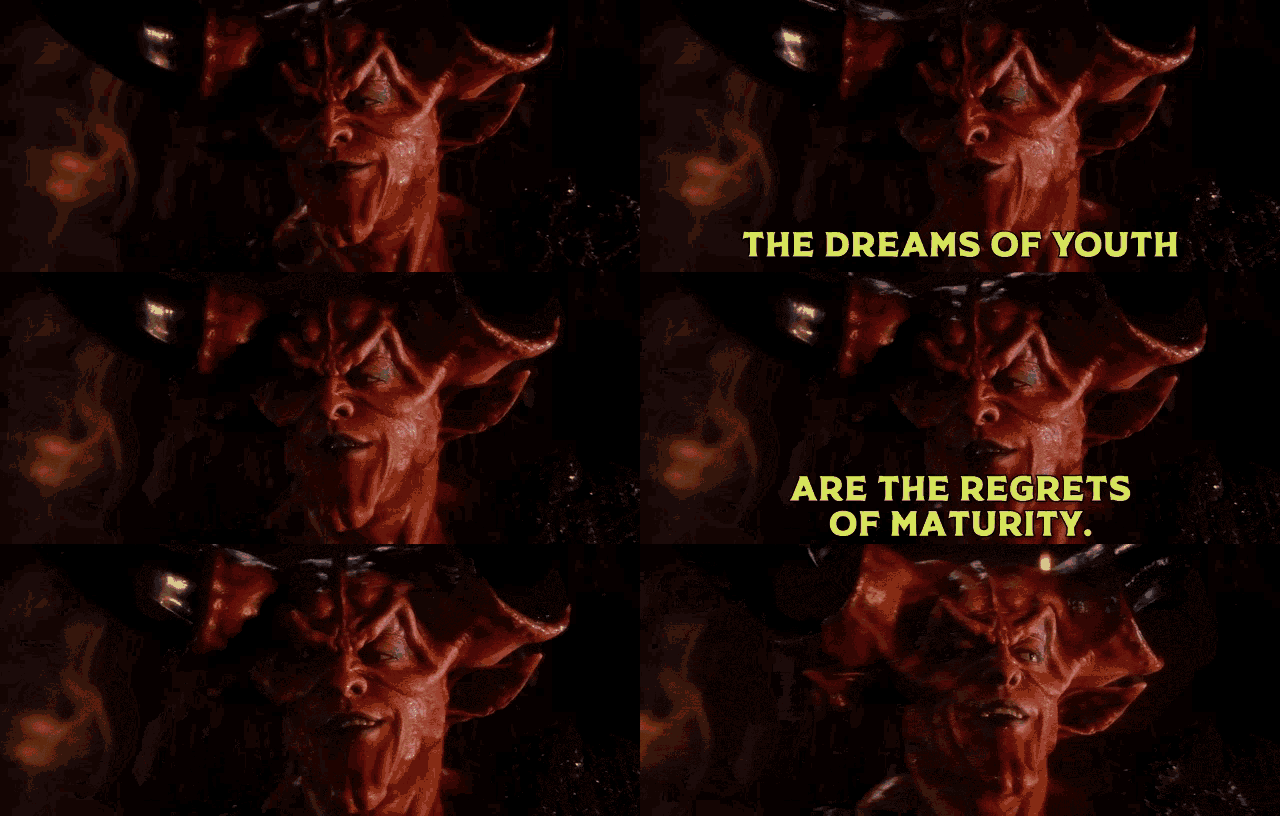
Ridley Scott’s very next movie after Blade Runner. Of course, I didn’t know who he was when I first saw Legend, when I was like, 6? 7? I couldn’t care less about the leads (played by Tom Cruise and Mia Sara), but holy shit, Tim Curry’s Lord of Darkness whips ass. All of Rob Bottin’s make-up work is great; I was terrified of Meg Mucklebones.

I much prefer the original cut with the Tangerine Dream soundtrack.

2. THE BEASTMASTER (1982)

Image

The dirtbag cousin to Conan the Barbarian (and I mean that in the best way possible). Tanya Roberts provides some cheesecake, Rip Torn snarls his way through every scene, and some poor bastard gets melted by a mothman.

The sequels are all garbage though.

3. CLASH OF THE TITANS (1981)

Image


This stands for movies with Ray Harryhausen effects in general. The Sinbad movies, Jason and the Argonauts, The Mysterious Island – they all hold up today. Harryhausen once said, “If you make things too real, sometimes you bring it down to the mundane.” Useful advice for the elf-game trade.

I would much rather watch this than the turgid remake from 2010.

4. KRULL (1983)

Image

As a kid, I thought the glaive (what the movie called the five-bladed boomerang in Ken Marshall’s hand above) was rad as hell and wished it got used more.

5. CONAN THE BARBARIAN (1982) / CONAN THE DESTROYER (1984) / RED SONJA (1985)

Image

John Milius is a maniac, but he understood the assignment. Basil Poledouris’ soundtrack goes so hard. The script is eminently quotable.

Conan the Destroyer is a weaker film, but in a way, it’s a good depiction of a D&D adventuring party and their shenanigans. My favorite bit of trivia about Destroyer is that Andre the Giant played the monster Dagoth.

Image
I love this picture. Schwarzenegger looks like a normal sized dude.

I have heard that Red Sonja was supposed to be an official Conan sequel, but there were issues with the rights or whatever. So, Schwarzenegger’s character is not Conan, but he’s totally Conan.

6. THE SWORD AND THE SORCERER (1982)

Image

A deep cut featuring one of the goofiest things you’ll ever see in a goofy genre – the Sky Sword, a sword with two extra blades that shoot off like guided missiles. Incredible.

I distinctly remember the bad guy’s creepy overly-long fingers.

Image
This is the same actor as Bull from “Night Court.”

What a time to be alive – you’d get up at 7 AM, watch cartoons for about 4, 4 and a half, hours straight. Then you’d just change the channel and watch dudes wreck other dudes with swords until your mom shooed you outside, where you’d reenact what you just watched with your friends.

Nostalgia is a helluva drug.

YOU LOOT THE GOBLIN

Image

Goblins keep all kinds of weird stuff in their pockets.

Roll 1d30:
1 – Bag of Assorted Teeth: Stained pouch full of teeth from an unknown number of species. 1-in-100 chance of pulling out a gold tooth.
2 – Barghest Frock: Hooded garment seemingly made from mangy dog-hides. Protects like light/leather armor and grants the ability to transform into a large black canine. In either form, the wearer has glowing red eyes.
3 – Battle Vest: Really a sturdy jacket with the sleeves cut off, decorated with spikes and garish embroidery. Doesn’t provide any protection, but makes the wearer feel like a badass.
4 – Bloodhound Baslard: When this long knife is spun around on a flat surface (like the floor or a table-top), it will point in the direction of the last creature it stabbed when it stops spinning.
5 – Choke Smoke Grenades: A net bag containing 1d3+2 glass spheres full of oily yellow-green fluid. When the fluid comes into contact with air, it turns into a rapidly-expanding cloud of noxious gas that irritates the eyes and lungs of living creatures. The spheres are small enough to be used as sling ammunition.
6 – Crimson Coin: Red-tinged gold coin that’s oddly heavy for its size. Anyone who sees you flip the coin into the air is instantly seized with a ravenous desire to have it.
7 – Double Crossbow: Can fire twice, sequentially or simultaneously, before needing to reload. Each trigger mechanism has a 2-in-20 chance of jamming; if both mechanisms jam at the same time, the weapon falls apart.

Image

8 – Eldritch Revenge Centipede: A bronze bracelet realistically wrought to look like a centipede. If the wearer is slain by the action of another creature, the centipede activates, seeking out the killer to deliver a fatal dose of venom.
9 – Filcher’s Fittocks: Grimy, unfashionable footwear that muffle all sounds of the wearer while in motion, but they are infested with fleas. If they’re ever washed, they lose their noise-cancelling property.
10 – Fill-in-the-Blank Curse Tablet: Legal pad-sized slab of dark gray metal covered with arcane diagrams and script. Someone with knowledge of the occult can identify it as a request to inflict grave misfortune, all it needs to work is for the target’s name to be engraved in the right place and the blood of requester spilled on the activation glyph.
11 – Firecrackers: 2d12 explosive noisemakers and 1 minute worth of fuse. Not powerful enough to do damage, but will ignite flammable materials.
12 – Fog Lamp: Feebly glows when lit. The area that would be illuminated instead fills with chill, sight-obscuring mist.
13 – Goblin Liquor: Unlabeled bottle of potent, bittersweet booze. If a non-goblin drinks enough to black out, they wake turned into a goblin.
14 – Hooligan Hatchet: Goblin-made mash-up of an axe, a hammer, and a crowbar.
15 – Instant Pit: Looks like a rolled-up carpet. When unfurled on solid ground, it becomes a circular pit 10 feet wide and 10 feet deep. Can only be rolled up again if it’s empty.

Image

16 – Jar of Magic Lard: An object or creature slathered in the stuff can fit through any opening of at least 1 square inch; effect wears off in an hour or until washed off. Contains enough applications to cover 8 goblin-sized creatures.
17 – Know-it-Alls: Tortoiseshell spectacles that comically magnify the wearer’s eyes without affecting their vision. Others perceive the wearer as being highly intelligent. (They do not actually increase intelligence.)
18 – Moondust: Pouch of fine silvery dust. Sprinkle it on something to make it levitate while moonlight shines on it. Only enough to use once.
19 – Mushroom Cap: Chunky knit stocking cap infiltrated with mycellium. If left in a damp, dark place, it will produce one edible mushroom per hour; there’s a 1-in-10 chance a mushroom will be hallucinogenic as well.
20 – Nunchucks: A light melee weapon consisting of a pair of hardwood rods joined together by a short length of chain.
21 – Rat-Tail Belt: Braided out of severed rat tails. The wearer doesn’t suffer ill effects from consuming spoiled or tainted food or drink.
22 – Rattleback Shawl: Made from the hide of a dire porcupine. When danger is imminent, the spines start clattering.
23 – Seelie Spanner: Crescent wrench forged from faintly iridescent metal. Seems to always fit whatever sized bolt it’s meant to turn.
24 – Sketchy Meat Pies: 1d4 meat pies wrapped in a grease-stained bandana. Can be eaten as is, but are better warmed up. Tasty and filling, but not made from the best ingredients or under ideal sanitary conditions; creatures with sensitive stomachs will have some trouble.
25 – Spiked Club: Hefty wooden truncheon studded with iron nails, wrapped with wire to keep it from splitting.
26 – Taxidermized Parrot: With this stuffed bird perched on their shoulder, a person can make their voice emanate from any other place they can see.
27 – Thousand-Year-Old Sword: Has an antique, lead-shaped blade; well-balanced and still razor sharp. Probably stolen from a pissed-off elf lord. Also possibly sentient.
28 – Tinker’s Friend: A vial full of metallic gray powder. When mixed with water it forms a quick-hardening paste for mending cracks and filling small holes in metal objects. There’s enough for six applications.
29 – Thunderbuss: Musket-like weapon with a stubby, bell-shaped muzzle. Fires a booming shockwave in a close-ranged conical burst. Can be used 6 times before it needs to be recharged by being struck by lightning.
30 – Witch’s Eye: Eyeball floating in a sealed vial of murky liquid. Protects the bearer from magical surveillance. But, the witch can still see out of it.