


News and Events

Hybrid organic-inorganic perovskites (HOIPs) comprise a family of semiconductors with many attractive properties for optoelectronics including high photoexcited carrier densities, moderate carrier mobility, shallow trap defects, and scalable solution processing. The incorporation of chiral organic molecules in these structures can give rise to chiral distortions in the inorganic sublattice that produce polarization- and spin-dependent phenomena such as circular dichroism, circular birefringence, spin polarized photoexcitation, and spin-dependent transport. These chiral HOIPs (CHOIPs) enable unprecedented control over the degree of chiral distortion via tailoring their composition and processing parameters. Our team has investigated a wide variety of CHOIPs in an effort to discover the relationship between the structure of the organic cation and the chiroptic properties of interest. I will discuss how multiple meta-stable crystal phases in these systems complicate efforts to optimize CHOIP thin films for chiral optoelectronics, and I will highlight the unique opportunities for materials engineering that we ar exploiting for future applications such as polarization-sensitive photodetectors and on-chip circularly polarized emitters.


| Temp: | 31 °F | N2 Boiling: | 75.9 K |
| Humidity: | 53% | H2O Boiling: | 368.4 K |
| Pressure: | 85 kPa | Sunrise: | 7:13 AM |
| Wind: | 2 m/s | Sunset: | 6:08 PM |
| Precip: | 0 mm | Sunlight: | 0 W/m² |



Selected Publications

SpaceX's Starship Super Heavy is the most powerful launch vehicle ever flown, intended to return humans to the moon and reach Mars. After measurements of three test flights (Flights 5, 6, and 9), this paper summarizes the measurements and briefly discusses launch noise and booster flyback boom characteristics. With a planned launch cadence to rival that of the Falcon 9, Starship's noise characterization is critical to determining its impacts and its place relative to other launch vehicles and noise sources. This paper accompanies an Acoustics 2025 plenary talk.

We describe a novel variation of the mirror twin Higgs model in which the color gauge group in both sectors is extended to SU(4)c and spontaneously broken to SU(3)c exclusively in the visible sector. Through this process, the mirror Z2 symmetry is spontaneously broken, allowing for a phenomenologically viable electroweak vacuum alignment. This structure produces interesting collider signatures, including heavy vectors and fermions with fractional electric charges. The twin sector, with unbroken SU(4)c, produces interesting cosmological characteristics, such as the possibility to reduce ∆Neff and stable spin-0 baryons. The enlarged top quark sector required by the extended color gauge symmetry preserves naturalness, with even less tuning than the original twin Higgs in many circumstances.

The use of audible sound for acoustic excitation is commonly employed to assess and monitor structural health, as well as to replicate the acoustic environmental conditions that a structure might experience in use. Achieving the required amplitude and specified spectral shape is essential to meet industry standards. This study aims to implement a sound focusing method called time reversal (TR) to achieve higher amplitude levels compared to simply broadcasting noise. The paper seeks to understand the spatial dependence of focusing long-duration noise signals using TR to increase the spatial extent of the focus. Both one- and two-dimensional measurements are performed and analyzed using TR with noise, alongside traditional noise broadcasting without TR. The variables explored include the density of foci for a given length/area, the density of foci for varying length with a fixed number of foci, and the frequency content and bandwidth of the noise. A use case scenario is presented that utilizes a single-point focus with an upper frequency limit to maintain the desired spectral shape while achieving higher focusing amplitudes.

A general method for designing proteins with high conformational specificity is desirable for a variety of applications, including enzyme design and drug target redesign. To assess the ability of algorithms to design for conformational specificity, we introduce MotifDiv, a benchmark dataset of 200 conformational specificity design challenges. We also introduce CSDesign, an algorithm for designing proteins with high preference for a target conformation over an alternate conformation. On the MotifDiv benchmark, CSDesign designs protein sequences that are predicted to prefer the target conformation. We apply this method in vitro to redesign human MAP kinase ERK2, an enzyme with active and inactive conformations. Out of two designs for the active conformation, one increased activity sufficiently to retain activity in the absence of activating phosphorylations, a property not present in the wild type protein.

This paper presents the first study comparing the spectra of a lab-scale afterburning rig operating at a relevant total temperature ratios value of
6, typical of Full-Scale (FS) afterburning jets, against Tam's similarity model. The spectral characteristics of FS afterburning jets were successfully reproduced on a lab-scale. Far-field acoustic data at 63 diameters relative to the nozzle exit were used to fit the similarity spectra, with a priority placed on achieving the best fit for the overall shape of the measured spectra while ensuring a smooth growth or decay of the peak frequencies. The transition region, which is delineated by a narrow range of microphone locations from 90° to 107.5°, required a combination of fine-scale similarity spectra (FSS) and large-scale similarity spectra (LSS) to better model both the peaks and roll-offs of the measured spectra. Only LSS was needed to model the spectra near the region of maximum overall sound pressure level radiation, whereas sideline angles only needed FSS. The similarity model was unable to accurately predict the double peaks observed at select angles. Additionally, a mismatch in the high-frequency slope between the similarity model and the measured spectra became apparent outside the region of peak radiation.
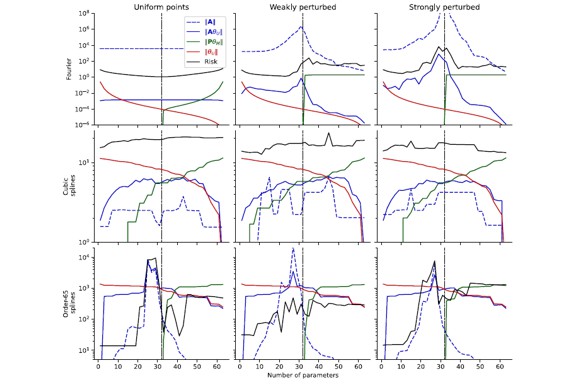
A central problem in data science is to use potentially noisy samples of an unknown function to predict function values for unseen inputs. In classical statistics, the predictive error is understood as a trade-off between the bias and the variance that balances model simplicity with its ability to fit complex functions. However, overparametrized models exhibit counterintuitive behaviors, such as “double descent” in which models of increasing complexity exhibit decreasing generalization error. Other models may exhibit more complicated patterns of predictive error with multiple peaks and valleys. Neither double descent nor multiple descent phenomena are well explained by the bias-variance decomposition. We introduce a decomposition that we call the generalized aliasing decomposition (GAD) to explain the relationship between predictive performance and model complexity. The GAD decomposes the predictive error into three parts: (1) model insufficiency, which dominates when the number of parameters is much smaller than the number of data points, (2) data insufficiency, which dominates when the number of parameters is much greater than the number of data points, and (3) generalized aliasing, which dominates between these two extremes. We demonstrate the applicability of the GAD to diverse applications, including random feature models from machine learning, Fourier transforms from signal processing, solution methods for differential equations, and predictive formation enthalpy in materials discovery. Because key components of the generalized aliasing decomposition can be explicitly calculated from the relationship between model class and samples without seeing any data labels, it can answer questions related to experimental design and model selection before collecting data or performing experiments. We further demonstrate this approach on several examples and discuss implications for predictive modeling and data science.
