Alternative Version, Peel Sessions

Acutely Obtuse

In this house at least, it’s very probably I Am Kurious Orange, but This Nation’s Saving Grace is often universally acknowledged as The Fall‘s greatest album. It is simultaneously accessible yet acutely obtuse in its weirdness; the concrete bass slam that drives Bombast into yr skull and the bone-shaking shouty skitter of Spoilt Victorian Child (surely the greatest Fall song title of all)…Couldn’t Get Ahead‘s skewed rockabilly and Gut Of The Quantifier‘s proto rap…My New House’s off-kilter poppish sheen…Paintwork‘s wonky balladeering…I Am Damo Suzuki‘s claustrophobic and descending head music…something for all tastes, you might say.

Released in 1985, it is, in a year of Brothers In Arms‘ (and even Psychocandy‘s and Meat Is Murder‘s) ubiquity, very much an outlier. Much like a decent measure of ancient malt, the first taste might leave you unsure, the residual after taste unpleasant even, but the ability to stick with it will slowly but surely establish it as a go-to when the moment calls. It is very much a rich and varied listen.

Image

The Fall – L.A.

I’ve been playing L.A. a lot recently. From its helicoptering bass riff in, it’s a bruising and repetitive soundscape that defies you not to listen more than once. Listen and repeat…listen and repeat. That’s been me the past week.

The Fall rhythm section, earthquake-proof and chiseled from the same bedrock as the track’s titular city, keeps everything solidly four to the floor. Mark barks, yelps and sing-speaks the song’s title in the background. Brix oohs and coos, the Californian Cher to his Salford Sunny, the additional leverage that comes from being the boss’s missus affording her the space to dust the whole thing in the abrasive yet hooky circular guitar riff that settles in your brain from first bar to last. The pop fly in the group’s gritty ointment, Brix was ably supported by producer John Leckie, mixing desk manipulator who rode that fine line between art and accessibility and helped make This Nation’s Saving Grace one of The Fall’s very best.

Image

Perhaps even better is the session version The Fall recorded for John Peel, worth it especially for the added dose of Mark’s uncalled for abrasion in the intro where he declares that “Lloyd Cole’s brain and face is made out of cowpatwe all know that!

Are you ready to be heartbroken, Lloyd? Listen on:

The FallL.A. (Peel Session)

Image

Alternative Version, Live!

Out Of Step/Out Of Time

I scanned this totally preposterous list on Substack over the festive period, where Thurston Moore lists his 350 Best Records of 2025. Yeah! – there’s no typo in there – that really does say 350, and Thurston really did list ’em all.

A totally pretentious concept, he goes, of course, for the willfully obscure and impossible to track down; cassette-only releases, band-made CDRs of live shows that 23 people were at, a Lana Del Rey (hey! I known her!) CDR single (ie promo-only release), a Sun Ra lathe-cut 10″, a Lou Barlow lathe-cut 7″, and so on and so on…

That coveted number one slot of Thurston’s was occupied by Laura De Jongh‘s Fundus. De Jongh is a harpist from Antwerp with a lovely, textured, ambient feel for soundscaping, great late night/early morning chill out stuff if that’s your kinda thing, but by the time of the list’s publication, her record – another 10″ (2025’s undisputed underground format of choice) was already long out of print.

Image

Who has time to listen to – and properly critique – that much new stuff…and then whittle it down to a shortlist of three and a half hundred?!? The album buyer for Rough Trade East won’t have managed that. Not even the counter staff at Mono in Glasgow will have managed that combined. I get that Thurston has used the opportunity to shed light on some of his lesser-known friends’ essential, if outre, work, but c’mon, man! Three hundred and fifty records! What nonsense!

Now, had this been 1997, Thurston might’ve opted for a more mainstream approach. Possibly the last great year for album releases, it seemed the year threw up a now-considered classic every other week. OK Computer and The Fat Of The Land, In It For The Money and Radiator, Dig Your Own Hole, Homogenic and Urban Hymns, Homework, Earthling, Blur and Tellin’ Stories, Heavy Soul, Vanishing Point, Maverick A Strike, Songs From Northern Britain, Mogwai Young Team, Brighten The Corners, Being ThereLadies And Gentlemen, We Are Floating In Space…ladies and gentlemen, we were spoiled for choice.

It’s quite possible too that a Tokyo collective of long-fringed shoegaze revivalists had cooked up quite the Jazzmastered storm on a limited to 50 copies CDR, wrapped in rice paper and designed to erase itself after half a dozen plays, but y’know, who knows? Maybe Thurston does. He probably has 2 copies.

Image

Even further back, 1991 was a similarly stellar year. Spin Magazine, the US equivalent to the UK’s NME (ie, it focused on metal-free, guitar-based music plus the odd slab of interesting hip-hop) went as far as declaring Teenage Fanclub’s Bandwagonesque its Album of the Year. Considering 1991 also threw up Nevermind and Loveless, Out Of Time and Screamadelica, Trompe le Monde, Blue Lines and De La Soul Is Dead, Weld, Achtung Baby, OG Original Gangster, Peggy Suicide and Foxbase Alpha, that’s quite the feat. Maybe it had something to do with ex-Orange Juice drummer Steven Daly being Spin’s contributing editor at the time…or maybe it was just the simple fact that Bandwagonesque was (and still undeniably is) a great record.

I listened to Out Of Time today, start to finish, twice. I can confirm that it’s lost none of its buzz – indeed, time has been very kind to it, and a record I’d heard a dozen times a day from the counter of Our Price is, in 2026, possibly even more appealing. REM’s real crossover album (Green may have brought them peeking from the margins, but Out Of Time went overground in a totally unprecedented way), even tracks like the much overplayed Losing My Religion and the much maligned Shiny Happy People sparkled boxfresh and urgent.

Image

The high points, of which there are many, go some way to explaining why people despair at the drop-off in quality of REM’s output in the years that followed. Low, with Michael Stipe’s voice in a, eh, low register is a slow-boiling beauty, possibly the second-best track on the record. The none-more Beach Boys-y Endgame is still sublime. I could play this at one point, learned by ear and note-perfect on an acoustic guitar. (I must get my chops back.) Belong‘s soaring wordless chorus, first heard and sung three years previously during 1989’s Green tour at the Barrowlands. Half A World AwayTexarkana‘s choppy riffing, Me In Honey‘s soaring and sparring dual vocals… Out Of Time is a properly fantastic album. You should make a point of playing it this week.

The pinnacle though? That’s easy. The gothic, country blues of Country Feedback is, quite clearly, the greatest song on the record, and quite clearly the greatest song Neil Young never wrote. Michael takes centrestage, the band slow and stately, totally in control of the song’s unwavering steadiness with Stipe’s unspooling vocal throwing in the odd, unexpected sweary word amongst its gorgeous melody. I could listen to this all day long and never tire of it. If I’m making a Thurston-type list for the end of ’26, Country Feedback may well be at the upper echelons of it. The 10″, lathe-cut, US promo-only white label, of course.

Here’s REM doing a grand version on Jools Holland’s Later in 1998.

REMCountry Feedback (Live on Later)

It’s quite easy to imagine a Neil Young version on Everybody Knows This Is Nowhere, his ramshackle and feedbacking guitar replacing the weeping pedal steel. If only.

REM and Neil YoungCountry Feedback (Shoreline Amphitheatre, October 1998)

The closest yet is from 1998, when ol’ Nel himself grabbed an acoustic guitar and joined REM for an encore at the Shoreline Amphitheater in California. Michael says at the start that it’s his favourite REM song, and who can blame him?

Alternative Version, Cover Versions, Gone but not forgotten, Hard-to-find

Nineteen

Plain Or Pan turns 19 today. One blink, and already, it’s into its final year of being a teenager, somehow mid-way through second year at University and making its own considered path in life. It’s very much its own thing these days, with its own mind and opinions and world view. Unlike its curator, gone is the need to be on it all weekend…unless by ‘on it’ you mean gym equipment. It’s protein, not pints for this one, and it looks good for it. Will it wish it had done more reckless things in its late teenage years? I doubt it. So far, it seems quite happy in its own skin. Let’s see how it fares in its 20th year – all things considered, it’s not bad going for a wee music blog steadfastly stuck mainly in the past.

Talking of which…

Image

I’ve been reading Colin MacInnes’s Absolute Beginners the past week. On Paul Weller’s say-so, I’d tried it years ago, more than once, but couldn’t get with it so sat it aside and let it gather decades of dust. I’m glad the urge took me to pick it up again. Something clicked. It hooked me and I read it in three nights flat. It is, as it turns out, a terrific book; fast of pace, meaty in subject matter and, when the protagonists are in scene, written in a sort of secretive teen-speak that could give Anthony Burgess’s nadsat argot in A Clockwork Orange a decent run for its money. I suspect you knew this already though.

Set in 1958 (and published hot off the press in 1959), it tells the story of a 19-year old west London teen, moved out already and living in a run down yet vibrant multi-cultural area. His neighbours are prostitutes…druggies…violent Teddy boys…beautiful people of all sexualities; it all makes for an obscene melting pot of edgy living. A hustling freelance photographer, we never find out his name – as he comes in and out of contact with the other key characters, he is referred to as ‘Blitz Baby’, ‘the kid’, ‘teen’, and so on – and we follow him as he falls out with his mother, takes a trip with his dying father and tries to convince his once girlfriend – ‘Crepe Suzette’ – not to settle for a marriage of convenience with a much older gay man. Race issues boil over – a result of a campaign of hate by the Daily Mail (or Mrs Dale, as the young folk refer to it) and our photographer is caught up in the melee of the Notting Hill riot, his head clobbered, his Vespa stolen, an easy target on account of his friendship with the Indian and Jamaican communities.

Jazz speak falls from every page, in-the-know references made to late-night Soho establishments where modern jazz is the new thing, where style-obsessed teens pop pills and seek thrills, the first generation post-war to grow up in a technicolour world where hope, ambition and aspiration are the key factors in eking out a life as far removed from your parents’ as possible. Nineteen, with a bit of cash in your pocket? And an attitude? And a way of speaking that is alien to the generation that came before you? You’re an absolute beginner.

The 1986 film adaptation of the novel has, since its release, come in for a fair bit of well-deserved and sometimes misguided stick. Even David Bowie’s majestic theme song – and one of his very best – can’t quite save it entirely, nor the sight of him turning up as slick advertising exec Vendice Partners in the sort of suit (if not accent) he might’ve adopted as stage wear towards the end of the decade. Like most adaptations, the book is far better (the film feels the need to name our absolute beginner ‘Colin’ – in memory of the novel’s deceased author, you have to think) but in the montage below there’s some great film-only dialogue, between the vibraphones and shuffling snares, brightly-coloured sets and hammy accents, that’s worth bending your ear towards.

*One point for every cast member you can name in the clip.


‘Aren’t you a little too old for her?’

‘I’m only thirty-seven…’

‘Thir’y seven?! Arahnd the waist, maybe..!’

(Also – doesn’t the Bowie track that plays at the end owe more than a little to Madonna’s Material Girl? A tongue-in-cheek reference maybe, given the subject matter of the scene being soundtracked?)

Image

Paul Weller called Absolute Beginners ‘a book of inspiration’, so much so that he ‘took’ it with him as his only source of reading material when he was banished by Kirsty Young on Desert Island Discs. If you are an impressionable teenager looking to find yourself and choose a path in life, the novel, with its themes of socialism and left-wing politics married to a decent soundtrack is a fine place to start. Weller would, of course, name a Jam track after the novel and later in the Style Council would create a tune called Mr Cool’s Dream, a reference, I’m assuming, to the character of the same name in MacInnes’s novel.

Weller was called upon to provide music for the film and so, drawing on his love of Blue Note and off-kilter time signatures, he came up with the bossanova boogaloo of Have You Ever Had It Blue?, a track that still has a comfy place in his setlist even to this day. And why not?

The Style CouncilHave You Ever Had It Blue?

And here’s Our Favourite Shop‘s With Everything To Lose, the, eh, *blueprint for the above track.


Footnote:

Have You Ever Had It Blue?, as groovy and finger clickin’ as it undeniably is, *owes more than a passing resemblance to the horizontally laid-back sunshine soft pop of Harper & Rowe‘s 1967 non-charting (and therefore obscurish) The Dweller. It’s certainly the best Style Council track that Paul Weller didn’t write. Perhaps, for this track, Weller should’ve renamed his group The Steal Council and come clean about it.

Harper & Rowe The Dweller


*in the clip:

As well as the obvious; Ray Davies, Alan Fluff Freeman, Patsy Kensit, Ed Tudor Pole, Lionel Blair, Edward ‘father of Lawrence’ Fox, Sade, Stephen Berkoff, Slim Gaillard, Smiley Culture, Bruno ‘Strictly’ Tonioli, Robbie Coltrane, Sandie Shaw, Mandy Rice-Davies…quite the cast, eh?

**maybe not all in the clip (!)

Hard-to-find

The Sloan Ranger

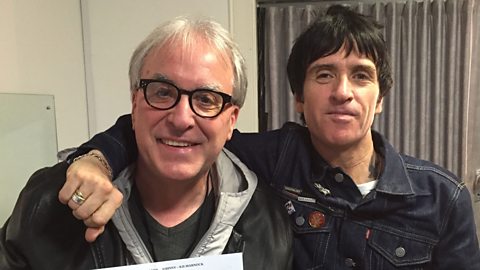
I’m backstage after a Johnny Marr book event a couple of Novembers ago. There’s a strict ‘Johnny will be meeting no fans tonight’ policy in place, but I have written a book I’d like to present to Johnny, and thanks to some impressive string pulling from the host Vic Galloway, I find myself waiting side stage at the end of the show, sat there until being summoned by the gods to meet Johnny. There are three other people near by. One I know. It’s the radio presenter Billy Sloan. I interviewed him for the very book I’m hoping to get to Johnny, so we are on chatting terms. He’s also booked for a gig I’m involved in a month or so later, so, yeah, I kinda know him. He too has a book for Johnny and we sit waiting like two wee boys about to show the headteacher our good work.

An assistant appears. “Right, Craig. You can come through. And BBC guy, you can come too.”

As I step forward, Billy masterfully slips in front of me. “This is my son, he’s with me.” Billy points to one of the other two folk and they step through the barrier with him, me now third in line. I’m suddenly being pushed rudely and roughly by the random fourth guy behind me, ushering me into the backstage area before anyone can stop him.

Billy Sloan!” I hear, the unmistakable friendly voice of St Johnny of Marr coming from round the corner. “I haven’t seen you since Rio! How are you doin’?!

Craig McAllister!” I hear, the unmistakable radio-friendly voice of Vic Galloway coming from the same place. “I haven’t seen you since Strathaven! How are you doin’?

The guy behind me leans in and speaks in my ear.

Are you guys famous or somethin’?” he asks in that nasally, neddy voice you hear all over Glasgow. “Gonnae let me go first…when they find oot ahm no’ famous, they’ll kick me tae fuck.”

Just wait your turn pal, I think, as Vic steers me into a wee room, Johnny and Billy and his son flicking eagerly through Billy’s new book at the side.

And then, eventually.

Hey! It’s Craig from the Ballroom Blitz!” (Years previously, at the Grand Hall in Kilmarnock, I’d told Johnny that the scene of his show that night was the inspiration behind the glam rock anthem, something that quite clearly had stuck with the nicest man in pop.) “D’you still have that Telecaster I signed?” (of course, duh-uh) “That was a great show in Kilmarnock…one of my favourites…etc etc...”

As I left, Billy already departed, the random stranger was manipulating the ‘Stage This Way’ notice off the wall and presenting it to Johnny to sign. I’d love love love to have seen his social media posts the next day. God knows what he told his pals.

Anyway.
Image

Saturday night there saw the last broadcast of The Billy Sloan Show on BBC Radio Scotland. After 11 years in the same slot (and many more elsewhere (45 in total, I think)) Billy is off the airwaves, unceremoniously shunted aside to make way for a new show where the emphasis will very much be on playlisted commercial music, the station’s new and strictly unsentimental controller keeping at least one twitchy eye on the RAJAR figures.

Were BBC Scotland a commercial station this could almost – almost – be understood, but the fact remains that BBC Scotland is OUR station and as such should be required – and proud, no? – to programme a broad spectrum of music that caters for all. Want commercial pop music? Just turn that dial, make your music sterile (to paraphrase Jimi Hendrix). Perhaps this new controller simply hasn’t yet been schooled in the BBC’s Reithian principles to inform, educate and entertain. Whatever the reason, it’s a disaster on many levels.

No one listens to late-night radio anyway…unless you’re specifically tuning in to a particular show. There will be people reading this who regularly tune in to Billy’s show and, dare I say, Riley and Coe on BBC 6 Music, nodding their educated and clever heads in agreement here. If by doing this BBC Radio Scotland hopes to attract a younger audience, good luck to ’em. It’s all podcasts and on demand and listen again these days, mate, if they’re even interested in the first place. The radio is a familiar friend for a demographic who have aged accordingly, but the young folk you so court consume their music in vastly different ways to us old bores, and dismantling your late-night schedule for the modern equivalent of light entertainment ain’t gonna fill that hole.

That the BBC has axed Billy’s show (and at the same time the Roddy Hart Show and the Iain Anderson folk show and Natasha Raskin-Sharp’s eclectic blues/world/and so much more show – the bulk of the station’s specialist music programming, as it goes) is late-night radio cultural rape and pillage on a scale not seen since the Vikings thundered their way to Valhalla.

Billy in particular has been responsible for introducing so many important artists to the Scottish public. From his beloved Simple Minds and U2, to Lloyd Cole, the Trashcan Sinatras and the Blue Nile, by way of the big hitters of the post-punk generation (Billy has a real fondness for Magazine and anything involving John McGeoch) and superstars of every era, Billy has played, interviewed and exclusively revealed them all.

In the past, his was the show where new bands sent their demo tapes. Often they’d pop up between a Bowie and an Alex Harvey track, hissy and tinny, knock-kneed and pretty green, but there all the same, coasting on the airwaves and playing in the nation’s ears. His was the show where these new bands might even be offered a session, a chance to record three or four songs professionally, to maybe have a live on-air chat with the always-interested presenter, to have real audience exposure and a chance to gain some new fans and grow a following. That sort of stuff is invaluable to anyone who’s ever bashed out a tune with enthusiastic hopefulness.

Commercial radio just doesn’t do this. Ken McCluskey of The Bluebells was quoted yesterday as saying Young At Heart will be played forever, but after Billy, no one will play their new songs. Imagine being an artist yet to write a Young At Heart and trying to get yourself heard. The axing of Billy’s shows – and all those others – has deprived forever a whole demographic of keen and urgent bands looking to cultivate a fanbase.
Image

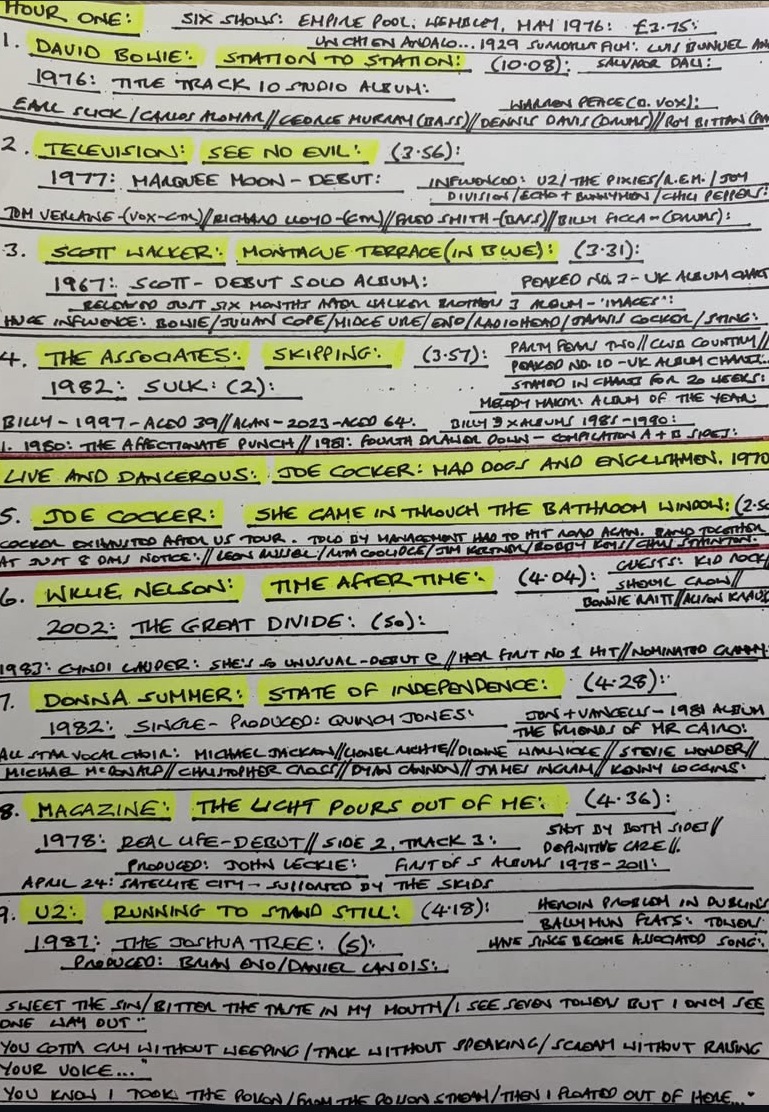
Billy’s last show was, as ever, a terrific listen, but with a subtly poignant playlist that hinted at more than he maybe could say. Was opening with Station To Station a coded way of telling us another station has already cleared the schedules for him? Or was he snarkily opening with a marathon Bowie track simply because it’s the antithesis of playlisted pop music? Either way, chapeau. Later on, there was U2’s Running To Standstill followed by The Clash’s Complete Control, and then the ultimate fuck you of playing the Velvets’ eight and a half minutes’-long live version of What Goes On. At the end, you might’ve expected a Simple Minds track, but no, Billy signed off with Sinead O’Connor’s The Last Day Of Our Acquaintance, its kiss-off refrain a clear reference to the powers above who allowed and encouraged this to happen:

This is the last day of our acquaintance
I will meet you later in somebody’s office
I’ll talk but you won’t listen to me
And I know your answer already

Shame on you, BBC Radio Scotland.

Let’s hope the airwaves ring once again – and soon – with the exclusive revelations of Scotland’s most-loved radio host.

You can listen (again) (on demand) to Billy’s final show here.

Image


Cover Versions, Gone but not forgotten, Live!

Panto Dame

The Dick Institute is a library, museum and art gallery in Kilmarnock. In recent years it has featured exhibitions of Quentin Blake’s artwork, the models of Aardman Animations, the writing of Michael Morpurgo and an interactive Lego installation. It serves the town well, an important totem of culture in an area often at the back of the queue when things like this are being disseminated. But that’s not important at this moment.

Panto season is in full swing just now. If you’ve seen one, you’ve seen ’em all; following a storyline as old as the hills, a pretty girl and a bequiffed, square-jawed handsome dude, at least one of whom is royal, are destined to be together, but only after evil is defeated.

Be it Sleeping Beauty or Beauty and the Beast, Jack and the Beanstalk or Aladdin, the principal characters of the cast rarely change. Puffs of smoke and sudden, polite bangs greet the fairy godmother, the jester/flunky/funny guy skips on stage in a multi-coloured costume, camply shouting “Hiya pals!” every 15 minutes and evil is introduced through a combination of dramatic music/lightning flashes/menacing clothing and hammy and knowing eyeball contact with the audience. Always, al-ways, a larger than life man fully embracing the concept of drag will drop innuendo after innuendo with every second line they deliver. (‘Haud that fur a meenit…whit ur ye worried aboot? It’s no’ hard!‘ etc etc.) Panto season is in full swing just now (oh yes it is) and I wouldn’t have it any other way. I love it!

I get to go with the school and I think the kids are sometimes more entertained at my reactions than they are with what is being delivered on the stage in front of them. I’ll happily boo the baddy and cheer the goody, even if some of the kids in my charge are far too self-conscious and cool for that sort of carry on. Lighten up, kids, this is great fun.

Panto is a goldmine of gaggery; souped-up dad jokes, punny and funny geographical sideswipes at neighbouring towns (‘It’s as barren and empty as the Ayr Utd trophy cabinet!‘), topical digs with references to popstars and current fads (“Six, seven!“) and a sprinkling of near the knuckle rippers that fly over the heads of many (but not all) school kids. The writers must have a blast.

Ah walked tae Prestwick Airport yesterday. Finally goat there an’ met a coupla Caramel Logs. Ah says, ‘How long huv youse been a wafer?‘”

Ah went tae a bar last week. Asked fur a pint. Some guy felt ma bum. Asked fur anither pint. The guy felt ma bum again. Anither pint. Same hing happened. Ah hink it musta bin a tap-ass bar.”

…so ah says…’Oany mair o’ that and you’ll be gettin’ a kick in the Dick Institute.'”

The houses are full each day – twice – once in the morning for school parties and once again in the evening for anyone – and run for around 60 shows across December, a pretty grueling and full-on month of work for the actors and crew. From empty page at the start to dress rehearsal, I’ve no idea how long a pantomime takes to pull together, but there’s clearly tons of work in it. More power to these people. May their jokes never change.

From one dame to another…

Whit’s the difference between Bing Crosby and Walt Disney?

Bing sings…and Walt disnae.”

Yeah. Jokes as old as the hills.

At some point in the early ’80s, writers started to refer to David Bowie as ‘The Dame’, a reference, I imagine, to the fact Bowie was by then one of the elder statesmen of the music scene. Little did those writers know, there were still another 30+ years of Bowie records and releases to come, some of which, history decreed, would stand shoulder to shoulder with his imperial mid ’70s phase. Meant as a slur, I’m not sure Bowie took any notice of it.

Image

In September 1977, between the releases of Low and ‘Heroes’, David Bowie recorded a slot for Bing Crosby‘s Christmas TV special. Arriving with Angie in matching flaming scarlet hair, the producers had something of a panic, delicately requesting that Bowie tone down his image to balance that of the Slazenger cardigan-sporting Crosby. Off came the earing. Off came the lipstick. On remained the crucifix and on went a hastily concocted brown rinse for his hair. From the corners of the wardrobe department, a silk shirt and suit jacket were found. Bowie acquiesced, and regardless of the dramatic changes to his appearance, he is very much still the epitome of cool.

Image

It was hoped that Bowie would accompany Crosby on a straightforward rendition of Little Drummer Boy, but after Bowie had told the show’s producers how much he detested the song, the show’s musical supervisors retreated to the basement and, breaking the land speed record for songwriting, wrote Peace On Earth as a counterpoint for Bowie to sing.

With less than an hour’s worth of rehearsal, Bing ‘n Bowie delivered a supreme take; crooned, sensitive, homely and Christmassy…all the more phenomenal when you stop to consider the music Bowie was making, and the lifestyle he was leading, at this time. Bing Crosby would call Bowie ‘a clean cut kid’ afterwards, ‘…a real fine asset to the show.’. Bowie would later claim he only did the show because his mum was a fan of Bing Crosby.

The recording, shown at Christmas 1977, wouldn’t make it to record until 1982 when RCA, very much against Bowie’s wishes, issued it in time for the Christmas market. It would peak at number three with sales in excess of a quarter of a million. A few months later, Bowie would leave RCA and join EMI, Let’s Dance a knowing twinkle in the old dame’s mismatched eyes.

Alternative Version, Gone but not forgotten, Hard-to-find, Live!, Sampled

Introducing The Band

A few months ago I posted about the burst of classical music that The Smiths used to signify they were taking the stage. Walk-on music, when used as effectively as The Smiths did it, is an integral part of the live experience. Those in front of the stage have their senses heightened…quicksilver adrenaline courses through the collective mass… eagerness is fit to burst and, as one, they peak when their heroes take the stage. In the article linked above, Mike Joyce talks about the prickling of the hairs on his arms as Sergei Prokofiev’s music reaches its climax and the group emerge from the shadows and onto the stage. Intro music is pure theatre and high drama, powerful in its effect for audience and band alike.

The recent death of Mani had me revisiting the Stone Roses catalogue and reminiscing about the Stone Roses gigs I’d been at. I say gigs, but Stone Roses shows were more of an event than a mere gig. The minute the group began to pick up traction, they eschewed the usual circuit of venues and instead put on ambitious landmark concerts.

Image

In the space of five rapid months in 1989, Stone Roses went from Glasgow Rooftops (above) – part of the touring circuit for bands of a certain size – to the Blackpool Tower Ballroom to a November show for 7000 rockers and ravers in London’s Alexandra Palace, at the time known as the broadcasting birthplace of the BBC and scene of some of those trippy 24-hour Pink Floyd and Soft Machine ‘happenings’ of the late ’60s, but certainly not the usual venue any bands might think to try and fill. Nowadays of course, any two-bit act with a bit of a following can add a date or two in the airy north London glasshouse, but in 1989 the Stone Roses’ choice of venue was genuinely inspired.

Image

Fast forward another six months and the group would set up stall on Spike Island, a windswept and chemically-polluted estuary of the Mersey. Two months later they’d play their final show (for then, anyway) in a huge tent on Glasgow Green, 10,000 rockers, ravers and by now bucket-hatted bampots witnessing the band at the peak of their powers. The travelling tent idea is also now fairly standard practice for bands of a certain size these days. (Spike Island less so.)

As the band’s popularity grew, they went from the standard idea of support act plus half an hour of playlisted music to an actual rave culture-inspired show, the group just one element of a spectacle that would involve guest DJs dropping crashing house beats and hip hop on the P.A., lasers and strobes on the lighting rig, mass E communion in the audience and generally good vibes all round. These shows were a million miles from watching Gaye Bykers On Acid from a cider-soaked corner of Glasgow Tech or the Wedding Present at the QMU or any other touring guitar band of the era you care to mention. Yes, even you, Primal Scream. In 1989, Bobby was still looking for the key that would start up their particular bandwagon. (It was somewhere down the back of his Guns ‘n Roses leather trousers, I’m led to believe.)

All of those shows mentioned above (I was at three of them) began with I Wanna Be Adored. Since writing the song, or at least since the release of that debut album, has there ever been a Stone Roses show that didn’t start with it? I don’t think so. I Wanna Be Adored is, in its own way, a senses-heightener, a quicksilver surge of electricity, an early peak in a set full of peaks, but in the live arena, it too would come rumbling from out of the corners, fading in as an intro tape heralded the group’s imminent arrival.

Stone Roses intro music:

Image

I’ve spent 35 years convinced that this music was made by the Stone Roses themselves, an abstract piece of art thrown away in the same vein as those backwards experiments they put onto b-sides, played for fun, recorded then used sparingly but appropriately. Certainly, the thunking, woody bassline is pure Mani. The hip-hop beat pure Reni. The sirens a clear extension of John Squire’s clarion call at the start of Elephant Stone.

Hearing this from Ally Pally’s carpeted floor minutes after Sympathy For The Devil is still strong in the memory. Hearing it again in the sweat-raining big top on Glasgow Green, many there unaware that this was not mere incidental rave music but Stone Roses’ call to arms (but we knew, oh yes, we knew, and excitement was immediately at fever pitch) still provokes a conditioned response in 2025.

It wasn’t made by Stone Roses though. Turns out it’s a piece of obscure-ish hip hop from 1987, looped, tweaked and added to by the Stone Roses team. The original – Small Time Hustler by The Dismasters – is immediately recognisable from that Stone Roses intro. Really, all the Stone Roses did was stick a few sirens on top of it…but combine that with Ally Pally’s echoing rave whistles and Glasgow Green’s surge of euphoria and it makes for high drama.

I wonder how many folk knew – truly knew – the source of that Stone Roses intro tape back in 1989?

Cover Versions, Gone but not forgotten, Hard-to-find

A Good Start!

There’s a story that Adam Horowitz tells – kinda preposterous, but totally believable (it’s the Beastie Boys, right?) – where waaaay back in the early days of the Beastie Boys he’s hanging out at a friend’s rather than be at school that afternoon when, from the TV, comes the unmistakable slow ‘n low DIY beats of his group’s own ‘Beastie Revolution‘, the flip side of their debut single Cooky Puss. Somehow, some way, British Airways had picked up on the track and used it to soundtrack a TV advert. Quite what the ad executives were thinking (or were on) by adding the Beasties’ track – lo-fi-Pass-The-Dutchie-as-recorded-by-Lee-Perry – to go hand in hand with an advert for global business travel is anyone’s guess, but there it was. Ad Rock couldn’t believe it. They had to ask for permission, didn’t they?

It so happened that Mike D’s mum had a friend of a friend of a friend who worked for a Manhattan law firm, and so, a young lawyer fresh out of law school and with the bit between his teeth was assigned to take on the Beastie Boys v British Airways in his first case. The four Beastie Boys (Kate Schellenbach was still a part of the group at this point) were subsequently awarded $10,000 each, an astronomical amount for a young person in 1983. Adjusted for inflation, it’s the equivalent of over $32,000 (£30,000) in today’s money. The money would go some way to helping the group establish themselves with decent equipment, accomodation and rehearsal space.

Image

Ad Rock did what any music-obsessed teenager would do: he took himself straight to Rogue, Midtown Manhattan’s music store. He had his eye on a black Rickenbacker, ‘the same one that Paul Weller from The Jam played‘ and had the $250 out to pay for it when, from the corner of his eye, he spied the new-to-market Roland TR-808 drum machine. Dilemma! He rationalised – he had a perfectly good guitar already…all the best, freshest records of the day were built on processed beats…here was his chance to own a real guitar…here was his chance to be cutting edge and adopt the brand new technology of the day…guitar?…beats?…guitar?…beats?… The 808 won out. Serendipitously, it would end up providing much of the backbeat for that first million-selling Beastie Boys album, after which Ad Rock could buy as many Rickenbackers as he fancied. A good decision, as it turned out.

It’s no secret that Beastie Boys have a hardcore punk thing at their roots, but when I first read the story above, I was suprprised that they were fans of The Jam. Of all the guitar-based bands to be into, they’d seem to be the most quintessentially English. The lyrical content, the suits, Weller’s undeniable accent…maybe that was the appeal.

In 2000, Fire And Skill, a tribue album to The Jam was released. It’s an eclectic (ie ropey) album and alongside the names you’d expect to be there (Liam Gallagher, Steve Cradock) were outliers such as Garbage, Buffalo Tom…and the Beastie Boys.

Beastie BoysStart!

Image
Beastie Boys

Their version of Start! is terrific. It’s cut from the same lightly toasted cloth that many of those groovy Beastie Boys instrumentals are cut from. There’s no immediate Taxman-aping thumping bass. There’s no frazzled, trebly guitar solo. There are hardly any vocals. Instead, it’s built on a bed of bubbling Jimmy Smith organ, a woozy melodica playing Paul Weller’s vocal melody, with skittery, hip-hoppish drums and splashing cymbals nailing the groove to the floor. Miho Hatori of Grand Royal labelmates Cibo Matto pops up to sing the ‘if I never, ever see you/what you give is what you get‘ refrain, but other than that, this is Beastie Boys doing what they do best – grooving on a soul jazz soft shoe shuffle for fun and out of sheer respect for the music.

In Dancing Through The Fire, Dan Jennings’ excellent re-telling of the Weller story from pre-Jam to the present day, there’s a story of the aeroplane-averse Weller travelling six hours by car between shows, playing the Beasties’ version of Start! over and over and over again. I hope Adam Horowitz gets to read about that.

Cover Versions, Get This!, studio outtakes

So You’re Gonna Be A Singer, Well I’ll Be Goddamned

Buddy’s Rendezvous is the name of a diner, the place where the character in Father John Misty‘s song meets up with his estranged daughter after a spell in jail.

It’s an entire movie in song, FJM proud at how pretty his daughter has turned out, lying to the old soaks in the bars about what a great job he did bringing her up, she noticing that he’s wearing the same coat he had on when he was sent down and telling him she’s going to be a singer, he telling her not to try and please everyone all the time and to ‘forget that leftie shit your mom drilled in your mind…whatever happened to the girl I knew?‘ It’s a brilliant song, evocative and filmic, that in its arrangement alone stirs up notions of Hollywood’s golden age of Art Deco and smooth-rolling, shiny-spoked Lincoln Continentals.

Image

It begins with a film noiresque saxophone bleating out the bluest of notes, climbing out of a smoky nightclub fug into the dark L.A. night, a loose, doo-wopish backing track accompanying it, the strings rising like smoke from a disgarded cigarette holder at a cocktail table. If Misty and producer Jonathan Wilson were aiming for ‘atmosphere’, you might say they nailed it.

Buddy’s Rendezvous and its parent album, Chloë and the Next 20th Century is a bit of an outlier in the FJM catalogue. For the most part, gone are the songs of syphilis and sexual proclivities, in are big sweeping Hollywood ballads, deft and ambitious in arrangement and played with an entirely straight face by a guy who’s normally happy to come across like a southern-fried Nick Cave. It wasn’t an album I immediately took to, but like much of FJM’s output, repeated plays reward the listener. Think of it as A Little Touch Of Schmilsson In The Night for Gen-Xrs and you’ll get on just fine with it too.

Released on Sub Pop, the record was presented to look like the sort of old time jazz record you might routinely shuffle past in your search for charity shop gold. The gatefold sleeve is thick and shiny, the labels on the records feature a fictitious label name and, occasionally annoyingly, fictitious song titles (and song times too). Even the publishing credits are made up. It’s a concept as grand as Misty’s musical vision and has, over time, become a real favourite.

Image

It stands to reason then that Lana Del Rey should do a cover of Buddy’s Rendezvous. Stately Hollywood glamour? Small hours and noirish? Slo-motion melodies unravelling like shook-free curls at midnight? Her version, of course, totally flips the perspective and that’s a big part of the appeal. Released as a one-off 7″ as part of the deluxe version of Chloë, it remains a sought after element of Del Rey’s expansive and exquisite catalogue.

I’m not sure of the officialness of the track below, but some enterprising and technically-minded public servant has produced a version with both Misty and Del Rey duetting on it. It seems to take FJM’s original backing track, leads off with Lana’s breathy vocal and by the end of the first verse has brought two idiosyncratic vocalists onto the one record. It’s clever and smart-arsed, but more than anything, just sounds terrific.

Buddy’s RendezvousLana Del Rey and Father John Misty

Image

*For the record, as much as I love the quirkiness of this ‘duet’, I think FJM’s original is the superior version. You should check it – him – out forthwith.

New! Now!

Wynderful

I’ve been following Nia Wyn on the various social media platforms for most of this year and just last week she’s gone and released the track that I can confidently predict will sit unchallenged at the top of the pile of my favourite singles of 2025. Given that this blog, and by association me, myself and I, is supremely influential on a global scale, you can expect that everyone and their talc-dusted granny will have joined the bandwagon before the middle of January, proclaiming the greatness of the track to anyone who’ll listen. For the record: you read it here first.

Nia WynI Wish It Would Rain

Image

The cynical here (and I know who you are) might point to the obvious reference points – Amy, Duffy, (Alabama Shakes, even) – on a record that’s a perfectly pitched amalgam of old gold and nu soul… and they wouldn’t be wrong – but that’s not the point.

I Wish It Would Rain is flawless in its quest for authenticity, and if you have even an ounce of soul in that tired and flabby middle-aged body of yours (yeah, I know my readership), then you’ll know that it’s simply undeniable. A warm record for cold nights, I Wish It Would Rain will be played long and often on repeat in the more perceptive households up and down the country….maybe even yours.

Rasping brass stabs, shuffling pistol crack snare, shimmering Hammond, tasteful guitar licks…and the ghostly vamping of a certain P. Weller esq will ensure this record reaches a far wider audience than it might otherwise have done, Plain Or Pan endorsement notwithstanding.

Image

With a brilliant sandpapery voice that falls somewhere between Macy Gray and Marge Simpson, Nia Wyn has spent the past couple of years refining a style that is ripe for crossover success. In moving from Llandudno to London, Nia has left behind the anarcho-punk, shaved-at-the-sides and centre-parted hair. Gone too is the angular fringe that was part suedehead and part Bananarama. In is a shortish new blow-dried crop, as sharp and smart as the tailoring she presents herself in. In too is a welcome friendship with Paul Weller, which can’t do any harm at all you’d have to think. What has remained – and is now stronger than ever – is a commitment to mining the best ideas from soul music, be that Motown, Philly, Stax or northern, and re-presenting them for these genre-blurring modern times.

Nia Wyn has the look to go with the tunes (seek out Can’t Get No Love Round Here for further evidence) and is poised, I dare say, for real commercial success in 2026. Don’t miss the boat.

*If anyone close to Nia is reading – I Wish It Would Rain would really benefit from having its own 7″ release. Go on! You’d be daft not to.


Get This!, New! Now!

Down On The West Side, Away From Sunlight

As autumn snaps itself sharply into winter and the early curtains of dusk draw their way across the gun metal grey skies on the commute home, the music being listened to in the car becomes equally as insular, wrapped tightly around itself for protection from the cold being blasted in by the westerly winds. As the windscreen wipers bump and squeak to the scraping of a Nick Drake cello or a Talk Talk bass glissando, as the indicators’ gentle ticking matches Sufjan Stevens’ gentle picking, as the sudden splash of a puddle matches the subtle crash of a jazz/folk paradiddle, it dawns on me that my music taste is seasonal.

Ska is for that first hint of summer, when it’s still technically early spring but folk are already waist deep in the filthy Firth of Clyde at Irvine beach. The reggae is reserved for the summer proper, although occasionally they clash by happy accident as playlists collide mid-barbecue. Dub? It sounds best on those rare days when even the sun can’t be arsed doing anything other than sit there and sweat. The twin colossuses (colossusi?) of Teenage Fanclub and Trashcan Sinatras work best in autumn, two groups who’ve travelled more than a few miles around the sun and, while being still recording and infrequently gigging concerns, are themselves in their autumnal years, with more miles in the rear-view mirror than what may still stretch ahead of them. Now there’s a sobering thought.

The new artists? They’re best kept for January when you can kid yourself on that this year will be the year when you embrace the new and unheard, before cracking mid-March for your annual Beatles/Clash/Smiths/Dylan/Bowie/Radiohead intake and the inevitable ‘why even bother with anyone else?’ thoughts. The yearly rotation of groups and songs and favourite albums is, to paraphrase Elton, the (song) circle of life. And I’m just fine with that, by the way.

I’m getting serious late-autumn Elliott Smith vibes from this – When The Sky Darkens Down by White Magic For Lovers. I think you’ll really like it.

White Magic For LoversWhen The Sky Darkens Down

Image

It’s windswept, mystical, close-miked and deftly picked. The finger scrapes on metal, the tumbling and ringing arpeggios that fall from six strings, the creeping chord changes and the whispered, late night vocal delivery all point to the church of Elliott. It’s uber melodic, steeped in melancholy and, with those low-in-the-mix syncopated bleeps and bloops that caterpillar their way through the background, something you’ll want to stick on repeat until the long, dark nights begin stretching free again. Lovely stuff.

Listeners of Guy Garvey’s BBC 6 Music show will be no strangers to White Magic For Lovers. He’s played them frequently for the past year or so, when tracks from When The Sky Darkens‘ parent album ‘Book Of Lies‘ first crept out. With musical roots stretching as far back as the Electric Soft Parade, the duo have decent pedigree…and a lovely way with an unravelling melody. You could do worse than investigate them. Start with Book Of Lies and its looping and somnolent lead track Axelrod, maybe, and work your way back from there. It’s a rewarding journey.