PlatformEngineering.org My Courses FAQs

This video is still being processed. Please check back later and refresh the page.

Uh oh! Something went wrong, please try again.

Platform Engineering Certified Architect (February)

Advanced certification for architects and DevSecOps leaders to build secure, scalable IDPs. Master policy-as-code with OPA and Gatekeeper, automate with Kubernetes Operators, and deliver frictionless developer experiences

rate limit

Code not recognized.

About this course

START DATE Feb 5th
TIME COMMITMENT 15 hours
DURATION 5 weeks
PRICE $2,000
FORMAT Instructor-led, live and on-demand

What you'll learn

By the end of this certification, you'll be able to:

checkmark Master the architectural foundations of scalable, reliable, and secure Kubernetes-based Internal Developer Platforms.
checkmark Implement security and compliance by design using Policy as Code with OPA, Gatekeeper, and Kyverno.
checkmark Build developer-facing APIs, CLIs, and UIs that power intuitive, self-service platform experiences.
checkmark Automate platform operations end-to-end with Kubernetes Operators and reconciliation patterns.
checkmark Apply zero-trust and runtime security controls to ensure platforms remain secure in real-world conditions.
checkmark Deliver a full working IDP and capstone project that integrates API, CLI, UI, and automation into one cohesive platform.

Prerequisites

For successful participation of the Platform Engineering Certified Architect course, students are expected to have fundamental understanding of:

bullet-icon

Cloud native (i.e. landscape and tooling built around Kubernetes)

bullet-icon

Kubernetes : Deploying workloads, using kubectl, managing namespaces/resources

bullet-icon

Git & GitHub : Comfortable with branching, pull requests, and CI/CD workflows

bullet-icon

Containerization: Docker build/run basics

bullet-icon

CLI tools proficiency (kubectl, gcloud, or similar)

bullet-icon

Policy as Code Tools: Exposure to OPA, Gatekeeper, or Kyverno (basic rules)

bullet-icon

Running CI/CD pipelines (GitHub Actions / Jenkins / GitLab CI)

bullet-icon

Dev Tools Setup: Local IDE (VS Code/JetBrains), API testing ( curl/Postman), terminal basics


Who's it for?

person_check
Architects

Architects who want to lay platform foundations like Policy as Code, RBAC, zero trust right.

person_check
Platform Engineers

Platform engineers who want to level up their architecture, K8s, Policy as Code and security skills.

person_check
Security engineers

Security engineers who want to level up their DevSecOps best practices for K8s platforms.


Curriculum

8 MODULES · 8 QUIZZES
MODULE 1 FEB 5 • 06:30 CET
Foundations and environment setup
Image
Image Intro to the course framework
Image Reference architecture
Image Environment setup (Coder, Kind, K8s)
Image Verify foundation (K8s, Grafana, Gatekeeper)
MODULE 2 ON-DEMAND
Policy-as-Code: Compliance at the point of change
Image
Image Introduction to Policy as Code
Image Introduction to DevSecOps & governance
Image Implement OPA/Gatekeeper policy engine
Image Block images with critical Common Vulnerabilities and Exposures (CVEs)
Image Use compliance at point of change
Q&A FEB 9 • 06:30 PM CET
Q&A Session
MODULE 3 FEB 12 • 06:30 CET
Secure foundations (Falco + Runtime security)
Image
Image Secure foundations (Falco + Runtime security)
Image Zero trust fundamentals
Image Deploy Falco for runtime security (eBPF)
Image Implement service identity (SPIFFE/SPIRE)
Image Integrate Gatekeeper (prevent) + Falco (detect)
MODULE 4 ON-DEMAND
Building developer facing platform APIs
Image
Image How APIs function as a product interface and abstraction layer
Image Design Teams API for self-service onboarding
Image Implement design-first (OpenAPI/Swagger)
Image Apply progressive disclosure principles
Q&A FEB 16 • 06:30 PM CET
Q&A Session
MODULE 5 FEB 19 • 06:30 PM CET
Command line interfaces for platform operations
Image
Image Role of CLIs for speed & scripting
Image How CLIs function as an abstraction layer
Image Develop a Python-based Teams CLI (teams-cli)
Image Enable automation via scripting/CI/CD
MODULE 6 ON-DEMAND
Platform automation with Kubernetes Operators
Image
Image Platform automation with Kubernetes Operators
Image Understand the Operator pattern
Image Build an Operator reconciliation loop
Image Automate namespace lifecycle
Image Configure Operator security (RBAC/limits)
Q&A FEB 23 • 06:30 PM CET
Q&A Session
MODULE 7 FEB 26 • 06:30 PM CET
Full-stack platform experience & capstone introduction
Image
Image Deploy final Teams Web Interface (Angular)
Image Verify end-to-end flow (UI->API->Operator)
Image Compare custom UIs vs commercial and open source portals (Backstage)
Image Introduce capstone project requirements
MODULE 8 MAR 5 • 06:30 CET
Capstone demonstration & retrospective
Image
Image Capstone demonstration & retrospective
Image Conduct individual capstone demos
Image Verify security gates (Gatekeeper/Falco)
Image Review key takeaways & best practices
Image Discuss next steps (GitOps, authentication)
EXAM ON-DEMAND
Architect Certification Exam
Image
Image Course Feedback Survey
Image Exam info


Meet your instructors

Ajay Chankramath

Ajay Chankramath

Founder, CEO @ Platformetrics

LinkedIn icon Connect with me on LinkedIn
  • bullet-icon Co-author of Effective Platform Engineering (Manning) and Domain-Driven Platform Engineering (Springer) and Author of Platform Engineer's Handbook (Packt)
  • bullet-icon Expertise in Platform engineering, GenAI in software delivery, Developer experience optimization, SRE, DevOps
  • bullet-icon 35+ years of experience in software development and delivery as a developer, architect and leader
  • bullet-icon Regular keynote presenter, workshop educator at Platform Con, DevOpsDays, Kube Days, All Day DevOps, and the DevOps Enterprise Summit (ELTS)
Brian Oliver

Bryan Oliver

Principal Technologist @ Thoughtworks

LinkedIn icon Connect with me on LinkedIn
  • bullet-icon Co-author of Effective Platform Engineering (Manning) and Designing Cloud Native Delivery Systems (O'Reilly)
  • bullet-icon Expertise in Platform engineering, Kubernetes, cloud-native delivery, developer enablement, compliance automation
  • bullet-icon Shares knowledge and resources at olivercodes.com
  • bullet-icon Regular presenter at KubeCon, CDCon+GitOpsCon, Craft-Conf, and other global events
 
 
Desktop
Mobile
 

Image


Image

 
Alumni stories
 
Testimonials          
Name Image Position Text Linkedin LinkedinPost
Jay Moran Image SVP of Platform Engineering & Distinguished Engineer at Fiserv I don’t often feel certifications are too useful, but in this case beyond being not vendor specific, I think this is one certification that really helps define a “Platform Engineer” versus someone who does some of the many components of what goes into platform engineering… https://www.linkedin.com/in/jaycmoran/ https://www.linkedin.com/posts/jaycmoran_platformasaproduct-idp-platformengineering-activity-7364777833262448641-ku7Z/?utm_source=share&utm_medium=member_desktop&rcm=ACoAAB7W6ucBwi1gPqF5QCBe36ipfkH_n4Cityo
Daniel Palermi Image Senior Cloud Engineer at Serko The Platform Engineering Practitioner certification helped me understand the evolution of DevOps and engineering practices over the years. It clarified the concept of platform engineering and its true purpose. In my opinion, everyone working in an IT company should take this course, as it offers valuable lessons that span across all roles.

https://www.linkedin.com/in/daniel-palermi-4a5b881b/  
Brittany Lebel Image Senior Product Owner, Kinsale Insurance The Platform Engineering course was a transformative addition to my career. The content was well-structured, covering everything from designing Platform Engineering Maturity  Models to developing reference architectures that drive standardization and empower developers with seamless self-service capabilities. The hands-on lectures on Pocket IDP provided an in-depth exploration of the entire implementation process, diving into technical details and real-case scenarios. This comprehensive approach offered invaluable insights into how an IDP functions as a product and how it can efficiently support production workloads.Thanks to this course, I now have the expertise to contribute meaningfully to the development and enhancement of our Internal Developer Platform, enabling us to accelerate application delivery cycles.I highly recommend this course to anyone eager to elevate their engineering expertise and make a tangible impact in platform engineering! https://www.linkedin.com/in/brittany-lebel/  
Marc Schnitzius Image Service Lead Platform Engineering at Codecentric AG The Platform Engineering  Certified Practitioner course is a great guide for better understanding that the success of an internal developer platform is not just about making developers happy and shifting all their problems to a platform team. https://www.linkedin.com/in/marc-schnitzius/  
Rafael de Araujo Pires Image Global Director of Architecture at AB InBev The Platform Engineering Practitioner certification was more than concepts. It was a reflection on my own platform journey since 2022.The biggest lesson? Platforms are about people. It’s about listening, building trust, and reducing friction so teams can deliver value with autonomy. It’s about connecting culture, product, and technology, and showing that developer satisfaction can be as strategic as any infrastructure investment.Platform engineering isn’t just code: it’s people, trust, and real business impact. https://www.linkedin.com/in/rafaeldearaujop/  


Desktop Mobile
 
 
Image


Image


Certification & Exam

checkmark
Show proof
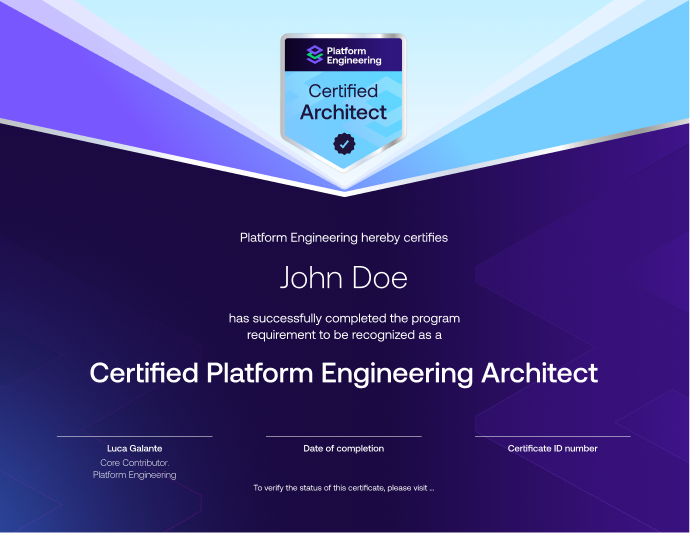
Receive an official Platform Engineering Certified Architect certificate when you complete the course and pass the exam. Valid for 1 year.
checkmark
Build your credentials
Use your certification to demonstrate verified skills in platform engineering and qualify for advanced programs.
checkmark
Share your achievement
Add your certificate to your LinkedIn profile and share with your network!
certificate preview


Architect Bundle

Save 20% $3,800 $3,150
checkmark

For engineers who want deep technical competence in platform architecture, infrastructure patterns, API design, and high-scale systems.

You will get:
checkmark

Fundamental principles and frameworks from Practitioner

checkmark

Architect secure, scalable Kubernetes IDPs using modern platform patterns

checkmark

Enforce security and compliance with Policy as Code (OPA, Gatekeeper, Kyverno)

checkmark

Build APIs, CLIs, and UIs that power developer self-service

checkmark

Automate platform operations with Kubernetes Operators and reconciliation loops

checkmark

Deliver a full end-to-end IDP through a hands-on capstone project

This bundle is for engineers who want to architect and deliver a secure, enterprise-scale Kubernetes-based platform.
Enroll in Architect Bundle


Question Answer

Why this certification?

Unlike other programs, this certification blends technical, product, and business frameworks so you can actually build and scale a successful platform initiative, not just understand the tech.

What will I learn?

This course teaches participants to master Kubernetes-based Internal Developer Platforms, focusing on architectural foundations. You will learn how to implement security and compliance by design, gain hands-on technical experience, and dive deep into topics like Policy-as-code (OPA/Gatekeeper/Kyverno), developer-facing APIs/CLIs, and Kubernetes Operators.

How is it delivered?

Live weekly sessions (recorded if you can’t join), self-paced modules, guest lectures, and an active Slack community of 500+ platform engineers.

How much time will it take?

About 3 hours per week for 5 weeks, plus optional homework. All sessions are recorded for flexible learning.

When will the instructor-led live sessions take place?

The sessions (unless stated otherwise) take place on Thursdays at 6:30 pm CET/12:30 pm ET , plus optional Live Q&A sessions on Mondays, same time. But remember - all recordings are shared, so it’s easy to take the course asynchronously.

Is this course for me?

It’s for architects, platform engineers, and security engineers who want to master compliance and security by design.

Successful participation requires fundamental understanding of cloud-native concepts (Kubernetes landscape/tooling), Kubernetes (workload deployment, kubectl, namespaces/resources), Git & GitHub (branching, pull requests, CI/CD), containerization (Docker basics), CLI tools (kubectl, gcloud), Policy as Code (OPA, Gatekeeper, Kyverno basic rules), CI/CD pipelines (GitHub Actions, Jenkins, GitLab CI), and dev tools (local IDE, API testing, terminal).

Do I get a certificate?

Yes. By doing an exam after the course, you’ll earn a verified digital certificate and LinkedIn badge recognized by leading platform teams.

What if I can’t attend live?

No problem, every session is recorded and available on demand.

What’s the exam like?

60 minutes, 50 multiple-choice questions, proctored. Passing score: 75%. You’ll have 2 attempts within 6 months of completing the course.

Can I pay by invoice or installments?

Yes, just contact us to arrange.

Can I buy now and start later?

Absolutely. Just contact us to arrange and join any future cohort.

Do I need any specific tools or technologies?

No special setup needed, just a laptop. We will provide all tech and tools needed through a Cloud Development Environment (CDE). This guarantees a consistent experience for all students, eliminating “works on my machine” issues.

Is coding required?

Yes, at least if you want to do the optional homework exercises.

What technologies are discussed?

Cloud-native concepts (Kubernetes landscape/tooling), Kubernetes (workload deployment, kubectl, namespaces/resources), Git & GitHub (branching, pull requests, CI/CD), containerization (Docker basics), CLI tools (kubectl, gcloud), Policy as Code (OPA, Gatekeeper, Kyverno), Terraform, CI/CD pipelines (GitHub Actions, Jenkins, GitLab CI), ArgoCD, dev tools (local IDE, API testing), portals like Backstage.

Do you offer private training for teams?

Yes, we run private team cohorts (virtual or in-person) tailored to your platform maturity and goals. Contact us for more information.

Still have questions?

Email certifications@platformengineering.org and we’ll be happy to help.


Curriculum

  • Module 1: Context, foundations and environment setup
  • Feb 5 - Live: Foundations and environment setup
  • Recording - Foundations and environment setup
  • Welcome and introduction
  • Recap of platform engineering
  • Your environment: Coder and Kind
  • Technical checklist and homework
  • Resources
  • Module 2 - Policy as Code: Compliance at the point of change
  • Introduction to Policy as Code
  • Defining Policy as Code
  • DevSecOps and platform evolution
  • Governance at the point of change
  • OPA Gatekeeper and technical implementation
  • Hands-On Exercise: CVE Scanning and Quality Gates
  • Resources
  • Live Q&A session - Feb 9
  • Feb 9 - Live Q&A
  • Module 3 - Runtime security monitoring and threat detection
  • Feb 12 - Live: Secure foundations (Falco + Runtime security)
  • Recording - Secure foundations (Falco + Runtime security)
  • Introduction to runtime security monitoring and threat detection
  • Zero Trust Architecture (ZTA) Fundamentals
  • Service identity and secrets management
  • Runtime security with Falco
  • Supply chain security and SLSA
  • SecOps integration: Defense in depth
  • Hands-on exercise: Implementing runtime security
  • Resources
  • Module 4 - Building developer-facing platform APIs
  • Introduction to Building developer-facing platform APIs
  • Purpose and scope of platform APIs
  • API Design Patterns and REST
  • The art of abstraction and progressive disclosure
  • Technical implementation with FastAPI
  • Automatic documentation and Swagger UI
  • Hands-on exercise: Deploying the Teams API
  • Resources
  • Live Q&A session - Feb 16
  • Feb 16 - Live Q&A
  • Module 5 - Command Line Interfaces (CLIs) for Platform Operations
  • Feb 19 - Live: Command line interfaces for platform operations
  • Recording - Command line interfaces for platform operations
  • Introduction to Command Line Interfaces (CLIs) for Platform Operations
  • The Role of CLIs in Developer Experience
  • Building the teams-cli tool
  • CLI design patterns and idempotency
  • Automation and CI/CD integration
  • Hands-on exercise: Team management via CLI
  • Resources
  • Module 6 - Platform automation with Kubernetes Operators
  • Introduction to platform automation with Kubernetes Operators
  • The Kubernetes Operator pattern
  • The Reconciliation Loop: Observe, Analyze, Act
  • Operators vs. GitOps
  • Teams Operator architecture and least privilege
  • Hands-on exercise: Deploying and monitoring Operators
  • Testing self-healing and drift detection
  • Resources
  • Live Q&A session - Feb 23
  • Feb 23 - Live Q&A
  • Module 7 - Full stack platform experience and capstone introduction
  • Feb 26 - Live: Full-stack platform experience & capstone introduction
  • Recording: Full-stack platform experience & capstone introduction
  • Introduction to full stack platform experience and capstone introduction
  • Visual exploration and interface segregation
  • Eventual consistency and the multi-plane workflow
  • Modern developer portals and Backstage
  • Introduction to the capstone project
  • Hands-on exercise: Deploying and verifying the UI
  • Resources
  • Module 8 - Capstone demonstration & retrospective
  • Mar 5 - Live: Capstone demonstration & retrospective
  • Recording - Capstone demonstration & retrospective
  • Introduction to capstone demonstration & retrospective
  • The capstone demonstration
  • The mindset shift: Platform-as-a-Product
  • Automation and the Operator pattern
  • Security by default and policy as code
  • Mastering abstraction and progressive disclosure
  • The future roadmap: Your journey as an architect
  • Resources
  • Feedback survey
  • Exam info

About this course

START DATE Feb 5th
TIME COMMITMENT 15 hours
DURATION 5 weeks
PRICE $2,000
FORMAT Instructor-led, live and on-demand

What you'll learn

By the end of this certification, you'll be able to:

checkmark Master the architectural foundations of scalable, reliable, and secure Kubernetes-based Internal Developer Platforms.
checkmark Implement security and compliance by design using Policy as Code with OPA, Gatekeeper, and Kyverno.
checkmark Build developer-facing APIs, CLIs, and UIs that power intuitive, self-service platform experiences.
checkmark Automate platform operations end-to-end with Kubernetes Operators and reconciliation patterns.
checkmark Apply zero-trust and runtime security controls to ensure platforms remain secure in real-world conditions.
checkmark Deliver a full working IDP and capstone project that integrates API, CLI, UI, and automation into one cohesive platform.

Prerequisites

For successful participation of the Platform Engineering Certified Architect course, students are expected to have fundamental understanding of:

bullet-icon

Cloud native (i.e. landscape and tooling built around Kubernetes)

bullet-icon

Kubernetes : Deploying workloads, using kubectl, managing namespaces/resources

bullet-icon

Git & GitHub : Comfortable with branching, pull requests, and CI/CD workflows

bullet-icon

Containerization: Docker build/run basics

bullet-icon

CLI tools proficiency (kubectl, gcloud, or similar)

bullet-icon

Policy as Code Tools: Exposure to OPA, Gatekeeper, or Kyverno (basic rules)

bullet-icon

Running CI/CD pipelines (GitHub Actions / Jenkins / GitLab CI)

bullet-icon

Dev Tools Setup: Local IDE (VS Code/JetBrains), API testing ( curl/Postman), terminal basics


Who's it for?

person_check
Architects

Architects who want to lay platform foundations like Policy as Code, RBAC, zero trust right.

person_check
Platform Engineers

Platform engineers who want to level up their architecture, K8s, Policy as Code and security skills.

person_check
Security engineers

Security engineers who want to level up their DevSecOps best practices for K8s platforms.


Curriculum

8 MODULES · 8 QUIZZES
MODULE 1 FEB 5 • 06:30 CET
Foundations and environment setup
Image
Image Intro to the course framework
Image Reference architecture
Image Environment setup (Coder, Kind, K8s)
Image Verify foundation (K8s, Grafana, Gatekeeper)
MODULE 2 ON-DEMAND
Policy-as-Code: Compliance at the point of change
Image
Image Introduction to Policy as Code
Image Introduction to DevSecOps & governance
Image Implement OPA/Gatekeeper policy engine
Image Block images with critical Common Vulnerabilities and Exposures (CVEs)
Image Use compliance at point of change
Q&A FEB 9 • 06:30 PM CET
Q&A Session
MODULE 3 FEB 12 • 06:30 CET
Secure foundations (Falco + Runtime security)
Image
Image Secure foundations (Falco + Runtime security)
Image Zero trust fundamentals
Image Deploy Falco for runtime security (eBPF)
Image Implement service identity (SPIFFE/SPIRE)
Image Integrate Gatekeeper (prevent) + Falco (detect)
MODULE 4 ON-DEMAND
Building developer facing platform APIs
Image
Image How APIs function as a product interface and abstraction layer
Image Design Teams API for self-service onboarding
Image Implement design-first (OpenAPI/Swagger)
Image Apply progressive disclosure principles
Q&A FEB 16 • 06:30 PM CET
Q&A Session
MODULE 5 FEB 19 • 06:30 PM CET
Command line interfaces for platform operations
Image
Image Role of CLIs for speed & scripting
Image How CLIs function as an abstraction layer
Image Develop a Python-based Teams CLI (teams-cli)
Image Enable automation via scripting/CI/CD
MODULE 6 ON-DEMAND
Platform automation with Kubernetes Operators
Image
Image Platform automation with Kubernetes Operators
Image Understand the Operator pattern
Image Build an Operator reconciliation loop
Image Automate namespace lifecycle
Image Configure Operator security (RBAC/limits)
Q&A FEB 23 • 06:30 PM CET
Q&A Session
MODULE 7 FEB 26 • 06:30 PM CET
Full-stack platform experience & capstone introduction
Image
Image Deploy final Teams Web Interface (Angular)
Image Verify end-to-end flow (UI->API->Operator)
Image Compare custom UIs vs commercial and open source portals (Backstage)
Image Introduce capstone project requirements
MODULE 8 MAR 5 • 06:30 CET
Capstone demonstration & retrospective
Image
Image Capstone demonstration & retrospective
Image Conduct individual capstone demos
Image Verify security gates (Gatekeeper/Falco)
Image Review key takeaways & best practices
Image Discuss next steps (GitOps, authentication)
EXAM ON-DEMAND
Architect Certification Exam
Image
Image Course Feedback Survey
Image Exam info


Meet your instructors

Ajay Chankramath

Ajay Chankramath

Founder, CEO @ Platformetrics

LinkedIn icon Connect with me on LinkedIn
  • bullet-icon Co-author of Effective Platform Engineering (Manning) and Domain-Driven Platform Engineering (Springer) and Author of Platform Engineer's Handbook (Packt)
  • bullet-icon Expertise in Platform engineering, GenAI in software delivery, Developer experience optimization, SRE, DevOps
  • bullet-icon 35+ years of experience in software development and delivery as a developer, architect and leader
  • bullet-icon Regular keynote presenter, workshop educator at Platform Con, DevOpsDays, Kube Days, All Day DevOps, and the DevOps Enterprise Summit (ELTS)
Brian Oliver

Bryan Oliver

Principal Technologist @ Thoughtworks

LinkedIn icon Connect with me on LinkedIn
  • bullet-icon Co-author of Effective Platform Engineering (Manning) and Designing Cloud Native Delivery Systems (O'Reilly)
  • bullet-icon Expertise in Platform engineering, Kubernetes, cloud-native delivery, developer enablement, compliance automation
  • bullet-icon Shares knowledge and resources at olivercodes.com
  • bullet-icon Regular presenter at KubeCon, CDCon+GitOpsCon, Craft-Conf, and other global events
 
 
Desktop
Mobile
 

Image


Image

 
Alumni stories
 
Testimonials          
Name Image Position Text Linkedin LinkedinPost
Jay Moran Image SVP of Platform Engineering & Distinguished Engineer at Fiserv I don’t often feel certifications are too useful, but in this case beyond being not vendor specific, I think this is one certification that really helps define a “Platform Engineer” versus someone who does some of the many components of what goes into platform engineering… https://www.linkedin.com/in/jaycmoran/ https://www.linkedin.com/posts/jaycmoran_platformasaproduct-idp-platformengineering-activity-7364777833262448641-ku7Z/?utm_source=share&utm_medium=member_desktop&rcm=ACoAAB7W6ucBwi1gPqF5QCBe36ipfkH_n4Cityo
Daniel Palermi Image Senior Cloud Engineer at Serko The Platform Engineering Practitioner certification helped me understand the evolution of DevOps and engineering practices over the years. It clarified the concept of platform engineering and its true purpose. In my opinion, everyone working in an IT company should take this course, as it offers valuable lessons that span across all roles.

https://www.linkedin.com/in/daniel-palermi-4a5b881b/  
Brittany Lebel Image Senior Product Owner, Kinsale Insurance The Platform Engineering course was a transformative addition to my career. The content was well-structured, covering everything from designing Platform Engineering Maturity  Models to developing reference architectures that drive standardization and empower developers with seamless self-service capabilities. The hands-on lectures on Pocket IDP provided an in-depth exploration of the entire implementation process, diving into technical details and real-case scenarios. This comprehensive approach offered invaluable insights into how an IDP functions as a product and how it can efficiently support production workloads.Thanks to this course, I now have the expertise to contribute meaningfully to the development and enhancement of our Internal Developer Platform, enabling us to accelerate application delivery cycles.I highly recommend this course to anyone eager to elevate their engineering expertise and make a tangible impact in platform engineering! https://www.linkedin.com/in/brittany-lebel/  
Marc Schnitzius Image Service Lead Platform Engineering at Codecentric AG The Platform Engineering  Certified Practitioner course is a great guide for better understanding that the success of an internal developer platform is not just about making developers happy and shifting all their problems to a platform team. https://www.linkedin.com/in/marc-schnitzius/  
Rafael de Araujo Pires Image Global Director of Architecture at AB InBev The Platform Engineering Practitioner certification was more than concepts. It was a reflection on my own platform journey since 2022.The biggest lesson? Platforms are about people. It’s about listening, building trust, and reducing friction so teams can deliver value with autonomy. It’s about connecting culture, product, and technology, and showing that developer satisfaction can be as strategic as any infrastructure investment.Platform engineering isn’t just code: it’s people, trust, and real business impact. https://www.linkedin.com/in/rafaeldearaujop/  


Desktop Mobile
 
 
Image


Image


Certification & Exam

checkmark
Show proof
Receive an official Platform Engineering Certified Architect certificate when you complete the course and pass the exam. Valid for 1 year.
checkmark
Build your credentials
Use your certification to demonstrate verified skills in platform engineering and qualify for advanced programs.
checkmark
Share your achievement
Add your certificate to your LinkedIn profile and share with your network!
certificate preview


Architect Bundle

Save 20% $3,800 $3,150
checkmark

For engineers who want deep technical competence in platform architecture, infrastructure patterns, API design, and high-scale systems.

You will get:
checkmark

Fundamental principles and frameworks from Practitioner

checkmark

Architect secure, scalable Kubernetes IDPs using modern platform patterns

checkmark

Enforce security and compliance with Policy as Code (OPA, Gatekeeper, Kyverno)

checkmark

Build APIs, CLIs, and UIs that power developer self-service

checkmark

Automate platform operations with Kubernetes Operators and reconciliation loops

checkmark

Deliver a full end-to-end IDP through a hands-on capstone project

This bundle is for engineers who want to architect and deliver a secure, enterprise-scale Kubernetes-based platform.
Enroll in Architect Bundle


Question Answer

Why this certification?

Unlike other programs, this certification blends technical, product, and business frameworks so you can actually build and scale a successful platform initiative, not just understand the tech.

What will I learn?

This course teaches participants to master Kubernetes-based Internal Developer Platforms, focusing on architectural foundations. You will learn how to implement security and compliance by design, gain hands-on technical experience, and dive deep into topics like Policy-as-code (OPA/Gatekeeper/Kyverno), developer-facing APIs/CLIs, and Kubernetes Operators.

How is it delivered?

Live weekly sessions (recorded if you can’t join), self-paced modules, guest lectures, and an active Slack community of 500+ platform engineers.

How much time will it take?

About 3 hours per week for 5 weeks, plus optional homework. All sessions are recorded for flexible learning.

When will the instructor-led live sessions take place?

The sessions (unless stated otherwise) take place on Thursdays at 6:30 pm CET/12:30 pm ET , plus optional Live Q&A sessions on Mondays, same time. But remember - all recordings are shared, so it’s easy to take the course asynchronously.

Is this course for me?

It’s for architects, platform engineers, and security engineers who want to master compliance and security by design.

Successful participation requires fundamental understanding of cloud-native concepts (Kubernetes landscape/tooling), Kubernetes (workload deployment, kubectl, namespaces/resources), Git & GitHub (branching, pull requests, CI/CD), containerization (Docker basics), CLI tools (kubectl, gcloud), Policy as Code (OPA, Gatekeeper, Kyverno basic rules), CI/CD pipelines (GitHub Actions, Jenkins, GitLab CI), and dev tools (local IDE, API testing, terminal).

Do I get a certificate?

Yes. By doing an exam after the course, you’ll earn a verified digital certificate and LinkedIn badge recognized by leading platform teams.

What if I can’t attend live?

No problem, every session is recorded and available on demand.

What’s the exam like?

60 minutes, 50 multiple-choice questions, proctored. Passing score: 75%. You’ll have 2 attempts within 6 months of completing the course.

Can I pay by invoice or installments?

Yes, just contact us to arrange.

Can I buy now and start later?

Absolutely. Just contact us to arrange and join any future cohort.

Do I need any specific tools or technologies?

No special setup needed, just a laptop. We will provide all tech and tools needed through a Cloud Development Environment (CDE). This guarantees a consistent experience for all students, eliminating “works on my machine” issues.

Is coding required?

Yes, at least if you want to do the optional homework exercises.

What technologies are discussed?

Cloud-native concepts (Kubernetes landscape/tooling), Kubernetes (workload deployment, kubectl, namespaces/resources), Git & GitHub (branching, pull requests, CI/CD), containerization (Docker basics), CLI tools (kubectl, gcloud), Policy as Code (OPA, Gatekeeper, Kyverno), Terraform, CI/CD pipelines (GitHub Actions, Jenkins, GitLab CI), ArgoCD, dev tools (local IDE, API testing), portals like Backstage.

Do you offer private training for teams?

Yes, we run private team cohorts (virtual or in-person) tailored to your platform maturity and goals. Contact us for more information.

Still have questions?

Email certifications@platformengineering.org and we’ll be happy to help.


Curriculum

  • Module 1: Context, foundations and environment setup
  • Feb 5 - Live: Foundations and environment setup
  • Recording - Foundations and environment setup
  • Welcome and introduction
  • Recap of platform engineering
  • Your environment: Coder and Kind
  • Technical checklist and homework
  • Resources
  • Module 2 - Policy as Code: Compliance at the point of change
  • Introduction to Policy as Code
  • Defining Policy as Code
  • DevSecOps and platform evolution
  • Governance at the point of change
  • OPA Gatekeeper and technical implementation
  • Hands-On Exercise: CVE Scanning and Quality Gates
  • Resources
  • Live Q&A session - Feb 9
  • Feb 9 - Live Q&A
  • Module 3 - Runtime security monitoring and threat detection
  • Feb 12 - Live: Secure foundations (Falco + Runtime security)
  • Recording - Secure foundations (Falco + Runtime security)
  • Introduction to runtime security monitoring and threat detection
  • Zero Trust Architecture (ZTA) Fundamentals
  • Service identity and secrets management
  • Runtime security with Falco
  • Supply chain security and SLSA
  • SecOps integration: Defense in depth
  • Hands-on exercise: Implementing runtime security
  • Resources
  • Module 4 - Building developer-facing platform APIs
  • Introduction to Building developer-facing platform APIs
  • Purpose and scope of platform APIs
  • API Design Patterns and REST
  • The art of abstraction and progressive disclosure
  • Technical implementation with FastAPI
  • Automatic documentation and Swagger UI
  • Hands-on exercise: Deploying the Teams API
  • Resources
  • Live Q&A session - Feb 16
  • Feb 16 - Live Q&A
  • Module 5 - Command Line Interfaces (CLIs) for Platform Operations
  • Feb 19 - Live: Command line interfaces for platform operations
  • Recording - Command line interfaces for platform operations
  • Introduction to Command Line Interfaces (CLIs) for Platform Operations
  • The Role of CLIs in Developer Experience
  • Building the teams-cli tool
  • CLI design patterns and idempotency
  • Automation and CI/CD integration
  • Hands-on exercise: Team management via CLI
  • Resources
  • Module 6 - Platform automation with Kubernetes Operators
  • Introduction to platform automation with Kubernetes Operators
  • The Kubernetes Operator pattern
  • The Reconciliation Loop: Observe, Analyze, Act
  • Operators vs. GitOps
  • Teams Operator architecture and least privilege
  • Hands-on exercise: Deploying and monitoring Operators
  • Testing self-healing and drift detection
  • Resources
  • Live Q&A session - Feb 23
  • Feb 23 - Live Q&A
  • Module 7 - Full stack platform experience and capstone introduction
  • Feb 26 - Live: Full-stack platform experience & capstone introduction
  • Recording: Full-stack platform experience & capstone introduction
  • Introduction to full stack platform experience and capstone introduction
  • Visual exploration and interface segregation
  • Eventual consistency and the multi-plane workflow
  • Modern developer portals and Backstage
  • Introduction to the capstone project
  • Hands-on exercise: Deploying and verifying the UI
  • Resources
  • Module 8 - Capstone demonstration & retrospective
  • Mar 5 - Live: Capstone demonstration & retrospective
  • Recording - Capstone demonstration & retrospective
  • Introduction to capstone demonstration & retrospective
  • The capstone demonstration
  • The mindset shift: Platform-as-a-Product
  • Automation and the Operator pattern
  • Security by default and policy as code
  • Mastering abstraction and progressive disclosure
  • The future roadmap: Your journey as an architect
  • Resources
  • Feedback survey
  • Exam info