David Hopkins recently started a new blogging series focused on paying it forward. It revolves around the hashtag #OpenBlog19. Although I was not explicitly tagged, he opened it up for anyone wishing to participate. So here is my response to the provocation: The most valuable lesson I ever learned’
My most valuable lesson learned is that it is not about having the answer, but instead working towards a solution. It can be easy to get caught in a fixed mindset around ‘best practices‘ and so forth, but too often this overlooks the context at hand. For me this plays out in a number of ways:
In the classroom
In today’s day and age, it can be so easy to be ‘right’. Follow this, do that. The problem is when these beliefs are often different in the next classroom or the class up the corridor. This can create tension that often plays out in the background.
Within relationships
In marriage, there is a constant need for give and take. This is all compounded when family is added to the mix (see Austin Kleon.)
On a project
It can be easy to get caught up in what should have happened or how things should work. However, it is more productive in the long term to work towards a shared solution that moves things forward.
To be honest, this is one of those lessons I feel learned yesterday and am sure I will learn again tomorrow. I am not sure if I am alone in this? As always, interested in your thoughts and opinions. Maybe I have gotten this all wrong?
At the start of each team meeting somebody shares a few things to get to know each other a little more. Here are some notes relating to my contribution …
It is easy to get caught up in autobiographical stuff, such as why I am not really Aaron Davis or how I was born behind a bank, but like Holden Caulfield, in A Catcher in the Rye, I don’t feel like going into it. Instead, I would prefer to share ten characteristics and the situations that influenced them.
Service
Although there is no doubt about my mother’s influence on my life, it can be hard to think about what I inherited from her. I think it would probably by her commitment to service. I seem to find myself doing the work that needs to be done, rather than the work that I might want to be doing.
Context
So often we discuss the practicalities of education. It can therefore be easy to question the value of a Bachelor of Arts. However, I think that my study inadvertently influences a lot of what I do. In particular, the power and potential of context. As I continue to collaboratively develop different strategies and solutions, empathising with other situations is so important.
Perseverance
In my first teaching position, I was the fifth teacher in the role and wrote my first set of reports after five weeks of teaching. I could understand why others had left, double Year Nine English to end each Friday never helped. However, sometimes what is most powerful thing is persisting through and looking back at the lessons learned.
Inequality
I spent a year at an indigenous school in country Victoria. The experience gave me insight into the inequality often inherent within systems and an insight into my own privilege.
Difference
Although originally trained as a secondary English and History teacher, I have managed to balance my time between both the primary and secondary classrooms. I was lucky enough to teach at a P-9 school for quite a few years and it really emphasised the difference in practice and thinking. The biggest challenge I found was agreeing on some sort of shared vision of learning and teaching that allowed both sides to have a voice.
Solid Foundation
For quite a few years I balanced life between the classroom and administration. It taught me that successful schools are build upon a solid foundation. Whether it be the way people are made to feel as they enter a school or having clear processes in place. Often it is said that the business manager rules the school. Maybe a different way of putting this is that the administration team often lays the groundwork for success.
Meaning of Success
Ask many about the Ultranet and they will mention dancing girls and the misuse of funds. I was a lead user and am always disappointed when people are unwilling to look beyond the failures. Although the platform itself failed, I feel the Ultranet itself brought about a lot of positives, especially in regards to collection of data and students. What the project therefore taught me was that success is sometimes in how you consider something.
Compromise
I have been married for ten years. In that time I have learnt about the importance of compromise. Sometimes it is for peace, other times it is for sanity. The fact of the matter is that nothing moves forward if there is not a little bit of give and take.
Chaos
There are some who argue that having children has made them a better teacher. I am not sure that this is true, but it has definitely provided perspective and taught me to live with the unexpected. I think Austin Kleon captures this situation best in his discussion of the complexities of families.
Team
My current work has taught me about the importance of team. It is the first place job I have worked in where I am truly dependent on the collaboration with others to solve problems. Although I have always worked in teams, it always felt that if you worked hard then it was possible to get things done. This is not possible when you are part of the complex system.
So what about you? What would you constitute as the ten influences which led to now? As always, comments welcome.
The word provides as a kind of ‘tincture’ to the year – its purpose being to regularly nudge you along a path of your choosing – a path that strengthens you in some way.
Although this was a useful focus, I felt that as the year went on I was becoming too black and white about things. Too clinical. Too methodical. Yes to this, no to that. Moving forward I felt I needed a means of engaging creatively within constraint.
Initially, I was inspired by Tantek Çelik and his efforts to regularly post positives. I wondered if my new word might be something like ‘solution focused’ or ‘happiness’. However, the more I thought about this, the more concerned I came about what such a focus might imply.
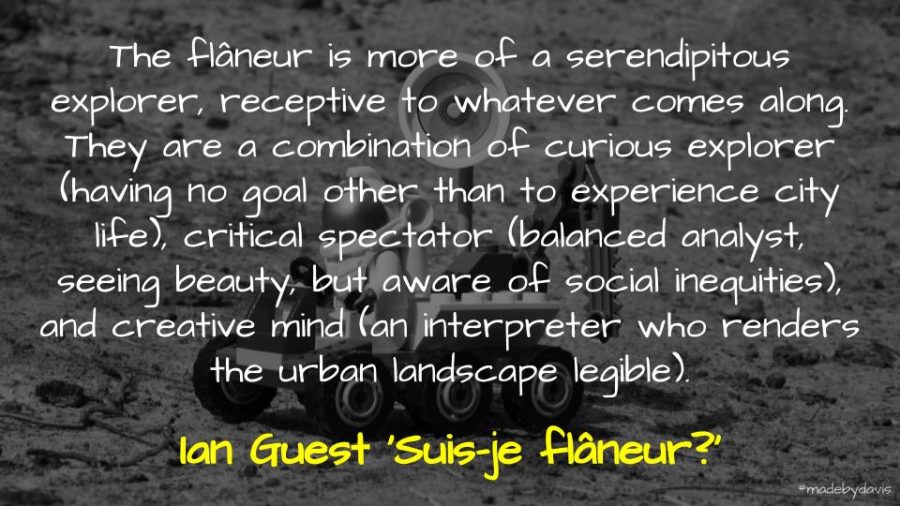
I moved to thinking about small things. Although I feel I pick up on things, I do not always act upon them. Julie Beck argues that unless we do something with what we have read within 24-hours then we often forget it. This got thinking about Ian Guest and his work in regards to flânerie. As he explains, the flaneur is a:
serendipitous explorer, receptive to whatever comes along. They are a combination of curious explorer (having no goal other than to experience city life), critical spectator (balanced analyst, seeing beauty, but aware of social inequities), and creative mind (an interpreter who renders the urban landscape legible).
What I liked about this was that it was not about merely observing, but also actively producing.
So far I have used Alan Levine’s new plugin to create an ‘On This Day’ page. I am also going to return to posting reflections more regularly. I did this a few years ago when I tinkered with the idea of a ‘What If‘ site. I hope that being more active will also help in extending my ‘serendipity surface’.
So that is me, what about you? Do you have any thoughts and suggestions? Do you have a word that you are focusing on this year? As always, comments welcome.
Whether it be sport, education or life, it can be easy to be typecast. The challenge is how to break this myth once it is established.
Glenn Maxwell: To Play or Not to Play, is that the Question?
When it comes to cricket, I am intrigued by Glenn Maxwell. On the one hand, he has shown the ability to achieve the unthinkable. Performing at the highest level, in a number of roles, with the bat, ball and in the field. Continually finding his way out of tricky situations through a mix of improvisation and creativity. This success and ability seems to have also been a part of his downfall as it has led to him being put in number of no win situations. Rather than seeing him cement himself in a particular position and subsequently a test career, he has seemingly been stuck playing something of a perpetual Mr. Fixit role.
In a recent interview with Sam Ferriss, Maxwell touches upon some of these challenges, one of which is the desire from selectors to just focus on white ball cricket.
Selection chairman Trevor Hohns said on Wednesday the National Selection Panel (NSP) want Maxwell to focus on white-ball cricket ahead of the 50-over World Cup in England later this year.
Maxwell shares the challenges associated with batting in six different positions in his first six test innings. With all the limited over cricket Maxwell has played, Ferriss suggests that in some ways it is amazing he has managed to play any test cricket. Some have blamed his character, the way he trains and his lack of runs and/or wickets. However, the biggest hurdle is often just opportunity:
If you are playing Shield cricket you’re not playing for Australia and if you’re playing for Australia you’re not playing Shield cricket.
Although he has taken the opportunity to play County cricket over the IPL, this is still restricted to just a few games. So much of his opportunities that Maxwell craves are therefore out of his hands.
Typecasting Teachers
This scenario has me thinking about education and the way in which teachers can be typecast into particular positions. Although this can be to the benefit of the school or system, it is often to the detriment of the individual.
Like Maxwell, I feel I have been thrown into a number of different situations as a Mr. Fixit. Whether it be to a change in staffing or timetable issues, personally they were often no win situations. Although I have the pedagogical nous, I did not always have the content knowledge to reference and build upon. In addition, these areas were often poorly supported with little room for development or innovation.
The catch is in an effort to break the Mr Fixit moniker you at the same time reinforce it. If you do poorly, then it justifies to some why you are just not good enough for what it is you were meant to be doing (even though that was not the reason given the change in roles), while if you do succeed this only adds to the myth made for you therefore earning yourself more Fix It jobs.
So often it feels like we talk about coaching and development until it no longer suits. Some argue that the answer is to move schools or change systems. However, just as it is not possible for Glenn Maxwell to go play test cricket for New Zealand it is not always possible to just move to the ideal role. Here lies the limit of a ‘solution focused’ approach that preaches ‘more runs’ or ‘different attitude’. The solution focus is to simply be grateful for what we have https://www.theatlantic.com/business/archive/2018/03/west-virginia-oklahoma-protests-teacher-pay/555434/, especially when in Maxwell’s case it has the potential to earn him millions of dollars and to be glad that he has been able to play test cricket at all (see Jamie Siddons).
So what about you? How have you been supported to succeed? Are there sacrifices that you have had to make for sack of the students and the wider system? As always, comments welcome.
Although Blasko’s use of synth bass and programmed beats with this album leads to comparisons with artists like Goldfrapp, Depth of Field never quite reaches the same dancefloor intensity. Instead the mix often creates a feeling of fragility. In listening I was reminded in part of LCD Soundsystem’s american dreams, as the more I listened, the more the choice to hold back on certain elements seemed to make more sense. Overall, I found it one of those albums that never seems settled and subsequently hooks you in because of it.
I would place this album between Goldfrapp and Lamb.
Lilac Everything is a captivating album. The decision of Emma Louise to definitively augment her voice makes for an intriguing listening experience. Where some may be critical of the artificial nature of pitch correction, the use in this circumstance is novel and critically challenges the notion of identity and belonging. There is just something uncanny about listening to a female artist taking on a male voice.
I would place this album between Father John Misty and Jeff Buckley.
The strength of Isaac Gracie’s self titled album is the rawness of his voice. In a world of lush productions, this album cuts things back to basics. Many of the tracks consist of drums, bass and guitar. This simplicity allows Gracie to stand out. In some ways this reminds me of acts like Beach House and London Grammar, who fill out their sound with less rather than more.
I would place this album between Art of Fighting and London Grammar.
It is interesting listening to artists who I grew up with, but have not necessarily listened to lately. They change, the world changes, music changes, I changed. The one thing that remains the same with Snow Patrol is Gary Lightbody’s distinctive voice. There is nuance with this album with a continual battle between acoustic and electric. Although some have argued that Jacknife Lee’s polished production is to the detriment of the album, I found that once I stopped comparing the album with the past it grew on me.
I would place this between Radiohead and Collective Soul
I loved last year’s MassEduction, but the rawness of Annie Clark’s voice accompanied by Thomas Bartlett on piano takes the music to a whole new level for me. Even though her music is relatively structured she manages to find creativity within constraint in this reworking. This is epitomised by a track like Slow Disco, which she has played supported by Bartlett’s piano, strings on the album, acoustically for NPR Tiny Desk and electroically in the Taylor Swift inspired reworking as Slow Fast Disco. Other artists to peel the layers back this year were Kimbra and Chilly Gonzales.
I would place this between MTV Unplugged and Chilly Gonzales
Christmas is always an interesting time of year when it comes to music. There are those like Michael Buble that have carved out a niche. Last year Sia created an interesting album of original music. With all this said there is something truly joyful about Chris Beckstrom’s ‘Holiday Extravaganzas’, where each year he electronically reimagines a collection of Christmas classics. The pictures are also a useful reflection of the effort involved.
I would place this between Daft Punk and Aphex Twin
Looking back it feels like the year of imagining, whether it be different versions (St Vincent) or new ground (Emma Louise). So what about you? What music has caught your attention this year? What albums and artists have you had on high rotation? Is there something that seems to tie your year together? As always, comments welcome.
Many argue that something is not right with social media as it currently stands. This post explores what it might mean to make Twitter great again?
Responding to Jack Dorsey’s call for suggestions on how to improve Twitter, Dave Winer put forward two suggestions: preventing trolling and making changes. Some of the particulars Winer shares include giving control over who can reply, eliminate character count and allow organisations to curate lists. Although I agree with Winer about some of these changes, I wonder if the answer to improving Twitter is always to make Twitter great again?
I feel the ways I use Twitter have changed considerably this year. My one word this year has been ‘intent’. A part of this is being more aware of my ‘prosumption’ online. One of my concerns is that Twitter is not the Twitter it once was for me. In short, it feels like there has been an increase in branding, as epitomised by ASCD’s recent spotlight on edu-twitter influencers. There has also been a rise in hostility and abuse. Some of which is automated, some of which perpetuated by crowds.
Although I have not wiped my account and started again, as Anil Dash did, I definitely started reviewing my practice and participation there. To be fair, my participation on Twitter has taken many guises over time. In the past it was the place where I shared ideas and connected the dots. The problem I found was that although I could dive back into my archive, it was far from organised. If this was my ‘outboard brain’ (as it had seemingly become) it had become rather chaotic. Initially, I adjusted things to syndicate to Twitter using Dave Winer’s Radio3 linkblog platform. I then moved to sending from my own site, however this did not feel right.
I wondered why I was actually sharing on Twitter (and every other site, such as Google+ and Tumblr), especially after reading Ben Werdmüller’s reflection on POSSE. Maha Bali suggests that sharing is a reciprocal act:
Giving means bringing something to gift to others … whereas sharing means reciprocity … you bring something of yours to give some to others, but others also bring some of theirs to give you, whether immediate or over time.
I do find that Webmentions are really enhancing linking—by offering a type of bidirectional hyperlink. I think if they could see widespread use, we’d see a Renaissance of blogging on the Web.
Posting on Twitter therefore lacked purpose, contributing to something I did not feel comfortable with. As I have elaborated on in the past:
Often it is presumed that sharing out links and continuing the conversation is always a good thing. However, at some point it can become too much of a good thing. The effort and intention to connect and engage in this situation has the opposite effect.
I also thought that if these links were for me then why not simply post them on my own site, what Greg McVerry describes as a social media of one. Posting on Twitter has now become about sharing if there was actually someone in particular that I felt might be interested and that was my main point on contact.
Mastodon doesn’t suffer from the organizational issues I described above, but by aping commercial social networking services, it suffers from the same design flaws.
Associated with this, I have tried to engage with Micro.Blog, but feel frustrated by the technological constraints. I love the use of RSS, but personally use my headings for too much to give them up and have yet to crack open the code as John Johnston has.
In the song Miss Those Days, Jack Antonoff sings about pining for the past:
I know I was lost, but I miss those days.
I think this conundrum captures the desire to return to what Kicks Condor has described as a weird Twitter. Although I was not tgere for the weirdest of times I remember my early days of anxiety and axiliration, of constant notifications, questions and check-ins. This is epitomised by Craig Kemp’s image of addiction:
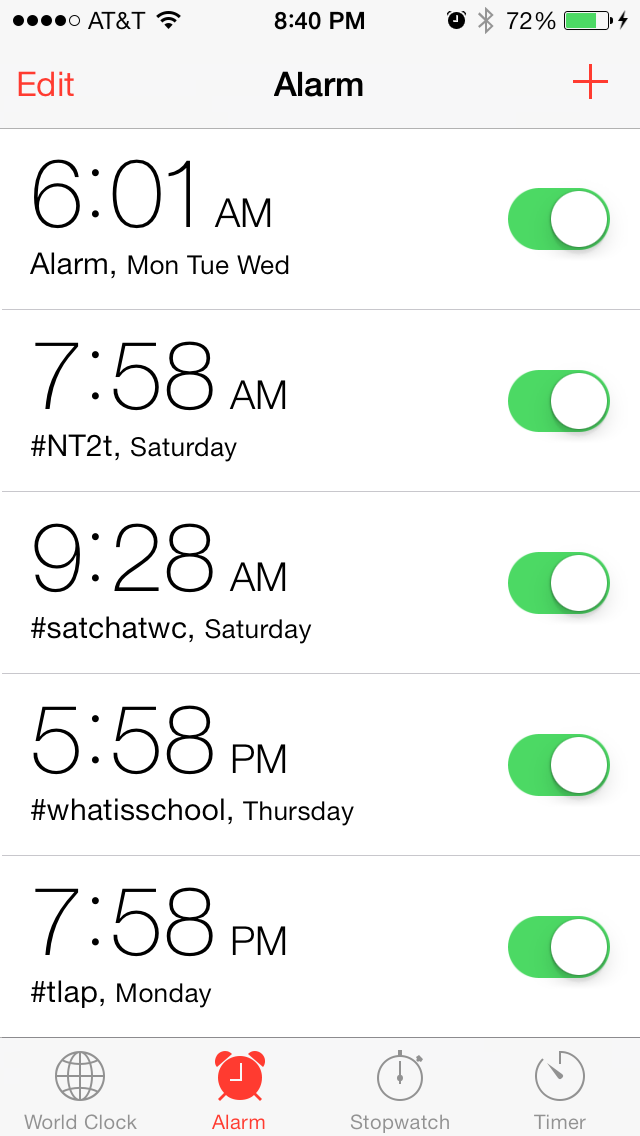
Although I never set alarms, there was a time when it encompassed a lot of what I did. I do not regret that time, but it is not necessarily something that I miss. My fast food social media diet has been replaced by one managed around blogs, feeds and comments. I do sometimes feel I miss out on some things, but trust that if I need to know something that I will probably capture through some other means.
What I am left most intrigued by is how my thinking has changed since I started talking with Dr. Ian Guest about this topic. Ironically, I think that his investigation inadvertently spurred my own inquiry. The ever present flanogropher.
NOTE: This post has sat in my drafts brewing for a few months. It involved a range of research. I apologise if it is inconsistent or incoherent, it is a topic that I have been really grappling with. I would love to know if anybody else has any thoughts. As always, comments and webmentions welcome.
Back in the 90’s, John Laws lead an ad campaign for Valvoline. It had the catchphrase of “oil ain’t oil”
It focused on the supposed quality and excellence of the oil in much the same way as John West did with salmon.
This focus on quality and excellence had me thinking lately about data and whether in fact ‘data ain’t data’ and that data is not neutral.
In an article for The Atlantic, Megan Ward provides a history of feedback. She touches on the origins associated with improving industrial machine efficiency and focus on finding fault. The problem is that in recent times it has been appropriated as a tool for managing people as a form of human machinery.
Positive ratings are a kind of holy grail on sites like Yelp and TripAdvisor, and negative reviews can sink a burgeoning small business or mom-and-pop restaurant. That shift has created a misunderstanding about how feedback works. The original structure of the loop’s information regulation has been lost.
Ward explains that this confuses things and in the process we risk making the activity one of noise, rather than any sort of purposeful meaning and change.
I was particularly reminded of this during a recent holiday to Fiji. I had some points of frustration about the place where we stayed and thought that it might be worth providing feedback. However, what I realised the longer I stayed was that such feedback would most likely miss the mark. Rather than improve the experience for others, as I imagined the feedback should, it would more likely be weaponised and lead to worse working conditions for the staff. To put the issues in context, they were each dealt with in a timely manner. In some respects that is all you can ask for. In addition to this, it would take away from what actually made the whole time most hospitable, the people. I decided not to provide feedback.
Another scenario that comes to mind is performance reviews in schools. I remember there was political outrage a few years ago that the vast majority of teachers in Victoria seemingly moved up their increment each year. It was felt by some that the review process was not weeding out under performing teachers. The problem I had then (and have now) is that it is failure for the wrong purpose. Teachers are not steam engines in need of optimisation towards some sort of greatness. Instead, they require feedback and follow-up based on particular contexts and conditions. This is why performance reviews are different to coaching programs. Jon Andrews explains this difference as improvement verses development.
The question that often feels overlooked when it comes to feedback is who or what is it actually for? It is easy enough to collect clicks and likes, but without purpose it can quickly just become noise. Data ain’t data, to treat it so misunderstands its purpose and association with feedback.
During a recent trip to Fiji celebrating our ten year wedding anniversary, my wife and I were lucky enough to visit a local primary school. It had roughly 200 students with a class for each year level. It is always interesting appreciating learning in different contexts. It highlights some things that we take for granted.
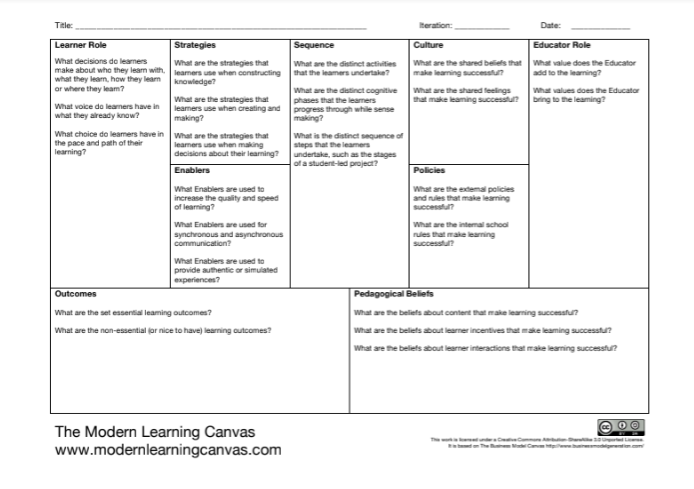
The Modern Learning Canvas is licensed under a Creative Commons Attribution-ShareAlike 3.0 Unported License.
Here are some of my observations of education in Fiji:
Roles, Strategies and Resources
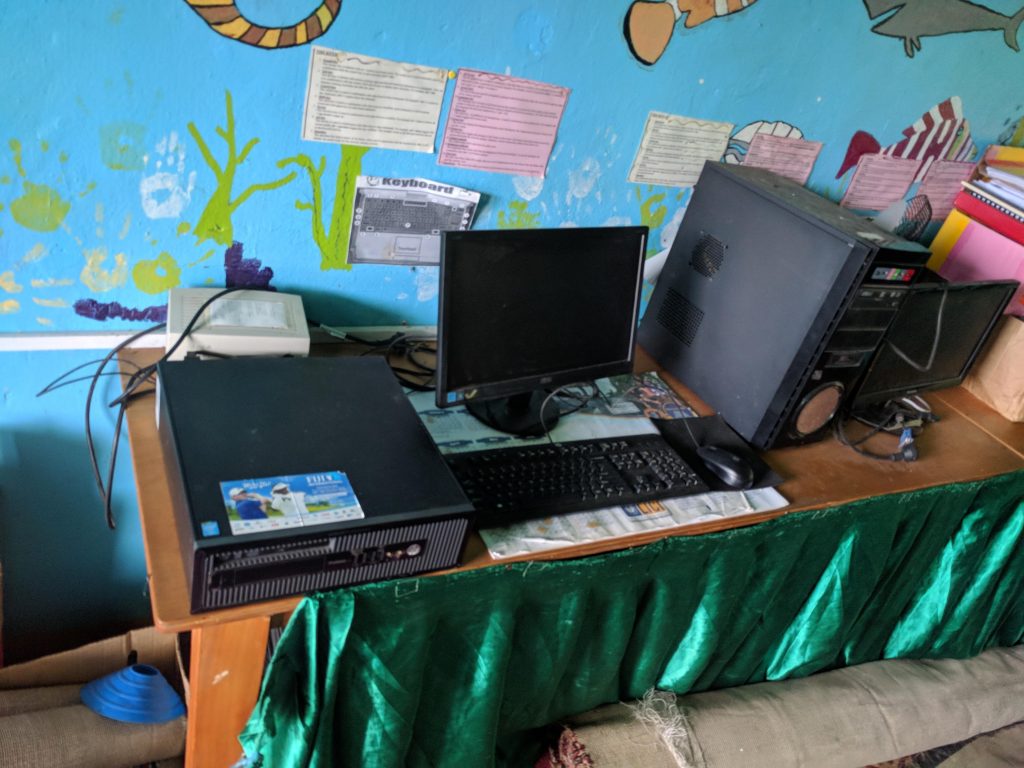
A Fijian computer room … one computer
Although the students we met were vocal, it was hard to decipher much choice or action over their learning. On the flipside of this, the educator’s role seemed pretty traditional with the teacher driving much of the learning.
It is always hard to properly judge learning by a walk through on a random day. What stood out though was the environments. The rooms were relatively dark, with the school building shaded by a veranda on one side and a hill on the other. The only cooling was via ceiling fans. I wondered what Stephen Heppell’s Learnometer would make of it?
The walls were covered with posters of various words and facts, while the chalkboards were full of formulas and activities. By their faded nature, I am not sure how many of the resources are changed around and it made me feel almost indulgent the way some teachers cycle through charts and posters. Having said this, I imagine that posters and paper would probably suffer from the humidity?
It is interesting to think about such technology as the chalkboard in regards to pedagogy, something Audrey Watters’ recently reflected upon. Although many people in the community had smartphones, there was limited access to devices in the classroom. No projectors. A few desktops in a room, but nowhere near enough for a class, let alone the school. Most teachers had a laptop though, which they would use to support learning. This reminded me of my own experience a few years ago and a post I wrote about what you could do with just one computer.
We were shown the library, which was a room with a few boxes of books around the edge. I did not notice many books in the classrooms. Although the government has a policy focusing on access and quality:
A reasonable collection of resources should comprise ten books per student.
It was not clear how this resourcing is funded. This also goes for the push for more devices too. Resourcing seems dependant on donations from companies, such as Vodafone.
Culture and Policy
Fijian Education at a Glance 2018
With limited access to resources, more emphasis seemed to be put on speaking and performance. For example, students went through a rendition of a number of stories, such as We’re Going On a Bear Hunt, where the class was divided into two with one side repeating the lines of the other. A part of me wondered though if this was as much a reflection of the way in which they learnt in general, as music and oration seemed to be ingrained in a lot of what Fijians seem to do?
Each of the schools in Fiji seemed to have some religious affiliation. In part I would guess that this was based on the missionaries who set them up. In the school we visited this was evident in the bible verses posted on the walls.
On a side note, the school had one of the most extreme emergency evacuation places, documenting what to do in the case of tsunami, earthquake, fire or mudslide. A reminder of nature’s presence.
Outcomes and Beliefs
It is interesting to consider Gert Biesta’s three arguments for a good education: qualification, socialization and subjectification. I felt the school touched on the first two of these. Speaking with some of the workers at the resort where we were staying the focus of education was very much about qualifications and what possibilities that might provide, while the posters discussing social media and alcohol touched on what it might mean to be a good citizen within the wider community. What this looked like in terms of outcomes was not so clear.
A Chalkboard and some desks is better than a tree in a field
When I think about other education environments I am always come back to a story, shared via Tom Whitby’s blog, involving teaching 230 children underneath a tree in Malawi. Although the school was not at those extremes – they had rooms and stable class sizes – it was a true reminder that sometimes we need to stop and appreciate the lot we have and make the most of it. What intrigued me is that as education becomes globalised, through such policy bodies as PISA, we overlook the expectations that can come with such changes. In some respect this is the purpose of the current project I am a part of, to bring schools up to a particular standard. Visiting Fiji has helped me think about some of the challenges and opportunities moving forward, as well as highlight some of my biases.
So what about you? Have you visited a school that helped challenge your thoughts and assumptions? As always, comments and webmentions welcome.
What might it mean to be ‘digitally mindful’ and does such a thing exist?
I was a part of a discussion about technology and wellbeing today. It was framed around the work of Hugh van Cuylenburg and the Resilience Project. For van Cuylenburg our focus should be on gratitude, empathy and mindfulness.
The focus then moved to Common Sense Media and the addiction to phones. The need for ‘tech-free time’ was brought up. This reminded me of a keynote last year from NSW Secretary of Education, Mark Scott, and his push for deep work, a term attributed to Cal Newport. The suggestion was that to be mindful we need to put the screens away. I was therefore left with the question, what might it mean to be ‘digitally mindful’ and can such a thing exist?
In an article for Common Sense Media, Elizabeth Galicia discusses some strategies families and tech companies can use to foster healthier habits. In addition to screen-free times and parental controls, there is discussion of ‘humane’ design and protection of data. The problem is that there does not seem to be any support for student action?
Maybe this action accounted for through the discussion of citizenship addresses this, but I feel there is a missed opportunity. Rather than wait for the ‘humane’ solutions to arrive, I wonder if there are opporrtunities to create deliberate safe spaces that can be used to support students in learning.
I did this myself with three classes connected together using Edublogs. One of the benefits is that comments were moderated, therefore if there was something shared that was inappropriate then it provided an opportunity for a learning conversation. As danah boyd points out in her seminal book It’s Complicated:
What the drive-in was to teens in the 1950s and the mall in the 1980s, Facebook, texting, Twitter, instant messaging, and other social media are to teens now. Teens flock to them knowing they can socialize with friends and become better acquainted with classmates and peers they don’t know as well.
A further extension on this is the #IndieWeb and the Domain of One’s Own project. There is something about not only being a part of networked publics online, but also actively engaging with what that actually means. For me, that has come to include commenting, collecting and posting from sites that I have some sort of say over. Some who are currently immersed in what this might mean for education are Greg McVerry and Ian O’Byrne. Although I think that there are currently hurdles around ease and access, for me this is what it means to be ‘digitally mindful’. It is not always easy, but I feel that as I have stepped back from engaging directly on social media I have become more aware of my presence online.
Although we can push for limited screen-time and better technology, I think that the challenge that faces many of us today is being more aware of the technology we have at our mercy and being more informed about what it all might mean.
What do you think? As always, comments and webmentions welcome.
This post started as a response to a possible future of technology. However, it grew and grew, so I have split it up. This then is a response to my reading of James Bridle’s book The New Dark Age and the place of the future of the smartphone.
If we didn’t have them … what would the world look like … Can we definitively say ‘better’ ?
For me, this is such an intriguing question. My initial response was a little circumspect. In particular, I think the idea of ‘better’ is problematic and instead argue for difference. This particular change is captured by Vala Afshar in the form of emojis:
There is no doubting that the smartphone has simplified so many actions and activities. When I think of my own habits, my writing and reading often starts with my phone, whether it be flicking through my feed reader or jotting down a few notes.
Yet I am left feeling something is still missing in the discussion. I wonder about the inherent design and consequence of smartphone use? I wonder about those places involved in the production? I wonder about the ethics involved?
This is our life now: strongly shaped by the detailed design of the smartphone handset; by its precise manifest of sensors, actuators, processors and antennae; by the protocols that govern its connection to the various networks around us; by the user interface conventions that guide our interaction with its applications and services; and by the strategies and business models adopted by the enterprises that produce them.
I am not necessarily arguing we should ‘ban’ smartphones in schools as it often feels like such decisions are sometimes made for the wrong reasons, whether it be liability or control. Instead I am striving for more critical reflection.
Here I am reminded of Doug Belshaw’s work on digital literacies. Rather than defining it as a thing in itself, Belshaw discusses eight different elements that come to play in different contexts and situations:
Cultural – the expectations and behaviours associated with different environments, both online and off.
Cognitive – the ability to use computational thinking in order to work through problems.
Constructive – the appropriate use of digital tools to enable social actions.
Communicative – sharing and engaging within the various cultural norms.
Confident – the connecting of the dots and capitalising on different possibilities.
Creative – this involves doing new things in new ways that somehow add value.
Critical – the analysis of assumptions behind literacy practises
Civic – the something being analysed.
Too often the focus of mobile technology in education is on cognition and communicative, rather than the critical and constructive. We are often willing to talk about moonshots and wicked problems unwilling to let go of certain assumptions and certifications.
The thing I can least afford is to get things working so perfectly that I don’t notice what’s changing in the environment anymore.
To return to Adam Greenfield, he argues that rather than being flexible and aware of our impact, we have bought into an ethos of efficiency of everyday existence.
Networked digital information technology has become the dominant mode through which we experience the everyday.
The question is at what cost? Should students be encouraged to use the portable over a more complicated device? Is it an ‘everything now’ cloud computing that we should aspire to? As I hold my old Nexus phone, I wonder what is it we actually need verses want? What next, phones inserted under our skin? As Douglas Rushkoff suggests, “What makes a phone great is not how new it is, but how long it lasts.”
So what about you? What are your thoughts on the ‘smartphone revolution’? As always, comments and webmentions welcome.