Moving Forward from #ALTSEP12 – ‘Taste Teaching’

The pgcap is over. Sad face. Very sad face. I miss my friends from the course, and I miss my ‘mummy’ (Chrissi) and my ‘ big sister’ (Cristina). (I miss Pete, too, I think he’s my education uncle). I miss the coffee and the oreos, the tweeting, the giggling, the questions, and the learning. I really do miss those Thursday mornings. Especially the oreos. And the coffee.

When I finished my presentation, I did express some worries that it felt like something had ‘ended’. But I think both Chrissi and Cristina have reminded me that, actually, it’s more like something is starting. I got my mom a calendar for Christmas that has proverbs on it for each day of the year. She read me ‘mine’ (for my birthday) and it said ‘Remember that the destination is not the end, but the beginning.’ Not only poignant because I’ll actually be climbing Mount Fuji on my birthday, but poignant because it affirms what I think about the alleged end of the pgcap. There is so much more to come and I have so much more to learn. We are all works in progress, as my dear mom says.

So, what is coming? Something actually quite exciting. Through the ALT module, I found out that, really, most of my students want to become full-time teachers when they graduate. I put that information together with the fact that I love helping my students, I want to learn more about module design, I want to raise Salford’s profile and I want to help put Salford linguistics on the map and I came up with a mental and ridiculous but RIDICULOUSLY BRILLIANT IDEA.

I am going to help my undergraduate students learn about teaching. Through running an informal yet informative and engaging little programme using reflective writing and group sessions to foster learning. (Sound familiar? Where oh where did I get the inspiration for that???)

The snag is – as with so many of my allegedly brilliant ideas – I’ve leapt before I’ve looked, I’ve gone off the gut and not really planned, I don’t know how to go about it, and I’ve already got ten students signed up for something that doesn’t exist yet. But I get marks for effort and enthusiasm, right?

Joking aside, I know I actually need to do some legwork and planning here. But the good news is I want to do it, and I know that I will do it, and I am so excited about developing my own little unofficial programme to help my students discover and get passionate about teaching so they can find out if it’s for them, and begin to develop their teaching own teaching ethos – and imagine how they’ll stand out with all the reflective skills they’re going to develop. Exciting times. This is also a good chance for me to learn about programme design, and to practice and build on what I learnt about constructive alignment. Everyone’s a winner.

If anyone has any resources for baby lecturers learning about how to design modules or programmes, I’d love to see them. Also, if anyone can think about activities or topics we can discuss to get reflecting about what teaching means, what learning means, and how we can be passionate and creative in the classroom, do please share.

Wish me luck! (And you will be able to see something of what we achieve by following @meaningsalford, as this little baby will be attached to our first year meaning module.)

7. List of References #ALTSEP12

Conole, G., & De Freitas, S., 2010. The influence of pervasive and integrative tools on learners’ experiences and expectations of study. In: Beetham, H., De Freitas, S., & Sharpe, R., eds, 2010. Rethinking Learning For A Digital Age. London: Routledge. Chapter 1.

Dunn, J. (2012). 50 little known ways Google Docs can help in education. Accessed 10th October, 2012, from http://edudemic.com/2012/04/50-little-known-ways-google-docs-can-help-in-education/?goback=%2Egde_68785_member_198971910

Harvey, L, 2001, A report to the Higher Education Funding Council for England. Birmingham: Centre For Research into Quality.

Higher Education Academy. (2011). UK Professional Standards Framework. Accessed February, 2012, from http://www.heacademy.ac.uk/assets/documents/ukpsf/ukpsf.pdfNicol, D., 2010. From monologue to dialogue: improving written feedback processes in mass higher education. Assessment & Evaluation in Higher Education. 35(5), pp.501-507.

Juwah, C., Macfarlane-Dick, D., Matthew, B., Nicol, D., Ross. D., & Smith, B., 2004, Enhancing student learning through effective formative feedback.  Higher Education Academy.

Laurillard, D. (2011) Teaching As A Design Science. London: Routledge.

Macfarlane-Dick, D., & Nicol, D, 2006, Rethinking Formative Assessment in HE: a theoretical model and seven principles of good feedback practice. Higher Education Academy.

Seeley Brown, J. & Thomas, D. (2011) A New Culture of Learning. Createspace Independent Publishing Platform.

1. INTRODUCTION AND RATIONALE(S) #altsep12

MY PROJECT – USING GOOGLE DOCS TO COLLECT AND GIVE PERFORMANCE FEEDBACK Working with two cohorts, I have been offering regular performance feedback to students via a Google Doc, and in this space they can give me performance feedback – if needed.

Why did I do this? Why have I brought a (simple but effective) piece of tech into the learning environment? Why am I working on feedback?

UK PSF RATIONALE & LITERATURE RATIONALE & PERSONAL RATIONALE – WHAT I’VE READ / OBSERVED

Feedback in higher education is often seen as a monologue rather than a dialogue (Nicol, 2010). That is to say that, on one hand, student>university feedback is collected but the students have no way of knowing what has happened as a result of their information. On the other hand, university>student feedback is often provided in a written format and educators do not know what the student has done on the basis of the feedback. In fact, it is not clear that students even understand what has been said to them (Juwah et al, 2004) – I do not imply here that this is the fault of students.  Neither interested party, then, is sure that the other has ‘listened’ and been able to ‘take on board’ what has been said in order to make improvements or adaptations to respective performances. Certainly, if any kind of feedback is not used to its potential, the value of collecting feedback is diminished and we lose a powerful tool which can inform both teaching practice and learning experiences.

In my first year of teaching in a university, I have observed that there are four other issues concerning feedback which I would like to combat through my teaching practice.

1) Most feedback – whether formative or summative – seems to be provided to students in direct response to a formal task. However, in my previous life as a sales manager, I am aware that it is the ‘pat on the back’ and the ‘you can do it’ and the ‘good job’ that make a difference in encouraging and motivating people on a daily basis. I wish to know how I can build in coaching-type feedback into my teaching practice to support students. This is linked to my personal learning objective of developing a ‘good’ feedback voice.

2) Feedback from student>university is generally quantitative. We are trying to measure people’s needs, wants and feelings in terms of numbers. I believe that only so much of a person can be captured numerically. I want my students to tell me what they feel about their learning experiences, and to share their wants, worries, hopes and needs regarding university.

3) Educators provide feedback to students, but it seems that a lot of feedback from students is directed towards the institution, not directly towards the teacher. There is, for whatever reason, a lack of performance feedback provided by students to educators about sub-module level matters. I also find it odd that there is no mechanism to give me feedback about how I am helping and supporting my students. The UK PSF (2011) requires us in A4 to ‘develop effective learning environments’ and in K2 to develop ‘appropriate methods for teaching and learning in the subject area’. Educator-directed performance feedback would give me information by which I could assess my progression in respect to these performance indicators.

4) Module feedback does not help those who provide it. Feedback helps the next cohort. Module feedback can be used to improve classes. But, it improves a class for the next cohort, not for the students that may be having an unpleasant or unsuitable learning experience. If we can provide a way of giving and getting feedback about teaching and learning as it happens and use that to modify student experience before the end of a module, we should be able to increase student engagement and satisfaction. Students who give feedback would get something in return.

Finally, the UK PSF (2011) asks us in V1 to ‘respect individual learners and diverse learning communities’ and, in V2, to ‘promote participation in higher education and equality of opportunity for learners’. I interpret these comments as educators giving students a voice. Last year, I worked with several students who suffered from anxiety problems and so found it hard to give and get comments from both educators and peers. These individuals have commented that my proposed project would enable them to find their voice and use it without feeling anxious.

STUDENT-BASED RATIONALE(S) – WHAT STUDENTS CURRENT AND PAST HAVE TOLD ME ABOUT GIVING AND GETTING FEEDBACK

Brian, Third Year: “I find regular feedback to be crucial…feedback gives us the chance to tackle areas that need improvement and prepare ourselves for assessment…without such feedback I have little means of gauging the quality of my work. Giving feedback to our tutors provides us with an opportunity to discuss our concerns both regarding how a course is taught…through offering feedback to tutors, we can discuss which techniques work or do not work.”

Judith, Third Year: “Feedback is really important for me as a students because I need to be able to gauge my progress and immediately see where changes have to be made; I want to achieve my full potential and this is only possible with continual feedback… I think it is also important to be able to give feedback…to a teacher…[s]ome methods of teaching are more effective than others. I am sure that every teacher wants to be effective and help studens learn, however many university lecturers have no formal teacher training and are unsure of how their teaching is received.”

Najat, Third Year: “Feedback informs the student how to improve their grade and hopefully encourages them to do this with relevant pointers. It is important to highlight positive as well as negative aspects of a student’s work otherwise they might feel deflated and be discouraged from continuing to make an effort…Giving feedback about teachers is equally important. What a teacher believes their students have learnt is not always the same as what students think they have learnt…Feedback permits teachers to address their teaching styles and take into consideration the learners’ needs. [Teachers] should be able to take criticism and modify any problems accordingly.”

Georgina, Third Year: “Regular feedback makes students feel valued by the educator, that their presence in the module was being noticed and appreciated. Equally, it would show if students are excelling at aspects of the course and if they could be given more challenging work to undertake…Regular feedback for educators would highlight strengths and weaknesses of the educator’s teaching style. It is important for the personal growth and progression of the educator to get feedback.”

WHY TECHNOLOGY ENHANCED LEARNING?
Natually, one of the reasons I have bought TEL into our learning environment is because I had to; it’s required by the ALT module. However, there are sound reasons to bring technology into the learning environment. As De Freitas and Conole (   ) point out, we’re increasingly involved in multimodal communication. Many of us are regular users of social networking apps, for example. Tech is a part of most people’s everday lives. If that’s how we do our lifelong and lifewide learning, why not bring it into the more formal, traditional (yuk) learning environment? We’ve also developed a better understanding of what learning is – we know so much more about it. As Thomas and Seeley-Brown (2011) point out in “A new Culture of Learning”, the pace of change in terms of use of new technologies is massive and we have to face that we need to keep up. By being stuck in the mud, we cannot live within and get the most out of our ever-changing world. I believe we need adaptable practice. We must be flexible in education.
However, I will say that I do not believe in tech for tech’s sake and this is one reason why my project is ‘tech lite’. I won’t use tech if pen and paper works equally well and is what the students need, or say they want. When the Zombie Apocalypse comes, those with the pen will wield the power…so let’s embrace tech but only when we need it. We must not be too reliant on it, or use it only to show off. I will reflect on what I feel about tech at the end of the project.
PROBLEMS / ISSUES I WISH TO ADDRESS IN MY PROJECT
  • Explore turning monologic feedback into dialogic feedback. (‘Closing the loop’ between getting feedback and actually using it in a recognisable way (Harvey, 2001, p1))
  • Develop a feedback ‘voice’ with which to deliver feedback in way that should be easy to understand.
  • Provide regular performance feedback that is not linked just to assessment.
  • Understand my students better so I may tailor the teaching to them.
  • Explore eliciting performance feedback.
  • Use feedback to adapt teaching and learning now rather than for the next cohort.
  • Widen participation and support students with diverse needs.
  • Explore TEL in context of my practice, and consider my own feelings about the use of certain technologies. (Do we always need tech? What is tech? Is ‘tech-lite’ as valid as ‘tech-heavy’?)

2. METHODOLOGY, DESIGN AND GUIDING ETHOS #altsep12

TEL TOOL > GOOGLE DOCS. WHY GOOGLE DOCS?

Edudemic.com (2012) lists 50 ‘little known ways’ that Google Docs can be used in education. Here are a couple: create graphs, share things, make webpages, make wikis, have a chat with colleagues and classmates – you name it, Google Docs can probably do it! That’s because every tool has, in my opinion, potentially infinite affordances. The number of affordances is only limited by the mind of the user. A jay can use a paperclip to get things out of a testube – even though a paperclip is not designed for that. I can use Google Docs in a million different ways – ways that the designers of the software might never have considered. For creative educators, Google Docs is amazing.

Why else? IT’S FREE OF CHARGE. This is a massive issue for me. I can see that my own university is being sledgehammered by cuts – my own subject area notwithstanding. We can pay thousands for Blackboard-like things or we can use something free and pay for teachers. In my humble opinion it is a no-brainer and I will always advocate spending money on cash over anything else. Full stop. Another great advantage is that, provided I can get web, it’s totally portable and interactive which means I can get on with my work if and when the fancy takes me, something that is useful in a world where academics are increasingly given more and more to do.

What are the problems? It’s not institutionally tested or endorsed. People higher up the food chain might have a problem with that. I am sure there are potential copyright issues around who actually owns my stuff that’s been uploaded so, in future, I’ll need to investigate that properly. We also have to think about privacy – apparantly we’re not supposed to put registers on Google Docs even though that would be a cheap and easy way to monitor attendance. This is because other people can possibly see the attendance data.

Let us know consider the (little) structure and thought behind the actual study around Google Docs.

ETHNOGRAPHY – I believe that I have ended up doing a partly ethnographic study. This is because I was immersed in the situation that I studied, and was technically a variable and an influencing factor in what went on. My study is ethnographic to a degree because I lived in the situation, I had an insider view, I was more than a mere observer, and because I wanted to see what emerged from the situation I and my students were in (Hoey, 2012). I didn’t set out to do anything ethnographic. I kind of realised that that’s where I was going as I went along. Asuch, I didn’t really consider any advantages or disadvantages of an approach before I got started. However, I have learnt the following:

Disadvantages of ethnography

* My study is vulnerable to a lot of observer bias. Things only get noticed or reported because of me – whether I realise this or not. I have tried to combat this a bit by constantly asking for comments and thoughts from my students – some of which I have reported for you.

* Ethnography is often difficult to generalise from because it’s messy and unpredictable – like the life it observes. Still, I feel we can learn from it. Ethnography seems to me to be about experiences, and we all agree that we can learn from them!!

Advantages of ethnography (adapted from Woodland’s work on marketing, accessed 2012)

* You get rich and in-depth information – Certainly this was my experience. Later on in the study you will see the richness and insight in my students’ comments.

* You get direct contact with your students – These are the people we care about and are trying to help. How better to learn about them and help them than to roll up your sleeves and get stuck in?

* You can ‘build hypotheses’ as you go – You can be reactive and adaptive based on something that you observe our of the corner of your eye. You can use that tiny titbit of information to improve your practice and / or do further research.

CASE STUDIES – I realised after I collected my surveys in (see below regarding surveys) that although I had always wanted to do a survey about my feedback technology project, I was sort-of doing a case study. Again, I didn’t think about this much or consult any materials about this before I got stuck in because, as usual, I followed my gut. However, looking back, there are key features of this project that diagnose it as a case study. According to Vancouver Island University (ND, accessed 2012), case studies

* Search for meaning. – Definitely I wanted to find out what would happen, and why things happen, and see what emerged from the use of the feedback documents.

* Make use of flexible design to improve practice. – I’ve been tinkering and refining and learning from my study as I’ve gone along. Later on, you’ll see how I’m using what I’ve learnt to improve my practice.

* Are longitudinal and qualitative. – I’ve got more than just numbers to learn from, and I spent a long time working with and for my students on this project.

* Are descriptive and yield a wealth of data. – I’ve not just learnt about technology and feedback, but I’ve learnt lots about my students, and myself.

* Focus on one / a small number of ‘cases’ (participants) – I focused on two cohorts, and I focused on one very simple piece of learning technology.

SURVEYS – Without knowing how or why, I simply wrote a massive questionnaire to embed within my study so that I could at least get some very basic data which I could generalise out from regarding using google docs to give and receive feedback. I used a variety of question types:

I did include some qualitative questions, asking people about their thoughts and feelings. As I have said, I don’t believe we can measure humans completely in numbers. Teaching is about thoughts and feelings in many ways. It emerged from the comments (which you will see later) that students want to get feedback, and see a need for giving it to educators.

I also gave students statements which they could tick if they applied. I used this when asking students how the feedback documents could be improved and how the introduction of the feedback documents could be improved. I provided these statements so I could control partly what the response was, meaning that I could realistically implement what they had recommended because I knew already whether it was possible or not.

I also included numerical, qualitative questions. I included (without knowing it, as usual)

* Likert Questions

* T/F questions

* Y/N questions

ITERATIVE DESIGN & FINAL ‘SHAPE’ OF MY STUDY OVERALL

At the beginning of the semester, I read the first couple of chapters of Diana Laurillard’s (2011) book on learning design. Here, I was introduced to the metaphor of thinking of teachers as perhaps architects or engineers, coming up with a design for a problem, and then working on it iteratively to improve the results for next time.

These ideas appealed to me. Certainly, there is a sense in which I am an architect of learning because I create the blueprints for learning – however, it’s the student who hold up the building and decorate the interior!! There was debate in our classes – particularly the session that I lead with David about learning design – about the amount of planning and sound reasoning and informed design that has to go into – or even constrain – design. I remember Craig saying that we do need some constraints, and that getting around the constraints (what I called letting creativity flourish in the cracks between the ‘rules’) was true creativity. Certainly, regarding the ALT project, some people felt that we needed a lot of informed planning before embarking on a project and also for rationalising what we were doing before we did it.

That is just not me. I prefer a much more iterative, gut-lead approach. Because I am creative and reflective, this is the best way for me to work. I can always research and post-hoc rationalise after my flashes of inspiration, and I know in my stomach when to bin something or change something that is not working. It’s not for everyone, but it is for me. So my study was a bit messy and gut-lead, but it lead to lots of learning. I did give myself some guidance in terms of how to approach giving feedback – I followed best-practice advice to shine as a beacon for how I wanted to behave. This is what informed the design of the feedback document. In terms of design of my survey, I built on my own experiences of surveys, and what I had learnt from teaching methodology to linguistics students.

7 STEPS TO GOOD FEEDBACK – GUIDING BEACON (MacFarlane-Dick & Nicol, 2006)

Good feedback practice:

1. Facilitates the development of self-assessment (reflection) in learning.

2. Encourages teacher and peer dialogue around learning.

3. Helps clarify what good performance is (goals, criteria, expected standards).

4. Provides opportunities to close the gap between current and desired performance.

5. Delivers high quality information to students about their learning.

6. Encourages positive motivational beliefs and self-esteem.

7. Provides information to teachers that can be used to help shape the teaching.

I attempted to follow this advice at all times. I don’t know if I succeed for sure, but I think so.

3. THE PEOPLE (CONTEXT FOR STUDY) #altsep12

MY FIRST YEAR COHORT

The first year’s are a group of 14 students. They have a good mix of ages and abilities. There are a small subset who attend less and seem to be slightly less engaged. However, on the whole, I feel the group is quite motivated. They are keen to learn, amusing and lively – there are quite a few students who I feel will go far if they work hard. As first year’s, they obviously have less experience of the university process and the university classroom than my second year group. That said, most of the students are bedding in fine and I think we’re forming a nice community of practice together now. I love this group because it’s full of raw enthusiasm and questioning. I want to support them in any way I can to build on that.

MY SECOND YEAR COHORT

My second year group is the same size as my first year group. We have a really good, informal and respectful working atmosphere together. Observers have commented that our working relationship is ‘intimate’. The personality of the group is a lot different.The second years are a lot more sensible (in some ways) and likelier to stay on task than the first year’s at this moment in time. They also know what is expected of them and they’ve worked with me before so they know how I tend to teach – they take to my activities willingly. This group is lovely and there are some very bright people in the group. A lot of the group know what they want to do career-wise now so some of them are very hungry and engaged indeed.

ME

I am a 2nd year GTA in Linguistics and I am 2nd year PhD student. Last year, I had the shock of my life when I started teaching and started doing the PGCAP programme and found that being an educator gives me about as much pleasure as anything else I have come across in life! I love working on my teaching practice because it makes me happy when I do a good job for my students and I can see that they have learnt something, that they feel secure at university. I’m driven to let the students know they are supported – particularly that they feel supported by me outside the one hour timetabled slot that they are supposed to have. Because Salford staff went above and beyond for me, I want to go above and beyond for my students. I hope this ethos comes through in the project that I have set up here for me a) to help my students and b) to find out how we can help future students.

THE CLASSES

I see both cohorts for one hour per week. (I’m not required to but I attend the lectures before the seminars that I teach so I can observe how they are learning and behaving.) The first year’s have been doing METHODOLOGY IN LINGUISTICS, meaning they learn about research methods and effectively a little about the philosophy of science. The second year’s do SEMANTICS, which means they learn about very simple logic, and try to posit what words really mean. Both subjects demand abstract thinking, analytical thinking, and precision of thought and strong argumentation. Some people sign up to this degree thinking it’s all about language in society and how babies learn language, see all of this crazy science stuff, panic and drop out. My concern is to support students through that initial ‘balking’ phase and actually ignite a passion in them that gets us loving and exploring all aspects of linguistics.

4. HOW THE PROJECT UNFOLDED #altsep12

FIRST YEAR’S

I hypothesised at the beginning of the project that the first year’s would be less likely to write anything on the class Google Doc. This was mostly a gut feeling – it seemed to me like they might be fresher from school and less likely to have encountered any crazy teaching ideas a la PGCAP. When you think about it, that’s actually an insulting idea – they will of course have encountered good teaching elsewhere, I’d hope! I also thought that they might not write much on the feedback document because part of the remit was that they provide critical feedback to me, the educator. I thought they might not be willing or able to do that.

At the start of the semester, I sat down with the group and showed them what Google Docs looks like, and I told them that we were having a feedback document. I gave them a written guide to using Google Docs, and explaining why feedback is important and how it works. I also went through – verbally and in written form – how we should behave towards each other online.

It took almost three weeks for one person to make an anonymous comment on the feedback document. This was one of four comments in total that the first year’s made during the semester. All of the comments that the first year’s made were anonymous. None of the comments featured peer-to-peer interaction. However, there was some closing of the ‘feedback loop’ in that comments did acknowledge things that I had said or done for the students which showed we were listening to each other and taking things on board. I showed I was listening by saying how I had acted on their comments. I should also add that everyone’s conduct was impeccable at all times – no breaches of our ‘respect rules’ took place.

The first year’s got feedback from me about their performance every week. This was usually sent to them within hours of the class in an email containing the link to the Google Doc. I did send the first year’s a couple of prompt emails throughout the project asking them to go to the document and comment.

Something nice emerged from our feedback document which we will be able to use to benefit our future sessions together: we found out that because I have a strong personality and some of the cohort have a strong personality, the best way for us to work now is avoid chaos when there’s serious stuff to be done, and work in pairs or threes, and then these smaller groups feedback to the class. Everyone has a chance to talk, now – thanks to the document!

SECOND YEAR’S

At the start of the semester, I introduced the feedback document to the group. I showed them what Google Docs looks like on the big screen, and compared it to word for them. I gave the second year’s the same documents that I gave to the first year’s.

The second year’s started to comment on the feedback document almost right away. And they were quite happy to leave their names on the comments. Well, some of the students were. It was interesting that it was clearly the most engaged and enthusiastic students who were commenting and commenting overtly. It struck me that this mirrored the interactions I have seen on the PGCAP with my own cohort-mates. It’s the ones who are already switched on that often take advantage of ‘extras’ such as this feedback document.

The nature of comments was a lot different to that of the first year’s. The document was not just about feedback, for starters. The second year’s interacted with each other, swapping video resources and asking / answering questions that had cropped up in class. The comments certainly barely touched on my teaching practice or what happened in class – in fact, the students simply commented a few times that they were happy with everything.

The second year’s’ feedback document was three times as long as the first year’s, showing that they were a lot more vocal. I probably left more comments on that document simply because I felt I had more to respond to. However, the standard bit of feedback about the group’s performance was left for them as well, again within a few hours of the class, normally. This group had fewer email prompts to use the Google Doc because I felt they didn’t need it. They seemed to be commenting. Now, looking back, I can see it was only a subset of students doing the commenting, though. In future, I need to think how I can bring others in more.

ME

I learnt an awful lot and a lot about myself while the actual project was unfolding. Each week, I had to make sure to remember to sit down and deliver prompt, clear and helpful constructive feedback and comments for the class. I didn’t forget – I did it every week. I’ve realised over the course of the project that students tend to prefer it if you do what you promise to do. They feel like they can rely on you. A little thing such as failing to send them feedback when you promised it can be very damaging to relations.

I really had to work on the wording and type of comments that I left for students. I tried to make the writing inclusive, using words like ‘we’ and ‘our’ to try and foster a group ethos, and a group ethos that I am part of too. Not because I want to muscle in on any territories or relationships where educators aren’t wanted but because I think we are all in this together and we are all learning together. For example, I am open with my students that there are things that I do not know or understand. So, sometimes, on a feedback document I have written ‘I feel that we need to explore X, Y, Z’ and I have really meant that I need to do that too – I hope that came across alright!

The hardest thing about this project was that I was hoping to get some ‘criticism’ from the students about how I was doing. I come from a sales background where you are constantly appraised and where it is always made clear to you what you are doing well and what you need to improve. Also, as I have said, I want my students to be satisfied with the teaching I provide. So, I was hoping that they would provide me with things I can do better for them. I suppose I did expect that some students would not be able to provide criticism to an educator. I didn’t expect that, actually, the students might just be satisfied or indeed happy with what I am doing. It turns out from feedback comments, MEQs and christmas cards (!!) that the students are happy with what I am doing. (But, this DOES enable me to refine my practice. It means keep doing the good things, and not being complacent.)

5. SURVEY RESULTS #altsep12

Something which I will address in my reflections – and which is a clear illustration of what happens when you do sometimes act without thinking – is the fact that I a) asked for too much numerical data and b) did not know how to do anything fancy with it when I got it. Below are some very basic graphs (with some problems, too, I must add because I have not got good skills in maths / excel, I am afraid), and what you see is not representitive of the full dataset. In the conclusions section of this study, however, you will see some general conclusions that I could reach simply based on judgements about what the students said.

Please access the document below to see the data:

pgcapdata

Discussion of the data, and what I have learnt follows in the next session.

6. CONCLUSIONS AND REFLECTIONS #altsep12

CONCLUSIONS ON THE STUDY:

INITIAL CONCLUSIONS FROM DATA

* First years ‘lurked’. – The data shows they wrote on the document less, and viewed it slightly less often.

* Second years more likely not only to comment but to comment with their names.

* Peer interaction more likely between second years. Interaction more dialogic.

* Most students found Google Docs to be a straightforward tool. Although I did not provide a graph for this, people said that the document did not need improving and it was easy to use.

* Most students felt that I provided them with enough information and suitable information to use Google Docs.

* Students felt, in general, that the feedback document gave them a voice.

* Students felt, in general, that the feedback document made them ‘feel supported by staff’.

* Students felt, in general, that ‘staff responded to and acted on our comments’.

COMMENTS AND THOUGHTS FROM STUDENTS

First Year Qualititative Comments

“Very positive. It is a great tool!”

“No problems with this. Wish I had the chance to do this in my first year.” – Why we should give staff feedback. (resitting student)

“I think it is really helpful and creates a sense of support.”

“Personally I don’t feel comfortable giving feedback to staff about their performance.”

“I’m sure that it would help improve the learning experience and environment and help direct the topics covered so that time spent on subjects is distributed in direct relation to learner’s abilities.” – Why we should give staff feedback.

“I found it really useful because I was able to see particularly what I had to revise over rather than going over everything again and again.”

“I think that staff would appreciate it, however my feedback would be very personal to me so I feel that my feedback wouldn’t be very useful for other students.” – Why we should give staff feedback.

“The university could benefit.” – Why we should give staff feedback.

“I think it’s great as we can improve ourselves.”

“I like it but I prefer it to be anonymous.” – Why we should give staff feedback.

“I think it is important – getting feedback after a module exam isn’t very helpful as we need to progress before the exam.”

“I think it’s a good idea but would have to be anonymous. I personally wouldn’t feel comfortable giving negative feedback to a staff member if they knew I had written it.” – Why we should give staff feedback.

“Depends on how regular [the feedback is]. Too regular is pointless e.g. if feedback was weekly there might be only two hours a week with a class of 20 for a teacher to evaluate.”

“It’s beneficial as it’s easier for staff to see where everyone’s at on an individual scale and so feedback can be given accordingly.”

“I think it’s good for the both the students and staff as it’s a chance for the whole learning process to improve.” – Why we should give staff feedback.

“That would be beneficial for me as I would be able to find out my weaknesses and strengths and focus on the weaknesses.”

“I think it would help staff improve.” – Why we should give staff feedback.

Second Year Qualitative Comments

“Feedback will help me to improve and understand the module.”

“[Teachers] can improve teaching and explain material which is hard to understand or confusing” – Why we should give staff feedback.

“Two way interaction and monitoring is mutually beneficial in terms of keeping learning methods relevant and enjoyable.”

“You (Becci) feel that our classes are useful, that we’ve got questions or would like to say about how our classes are going on. You can see our positive or negative reaction and what can be improved.”

“I think [getting feedback] makes a huge difference; I really like to get feedback whether it is positive or negative.”

“Again, I think it is a really helpful tool because if something isn’t being conveyed very clearly, staff may only realise this if students speak up.” – Why we should give staff feedback.

“Extremely important to be able to understand what stage I am at so I am able to focus more on what needs improvement with regards to my performance and what lecturers / teaching staff are looking for in answers so I have a full understanding.”

“This gives us a voice and possibly an opportunity to change things for the better.” – Why we should give staff feedback.

“It’s a good idea, except the feedback given is always about the group as a whole and I personally don’t benefit from that as an individual.”

“I think feedback is beneficial – more personal feedback might be useful.”

“I do not feel I am in a position to tell a lecturer my opinion of their performance, however, if it affected my learning, I would.” – Why we should give staff feedback.

“Maybe a bit hesitant about giving bad (if there ever is any!!) [feedback] but good, I don’t mind.” – Why we should give staff feedback.

REFLECTIONS ABOUT THE PROJECT, TUTOR COMMENTS AND STUDENT COMMENTS:

In terms of the project: I think that this has been a wonderful project, generally. The design and execution of the project (particularly with regards to the survey and data) was not perfect, but I have learnt a lot, learnt what not to do in future, and I have helped my students – which the data clearly shows. I think, if I am honest with myself, that I did need more structure and planning with regards to at least the methodology of the project. I needed to do this before or at the same time as having my initial ideas. I believe there should’ve been more guidance and support on offer in our ALT sessions and via the tutors in 1-2-1s but ultimately the responsibility is mine and I would’ve wanted to have a more informed methodology before the fact, not after.

Tutor Feedback:

* What will the institution feel about us using Google Docs? I suppose when I am a ‘real’ academic, I will need to consider this. I wouldn’t want to breach any guidelines or upset anyone. That said, if the tech saves money and is the best thing for the students, we should be using it.

* Guidance / Best Practice around this project to help others? I will be using the google docs feedback document again for the same cohorts next semester. I will refine the design and the delivery of this. Then I can put something together that I can roll out. The business school has asked me to deliver a talk about this idea already, though.

* What about students with support plans? I knew before I created the document that neither cohort had any support plans for learning difficulties. Clearly, such a written document could exclude people with issues such as dyslexia or dyspraxia or even attention deficit disorder. I would discretely work with such students to allow them to participate by showing them how to create videos that they can embed. Or, I’d embrace a different technology such as Ipadio. Whatever we use in classes, we need to do it on the basis of student needs.

* What kind of ‘performance’ issues might my feedback docs best help with? A student of mine from last year told me that she had a big issue with a junior lecturer this year whose delivery was felt by the class to be uninspiring and dull. In the end, the staff member said she wished she had been told earlier what was wrong so she could address it. Certainly, it’s hard to say ‘we feel you’re boring’ to someone’s face but this is the kind of thing that we could say politely but safely in a feedback document. An issue that arose in our classes was one of rowdiness and too much messiness in discussion. Thanks to the feedback document, students could let me know they preferred more structured activities and we built this in and increased our productivity.

* How can we scale this up for use with larger groups? Google Docs allows you to do surveys as well as simply writing what comes into your head. For a larger class, the teacher could put in quantitative questions as well as allowing a sort-of scribble space for people to leave freestyle comments.

Reflections on what my students said and did

Both cohorts read the feedback documents regularly, showing that they were interested in getting feedback. The first year’s did not write much, but it turned out (through chatting to them and through the data) that actually they were quite happy with classes. However, I think some of them did not feel comfortable about or able to criticise me. The second year’s made much more use of the document. It was chiefly the very engaged that did – and in the surveys they actually commented that they were disappointed that not many other classmates joined in because they wanted the interaction. Based on the behaviour of both groups, I think we need to find ways to increase the interaction, keep the conversation going, and draw people into this. Students say they feel supported and cared for by the fact they can give and get regular feedback so I suspect I need to keep this tool or something similar alive. In terms of the technology aspect of the project, two students out of all the students said they didn’t really do technology and this is why they did not interact so much. The others said they enjoyed using the technology and were able to do so with relative ease. I think as long as I support the others who do not like computers much to have a say, we could keep using google docs to give and get feedback.

Going forward, I would not only teach the students how to use the document, but I would sit them down and have an explicit debate about why we all want and need feedback, and explain to them what a feedback dialogue is and how we need to respond to each other to show that we are listening. Student comments also showed a few students didn’t think group feedback can help their individual performance, which is simply not true. It just means they don’t know how to generalise out from a group-directed comment to one that helps them. After all, if I say that the best assignments used a wide range of resources and your individual assignment did not do that, it is clear that a group comment can help you – provided you recognise what feedback is and how to use it to your advantage. Therefore I will do a bit more work about this with my groups at the start of next semester.

WHAT I LEARNT ABOUT MYSELF

I learnt many things about myself during this project. First of all, one big thing to emerge from this project is that my numerical skills and data-handling skills are utterly appalling and must be fixed. I never liked maths and was totally disengaged at school. Doing a project in pragmatics for my PhD, my data skills are not a massive issue right now. However, my area is not very employable on its own – you have to do sexy experiments in order to be employable and in demand. As it stands, I don’t have the skillset for this. Furthermore, I recently made friends with the Manchester PGRs in Linguistics and I notice that most of them do stats and can code and I just feel totally left behind by what they can do that I can’t. I must take time to remedy this. I need to be on top of my game.

What else did I learn about myself? I learn that I need to know how I am doing and that I need to know if I am doing wrong. I think this is linked to my confidence and self-esteem a bit. I don’t want to do a bad job for my students who not only provide me with a job but are dear to me and make me enthusiastic for my subject. I need to understand that just because I get no feedback, it doesn’t mean I am not doing a good job – I can infer nothing from it. While feedback is essential to improving my practice, it should be something that students provide for their benefit, and I should not be using it to bolster my self-esteem. Self-esteem comes from within and, through this project, I have been able to reflect on the role of performance feedback in how I see myself. I realised that I am a good teacher anyway – mainly because I try hard and I care. That was something that I worked out myself!

LEARNING OBJECTIVES – DID I MEET THEM?

On the whole, I met my learning objectives. Methodology was the only area where I felt I really underperformed.

Create and adopt a theoretically-informed voice for delivering written feedback – Using Macfarlane-Dick & Nicol’s (2006) 7 steps to good feedback, I found a voice that is friendly, respectful, clear and inclusive.

Find and evaluate reliable sources on feedback and feedback conversations – I certainly found the right literature, even if I didn’t explicitly integrate everything that I found. I did this by going to bodies such as JISC and HEA because they are considered beacons of good practice. Did I evaluate everything? Maybe not. As always, I struggled to read. So much of pedagogy does seem like common sense. However, I do understand in academia you do have to back up what you claim even if it seems silly to do so. I am still working on this issue, particularly with regards to backing up claims in my PhD.

Develop academic writing skills and extend critical thinking skills – Any piece of writing allows you to develop your academic writing skills. Certainly I have had to find and criticise pedagogy texts that I would otherwise not engage with and that is a useful skill for a researcher to develop. We have to read things we sometimes find boring or unnecessary – not that all the stuff we have to read for ALT is.

Critically analyse methodological approaches for conducting pedagogical studies – I did not manage to do this. As I said, I did not do much planning before I embarked on my project. On the one hand that is my fault because that is how I am. On the other hand, I was preparing for my interim assessment and running my first ever conference and I simply didn’t have the time or the energy to engage as much as I wanted too. Still, I have a bigger awareness of the issues and know what I need to do next time – so it was not all a failure!

MY THOUGHTS ON TEL (FROM PROJECT AND MODULE)

In my own practice, I see a real and continuing role for Technology Enhanced Learning. In this case, I decided to see if a TEL intervention was the right fit for obtaining and giving feedback and I have decided that ON THIS OCCASION it was. But technology may not be wanted or needed for everything. I do maintain that sometimes pen and paper work best. I will use a truly BLENDED approach to my teaching by embracing both methods, the chief factor in deciding which to use being what my students need, since it is their needs which inform my choices most. I’m no luddite, and I will always embrace what is new and exciting. But, goodness me, fountain pens are flipping lovely and often work just as well. I will never use tech just for the sake of it, to show off. It’s about choosing a rationalised best-fit.

Reflecting on my #ALTSEP12 assessment / project

HOW DID I PREPARE FOR MY #altsep12 PRESENTATION?

Picture by Michal Osmenda via Flickr (some rights reserved)

Study evening

I only really started preparing for my #altsep12 project presentation three days before the big day. Doing my interim exam for my PhD, running a conference, and doing my university teaching and some private tuition has made me one busy bunny this semester! (I do like to think I’ve coped and not fallen totally behind, though!) Monday was my first clear day to work on my presentation, so I rolled out of bed, brewed up some ‘brown drink’ and worked for six hours solid on my presentation. I guess it was all ready to come out!

The first thing I did was open up Open Office Impress and do what I always do: create an ‘outline’ slide, visualising what I need to say and in what order. How did I know what I needed to say? I used my learning contract as a kind of ‘abstract’ for the talk, and I used the assessment criteria that our tutors gave us. I felt this would give me a safety net and make sure that I produced an informative and interesting talk that would allow me to showcase what I’d found out – and get a good mark! The night before, I made sure I had a lovely bath and a good sleep. That’s part of preparing, too.

HOW DID I FEEL BEFORE MY PRESENTATION?

No copyright restrictions for this image.

Traveler relaxes in the privacy of her compartment on the Empire Builder passenger train enroute from Chicago to East Glacier Park, Montana, and Seattle, Washington, June 1974

I was very excited! But also, I felt very relaxed and I felt like I was going on a journey. I’m really not scared about getting up and disseminating my ideas. I feel my undergraduate experience at Salford, my little bit of conference experience AND everything we’ve done on the pgcap has stopped me from being nervous about this sort of thing. As I was joking to people, I actually LOVE this doing presentations: people have to listen to me talk. Brilliant!

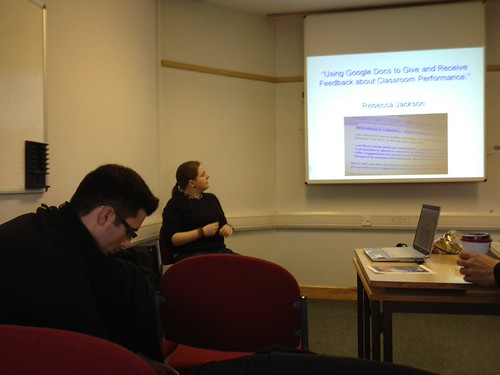
HOW DID MY PRESENTATION GO? WHAT DID I FEEL AND LEARN WHEN DOING IT?

Picture by ‘pgcap’ on Flickr (some rights reserved)

ALTSep12 presentations, week 10

Well, I learned that I had too many slides! Which either means that its ambitious to ask us to meet the learning objectives in 15 minutes OR my project scope is too large! It could be the latter! I did have to speed up towards the end. And my graphs didn’t display. And the projector cut the bottom of my slides off! But, despite all these little things, people were still able to get a feel for my project – I think – and I was able to remember the bits of information that didn’t turn up on the slides for whatever reason.

I think that my presentation went very well. I felt so while I was doing the talk, and speaking to Chrissi and Dave, and David, John and Andy, I got feedback that confirmed that feeling. Perhaps I could’ve been more concise and actually talked less – what do others think? However, I did have a lot to say. I was relating my project to my feelings and experiences and wanted to get across how much this project meant to me. That’s why I said so much, I suppose!

I felt happy and relaxed (mostly) while I was talking. I really like disseminating my ideas. Now that I am comfortable presenting, it’s time – going forward – to think about how I can make my talks simpler and more interactive! We can always do better!

WHAT DID I LEARN FROM MY FRIENDS AND COLLEAGUES TODAY, AND WHY?

2012-11-29 11.21.02

* Reframe and celebrate failure – One of the learning projects that I heard about didn’t ‘go to plan’ in the traditional sense. But as a result, deep and powerful learning about what NOT to do followed. Good! So what we might traditionally class as a failure is actually a success. We need to let students know that failure can be a useful thing!

* Passion and enthusiasm – My friends and colleagues oozed passion and enthusiasm for teaching and, frankly, it is infectious. I am still buzzing from yesterday’s experience!

* New tools, new skills. – I was amazed by some of the creative and supportive ideas that my colleagues had. I was particularly impressed with how John McMahon is truly extended the classroom out to different types of learners at different locations using youtube, Google Hangouts, and video technology. David’s humorous yet kind and supportive forum posts / emails showed me that I am taking the right approach with how I interact with my students. Andy’s deep reflection about whether we need to reinvent the wheel struck a chord with me. Sometimes an existing solution (tech or not) will do the job as well as anything with bells and whistels. Sometimes it won’t. Both are ok!!

* Discussion, creativity and inspiration – It should be clear that I am buoyed and inspired by what we discussed in our presentations.

HOW DID I FEEL WHEN I GOT MY FEEDBACK? HOW DOES THIS MAKE ME FEEL ABOUT TEACHING.

Honestly? I could’ve punched the air. Especially when David wrote ‘I’d love to be one of your students’ on my feedback sheet. There is no kinder praise. It seems like I am doing a good job for my students, which is the thing – along with linguistics, travel, cooking and my family – which gives me the most pleasure in life. My feedback affirmed that I am on the right track and I am making the right decisions about my practice.

HOW WILL WHAT I LEARNED AND EXPERIENCED TODAY SHAPE MY TEACHING EXPERIENCE AS A WHOLE. WHERE CAN I GO FROM HERE?

ANY LAST WORDS? I’ve never had fun being assessed before. This was nothing to be afraid of, and every bit an enriching and wonderful learning experience. I want my students to have this experience, too. When I get my hands on modules of my own…!

They were lurking all along…and ALL THE DATA

I’ve just collected 14 questionnaires from my first year methodology class. The results were a pleasant read – a suprisingly pleasant read!

If you recall, I have been using (with them and with a second year class) class-feedback Google Docs to give the students performance feedback and get performance feedback from them on a weekly basis.

For this first year class, I was sure that only one student had made comments – which indeed my questionnaire results showed. However, it turns out that nearly ALL the students had read the document and had been paying attention to my comments. So, basically, my students were LURKING! They were there, they were consuming the information, they were checking in…I just did not know!

Reading between the lines with regards to informal comments and some comments on the questionnaire, I have the impression that the students didn’t feel – in terms of feedback to me – that I needed to change that much in my performance for them so that could be why they didn’t write a lot. However, how can I know that students are taking on board and implementing the feedback given if they don’t say anything? And if we don’t comment back-and-forth to each other, is a feedback dialogue taking place?

One nice intial trend is that people are saying (whether they commented a lot or not or whether they read the document often or not) that they had a voice and they felt supported because the document was there. Perhaps, sometimes, it is nice to feel that things are on offer SHOULD you need them.

Anyway, I don’t want to say more about my data until I have collected the data from the second year group tomorrow. I can then see if there are any differences between the two groups. I know from looking at the google document usage from both groups that there are differences but I want to see if there’s anything in the second group’s responses which explain these differences.

The issue now is ALL THE DATA. I have so much data. Why did I put so many questions in my questionnaire? How am I going to have the time to make so many graphs and charts? And, even if I make pretty graphs and charts, these are quite superficial and surface forms of data. What about things like working out if there are any trends between different factors? How can I know? For example, it might be that people who read the document most felt most supported by its presence. How can I know that this is a significant correlation?

I’m not going to learn stats by next week, am I?

But, think of the positives. I have learned stuff already from the project, and I know that I will be learning even more when I have learned from the data. Whatever I find out will inform when and how and why I get and give feedback in future, which can only benefit my students. I have also learned that if I want to do well in my chosen field of cognitive pragmatics, then I will need to improve my knowledge of methodology and statistics since, sadly, all the sexy jobs involve doing high-falutin’ experiments.

Ach! I hate maths…maybe it’s time to cross that bridge…