
   __ __         __            ___
  / // /__ _____/ /__  ___ _  / _ \___ ___ __
 / _  / _ `/ __/  '_/ / _ `/ / // / _ `/ // /
/_//_/\_,_/\__/_/\_\  \_,_/ /____/\_,_/\_, /
retro edition                         /___/
Now optimized for embedded devices!!
| About | Successes | Retrocomputing guide | Email Hackaday |
We’re sometimes shocked at the electronics included in ‘disposable’ items. For some reason (our tech inclinations?) we’ve been getting those audio greeting cards from relatives and it kind of kills us to see the PCB, batteries, and speaker in what would have otherwise been a fully recyclable card. Now we’ve got several sets of those guts waiting around for our next project.
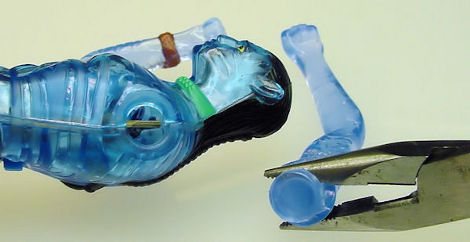
[David Cook] cracked open another disposable item, an Avatar action figure that came as a Happy Meal prize. What he found inside will actually be useful. There’s a battery holder for the three coin-cell batteries, A blue LED (for those blue LED hacks our commenters are so fond of), and a piezo speaker. There are some other discrete components that may be of use to you but the first three are certainly a boon for those that are junk scavengers like us.
Has anyone else found some goodies inside these types of free toys? We’d love to hear about them in the comments. But for now we’re just glad to see the first good thing to come out of that annoying market saturation that accompanied the movie release.
Incidentally, [David's] h-bridge writeup is our go-to reference for building quick motor controllers from parts on hand, or that can be purchased locally.
[Thanks Gron]

The Kinect has been hacked for many purposes, but this Android implementation tutorial is the first we’ve heard of it being used on a mobile phone platform. Although not a finished product at this point, [Raymond's] tutorial is a good starting point for those wanting to experiment with fusing these two technologies.
The Kinect programming for this tutorial has been done with the Tegra Ventana development kit for Android 3.0. An Ubuntu-Linux installation is used, but this technique should be portable to any Linux system according to the author.
The procedure given is pretty straightforward, and the author even provides an example of the results in a video after the break. It’s interesting to note that, when connected, the Kinect is seen as two devices, “Xbox NUI Camera” and “Xbox NUI audio”. We look forward to new hacks to come out for this device, possibly using this set of tools.
For another related hack, check out this robotic skeleton controlled with the Kinect.

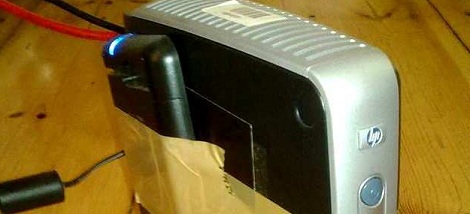
It’s not environmentally friendly, but most of us run a small home server 24 hours a day. A small server is a useful tool to have that unfortunately wastes a lot of energy. [kekszumquadrat]‘s thin client home server is actually a passable LAMP box that doesn’t draw a ton of power.
[kekszumquadrat] started looking at the SheevaPlug when beginning his quest but was a little concerned about the power supply failing. Looking for alternatives, he ran across a lot of cheap thin clients on eBay. The price was right and everything runs Linux, so a few days later he had an HP t5710 thin client on his doorstep.
This little computer came a copy of an embedded version of XP on a flash drive connected to the IDE port. Ditching that “operating system”, [kekszumquadrat] connected a USB hard drive and installed Arch Linux. After a few updates and package installations, he had a useful machine connected to the Internet.
Compared to the 7 Watts the SheevaPlug draws, the 15 W thin client is an energy hog. Compared to our improvised servers, [kekszumquadrat] is doing a remarkable job. Recycling old hardware never hurt anyone, either.
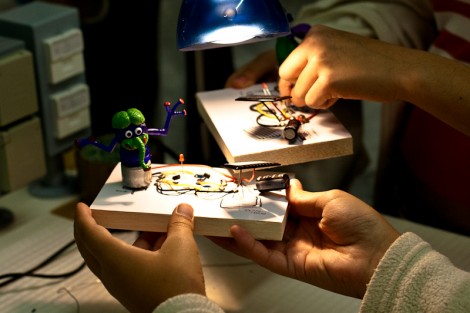
Teaching kids to solder using kits is a fun time, but most of these beginner kits are a bit mundane. Not this one, it’s a solar-powered monster project. The components and their wiring connections are printed on a sheet of paper along with a background for that particular monster. The base of the paper is glued to a block of wood and at each solder junction there’s a copper nail. This way the kids can line up the components, check the picture to make sure the polarization is correct for each, then solder onto the large and stable nail head. As you can see in the video after the break, when the solar cell collects enough electricity the transistor triggers a motor to spin the monster.
But don’t get the idea that kits are only for kids. If you haven’t tried your hand with SMD soldering yet, this kit is for you.
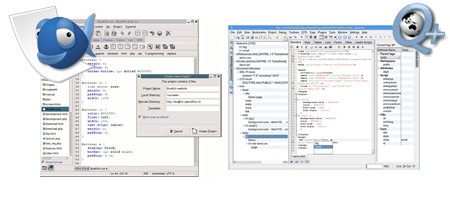
Download Squad has been publishing an informative series on switching to Linux, and their latest article is about the benefits of web tools on Linux.
HTML editors like Bluefish and Quanta do not have all the features of Dreamweaver, but with many modern CMSes these features aren’t really necessary.
Other benefits include testing out web pages on your Linux home environment, and adding webhosts as remote locations. This makes management, testing, and deployment easier, and can eliminate the need for FTP software.
Bear in mind that the article is only the first part of an ongoing series on Linux web tools, which is itself part of a larger series about switching to Linux.
