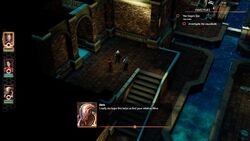
The Dreamlands are a vast realm with many regions, villages, cities and other, lesser known locations to visit and explore. There is no specific quest or story provided to players, rather what is provided is a realm within which to find a quest or story. It may be different for each player and will depend on how players approach the game.
Cyclopean II: The Dreamlands continues in the tradition of its predecessor, Cyclopean: The Great Abyss, in that it may seem simple at first. However, the gameplay becomes more complex as players learn the intricacies of its various systems. Read the in-game dialogue and text carefully, and you may actually learn some useful things.
A Variety of Strategies
Although combat plays a role in the game, it is not the only means of achieving one's goals. Players may find it much more useful to use a combination of combat, stealth and/or dialogue to deal with the inhabitants of dream. In fact, the game will punish you severely if you try to fight everything as a low level character, so try to manage your gold, health, alliances and sanity carefully as you traverse the Dreamlands.
Old School CRPG
The first Cyclopean followed the tradition of early CRPGs like Ultima, Questron, and Legacy of the Ancients (among others) in that it presents two differing views of the game world. Outside of dungeons, you see your character from the top down in a 2D display of the map. Whereas, in dungeons, the view changes to a 3D, first person perspective. Cyclopean II continues this approach, and adds several cities: 2D areas which are more densely populated, separate from the main map.
Choose Your Dreamer Carefully
When you start the game you will be presented with a random dreamer, with basic abilities and equipment, and any alliances they have. You can choose to play as that person, or "reroll" to see if you can find a better option. Cyclopean gives you the freedom to choose from a wide variety of stodgy sounding English upper class gentlemen to play as.
Turn Based Gameplay
The gameplay and combat is all turn based, allowing you to make strategic decisions. Enemies are dangerous, but polite, and will wait their turn.
Alliances
Some characters will start the game with an alliance in place. This can be very helpful in the early stages, especially for new players. Alliances allow you to have some of the various denizens of the Great Abyss join your party, and help to fight other enemies. New alliances can be formed during the game by finding and reading the right books.
Game Manual
There are many other game mechanics and other things that are described in the game manual. The manual has been fully integrated with the game, so you can bring it up at any time, to learn about the various game mechanics available.
Finding the best online casino is not easy. South Africa has a lot casinos to offer and only a few of them are the best. Start your casino journey from a portal and make the right choice.
It has been one year since the launch of Avowed and the team is ending its post-launch roadmap with a substantial anniversary update built with both returning and new players in mind. This release delivers long-requested community features and a broad slate of quality-of-life improvements, including a fan driven feature to bring Avowed even closer to its Pillars of Eternity franchise roots. On top of that, Avowed is now available on PlayStation 5 opening the Living Lands for even more envoys to explore.
Let’s break down all of the big new additions that are coming to the game with this update.
New Playable Species
Headlining the anniversary update is a major expansion to character creation: three new playable species join the existing Humans and Elves.
Dwarves – The most well-traveled species in Eora, the stout dwarves are known for their great strength and tenacity.
Orlans – Their two-toned skin, prominent ears, and hirsute bodies all in the smallest size of Kith make them stand out in Eora.
Aumaua – Towering, powerfully built, and physically imposing.
With all five of the Eoran kith species now available, players have more ways than ever to define who their envoy is as they decide the fate of the Living Lands. The new species are available for selection at character creation, but for those who are currently in the middle of an adventure and are looking for a change, a mirror has been added to the Party Camp that allows players to change their appearance, including species, at any time!
Not only do the different species change how you look, but the team has also added in stat bonuses for all species adding another layer to character creation.
To team up with species specific stat boosts, we have also added a stat boost that comes along with your background choice, adding more to your build variety.
New Weapon Type: Quarterstaff
A brand new weapon type is joining the arsenal with the quarterstaff. Designed with the archmage fantasy in mind, the quarterstaff is a new bludgeoning weapon that comes complete with wand style stun finishers. Unleash brutal physical combos along with a fury of spells that would make even Concelhaut jealous.
A World Built for Return Visits
For those who are making their return to Avowed to check out the anniversary update, welcome back. If this is your first time in the Living Lands, you are about to enter a world of wonderous flora and fauna, exceptional exploration, and satisfying combat.
Today is a special day for us. The very first public Space Scum demo is finally here!
Before anything else, we want to say thank you to everyone who joined our playtests, shared feedback, reported bugs, and helped us shape the game along the way. Space Scum wouldn’t be what it is today without your support and honesty. Launching this demo feels like opening the door to the next chapter.
Our first demo. Built together
We’re releasing it now so we can keep improving it together with you. Expect updates, tweaks, fixes, and changes driven by real player feedback. Your voice directly influences where the demo goes next, but there's already two planets and endless missions for you get your teeth into!
Reviews help more than you think
If you enjoy your time with the demo, please consider leaving a review. Reviews help other players discover the game, give us valuable insight, and make a huge difference for small indie teams like ours. Even a short impression helps.
Found bugs? Have ideas?
If you run into any issues or want to share suggestions, please fill out our feedback form
We read everything and use your input to guide both future demo updates and the development of the full game.
Devlogs are coming
We’re already working on a new series of devlogs to share more behind-the-scenes insights, upcoming changes, and what’s next for Space Scum.
Join our Discord to chat with the team and share your thoughts, we read everything you send us!
Overhype Studios' Battle Brothers is one of the most beloved tactical RPGs of the modern era, in general and especially here on the Codex. For that reason, although we usually ignore such requests, we just had to take a look at the preview build of Overhype's next title MENACE when we received a key from publisher Hooded Horse a few weeks ago. The task of previewing the game fell upon prestigious contributor Strange Fellow. By now many of you are already playing MENACE on Early Access and chatting about it on our forums, but I think this preview is still an important piece of feedback for the developers. According to Strange Fellow, while the game's combat engine is solid and satisfying, everything else - from the overarching strategy layer to the enemy roster to the setting and tone - just isn't good. Here's an excerpt:
The game doesn’t waste much time in getting you down on the ground and into tactical combat. Once there, you’ll find that in terms of scale MENACE places itself somewhere in between squad tactics and wargames. Each unit you control is made up of one squad leader plus up to eight faceless “squaddies”. More squaddies in a squad means more soldiers with guns which translates into more firepower and more total HP, as a unit is only out of action when every squaddie plus its leader has been killed. Presentation aside, they function much like singular soldiers in similar games – you can equip each squad with two different weapons as well as armour and utility items such as grenades or combat drugs. You also have squad leaders designated as pilots, and these let you bring vehicles like trucks, tanks or bipedal mechs on your missions.
On the battlefield, MENACE is clearly a squad tactics game at heart. It gives you a fine-grained level of control over a small number of units, with action points governing how much a unit can do in a turn. You’ll take into account movement costs, cover level, stances, weapon ranges and even turning costs for vehicles. All your typical X-Com stuff, in other words. And broadly speaking that’s the sort of experience you can expect. Combat is turn-based, but with a twist. Usually how it works in these games is that either all the units on each team take their turn at once (cf. X-Com, Jagged Alliance), or else there’s an interlaced initiative queue (cf. most CRPGs). In MENACE, however, teams take it in turns to move one chosen unit each, like chess except that all units have to take their turn each round. A second thing that separates MENACE from its peers is that there’s no overwatch mechanic of any kind. You can’t set your dudes to await an enemy approach or save up AP to interrupt the enemy. Certain units have an ability that lets them return fire if they’re shot at, but that’s the extent of it.
The combination of these two things makes the combat feel markedly different from what you’re probably used to from these games. You can’t simply set up overwatch traps and wait for enemies to mill into them like lemmings, or send one scout ahead while the rest hang back with sniper rifles and destroy anything he uncovers without the enemies getting a chance to react. The risk with this sort of setup is that neither side has any control of what the other is doing during its turn, which can easily lead to combat feeling static and boring. MENACE’s way of dealing with this is with a suppression mechanic. In addition to doing damage, each attack also builds up a suppression meter on the target, and suppressed soldiers have their AP and accuracy reduced. It’s possible to suppress squads to such an extent that they can’t do anything on their turn, and doing so is central to successful combat.
I’ve always been a big fan of this mechanic in games and find it strange that it isn’t used more. The implementation here is excellent. In general, enemy squads are fairly tough and take at least a few shots to go down, so the best strategy is usually to suppress them into uselessness to make sure they don’t retaliate as you grind them down. Enemies will do the same to you, of course, so combat is often a matter of suppressing the right enemies before they can lock you down. In addition to suppression and accuracy, each weapon also has an armour penetration value, and generally speaking any given weapon is good for at most two of these three things. Assault rifle and machine gun variants are typically good at suppression but do poorly against armour. Dealing with heavily armoured units requires weapons such as sniper rifles and lasers, which typically don’t deal much raw HP damage or suppression. The typical strategy is therefore to suppress with automatic weapons and manoeuvre your can openers around to where they can take down the cowering tin cans. However, since control changes hands between you and the enemy every time a soldier takes his turn, there’s always the danger of something unexpected interfering with your plan, which will force you to delay your suppress-and-destroy dance in order to make a response.
It’s a recipe that feels great to play with. The sense of give-and-go and shifting tides of battle is wonderful – the chess-like turn system means you don’t get to execute an entire plan without enemies getting a chance to respond, and this, in combination with the absence of overwatch as well as the suppression mechanic nullifies the tendency for the best tactic to always be alpha striking the opposition to death on first contact, which tends to plague games of this type. Instead, you get all the best elements of protracted fights where you have to respond to what the opposition is doing. Whether things go wrong or right, they tend to do so slowly, giving you time to turn the situation around or, as the case may be, to mess it up.
[...] If you’ve previously played the demo, most of the above will be old news to you. What’s new with Early Access is a proper campaign, where you wage war against enemy factions, negotiate with friendlies and upgrade your soldiers and gear as you go.
Let’s cut to the chase: it’s not good. There are numerous reasons why it’s not good, but the short of it is that it fails to challenge you, to provide you with tough decisions, to make you feel as though your victories and defeats matter, or to build a feeling of progression.
Firstly there’s the manner in which you take on Operations. There are three inhabited planets in the Wayback system, each with its own biome and each controlled by a different faction. At the start of the game, as soon as you get out of the tutorial, you’ll be presented with a screen displaying the Wayback system, and you’ll find that each planet offers you a single Operation. Choosing an Operation on this screen is what you’ll be doing all game long. It’s your only way of getting into fights, which is your only way of procuring more resources and XP, which is your only way of advancing the story. You don’t discover new Operations, or fly your ship around between the planets, or deal with periodical drains on your resources in the form of wages or loyalty scores or deal with other logistics of any kind. All of that is abstracted away. All you do is pick an Operation from one of the three planets and then you pick another Operation from one of the three planets, over and over again.
This is incredibly boring.
If you think I’m being unfairly reductive, allow me to expound. The missions that comprise an Operation will differ by difficulty level and enemy type, but they are randomly distributed across the three planets and all the random variables like objectives and rewards will be drawn from the same global pool. This means that pirates on the ice planet will look and fight the same as pirates on the forest and desert planets, they will pop up on each with the same frequency, they’ll drop the same stuff, and the mission objectives will be the same. In fact, the differences between the three planets can be summed up as follows: if you go to the ice planet the ground is white in colour, if you go to the desert planet it’s brown, and if you go to the forest planet it’s green. That’s more or less it. I mentioned earlier that maps quickly start feeling too similar. A large part of the reason for this is that all three planets are exactly the same, both in terms of the aesthetics of their architecture and in terms of map layouts.
There’s always around one to three missions available and the only thing to do is choose which of them to do first. You do this over and over and over for the entire game. Unlocking story missions on a specific planet? Unlocking new planet-specific mission types? No, nothing like that. Which colour would you like your mission in today, sir?
The Darkness Below is a large-scale, single-player dungeon crawler inspired by the golden era of 90s RPGs — Dungeon Master, Eye of the Beholder, Might & Magic III–V, Lands of Lore — rebuilt with deeper character systems and modern stability.
Explore a handcrafted fantasy world through first-person grid movement and fast turn-based combat.
Train skills by using them. Advance through expertise tiers. Shape your party through meaningful progression and choice.
This is a true old-school CRPG — without the old technical limits.
What Awaits You
• 40+ handcrafted maps spanning villages, cities, wilderness, towers and multi-level dungeons
• 34 quests (main & side), woven across an interconnected world
• 53 unique monsters, each with custom actions and tactical behaviors
• 43 spells across multiple elements and expertise tiers
• 33 trainable skills, improved through active use and specialized trainers
• 15 races (with selectable subraces) and 7 professions, each shaping long-term character growth
• 16 feats to refine your build
Designed for Classic CRPG Fans
The Darkness Below is not a simplified retro experience.
It is a full-scale dungeon crawler built for players who enjoy:
• Structured progression
• System depth
• Tactical combat
• Exploration without hand-holding
• Meaningful character building
If you miss the weight and structure of classic dungeon crawlers — this is built for you.
We've added a custom difficulty option (Mutant) in the game that you can use to configure the various parameters to your liking.
If you want to play with Dominating's enemy distribution, but don't like the stat bloat, you can change it now.
If you find the easiest difficulty too hard, or the hardest difficulty to easy, you can further adjust them.
If our puzzles give you headache, you can reduce it by changing the puzzle difficulty specifically.
I've even added the ability to change the level cap, but be careful when using this one with the oddity system, as I do not think there's enough experience to level you all the way to the max setting (level 50). This option is only available with the Expedition DLC because of how leveling code is structured.
My official stance regarding the default difficulty has also changed somewhat. I don't necessarily think that Underrail has one default difficulty anymore, but rather that there is a progression from Easy to Hard as the player acquires more knowledge of the game's systems and encounters (and grows in virtue of patience and willingness to suffer).
So to better reflect their purpose, I've changed the names of Easy, Normal and Hard difficulty to Beginner, Veteran and Expert, and changed their descriptions accordingly.
I've also re-enabled the game's command console, but disabled some technical commands that are used in development. I have plans of opening the game for further tweaking and modding in the future and the console will be crucial for that.
Also, I want people to be able to tweak the difficulty in their ongoing play-throughs, so they can use a new console command for this. You will not be able to change the encounter or puzzle difficulty on the fly though, because that is likely to silently break your game and prevent you to finishing parts of it or the entire thing.
Of course, we also fixed some minor bugs.
Here's the full list:
General
Added Custom difficulty (called Mutant) that allows you to configure various game system parameters for your playthrough
Changed the names of Easy, Normal and Hard difficulty to Beginner, Veteran and Expert respectively
Beginner difficulty will now halve the health of all NPCs
Re-enabled the command console
Added console commands for changing the difficulty parameters of a running game (except the encounter and puzzle presets)
That's it for now, guys. I hope you like this new feature. We don't have much time to work on Underrail 1 now, as ~98% of our production is focused on Underrail 2: Infusion. If you haven't wishlisted it yet - please do, and keep an eye out for its dev logs. One should be coming along soon.
The first demo for Dverghold is live! Download now to get a first look at the old-school dungeon crawling of Dverghold, dive into the world of Hyrdengard and hack & slay your way through the first level of the depths under the isle of Rekestt. The demo also gives you a chance to to multiple exclusive new tracks by Dungeon Synth artist Splendorius!
This is an initial demo that does not contain all the features that will be available in Early Access yet. It is going to be our submission for Steam NextFest, so we have until then to polish and fix bugs. Have fun and let us know about any issues you still can find!
Consoles port will be eventually made, as usual, after PC release. The date has not been decided yet.
Localization might or might not be incomplete at the release day. The game is guaranteed to be localized to EN, DE, FR. As usual, more languages than those listed will be added, most likely after release.
Sector Unknown has officially left Early Access and is now fully released.
The game is available now as of 10:00 AM Pacific Time, with a 30% launch discount.
This marks the completion of the Early Access phase and the beginning of the next chapter for the game.
Thank you to everyone who played, reported bugs, shared feedback, left reviews, streamed the game, or simply supported it along the way. Your involvement directly shaped the full release, and the game is better because of you. I’m truly grateful.
To those discovering Sector Unknown for the first time - welcome. I hope you enjoy the experience, and I’ll continue supporting the game with updates and fixes moving forward.
The war for Nevendaar begins, Disciples: Domination is available now! We invite you to sift through the corruption in a grim tale of power, war, and sacrifice to experience the dark-fantasy strategy RPG with turn-based combat.
Disciples: Domination is available in Standard Edition (€44.99 / $44.99 / £39.99) and Deluxe Edition (€54.99 / $54.99 / £49.99) on PC (Steam, Steam MacOS, Microsoft Store, Epic Games), Xbox on PC, Xbox Series X|S and PlayStation®5.
Behold the launch video below and enter the crumbling realm of Nevendaar... are you prepared to save it?
Return to Nevendaar fifteen years after Avyanna defeated the malevolent gods and ascended to her rule as Queen, freeing the realm from the clutches of tyranny. Navigate the challenges of ruling a kingdom as Avyanna struggles with twisted horrors and fears of her power as an unknown force begins to spread madness throughout the world. The fate of Nevendaar and the world stands upon the choices you will make as you chase the truths behind the ceaseless conflicts, dark magic, and lurking conspiracies.
Disciples: Domination is a dark-fantasy strategy RPG blending turn-based combat with quick-paced, tactical, grid-based battles featuring dynamic events, and methodical interactions. New skills, faction abilities, and unit synergies deepen strategic options to recruit, upgrade, and lead armies by combining unique skills and abilities to defeat the enemy in turn-based encounters. Unlock new companions to aid in the quest to save Nevendaar and explore new regions, meet compelling characters, encounter the Dwarves and discover if this time they are friends or foes, face terrifying adversaries, and dive into rewarding quests as the story unfolds.
Kalypso Media has kicked off the launch of Disciples: Domination a with release day livestream, which you can watch a recording of now! Check out the video as Kalypso Media answers questions from the community and offers insight into the realm of Nevendaar on the Kalypso Media YouTube Channel.
Disciples: Domination is available now on PC (Steam, Steam MacOS, Microsoft Store, Epic Games), Xbox on PC, Xbox Series X|S and PlayStation 5 in Standard Edition (€49.99 / $49.99 / £44.99) and Deluxe Edition (€59.99 / $59.99 / £54.99). Both editions grant you access to the corrupted realm of Nevendaar, where every decision shapes the fate of Avyanna, her followers, and her realm with the Deluxe Edition featuring new looks for Avyanna, her companions, and her mount, along with weapon skins, Resource Starter Boost Pack, digital compendium, and soundtrack.
That brings us back to Zero Parades, which tells the story of Hershel Wilk, codename “Cascade”, who’s pulled out of retirement for the all-time classic spy trope, One Last Job. By moving into the espionage genre, ZA/UM has been able to work at a notably different scale than it did with Disco Elysium. While Zero Parades takes place in a physical space not too dissimilar to that of the studio’s previous game, by stepping into the shoes of a spy rather than a local detective, the story naturally explores a much grander stage.
“You do have to contend with world powers,” Ashilevi reveals. “It's not just wallpaper, or stuff that you read from notes that people leave in drawers, or newspapers left on tables. You do have to come into close contact with some of the big players as well.”
This global stage is explored through Hershel’s very personal lens, so while the stakes are certainly heightened this time around, your actions are still conducted at street level. You may be able to turn the cogs of a mega corporation and shift the balance of worldwide politics, for instance, but to do so may require betraying your closest friend. Hershel’s own pain will be tangible, whereas those rotating cogs will feel distant, perhaps even unimportant, to her own life. Such is the toll of espionage.
To create something that reflects Disco Elysium’s triumphs, though, you can’t just tackle issues of the human condition. You’ve got to get at least a little eccentric. And that’s where Hershel’s hobbies come into play.
“She's deeply fascinated with comic books, music, you name it,” Ashilevi reveals. “So the story is also an exploration of pop culture and what soft power means. Why is it important for us to be obsessed with pop artists and cartoons, and films and pulp novels, and things like that? Why are people so deeply obsessed with retro tech and bootlegged media, like underground forbidden films? What does it do to your soul, and how does it define your identity?”
While music, fashion, TV shows, and retrofuturistic music formats all contribute to the city of Portofiro’s vibrant texture, there is a dark side to it all. What is a consumer as a political entity? How do tiny decisions, like tuning into a particular show or buying a certain magazine, tie into the movements of the big powers? These are potential avenues for Hershel – for you – to investigate.
The battle for soft and hard power, waged between international banks, imperialist states, and communist unions, is something that goes beyond just Hershel’s current mission. “We need to come up with an inspiring enough sandbox so that whatever we choose to do with those characters or this universe next, we can just jump right into it and keep telling stories because the groundwork has been laid,” says Ashilevi. Zero Parades is the starting point for something bigger, then.
At least that’s the hope. The world of Elysium was also envisioned as a space for multiple stories, but it seems that book is now eternally closed. And while Zero Parades may not necessarily need to be as significant a breakout hit as Disco Elysium was to unlock the potential for sequels, it does need to stand tall in a world where the “Disco-like” is a rising genre, made up of games developed both by fans inspired by that RPG masterpiece and new studios set up by the scattered former members of ZA/UM’s original creative team. But by following their own creative North Star, the team behind Zero Parades hopes to captivate players once more.
“We have no clue what kinds of games or stories people are hoping to get out of ZA/UM,” Ashilevi says. “The only thing we can control is whether we're staying true to our own vision and voice. And that's what we have done with Zero Parades.”
Barcelona, Spain / Vienna, Austria - February 12th, 2026: The Gothic 1 Remake's primary objective has always been to recreate that raw, unforgettable magic of the original – the gritty camp vibes, the living open-world, the rough language, the unforgiving wilderness, and that nameless, no-hero outsider feel that made Gothic a cult legend 25 years ago. The developers at Alkimia Interactive poured endless hours into tweaking every detail: faces that scream "Old Camp thug," voices with that perfect throaty rasp for each character, features that hit just right while feeling modern without losing the grit.
This project was never about slapping together "good enough" – it's about making it look and feel "Gothic" in every corner of the world. And this could only be achieved through way more iterations than your average project.
That's why the Gothic 1 Remake won't be releasing "Early" 2026, nor will it be late; it will arrive precisely when it's meant to:
June 5th, 2026.
Phew. We said it. Locked and loaded, you'll visit the Colony once again in June 2026. One thing is for sure: this could have only been done with the constant support of the Gothic community. That pure, unfiltered passion is what defines Gothic. We can't wait for the players to finally hear the words "Welcome to the Colony!" again.
Gothic 1 Remake is in development for PC, PlayStation®5, and Xbox Series X|S, launching June 5th, 2026. Stay tuned for digital pre-orders!
PARIS, February 10, 2026 – New Tales and Artefacts Studio today revealed Terrinoth®: Heroes of Descent, a high fantasy tactical RPG that brings the legendary Descent tabletop universe from Fantasy Flight Games, as a video game for the first time. Launching on PC, Mac, PlayStation®5 and Xbox Series X|S in Spring 2026, the game combines real-time exploration with deep, turn-based tactical battles and can be played solo or in co-op.
Set in the troubled lands of Terrinoth one year before the events of Descent: Legends of the Dark, Terrinoth: Heroes of Descent invites players into a new chapter of the saga, where fractured realms and encroaching darkness call for a new generation of heroes. Players will form a party of adventurers and journey across perilous locations throughout Terrinoth, uncovering a fully original storyline that expands the lore of the board game series.
“As fans of Descent, stepping into Terrinoth has been both a huge responsibility and an incredible joy,” said Bruno Chabanel, CEO of Artefacts Studio. “With Terrinoth: Heroes of Descent we wanted to capture the feeling of a tense tabletop dungeon crawl and translate it into a tactical RPG that flows naturally on PC and consoles with a multiplayer cooperative mode to accurately convey the atmosphere of the board game. It’s easy to pick up, but there is always another strategy, another synergy or another build to discover.”
A New Chapter for the Descent Community Terrinoth: Heroes of Descent has been created for both long-time tabletop fans and players discovering Terrinoth for the first time. Familiar factions, threats and themes return in a new form, while the narrative, characters and missions have been built so that no prior knowledge is required to follow the story.
“Seeing the Descent board game world of Terrinoth come to life in a full video game experience is something fans have been asking for over many years,” said Brian Mulcahy, Head of Franchise Development at asmodee “Terrinoth: Heroes of Descent respects the spirit of the tabletop game while opening Terrinoth to a wider audience of tactical RPG players. It’s a meaningful new step for the franchise.”
Players can wishlist Terrinoth: Heroes of Descent on Steamfor PC & Mac, PlayStation®5andXboxSeries X|S before the game releases this Spring. Additionally, a first demo is available to download now on Steam for players to experience a first glimpse of the world of Terrinoth.
Stay up to date with the latest news on Terrinoth: Heroes of Descent by joining our Discord or following @HeroesofDescent on YouTube,X and Bluesky.
Issaquah, WA, USA - February 9th, 2026 - Seismic Squirrel today announced that Aether & Iron, a narrative-driven RPG focused on player choice and character-driven storytelling, will launch on PC via Steam on March 31, 2026.
Set in an alternate 1930s New York transformed into a vertical city by the discovery of “aether”, a key component to newfound anti-gravitational technology, Aether & Iron follows Gia, a smuggler navigating crime syndicates, political conspiracies, and fragile alliances. Players shape Gia’s story through meaningful decisions, with every choice influencing relationships, outcomes and the fate of the city itself. The game is fully voiced and features writing talent with credits on Mass Effect, Far Cry, and Sovereign Syndicate, with an original score composed by two-time Grammy Award winner Christopher Tin and Grammy nominee Alex Williamson, best known for their work on the Civilization series.
“Aether & Iron is about finding your own path when the world doesn’t give you many choices, if any at all.” said Tyler Whitney, Narrative Lead at Seismic Squirrel. “Whether you’re talking your way out of trouble, taking a risky job, or deciding the fate of someone who has put their life in your hands, every decision shapes Gia’s story and the future of New York. We’ve spent years building this world and bringing its characters to life, and we’re incredibly excited for players to finally experience it when the game launches this March.”
Gameplay blends narrative-driven role-playing with tactical, turn-based vehicular combat that reflects the risks of life in the city’s underworld. Players customize a fleet of aether-powered vehicles and recruit a diverse cast of companions, each bringing unique talents and personal stories that influence both combat encounters and narrative paths.
As a seemingly simple smuggling job escalates into a conspiracy threatening the entire city, players develop their Hustle, Smarts and Brass - core abilities that shape combat effectiveness, dialogue options and high-stakes decisions. Even the most carefully considered choices carry uncertainty, where success or failure can come down to a single dice roll. Over time, those decisions determine whether New York’s citizens find hope, or remain trapped in corruption and violence.
Aether & Iron launches on Steam and Steam Deck on March 31, 2026, featuring full English voice acting and text localization support for English, Spanish (Spain & Latin America), French, German, Polish, Russian, Brazilian Portuguese, and Simplified Chinese - Play the demo and wishlist Aether & Iron now, on Steam!
Electronic Arts was taking a more and more hands-on role as Origin’s fortunes declined. A pair of executives named Neil Young and Chris Yates had been parachuted in from the Silicon Valley mother ship to become Origin’s new General Manager and Chief Technical Officer respectively. Much to the old team’s surprise, they opted to restart Ultima IX in late 1997. They read the massive success of the CRPG-lite Diablo as a sign that the genre might not be as dead to gamers as everyone had thought, especially if it was given an audiovisual facelift and, following the example of Diablo, had its gameplay greatly simplified. A producer named Edward Alexander Del Castillo was hired away from Westwood Studios, where he had been in charge of the mega-selling Command & Conquer series of real-time-strategy games. If anyone could figure out how to make the latest single-player Ultima seem relevant to fans of more recent gameplay paradigms, it ought to be him.
What with the ongoing layoffs and other forms of attrition, fewer than half of the 23 people who had been working on Ultima IX prior to the Ultima Online interregnum returned to the project. Those who did sifted through the leavings of their earlier efforts, trying to salvage whatever they could to suit Del Castillo’s new plans for the project. He re-imagined the game into something that looked more like the misbegotten Ultima VIII than the hallowed Ultima VII. The additional party members were done away with, as was the roving camera, and the visuals and interface came to mimic third-person action games like the hugely popular Tomb Raider. Del Castillo convinced Richard Garriott to come up with a new story outline in which Britannia didn’t get destroyed, an event which might now read as confusing, given that people would presumably still be logging into Ultima Online to adventure there after this single-player game’s release. In the new script, as fleshed out once again by Bob White, the player’s goal would be to become one with the villainous Guardian, who would turn out to be the other half of himself, and rise as one being with him to a higher plane of existence; thus the “ascension” of the eventual subtitle. It felt like the older games in the way it flirted with spirituality, for all that it did so a bit clumsily. (Garriott stated in a contemporaneous interview that “I’m enamored with Buddhism right now,” as if it was a catchy tune he’d heard on the radio; this isn’t the way spirituality is supposed to work.)
In May of 1998, Origin brought the work in progress to the E3 trade show. It did not go well. The old-school fans were appalled by the teaser video the team brought with them, featuring lots of blood-splattered carnage choreographed to a thrash-metal soundtrack, more DOOM than Ultima. Del Castillo got defensive and derisive when confronted with their criticisms, making a bad situation worse: “Ultimas are not about stick men and baking bread. Ultimas are about using the computer as a tool to enhance the fantasy experience. To take away the clumsy dice, slow charts and paper and give you wonderful gameplay instead. They were never meant to mimic paper RPGs; they were meant to exceed them.” In addition to being a straw-man argument, this was also an ahistorical one: like all of the first CRPGs, Richard Garriott’s first Ultima games had been literal, explicit attempts to put the tabletop Dungeons & Dragons game he loved on a computer. Internet forums and Usenet message boards burned with indignation in the weeks and months after the show.
Those who could abandoned the increasingly dysfunctional ship. Bob White bailed for John Romero’s new company Ion Storm, where he became a designer on Deus Ex. Then Del Castillo was fired, thanks to “philosophical differences” with Richard Garriott. Lead programmer Bill Randolph recalls the last words Del Castillo said to him on the day he left: “They don’t care about the game. They’re just going to shove it out the door unfinished.”
Garriott announced, not for the first time, that he intended to step in and take a more hands-on role at this juncture, but that never amounted to much beyond an unearned “Director” credit. “You know, he had a lot of other obligations, and he had a lot going on, and a lot of other interests that he was pursuing too,” says Randolph by way of apologizing for his boss. Be that as it may, Garriott’s presence on the org chart but non-presence in the office resulted in a classic power vacuum; everyone could see that the game was shaping up to be hot garbage, but no one felt empowered to take the steps that were needed to fix it. Turnover continued to be a problem as Origin continued to take on water. Few of the people left on the team had any experience with or emotional connection to the previous single-player Ultima games.
Del Castillo’s ominous prophecy came true on November 26, 1999, after a frantic race to the bottom, during which the exhausted, demoralized team tried to hammer together a bunch of ill-fitting fragments into some semblance of a playable game in time for EA’s final deadline. They met the deadline — what other choice did they have? — but the playable game eluded them.
[...] As you have probably surmised, Ultima IX did not do well in the marketplace. There was never any serious discussion of continuing the single-player series after it was greeted with bad reviews and worse sales. In fact, it managed not only to kill the series to which it belonged but for all intents and purposes the studio that had always been so closely identified with it as well. It was the last single-player game ever to be completed at Origin Systems.
Officially speaking, Origin continued to exist for another four years after it, but only as an MMORPG house. Right about the same time that Ultima IX was reaching stores, Ultima Online was actually ceding its crown as the biggest MMORPG of all to EverQuest. Nevertheless, in a bull market for shared worlds like these in general amidst the first wave of widespread broadband-Internet adoption, Ultima Online’s raw numbers still increased, reaching as many as 250,000 subscribers in early 2003. But the numbers started to go the other way thereafter as the MMORPG field became ever more crowded with younger, slicker entrants. Inevitably, there came a day in February of 2004 when it no longer made sense to EA to keep an office open in Austin just to support a single aged and declining online game. And so the story of Origin Systems came to its belated, scarcely noticed end, a decade after its best years were over.
By then, Richard Garriott was long gone; he had left Origin in March of 2000. His subsequent career did little to prove that his dilettantish approach to the later Ultima games had been a fluke. He dabbled in gaming only in fits and starts, most notably by lending his name to several more MMORPGs. As also happened with his old Origin sparring partner Chris Roberts, an unfortunate whiff of grift came to attach itself to him; I tend to think that it’s born more of carelessness in his choice of projects and associates than guile in his case, but that doesn’t make it any more pleasant to witness. Shroud of the Avatar, his Kickstarter-funded would-be second coming of Ultima Online, produced more than its fair share of broken promises and ethical questions about its pay-to-win focus during the 2010s. More recently, he has talked up an MMORPG based on blockchain technology (Lord help us!) that now appears unlikely to turn into anything at all. It seems abundantly plain that his heart hasn’t really been in making games for many years now. One hopes he will finally be content just to retire from an industry that has long since passed him by.
Barcelona, Spain / Vienna, Austria - February 6th, 2026: One of the defining traits of the Gothic franchise has always been its living world. A dynamic ecosystem full of creatures, NPCs, and critters that carry out their daily routines, whether the player is watching or not. This self-sustaining environment has long been key to Gothic’s unmistakable atmosphere, turning the Valley of Mines into more than just a backdrop; it’s a breathing, believable place that feels alive.
In the fifth entry of their ongoing Making Of series, the developers at Alkimia Interactive take players behind the scenes to show how this hallmark feature has been faithfully reimagined for the new generation. Every area, landmark, and character has been rebuilt from the ground up, carefully balancing authenticity with fresh detail and modern technology.
Familiar sights like the old monastery ruins or the Tower of Xardas return in stunning new form, helping players navigate and recognize the world without relying on a map - just as in the original game, where players had to find a map before they could use one. This design philosophy remains intact, ensuring exploration still feels rewarding and immersive.
Another major highlight of this Making Of is the expanded armor system. In the classic Gothic, each faction offered light, medium, and heavy armor tiers. The remake goes a step further: players can now customize and modify their armor, both in looks and stats, giving every piece a distinct feel while keeping its faction identity intact.
The Making Of also introduces the new conversation camera system, adding cinematic flair and energy to every dialogue. Whether you’re facing a grumpy guard, a shady trader, or a friendly fellow (a very rare encounter in the Valley of Mines...), interactions now feel more personal and dynamic than ever before — but better see for yourself in Gothic 1 Remake – Making Of #5: Bringing the World to Life, available now on THQ Nordic’s official channels.
February 5, 2026 - Hooded Horse and Overhype Studios' turn-based tactical game MENACE is out now in early access for PC! Lead a strike force of marines, misfits, and malcontents to a lawless frontier and establish order across Steam, GOG, the Epic Games Store, and the Microsoft Store, as well as PC Game Pass.
Aboard the TCRN Impetus, players will command an ensemble cast of colorful characters. Lead infantry squads, mechs, and armored units across the Wayback system at the behest of local warlords, morally bankrupt corporations, and other disparate factions fighting for control.
Cut off from the core worlds, players must utilize whatever resources they can buy or scrounge, with a vast array of equipment, weapons, and vehicles to choose from when assembling their squads. Travelling from planet to planet, players will need to plan out multi-staged operations, ensuring there is enough manpower and equipment to meet all challenges as they fight against pirates, xenos, and the unrelenting, unknowable constructs of the Menace…
The initial early access offering provides 50+ mission types across several planets, with more biomes, mission types, and equipment planned throughout early access. The team will also build out the storyline and endgame scenarios, and respond to player feedback as they go.
The game will be localized from English into German, French, Spanish, Polish, Turkish, Ukrainian, Russian, Brazilian Portuguese, Simplified Chinese, Traditional Chinese, Korean, and Japanese.
MENACE is out now in early access for PC via Steam, GOG, the Epic Games Store, and the Microsoft Store for $39.99 / £34.99 / €39.99 / ¥3,980. A 25% launch discount is running until February 19, 2026.
It is also available via PC Game Pass (Game Preview).
Do you have the grit to forge ahead or will you end up in the grave?
Of Grit and Graves is a roguelite turn-based tactical RPG where every decision hinges on the roll of a die. Lead a party of four heroes through procedurally levels where strategic thinking meets the thrill of chance. This isn't just another dungeon crawler—it's a love letter to classic tabletop RPGs.
Your Legendary Party Awaits
Command four distinct heroes, each with unique abilities and tactical roles:
The Warrior - A relentless fighter whose rage builds with each fallen foe, eventually doubling attack power in berserker fury
The Cleric - A divine healer who mends wounds, shields allies with sacred magic, and summons monstrous allies to fight along side your party
️The Rogue - A shadowy assassin who strikes from behind for devastating sneak attacks and expertly finds deadly traps
The Wizard - A master of arcane arts wielding battlefield-controlling spells and devastating offensive magic
Dice Determine Your Destiny
Roll physical 3D dice that tumble with satisfying weight, or speed up gameplay with instant results—the choice is yours.
Tactical Combat
Position your heroes strategically as line of sight, range, and hidden traps all matter. Plan your attacks, anticipate enemy moves, and use the environment to your advantage. Combat unfolds through dice rolls where your character build—not just luck—determines victory.
Monster AI that challenges you with sophisticated threat-based targeting and tactical spellcasting. Enemies remember who hurt them most and adapt their strategies accordingly.
Endless Dungeon Adventures
Explore procedurally generated dungeons that ensure no two expeditions are identical. Face varied quest objectives that demand different tactical approaches. Each dungeon features unique layouts with hidden traps, locked doors, and treasure chests brimming with gold and rare relics.
In the forth episode of our series on the development of Disco Elysium we talk to some of the art team about the process of crafting the visual language of this iconic game.
00:00 - Cold Open
01:10 - Artistic Foundations
05:30 - Childhood Inspirations
08:14 - The Art Team
12:01 - Painting Martinaise
20:53 - Virtual Texturing
22:26 - Portraits
32:01 - CREDITS